Generating Qualified B2B Leads: Why Volume Is Not Enough
Generating Qualified B2B Leads: Why Volume Is Not Enough
Qualified B2B inquiries require a strategic growth architecture instead of pure volume. Connect SEO, AI visibility, and your conversion infrastructure for a measurable pipeline and strong revenue.
Introduction
Your marketing delivers leads, but your sales team isn't closing. Traffic is increasing, campaigns are running, and dashboards show green numbers. Yet, the pipeline remains empty and Customer Acquisition Costs continue to climb. The problem is not the quantity, but the quality of the leads reaching your sales team.
Qualified B2B inquiries do not result from more budget, more clicks, or more campaigns. They are generated by a strategic growth architecture that connects visibility, demand capture, and conversion infrastructure into a measurable system. This article highlights precisely this difference between volume and pipeline-relevant lead generation.
This article is aimed at B2B decision-makers in SaaS, tech, and IT services in the DACH region who, despite rising traffic and lead volume, struggle with high Customer Acquisition Costs and weak closing rates. If you are in the active buying window and want to understand why your marketing isn't delivering a qualified pipeline, you are in the right place.
The Key Insight: High volume alone does not lead to successful B2B lead generation. The conversion rate from lead to opportunity is the crucial key performance indicator, not the number of generated contacts. Companies that optimize their SQL rate instead of their lead volume lower their acquisition costs and increase their revenue measurably.
What you will take away from this article:
Why traffic without intent only scales the noise, and how to strategically use the difference between MQLs and SQLs
Which three systematic errors cause volume-based B2B lead generation to fail
How a revenue marketing architecture makes qualified inquiries predictable, including AI search visibility, conversion infrastructure, and attribution
Concrete benchmarks and KPIs that show whether your marketing is truly delivering pipeline
Immediate actions you can implement to measurably improve your lead quality
What Are Qualified B2B Inquiries Really?
The term "qualified leads" is used inflationarily in the B2B sector. For many companies, it simply means: someone filled out a form. However, a qualified B2B lead has a concrete need and decision-making authority. They have the budget, authority within the buying center, a clearly defined need, and a realistic timeline. These BANT criteria separate real pipeline opportunities from mere interest.
Distinguishing them from unqualified leads and pure traffic volume is crucial here: wasting resources happens through unqualified leads and mass outreach. A high number of unqualified inquiries can strain sales capacities and frustrate your sales team instead of supporting them. From a revenue marketing perspective, SQLs are the only relevant KPI for growth. Everything else consists of intermediate steps that only have value if they demonstrably lead to a qualified pipeline.
Companies should not neglect lead fit. Target customers must be clearly defined to use marketing budgets efficiently. Because qualified B2B leads have budget and decision-making authority. This is the key to the difference between a full CRM and a full pipeline.
The Difference Between MQLs and SQLs and Lead Scoring
Marketing Qualified Leads show interest, for example, by downloading a whitepaper, participating in webinars, or opening emails. MQLs show interest, SQLs are ready for sales. This difference sounds simple, but it has a massive impact on your entire business.
A Sales Qualified Lead is a sales-ready inquiry with measurable pipeline relevance. The prospect has not just consumed content, but actively signals intent to buy. A qualified B2B lead significantly increases the closing rate because your sales team conducts discussions with decision-makers instead of information gatherers.
Converting rates between the two lead types differ drastically: data from various SaaS industries show that the MQL-to-SQL conversion rate often lies between 30% and 47%, varying significantly depending on the industry. This means: out of 100 MQLs, a maximum of 47 become real sales opportunities. The differences in CAC are correspondingly substantial. Anyone who only measures MQLs systematically overestimates their marketing success.
Why Volume Metrics Are Deceptive
Traffic without intent only scales the noise. Around 60% of search queries in B2B now end without a click. AI-powered answering systems deliver responses directly in the search environment. If your brand is not featured there, you simply do not exist for certain phases of the purchasing decision.
Lead quantity vs. pipeline quality is particularly evident in complex B2B buying journeys where the buying center consists of multiple decision-makers. B2B decision-makers use multiple touchpoints for lead generation. A single download or a single email address does not capture this complexity.
Added to this are attribution problems in fragmented marketing channels. Studies show that AI search generates 10 to 15% of the B2B pipeline volume, which is invisible in any traditional attribution model. Those who only measure clicks and last-click attribution miss fundamental signals about what is actually generating pipeline.
Why Volume-Based Approaches Fail in B2B
Most B2B companies do not make a single mistake in lead generation. They repeat three systematic errors that reinforce each other and collectively prevent marketing investments from turning into real pipeline. A lack of trust cannot be built through mass marketing. High-quality demand is created through better target group knowledge and relevance.
The Campaign Hamster Wheel
More budget leads to more traffic, but rarely to more qualified inquiries. The typical response to a weak pipeline: increase campaign budgets, test new channels, produce more content. The result is rising click costs without any improvement in conversion infrastructure.
Fragmented channels without a strategic growth architecture create a hamster wheel: you spend more, generate more leads, but your B2B sales team cannot turn them into more pipeline. Without a conversion infrastructure consisting of optimized landing pages, lead scoring, and systematic follow-up processes, volume simply becomes expensive. Lead scoring makes lead evaluation objective and scalable, making it the first step out of this hamster wheel.
Content Marketing Without Buying Context
Generic content generates attention instead of capturing demand. Many B2B content marketing strategies focus on the awareness phase: blog articles, social media posts, generic whitepapers. In addition, an targeted B2B lead strategy via Google that attracts dream clients instead of clicks shows how content can be aligned with real buying intent. This content attracts prospects who are searching but have no concrete immediate need.
B2B customers expect content that understands their individual needs. A lack of intent-based content in the consideration phase means that while you collect email addresses, you do not generate qualified inquiries. Content marketing only answers potential buyers' questions effectively if it is aligned with the right phase of the buyer journey. Poor conversion optimization from landing pages to inquiries amplifies the problem: even those who find the right content do not convert because the handoff to the sales funnel is missing.
Marketing-Sales Silos
Different KPIs between Marketing and Sales are one of the most common errors in B2B companies. Marketing measures leads and contacts. Sales measures deals and revenue. Without a common definition of lead quality and clear handoff points, both teams work past each other.
Lead qualification should ensure that not every inquiry is treated the same. The lack of a shared definition of what concretely constitutes a Sales Qualified Lead leads to inefficient lead handoff and follow-up processes. Marketing delivers datasets that sales does not want to work with. The sales team complains about quality, while marketing complains about the lack of follow-up. Both are right, and both lose.
The iGrow Revenue Marketing Architecture for Qualified Inquiries
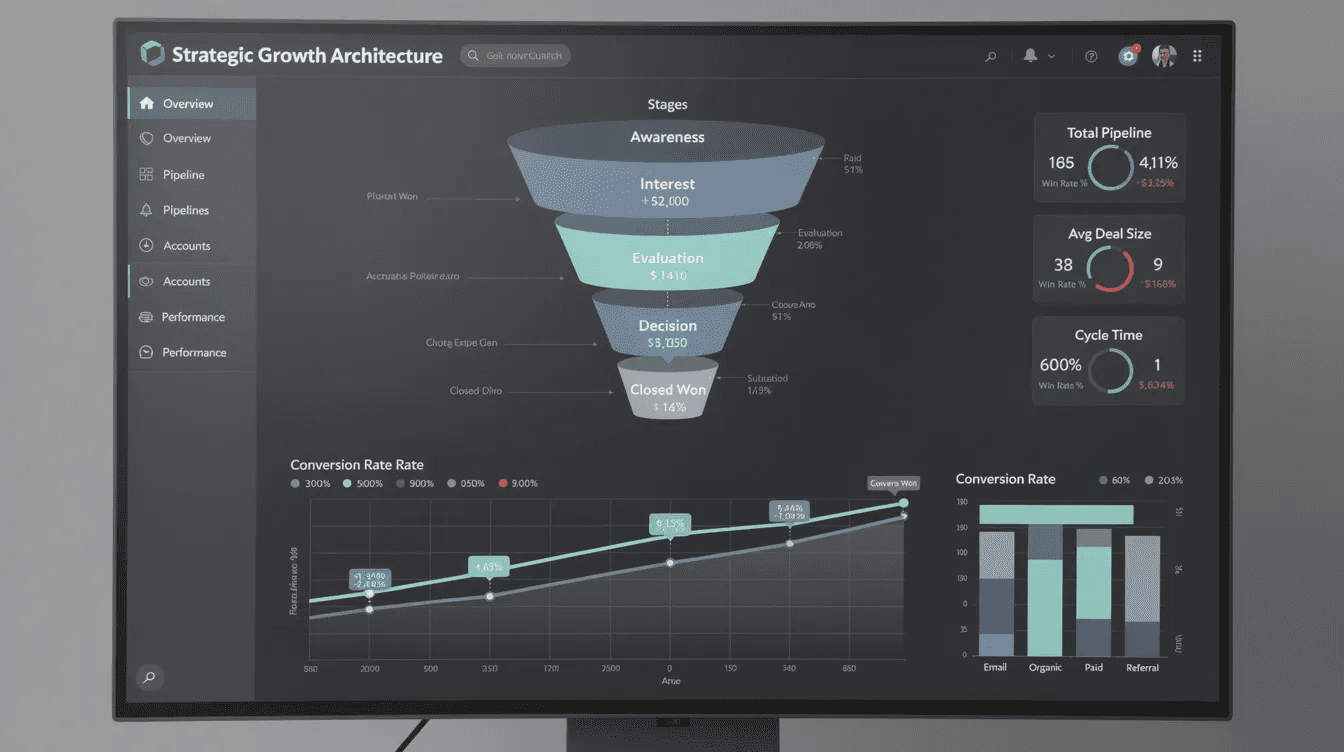
The solution does not lie in isolated measures. It lies in a measurable growth infrastructure that systematically connects visibility, demand capture, and conversion. As a B2B Growth Partner and external revenue engine, iGrow builds precisely this strategic growth layer, which does not replace your internal teams or tools, but sits above them and aligns everything with pipeline goals.
Strategic Growth Architecture
The first step is market positioning and defining the ideal customer profile. Account-Based Marketing focuses on selected dream clients. Instead of spreading a wide net, you define your Ideal Customer Profile (ICP) by industry, company size, decision-maker roles, and concrete needs. A clear target customer profile is the foundation for every subsequent measure.
AI search visibility builds trust before a potential buyer even visits your website. Over 50% of B2B software buyers now begin their purchasing process in an LLM. Appearing in ChatGPT, Perplexity, and Google AI Overviews wins trust before the user ever visits a website. A strategic guide to building AI visibility for a measurable pipeline shows how this digital visibility opens doors to new buyers.
The SEO structure is aligned with intent-based keyword strategies. It is not keywords with the highest search volume that matter, but those with the clearest buying context. The revenue marketing strategy connects all elements into a single system with clear SQL goals instead of fragmented, isolated measures. An optimized digital presence significantly increases visibility, but only if it is built strategically.
Demand Generation Channels for B2B Lead Gen
SEO serves demand capture instead of generic traffic. B2B buyers research 70% of their information online. Your SEO strategy must start exactly where this research translates into buying intent; a specialized B2B SEO agency for stable leads without ads can secure this organic demand over the long term.
AI Search Visibility in ChatGPT, Perplexity, and Google AI Overviews is becoming the decisive channel. How deeply AI search in B2B marketing is transforming SEO strategies is shown by the fact that about 48% of US B2B buyers already use AI for vendor evaluation. Almost 59% of companies with a targeted AI visibility strategy report concrete pipeline growth, with 40% seeing 5 to 10% growth and another 19% seeing over 10% growth.
Google Ads focusing on high-intent keywords complement organic visibility precisely where purchasing decisions are actively made; especially for SaaS companies, a Google Ads guide for sustainable B2B revenue growth offers additional structure and deepens B2B lead generation via Google that attracts dream clients instead of clicks as well as comprehensive B2B lead strategies via Google based on AI-powered analysis. Conversion-optimized landing pages for qualified inquiries form the final piece of the demand generation system. Omnichannel strategies increase the probability of qualified leads and significantly improve lead qualification.
Operational Marketing Tools Integration
CRM systems form the basis for seamless lead attribution. Without clean datasets in the CRM, you do not know which channel delivers which SQLs. Marketing automation enables systematic lead scoring and lead nurturing. Lead nurturing supplies prospects with information until they are sales-ready and qualifies them step-by-step along the buyer journey.
Analytics platforms for revenue tracking replace the traditional dashboard world that only shows clicks and impressions. Email marketing has a high return on investment in the B2B sector and remains a central tool in the nurturing process. Sales tools for efficient SQL processing ensure that qualified inquiries are quickly and systematically handled by sales. A complete digital presence is crucial for lead generation, but only the integration of all tools turns it into a revenue system.
For example, companies in the SAP Business Network generate 54% more efficient sales administration. Participating in B2B buyer networks additionally increases visibility and creates further touchpoints in the buyer journey.
Common Challenges and Solutions in Lead Management
Transitioning from volume-based to quality-focused lead generation comes with typical pitfalls. B2B decision-makers who have successfully gone through this process report three central challenges.
Lack of Pipeline Transparency
If you do not know which channel delivers which qualified inquiries, you are optimizing blindly. The solution begins with implementing attribution tracking for true ROI measurement. Multi-touch attribution, call tracking, and self-reporting ("How did you find us?") replace the insufficient last-click logic. Optimizing your digital presence is crucial for lead generation, but without clean tracking, success remains invisible.
A clear SQL definition between marketing and sales is the second step. Both teams agree on measurable criteria. Regular pipeline reviews and conversion optimization ensure that the process is continuously improved. Studies show that increases in AI citations reflect in rising brand search volume with a delay of 4 to 6 weeks. Patience and systematic tracking are indispensable here.
High Customer Acquisition Costs
Focusing on the LTV:CAC ratio instead of short-term lead costs changes the entire evaluation of your marketing. Qualified leads increase the efficiency of the entire sales force because your team spends less time on leads that will never close.
AI visibility reduces the costs of building trust because potential clients already know you before they trigger a paid touchpoint. A concrete example: In the SoWork Case Study – a detailed case study on increasing AI visibility from 16.6% to 100% in 90 days – the company increased its AI visibility from 16% to nearly 100% within 90 days – a result that a specialized B2B Google Ads agency with a revenue focus can systematically scale. Which agency can reduce these costs depends crucially on whether they operate performance marketing in isolation or build a revenue marketing system.
Weak Conversion Rates
Website optimization for the B2B buyer journey means that every page is aligned toward a concrete next step. High-quality content marketing attracts experts and potential clients, but only if the content is intent-based and tailored to the right phases of the purchasing decision.
Landing page tests focusing on qualified inquiries instead of maximum form fills fundamentally change the quality of the generated leads. A Reddit report from a SaaS agency documents: they deliberately reduced lead volume by 40% by only allowing leads that met the Ideal Customer Profile. The result was significantly less work in sales, higher lead quality, and within a few weeks, a significantly improved conversion rate from leads to SQLs. Over 90% of SaaS marketers view AI visibility in 2026 as critical. A structured approach to becoming visible in AI search and GEO where your competition is still sleeping thus becomes a competitive factor. Predictive lead scoring models can increase the conversion rate from lead to qualified lead from a typical 10% to 15%.
Key Metric | Typical Benchmark | Why It Matters |
|---|---|---|
MQL to SQL Conversion Rate | 30 to 47% depending on the industry | Shows how much of your lead work actually generates pipeline |
Search Queries Without a Click | approx. 60% | Proves that traditional SEO alone is no longer enough |
B2B Buyers Performing AI Research | approx. 48 to 50% | AI visibility is becoming a mandatory channel |
Pipeline Growth Through AI Visibility | 5 to 10% for 40% of companies | Direct revenue relevance of AI visibility |
AI Referral Share of Traffic | under 2%, growing rapidly | Investing early creates a competitive advantage |
Conclusion and Next Steps
Qualified B2B inquiries are not a volume problem. They are a qualification problem, a visibility problem, and a system problem. Clicks are not pipeline. Traffic without buying context only scales the noise. The quality of leads is crucial for B2B decision-making processes, and only those who systematically align their growth architecture with SQLs instead of vanity metrics will build a predictable and scalable pipeline.
In-depth articles discuss approaches to optimizing lead generation, but the execution is what counts. Your immediate next steps:
Establish SQL Definition: Agree with your sales team on measurable criteria (BANT) that define a Sales Qualified Lead. Qualified leads increase the efficiency of the entire sales force.
Build AI Visibility: Check if your company is cited as a source in ChatGPT, Perplexity, and Google AI Overviews. Building AI visibility strategically in B2B is no longer an optional channel.
Implement Attribution Tracking: Replace last-click models with multi-touch attribution and self-reporting. This is the only way to see what is actually delivering pipeline.
Optimize Conversion Infrastructure: Align landing pages, lead scoring, and forms toward qualification instead of maximum volume.
Build a Revenue Marketing System: Connect visibility, demand capture, and conversion into a measurable growth system with clear SQL goals.
As a specialized revenue marketing partner, iGrow builds exactly these scalable growth systems for B2B SaaS, tech, and B2B companies in the DACH region. No isolated measures, but the strategic growth layer that connects market positioning, AI search visibility, SEO structure, and conversion infrastructure into a measurable system.
Secure your non-binding Smart Growth Call now. In 30 minutes, we will work together to define three concrete growth levers, including an individual scorecard for your company. Additionally, you will receive a free setup as well as AI visibility tracking. We analyze your Google Ads account live and show you immediate, unused quick wins and optimization potentials. As a B2B Growth Partner with a clear growth architecture and specialized digital marketing agency for B2B SaaS in the DACH region, iGrow positions itself as your B2B growth partner.
Smart Growth Audit | Your Free Potential Analysis (Value: €500)
FAQ: Frequently Asked Questions About Qualified B2B Inquiries
Qualified B2B inquiries require a strategic growth architecture instead of pure volume. Connect SEO, AI visibility, and your conversion infrastructure for a measurable pipeline and strong revenue.
Introduction
Your marketing delivers leads, but your sales team isn't closing. Traffic is increasing, campaigns are running, and dashboards show green numbers. Yet, the pipeline remains empty and Customer Acquisition Costs continue to climb. The problem is not the quantity, but the quality of the leads reaching your sales team.
Qualified B2B inquiries do not result from more budget, more clicks, or more campaigns. They are generated by a strategic growth architecture that connects visibility, demand capture, and conversion infrastructure into a measurable system. This article highlights precisely this difference between volume and pipeline-relevant lead generation.
This article is aimed at B2B decision-makers in SaaS, tech, and IT services in the DACH region who, despite rising traffic and lead volume, struggle with high Customer Acquisition Costs and weak closing rates. If you are in the active buying window and want to understand why your marketing isn't delivering a qualified pipeline, you are in the right place.
The Key Insight: High volume alone does not lead to successful B2B lead generation. The conversion rate from lead to opportunity is the crucial key performance indicator, not the number of generated contacts. Companies that optimize their SQL rate instead of their lead volume lower their acquisition costs and increase their revenue measurably.
What you will take away from this article:
Why traffic without intent only scales the noise, and how to strategically use the difference between MQLs and SQLs
Which three systematic errors cause volume-based B2B lead generation to fail
How a revenue marketing architecture makes qualified inquiries predictable, including AI search visibility, conversion infrastructure, and attribution
Concrete benchmarks and KPIs that show whether your marketing is truly delivering pipeline
Immediate actions you can implement to measurably improve your lead quality
What Are Qualified B2B Inquiries Really?
The term "qualified leads" is used inflationarily in the B2B sector. For many companies, it simply means: someone filled out a form. However, a qualified B2B lead has a concrete need and decision-making authority. They have the budget, authority within the buying center, a clearly defined need, and a realistic timeline. These BANT criteria separate real pipeline opportunities from mere interest.
Distinguishing them from unqualified leads and pure traffic volume is crucial here: wasting resources happens through unqualified leads and mass outreach. A high number of unqualified inquiries can strain sales capacities and frustrate your sales team instead of supporting them. From a revenue marketing perspective, SQLs are the only relevant KPI for growth. Everything else consists of intermediate steps that only have value if they demonstrably lead to a qualified pipeline.
Companies should not neglect lead fit. Target customers must be clearly defined to use marketing budgets efficiently. Because qualified B2B leads have budget and decision-making authority. This is the key to the difference between a full CRM and a full pipeline.
The Difference Between MQLs and SQLs and Lead Scoring
Marketing Qualified Leads show interest, for example, by downloading a whitepaper, participating in webinars, or opening emails. MQLs show interest, SQLs are ready for sales. This difference sounds simple, but it has a massive impact on your entire business.
A Sales Qualified Lead is a sales-ready inquiry with measurable pipeline relevance. The prospect has not just consumed content, but actively signals intent to buy. A qualified B2B lead significantly increases the closing rate because your sales team conducts discussions with decision-makers instead of information gatherers.
Converting rates between the two lead types differ drastically: data from various SaaS industries show that the MQL-to-SQL conversion rate often lies between 30% and 47%, varying significantly depending on the industry. This means: out of 100 MQLs, a maximum of 47 become real sales opportunities. The differences in CAC are correspondingly substantial. Anyone who only measures MQLs systematically overestimates their marketing success.
Why Volume Metrics Are Deceptive
Traffic without intent only scales the noise. Around 60% of search queries in B2B now end without a click. AI-powered answering systems deliver responses directly in the search environment. If your brand is not featured there, you simply do not exist for certain phases of the purchasing decision.
Lead quantity vs. pipeline quality is particularly evident in complex B2B buying journeys where the buying center consists of multiple decision-makers. B2B decision-makers use multiple touchpoints for lead generation. A single download or a single email address does not capture this complexity.
Added to this are attribution problems in fragmented marketing channels. Studies show that AI search generates 10 to 15% of the B2B pipeline volume, which is invisible in any traditional attribution model. Those who only measure clicks and last-click attribution miss fundamental signals about what is actually generating pipeline.
Why Volume-Based Approaches Fail in B2B
Most B2B companies do not make a single mistake in lead generation. They repeat three systematic errors that reinforce each other and collectively prevent marketing investments from turning into real pipeline. A lack of trust cannot be built through mass marketing. High-quality demand is created through better target group knowledge and relevance.
The Campaign Hamster Wheel
More budget leads to more traffic, but rarely to more qualified inquiries. The typical response to a weak pipeline: increase campaign budgets, test new channels, produce more content. The result is rising click costs without any improvement in conversion infrastructure.
Fragmented channels without a strategic growth architecture create a hamster wheel: you spend more, generate more leads, but your B2B sales team cannot turn them into more pipeline. Without a conversion infrastructure consisting of optimized landing pages, lead scoring, and systematic follow-up processes, volume simply becomes expensive. Lead scoring makes lead evaluation objective and scalable, making it the first step out of this hamster wheel.
Content Marketing Without Buying Context
Generic content generates attention instead of capturing demand. Many B2B content marketing strategies focus on the awareness phase: blog articles, social media posts, generic whitepapers. In addition, an targeted B2B lead strategy via Google that attracts dream clients instead of clicks shows how content can be aligned with real buying intent. This content attracts prospects who are searching but have no concrete immediate need.
B2B customers expect content that understands their individual needs. A lack of intent-based content in the consideration phase means that while you collect email addresses, you do not generate qualified inquiries. Content marketing only answers potential buyers' questions effectively if it is aligned with the right phase of the buyer journey. Poor conversion optimization from landing pages to inquiries amplifies the problem: even those who find the right content do not convert because the handoff to the sales funnel is missing.
Marketing-Sales Silos
Different KPIs between Marketing and Sales are one of the most common errors in B2B companies. Marketing measures leads and contacts. Sales measures deals and revenue. Without a common definition of lead quality and clear handoff points, both teams work past each other.
Lead qualification should ensure that not every inquiry is treated the same. The lack of a shared definition of what concretely constitutes a Sales Qualified Lead leads to inefficient lead handoff and follow-up processes. Marketing delivers datasets that sales does not want to work with. The sales team complains about quality, while marketing complains about the lack of follow-up. Both are right, and both lose.
The iGrow Revenue Marketing Architecture for Qualified Inquiries
The solution does not lie in isolated measures. It lies in a measurable growth infrastructure that systematically connects visibility, demand capture, and conversion. As a B2B Growth Partner and external revenue engine, iGrow builds precisely this strategic growth layer, which does not replace your internal teams or tools, but sits above them and aligns everything with pipeline goals.
Strategic Growth Architecture
The first step is market positioning and defining the ideal customer profile. Account-Based Marketing focuses on selected dream clients. Instead of spreading a wide net, you define your Ideal Customer Profile (ICP) by industry, company size, decision-maker roles, and concrete needs. A clear target customer profile is the foundation for every subsequent measure.
AI search visibility builds trust before a potential buyer even visits your website. Over 50% of B2B software buyers now begin their purchasing process in an LLM. Appearing in ChatGPT, Perplexity, and Google AI Overviews wins trust before the user ever visits a website. A strategic guide to building AI visibility for a measurable pipeline shows how this digital visibility opens doors to new buyers.
The SEO structure is aligned with intent-based keyword strategies. It is not keywords with the highest search volume that matter, but those with the clearest buying context. The revenue marketing strategy connects all elements into a single system with clear SQL goals instead of fragmented, isolated measures. An optimized digital presence significantly increases visibility, but only if it is built strategically.
Demand Generation Channels for B2B Lead Gen
SEO serves demand capture instead of generic traffic. B2B buyers research 70% of their information online. Your SEO strategy must start exactly where this research translates into buying intent; a specialized B2B SEO agency for stable leads without ads can secure this organic demand over the long term.
AI Search Visibility in ChatGPT, Perplexity, and Google AI Overviews is becoming the decisive channel. How deeply AI search in B2B marketing is transforming SEO strategies is shown by the fact that about 48% of US B2B buyers already use AI for vendor evaluation. Almost 59% of companies with a targeted AI visibility strategy report concrete pipeline growth, with 40% seeing 5 to 10% growth and another 19% seeing over 10% growth.
Google Ads focusing on high-intent keywords complement organic visibility precisely where purchasing decisions are actively made; especially for SaaS companies, a Google Ads guide for sustainable B2B revenue growth offers additional structure and deepens B2B lead generation via Google that attracts dream clients instead of clicks as well as comprehensive B2B lead strategies via Google based on AI-powered analysis. Conversion-optimized landing pages for qualified inquiries form the final piece of the demand generation system. Omnichannel strategies increase the probability of qualified leads and significantly improve lead qualification.
Operational Marketing Tools Integration
CRM systems form the basis for seamless lead attribution. Without clean datasets in the CRM, you do not know which channel delivers which SQLs. Marketing automation enables systematic lead scoring and lead nurturing. Lead nurturing supplies prospects with information until they are sales-ready and qualifies them step-by-step along the buyer journey.
Analytics platforms for revenue tracking replace the traditional dashboard world that only shows clicks and impressions. Email marketing has a high return on investment in the B2B sector and remains a central tool in the nurturing process. Sales tools for efficient SQL processing ensure that qualified inquiries are quickly and systematically handled by sales. A complete digital presence is crucial for lead generation, but only the integration of all tools turns it into a revenue system.
For example, companies in the SAP Business Network generate 54% more efficient sales administration. Participating in B2B buyer networks additionally increases visibility and creates further touchpoints in the buyer journey.
Common Challenges and Solutions in Lead Management
Transitioning from volume-based to quality-focused lead generation comes with typical pitfalls. B2B decision-makers who have successfully gone through this process report three central challenges.
Lack of Pipeline Transparency
If you do not know which channel delivers which qualified inquiries, you are optimizing blindly. The solution begins with implementing attribution tracking for true ROI measurement. Multi-touch attribution, call tracking, and self-reporting ("How did you find us?") replace the insufficient last-click logic. Optimizing your digital presence is crucial for lead generation, but without clean tracking, success remains invisible.
A clear SQL definition between marketing and sales is the second step. Both teams agree on measurable criteria. Regular pipeline reviews and conversion optimization ensure that the process is continuously improved. Studies show that increases in AI citations reflect in rising brand search volume with a delay of 4 to 6 weeks. Patience and systematic tracking are indispensable here.
High Customer Acquisition Costs
Focusing on the LTV:CAC ratio instead of short-term lead costs changes the entire evaluation of your marketing. Qualified leads increase the efficiency of the entire sales force because your team spends less time on leads that will never close.
AI visibility reduces the costs of building trust because potential clients already know you before they trigger a paid touchpoint. A concrete example: In the SoWork Case Study – a detailed case study on increasing AI visibility from 16.6% to 100% in 90 days – the company increased its AI visibility from 16% to nearly 100% within 90 days – a result that a specialized B2B Google Ads agency with a revenue focus can systematically scale. Which agency can reduce these costs depends crucially on whether they operate performance marketing in isolation or build a revenue marketing system.
Weak Conversion Rates
Website optimization for the B2B buyer journey means that every page is aligned toward a concrete next step. High-quality content marketing attracts experts and potential clients, but only if the content is intent-based and tailored to the right phases of the purchasing decision.
Landing page tests focusing on qualified inquiries instead of maximum form fills fundamentally change the quality of the generated leads. A Reddit report from a SaaS agency documents: they deliberately reduced lead volume by 40% by only allowing leads that met the Ideal Customer Profile. The result was significantly less work in sales, higher lead quality, and within a few weeks, a significantly improved conversion rate from leads to SQLs. Over 90% of SaaS marketers view AI visibility in 2026 as critical. A structured approach to becoming visible in AI search and GEO where your competition is still sleeping thus becomes a competitive factor. Predictive lead scoring models can increase the conversion rate from lead to qualified lead from a typical 10% to 15%.
Key Metric | Typical Benchmark | Why It Matters |
|---|---|---|
MQL to SQL Conversion Rate | 30 to 47% depending on the industry | Shows how much of your lead work actually generates pipeline |
Search Queries Without a Click | approx. 60% | Proves that traditional SEO alone is no longer enough |
B2B Buyers Performing AI Research | approx. 48 to 50% | AI visibility is becoming a mandatory channel |
Pipeline Growth Through AI Visibility | 5 to 10% for 40% of companies | Direct revenue relevance of AI visibility |
AI Referral Share of Traffic | under 2%, growing rapidly | Investing early creates a competitive advantage |
Conclusion and Next Steps
Qualified B2B inquiries are not a volume problem. They are a qualification problem, a visibility problem, and a system problem. Clicks are not pipeline. Traffic without buying context only scales the noise. The quality of leads is crucial for B2B decision-making processes, and only those who systematically align their growth architecture with SQLs instead of vanity metrics will build a predictable and scalable pipeline.
In-depth articles discuss approaches to optimizing lead generation, but the execution is what counts. Your immediate next steps:
Establish SQL Definition: Agree with your sales team on measurable criteria (BANT) that define a Sales Qualified Lead. Qualified leads increase the efficiency of the entire sales force.
Build AI Visibility: Check if your company is cited as a source in ChatGPT, Perplexity, and Google AI Overviews. Building AI visibility strategically in B2B is no longer an optional channel.
Implement Attribution Tracking: Replace last-click models with multi-touch attribution and self-reporting. This is the only way to see what is actually delivering pipeline.
Optimize Conversion Infrastructure: Align landing pages, lead scoring, and forms toward qualification instead of maximum volume.
Build a Revenue Marketing System: Connect visibility, demand capture, and conversion into a measurable growth system with clear SQL goals.
As a specialized revenue marketing partner, iGrow builds exactly these scalable growth systems for B2B SaaS, tech, and B2B companies in the DACH region. No isolated measures, but the strategic growth layer that connects market positioning, AI search visibility, SEO structure, and conversion infrastructure into a measurable system.
Secure your non-binding Smart Growth Call now. In 30 minutes, we will work together to define three concrete growth levers, including an individual scorecard for your company. Additionally, you will receive a free setup as well as AI visibility tracking. We analyze your Google Ads account live and show you immediate, unused quick wins and optimization potentials. As a B2B Growth Partner with a clear growth architecture and specialized digital marketing agency for B2B SaaS in the DACH region, iGrow positions itself as your B2B growth partner.
Smart Growth Audit | Your Free Potential Analysis (Value: €500)
FAQ: Frequently Asked Questions About Qualified B2B Inquiries
Written by:

Edin
Author & Founder
Share this article
What distinguishes qualified from unqualified B2B inquiries?
Qualified B2B leads have a budget and decision-making authority. They meet the BANT criteria: Budget, Authority, Need, and Timeline. Unqualified inquiries merely show interest without a specific need, decision-making authority, or timeline for a purchasing decision. An MQL shows interest, while an SQL is ready for sales. Lead qualification determines whether an inquiry moves your sales team forward or just ties up resources.
How can you increase the SQL rate while keeping marketing costs the same?
Three levers have an immediate impact: First, implement lead scoring to make lead evaluation objective and scalable. Second, align content with the consideration and decision phases of the buyer's journey instead of just awareness. Third, optimize landing pages and forms to qualify leads rather than just collect contact info. Omnichannel strategies significantly improve lead qualification when they are strategically aligned with your target customer profile.
Which KPIs are more important: lead volume or pipeline quality?
Pipeline quality determines your growth. The relevant KPIs are SQL rate, conversion rate from MQL to SQL, the LTV:CAC ratio, AI citation rate, and Branded Search Lift. Lead volume is only a meaningful metric when viewed in relation to the SQL rate. The conversion rate from Lead to Opportunity is the most important performance indicator for your revenue marketing.
How long does it take to build a sustainable pipeline of inquiries?
A realistic expectation is 3 to 6 months for initial measurable results. AI visibility usually impacts brand search and pipeline with a lag of 4 to 6 weeks. The conversion infrastructure can show impact faster, but requires continuous optimization. Improvements through AI visibility or conversion optimization take time, but companies with a clear strategy see 5 to 10% and more pipeline growth through AI visibility.
Why isn't increasing traffic enough to get more qualified inquiries?
Because around 60% of B2B searches now end without a click. AI-powered answer engines deliver results directly within the search platform. Even if your traffic is increasing, you are often only reaching users without a specific purchase intent. Leads are not a volume problem, but a qualification problem. If you don't appear as a trusted source in ChatGPT, Perplexity, and Google AI Overviews, you will be overlooked during the crucial phase of the purchasing decision.
What distinguishes qualified from unqualified B2B inquiries?
Qualified B2B leads have a budget and decision-making authority. They meet the BANT criteria: Budget, Authority, Need, and Timeline. Unqualified inquiries merely show interest without a specific need, decision-making authority, or timeline for a purchasing decision. An MQL shows interest, while an SQL is ready for sales. Lead qualification determines whether an inquiry moves your sales team forward or just ties up resources.
How can you increase the SQL rate while keeping marketing costs the same?
Three levers have an immediate impact: First, implement lead scoring to make lead evaluation objective and scalable. Second, align content with the consideration and decision phases of the buyer's journey instead of just awareness. Third, optimize landing pages and forms to qualify leads rather than just collect contact info. Omnichannel strategies significantly improve lead qualification when they are strategically aligned with your target customer profile.
Which KPIs are more important: lead volume or pipeline quality?
Pipeline quality determines your growth. The relevant KPIs are SQL rate, conversion rate from MQL to SQL, the LTV:CAC ratio, AI citation rate, and Branded Search Lift. Lead volume is only a meaningful metric when viewed in relation to the SQL rate. The conversion rate from Lead to Opportunity is the most important performance indicator for your revenue marketing.
How long does it take to build a sustainable pipeline of inquiries?
A realistic expectation is 3 to 6 months for initial measurable results. AI visibility usually impacts brand search and pipeline with a lag of 4 to 6 weeks. The conversion infrastructure can show impact faster, but requires continuous optimization. Improvements through AI visibility or conversion optimization take time, but companies with a clear strategy see 5 to 10% and more pipeline growth through AI visibility.
Why isn't increasing traffic enough to get more qualified inquiries?
Because around 60% of B2B searches now end without a click. AI-powered answer engines deliver results directly within the search platform. Even if your traffic is increasing, you are often only reaching users without a specific purchase intent. Leads are not a volume problem, but a qualification problem. If you don't appear as a trusted source in ChatGPT, Perplexity, and Google AI Overviews, you will be overlooked during the crucial phase of the purchasing decision.
What distinguishes qualified from unqualified B2B inquiries?
Qualified B2B leads have a budget and decision-making authority. They meet the BANT criteria: Budget, Authority, Need, and Timeline. Unqualified inquiries merely show interest without a specific need, decision-making authority, or timeline for a purchasing decision. An MQL shows interest, while an SQL is ready for sales. Lead qualification determines whether an inquiry moves your sales team forward or just ties up resources.
How can you increase the SQL rate while keeping marketing costs the same?
Three levers have an immediate impact: First, implement lead scoring to make lead evaluation objective and scalable. Second, align content with the consideration and decision phases of the buyer's journey instead of just awareness. Third, optimize landing pages and forms to qualify leads rather than just collect contact info. Omnichannel strategies significantly improve lead qualification when they are strategically aligned with your target customer profile.
Which KPIs are more important: lead volume or pipeline quality?
Pipeline quality determines your growth. The relevant KPIs are SQL rate, conversion rate from MQL to SQL, the LTV:CAC ratio, AI citation rate, and Branded Search Lift. Lead volume is only a meaningful metric when viewed in relation to the SQL rate. The conversion rate from Lead to Opportunity is the most important performance indicator for your revenue marketing.
How long does it take to build a sustainable pipeline of inquiries?
A realistic expectation is 3 to 6 months for initial measurable results. AI visibility usually impacts brand search and pipeline with a lag of 4 to 6 weeks. The conversion infrastructure can show impact faster, but requires continuous optimization. Improvements through AI visibility or conversion optimization take time, but companies with a clear strategy see 5 to 10% and more pipeline growth through AI visibility.
Why isn't increasing traffic enough to get more qualified inquiries?
Because around 60% of B2B searches now end without a click. AI-powered answer engines deliver results directly within the search platform. Even if your traffic is increasing, you are often only reaching users without a specific purchase intent. Leads are not a volume problem, but a qualification problem. If you don't appear as a trusted source in ChatGPT, Perplexity, and Google AI Overviews, you will be overlooked during the crucial phase of the purchasing decision.