Increase AI Visibility: From 16.6% to 100% in 90 Days - The SoWork Case Study
Increase AI Visibility: From 16.6% to 100% in 90 Days - The SoWork Case Study
SoWork was invisible to AI systems. 90 days later: 100% AI Visibility in 7 engines, Increase in MRR, and 190 real hard conversions. Here’s how.
Increase in MRR. 190+ real hard conversions. And conversion tracking that simply didn’t exist before. This is what happens when you stop optimizing for pageviews and start optimizing for real business outcomes.
AI Search Optimization plays a key role here, as it significantly increases the visibility and efficiency of modern SaaS companies through the targeted use of artificial intelligence.
What you’ll learn in this case study
If you run a SaaS product and are wondering why your marketing is burning money without delivering results, then this case study was written for you.
You’ll see how a product that almost always won in direct comparisons still attracted hardly any new customers. Not because the product was bad. But because it simply wasn’t readable for search engines and AI systems, and because the targeted use of AI technologies to optimize visibility was missing.
You’ll understand why AI Search in B2B marketing is no longer a nice-to-have, but the channel through which a growing share of your potential customers make purchasing decisions today. And you’ll see what happens when you approach this systematically instead of running ads blindly and hoping for traffic. The intelligence of modern AI systems plays a crucial role here, as they analyze complex data and contribute specifically to improving your visibility.
The product: SoWork
SoWork is an AI-powered Digital HQ for remote teams. The product combines a persistent virtual office space, spatial video and chat, an AI meeting library, and team analytics in a single system. It replaces Zoom, Slack, and AI transcription tools at the same time.
That is an exceptionally strong product promise. Anyone who compared SoWork directly with Gather, Kumospace, or Roam almost always chose SoWork.
The problem: most potential customers never made that comparison. Because they didn’t find SoWork beforehand.
The starting point: A strong product nobody saw
What the audit revealed
Before iGrow took over the work, a complete technical and content analysis of the SoWork website was carried out. The findings were clear:
What was checked | What was found | What it means |
|---|---|---|
Website Health Score | 66 out of 100 | Critical, the technical foundation is not working |
Non-indexable pages | 65.8% | Two-thirds of the website do not exist for Google |
Active 4XX errors | 65+ active errors | Crawlers are actively blocked, crawl budget is lost |
AI Visibility Score | 16.6% | SoWork appears in fewer than 1 in 6 AI answers |
AI grounding (llm.txt etc.) | Not present | AI has no structured explanation of the product |
Internal linking | Very thin | No semantic connection between topic areas |
The result of this analysis was: SoWork wins almost every direct comparison but is not found before that comparison. The product was stronger than its visibility.
The real problem: No functioning conversion tracking
Even before visibility could be addressed, a more fundamental problem had to be solved. What was measured as a conversion was not a business result.
What was counted as a conversion: a pageview. A page load of the website.
No onboarding_completed. No funnel entry. No measurable business event.
That means: campaigns were running blind. Money was spent without knowing whether even a single user had ever created an office. And optimizing for the wrong goal means: more budget equals more waste.
The numbers before takeover (01/01–01/27/2026)
Metric | Value | Assessment |
|---|---|---|
Clicks | 37,464 | Very high — but without quality control |
Impressions | 115,116 | High reach — wrong target audience |
Cost | XXXXXX | 27 days without measurable business impact |
CTR | 32.54% | High — due to high-volume keywords without purchase intent |
CPC | USD 0.13 | Low — because wrong target audience |
Conv. rate | 0.6% | Measured on pageviews — no business value |
onboarding_completed | Not tracked | Not a single hard business event measured |
This was not a traffic problem. It was a measurement and visibility problem at the same time
How purchase decisions are really made today
Before you understand why these measures worked, you need to understand how the buyer journey in this category works.
It doesn’t start with a brand search. It starts with frustration.
A team has been using Gather for months. The video lags. The UX is annoying. Someone on the team says: “Isn’t there something better?” and five minutes later someone types into ChatGPT or Perplexity: “Best virtual office alternative to Gather.”
At that moment, it is decided whether SoWork is in the conversation. Or not.
If you are not visible at that moment, you lose the deal before it even begins. And this doesn’t happen in Google alone. It happens in ChatGPT, Gemini, Perplexity, Microsoft Copilot, and Google AI Overview.
AI Search does not reward volume. AI Search rewards clarity, structure, and citability in AI search systems. And that was exactly the bottleneck that had to be resolved.
AI search in particular now plays a decisive role in ranking and discoverability of content, because it determines which solutions users are shown at all in AI-based search systems like ChatGPT or Perplexity.
The strategy: First structure, then scaling
In week 0, a clear decision was made: no additional content without a technical foundation. No ads without clean conversion tracking. First make it measurable, then scale.
Especially in the era of AI-based search systems, the development and continuous adaptation of modern SEO strategies for generative engines is crucial to sustainably increase visibility in AI systems and remain successful in digital competition.
The three strategic pillars
Pillar 1: Technical visibility Machines must be able to read, understand, and index the website. Everything else is secondary. No content push on an unstable foundation.
Pillar 2: Bottom-funnel content Comparison and alternative pages for users ready to switch. This is the most common entry point in the buyer journey in this category. Whoever searches “Gather alternative” already has purchase intent.
Pillar 3: AI citability Structured content that AI systems can directly use as an answer. This is not the same as classic SEO; the goal is to be a trustworthy source for language models. Targeted content optimization for AI visibility is crucial here, as high-quality, relevant, and clearly structured content significantly increases visibility and citability in AI systems.
The 90-day roadmap
Here you can find a roadmap for increasing AI visibility that combines various methods—from traditional SEO methods to innovative AI-based approaches—to optimize visibility:
Phase | Timeframe | Focus | Concrete measures |
|---|---|---|---|
Phase 1 | Days 0–14 | Technical foundation | Eliminate 4XX errors, sitemap, canonicals, titles/metas, first /vs pages, fix conversion tracking |
Phase 2 | Days 15–45 | Build authority surfaces | Alternative pages, use-case pages, first money-prompt articles |
Phase 3 | Days 46–90 | Scale and distribute | Case studies, comparison tables, , topic cluster, entity structure, internal linking |
The role of E-E-A-T for AI visibility
In the AI era, this applies: Pure keyword optimization is dead. What matters now is quality, credibility, and authority of content. E-E-A-T (expertise, experience, authority, trustworthiness)—these four factors determine visibility. Mandatory for every company: appear as a relevant source in AI-generated search results.
AI systems like Google Gemini and ChatGPT evaluate according to clear rules: well-founded, trustworthy, user-centered. No exceptions. Companies that align content strategies with E-E-A-T principles gain a decisive advantage in online marketing. Result: more frequent mentions in AI answers. Positioning as the preferred solution. Measurable. Reproducible.
Expertise – Rule number 1: high-quality, in-depth content. Precisely aligned with user questions. No superficial texts. Companies must share knowledge transparently. Prepare complex topics in an understandable way. Result: AI tools recognize expert status. Preferred delivery guaranteed.
Experience and authority – demonstrable through: customer reviews, certifications, case studies, partnerships. No empty claims. These signals strengthen perception as a leading provider. Direct effect: increased likelihood of reference mentions in AI search results. Verifiable. Traceable.
Trustworthiness – indispensable in digital marketing. Mandatory elements: transparent information, secure website, clear privacy policies, traceable sources. No trust = no visibility. Especially in the AI era: users trust AI answers. A trustworthy online presence becomes a decisive competitive advantage. Non-negotiable.
Execution: What happened when
Week 0 (approx. Jan 15–27, 2026): Diagnosis
Complete technical and content audit. Finding: Health Score 66/100, 65.8% of pages not indexable, 65+ active 4XX errors, AI visibility 16.6%, no conversion tracking for real business events.
Strategic finding: The product wins every direct comparison — but isn’t found beforehand.
Decision: Build structure first, then scale.
Week 1 (Jan 28, 2026): Technical foundation and Google Ads 2.0
On day 1 of active execution, the following measures were implemented:
All 60+ active 4XX errors eliminated — crawl blockages fully resolved
Sitemap cleaned up, restructured, and submitted to Google and Bing
Canonical URLs set correctly and enforced for all critical pages
Duplicate titles and meta descriptions removed and rewritten
First /vs pages live: SoWork vs. Gather, SoWork vs. Kumospace, SoWork vs. Roam
Google Ads 2.0 live: conversion tracking switched from pageviews to onboarding_completed (Office Creation Completed)
Brazil Gather ad campaign launched — keywords: gather town, gathertown, gather town alternatives
Modern technologies such as AI-supported systems and tools were used in implementing these measures to specifically support the effectiveness of the SEO and Google Ads strategy and to increase AI visibility.
Result of the first ads week (01/28–02/05): 3,533 clicks, USD 1,108.44 spend, 32.58 onboarding_completed hard conversions — conversion rate 1.01% versus 0.6% before. Factor 1.7x in the first week of operation with real tracking.
January 24, 2026: First AI visibility peak
Already in the first measurement period after the technical cleanup, the AI dashboard showed a dramatic signal. The AI Visibility Score jumped to 100% — a weekly increase of +60.5 percentage points.
AI engine | Visibility score | Change |
|---|---|---|
Gemini | 100% | +58.3 pp |
AI Mode | 100% | +50.0 pp |
AI Overview | 100% | +100.0 pp |
Perplexity | 100% | +100.0 pp |
Copilot | 100% | stable |
ChatGPT | 45.5% | +45.5 pp |
Share of Citations: 52.6% — more than every second AI source citation in the category went to SoWork. Share of Voice on par with Gather (45.5%). Within days, SoWork had become the most cited alternative in the category.
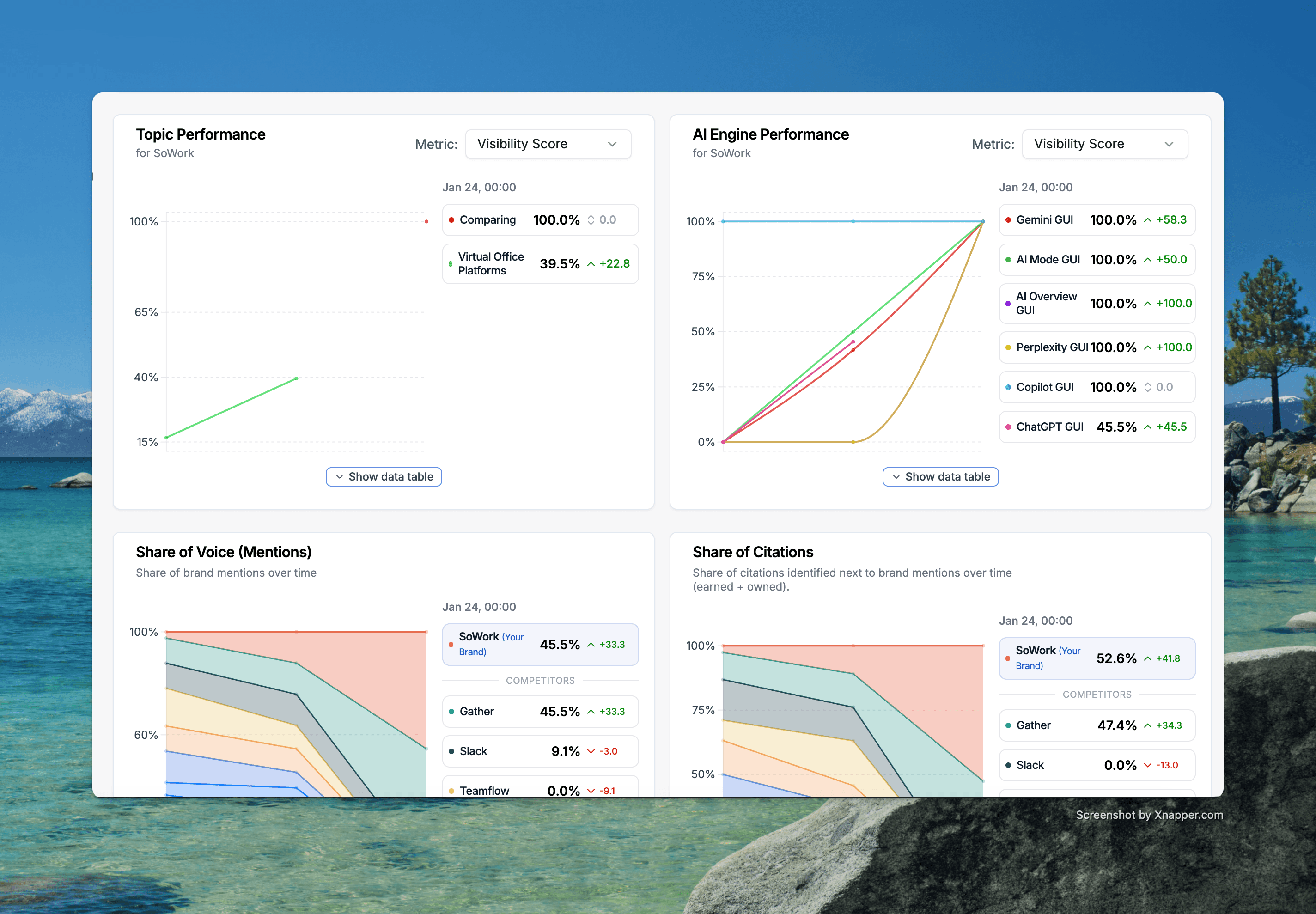
To increase AI visibility, a structured GEO Visibility Audit and continuous monitoring of AI visibility are essential. This is the only way to detect changes early and adapt the content strategy in a targeted way to strengthen your position versus competitors.
Feb 2/3, 2026: First money-prompt article
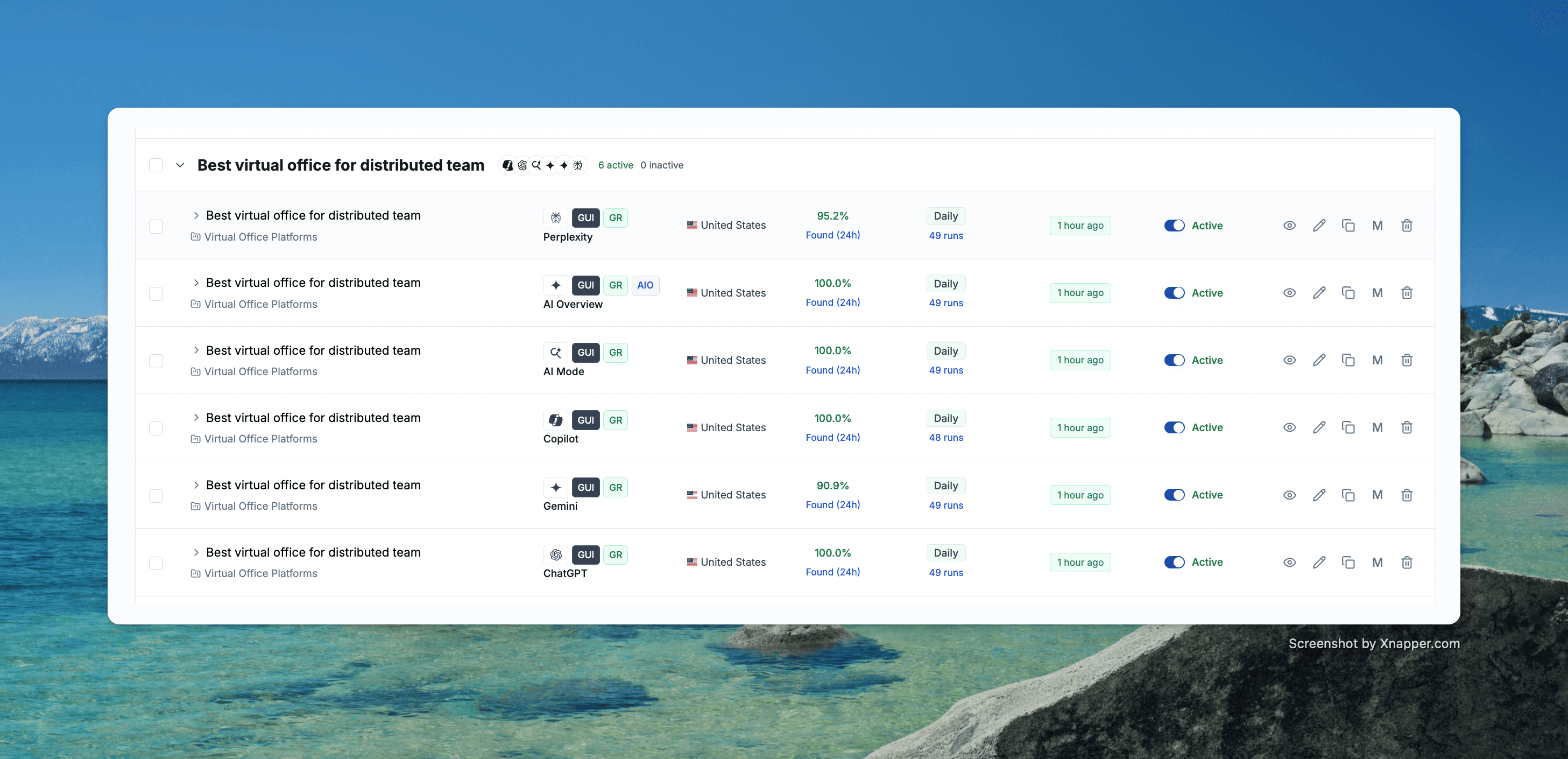
The first money-prompt article was published: “Best virtual office for distributed teams.”
Within 24 hours of publication: 100% visibility in 6 of 6 AI engines for this specific prompt. This is no coincidence — this is structured, AI-optimized content with measurable impact. AI models improve their ability to analyze and predict by continuously learning from new content and steadily optimizing their results through machine learning.
Feb 11, 2026: #1 on Google and Bing AI milestone — day 22
A double milestone:
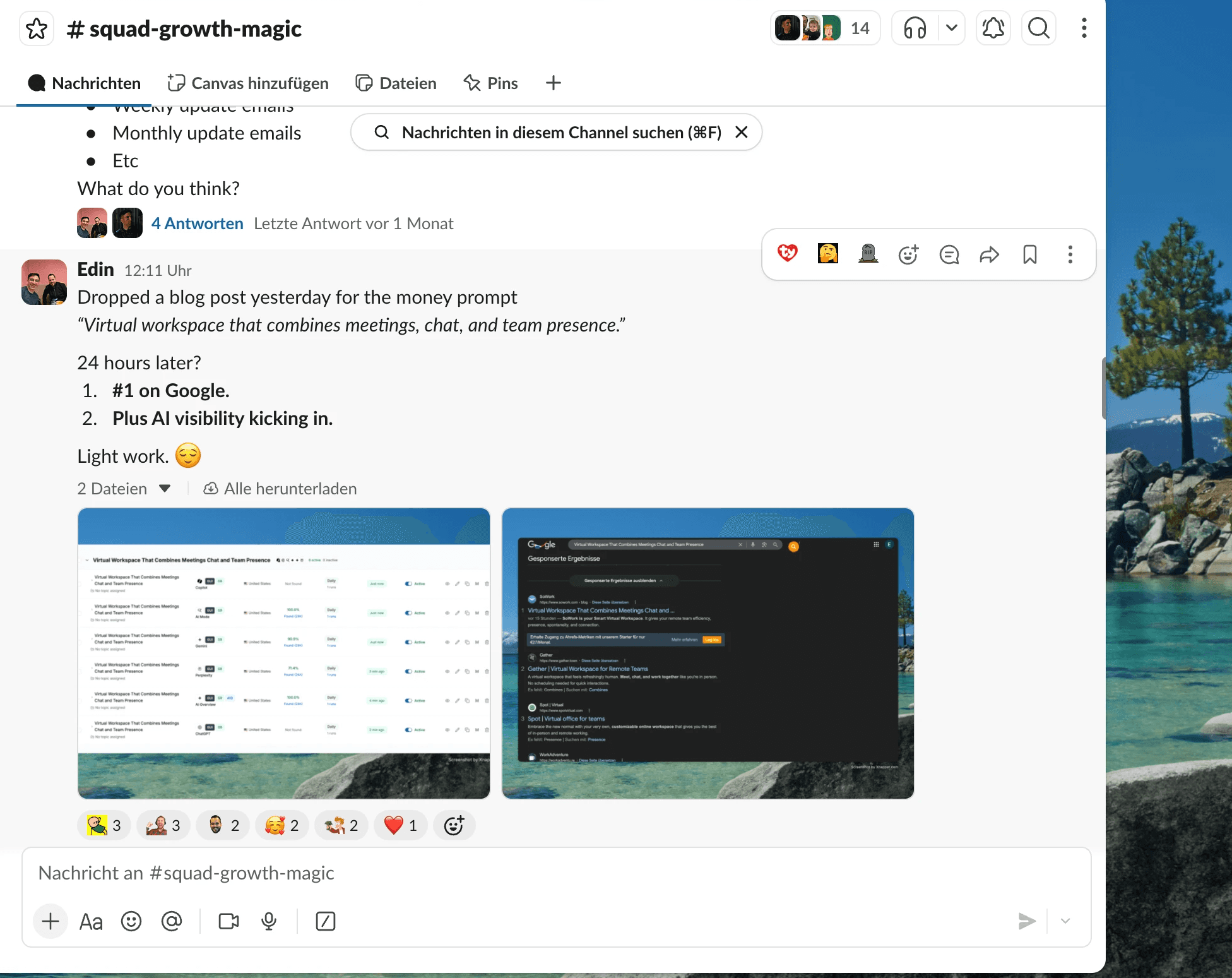
Organically, SoWork reached position 1 on Google for a money-prompt keyword — the day after publication.
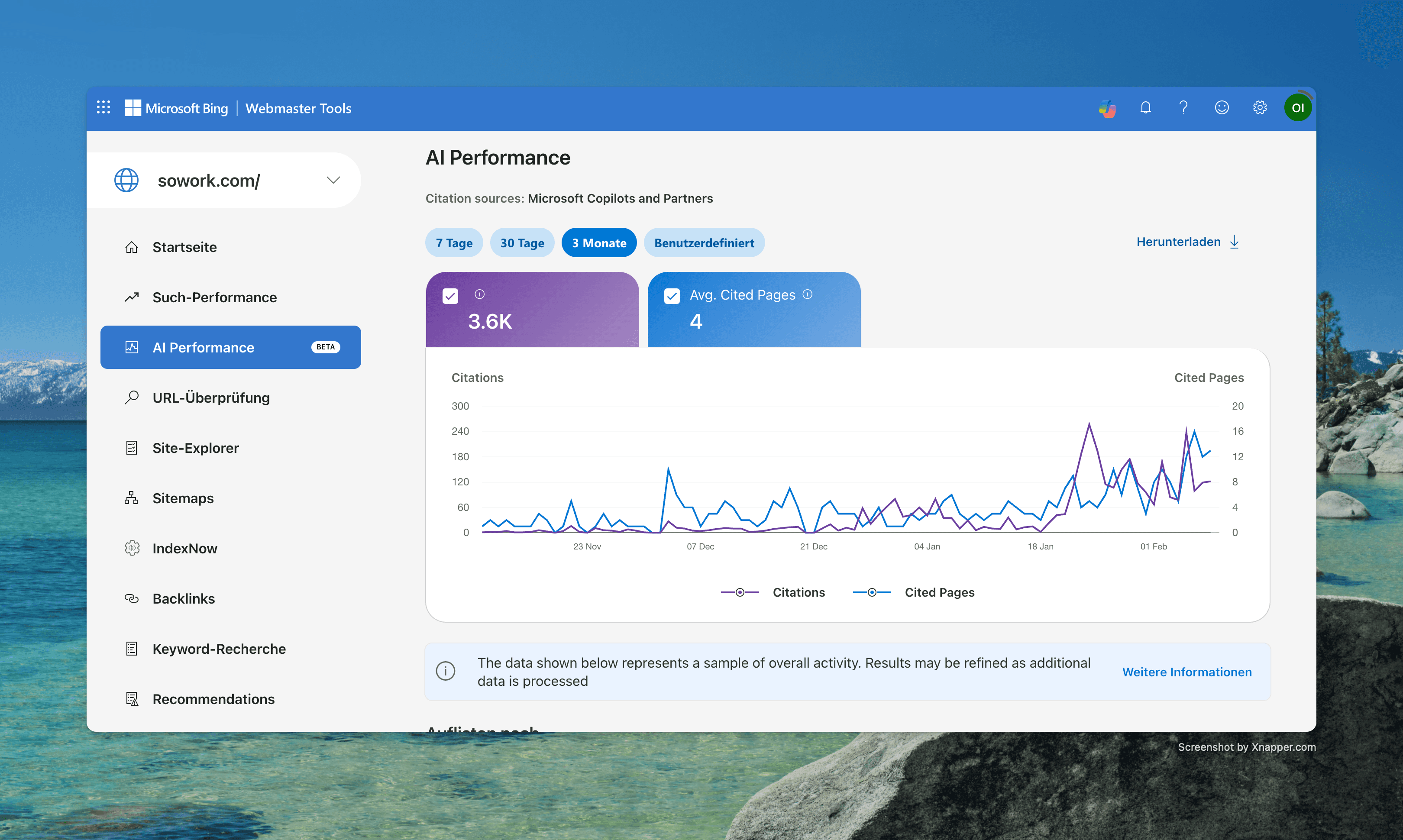
At the same time, a historic data point from Microsoft Bing was confirmed: 3,600 AI citations from Microsoft Copilot and partner systems. Not through an internal tracking tool, but directly from Microsoft Bing Webmaster Tools — first-party data.
A decisive factor: both search engines rely on LLMs (Large Language Models) like GPT-4 as the basis of their generative AI engines. These models enable human-like language processing and semantic understanding, which is essential for increasing AI visibility and optimizing content in the AI context.
That was day 22 after project start. SoWork was officially anchored in the Bing AI infrastructure.
March 4, 2026: End state — 100% in all 7 AI engines
AI engine | Final score | Change vs. start |
|---|---|---|
ChatGPT | 100% | +58.2 pp |
AI Overview | 100% | +23.6 pp |
AI Mode | 100% | +25.7 pp |
Gemini | 100% | +26.0 pp |
Perplexity | 100% | +59.7 pp |
Grok | 100% | +25.6 pp |
Copilot | 100% | +32.4 pp |
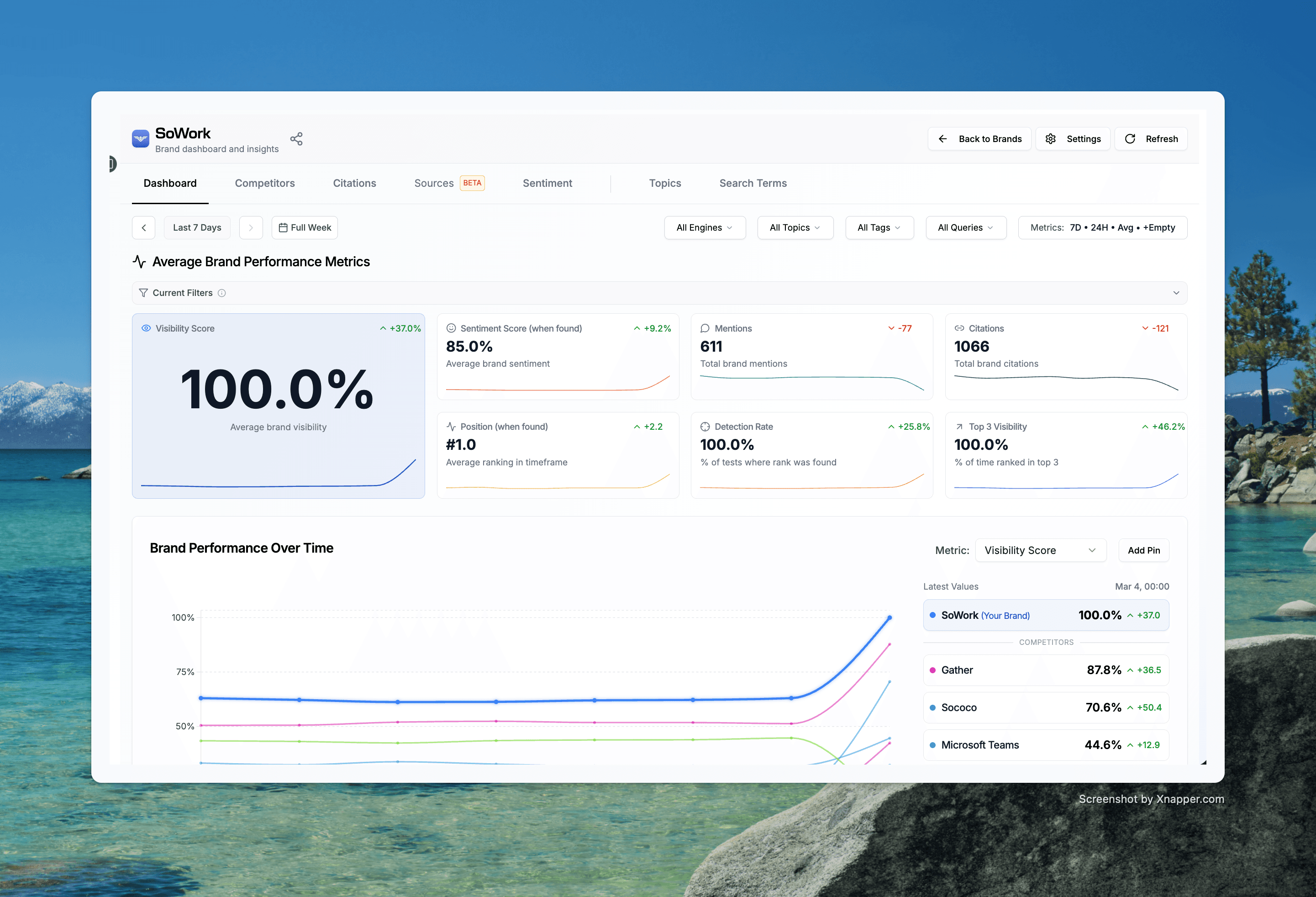
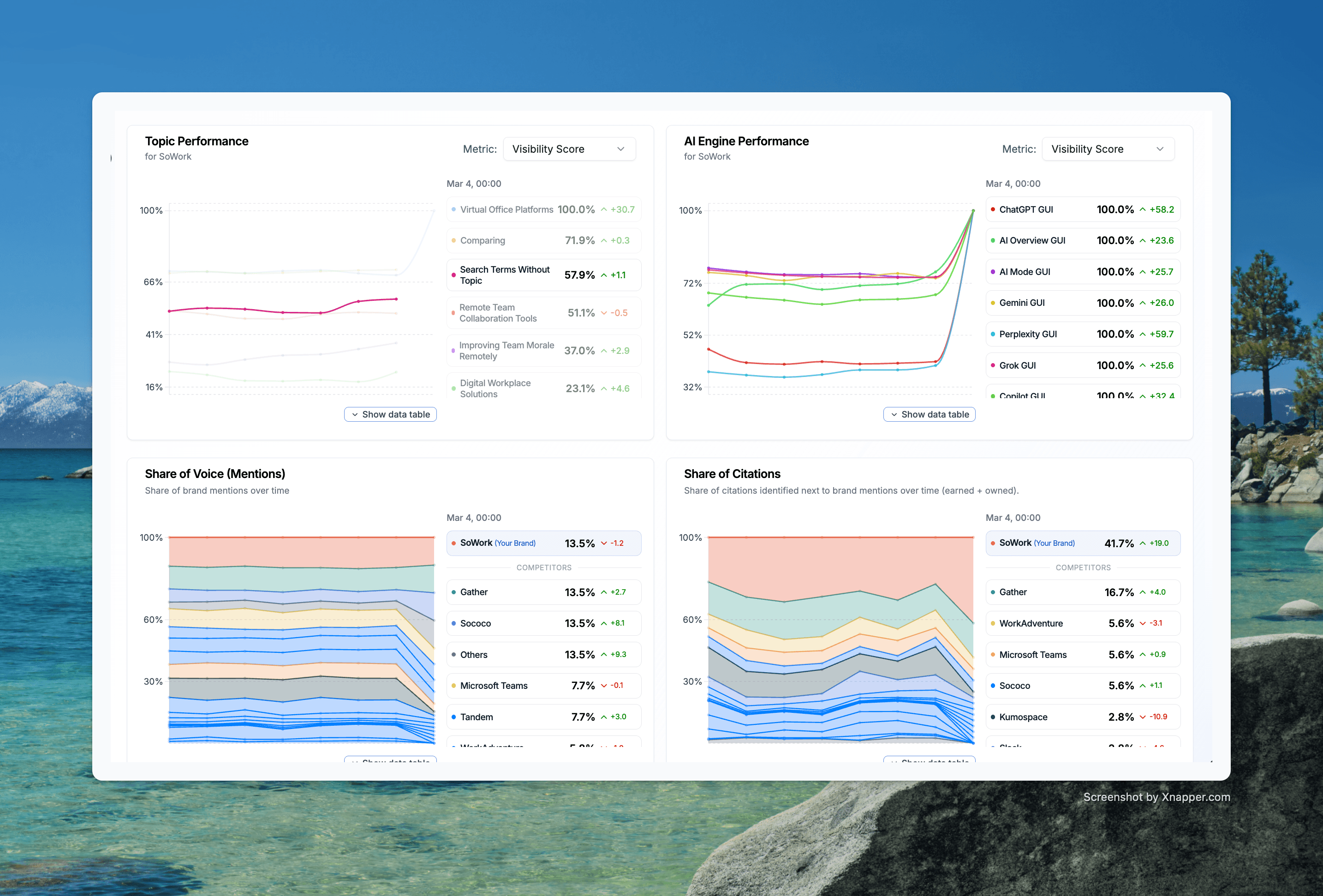
AI Visibility Score: 100%. Share of Citations: 41.7% — SoWork ahead of Gather (16.7%) and all other competitors. Position #1.0 in average position. Detection rate: 100%. Total citations from Bing Webmaster Tools: +10,000, and +13,000 citations measured in RankScale over the entire duration of our collaboration.
For long-term growth in AI visibility, it is crucial to continuously monitor and optimize the perception and mentions of your brand in AI systems in order to sustainably strengthen brand authority and visibility.
The results: What was concretely achieved in 90 days
AI Search and visibility
KPI | Start | End | Change |
|---|---|---|---|
AI Visibility Score | 16.6% | 100% | +83.4 percentage points |
Share of Citations | 22.7% | 41.7% | +19 pp |
Top 3 visibility | 53.8% | 100% | +46.2 pp |
Position (when found) | — | #1.0 | March 2026 average |
Detection rate | — | 100% | All 7 engines |
Total AI citations | — | +23.000 | April 2026 |
Visibility in AI answers is a decisive indicator of the success of optimization measures, because it shows how often and in what context the brand appears in AI-generated responses.
Google Ads: From flying blind to precise control
Metric | Before | After |
|---|---|---|
Measured conversions | 215 pageviews | 190.74 onboarding_completed |
Conversion rate | 0.6% (on pageviews) | 1.53% (Phase 1, on hard conv.) |
CPC | USD 0.13 | USD 0.24 (overall period) |
Cost per conversion | Not measurable | USD XX per hard conv. |
Business value | Zero | 190+ real users who created an office |
Important regarding the CPC increase: The higher CPC is not a worse result. It is the direct consequence of refined targeting. Away from cheap volume traffic without purchase intent, toward users with real switching intent. Clicking cheaper but never creating an office costs more in the end.
Organic growth (GA4, 01/28–03/21/2026)
Channel | onboarding_completed | Attribution |
|---|---|---|
Paid Search | 189.37 | Directly from Google Ads |
Organic Search | 100.80 | Direct result of SEO and AI measures |
Referral | 58.36 | Referral traffic |
Total | 348.53 | All channels |
First Click Attribution: Organic Search leads with 430 onboarding_completed. Last Click: Organic Search leads with 436.
This is direct proof: the organic and AI measures generate real conversions. No detour via assisted attribution. Organic is both the initiation channel and the closing channel.
Business impact: MRR growth
MRR growth increased by a double-digit percentage from January to March 2026. Directly attributable to the combined measures of AI visibility, Google Ads with real conversion tracking, and organic SEO.
Since the project started, SoWork and iGrow have met weekly in OKR meetings. Growth was not only measured, but actively managed.
Competitive position: How SoWork took over the category
Competitor | AI Visibility March 2026 | Share of Citations | Assessment |
|---|---|---|---|
SoWork | 100.0% | 41.7% | Market leader — highest visibility, highest citation share |
Gather | 87.8% | 16.7% | Strongest follower — but 25 pp behind SoWork |
Sococo | 70.6% | 5.6% | Catching up — far behind |
Microsoft Teams | 44.6% | 5.6% | Established — generic, no niche focus |
Kumospace | — | 2.8% | Citations declining |
Teamflow | 0.0% | — | Out of the market |
Visibility across different AI platforms is now a decisive factor for competitive positioning, because brands are found there specifically and traffic and performance can be measurably optimized.
SoWork didn’t just catch up. SoWork took over the category.
Money prompts: How SoWork is visible for the most important questions
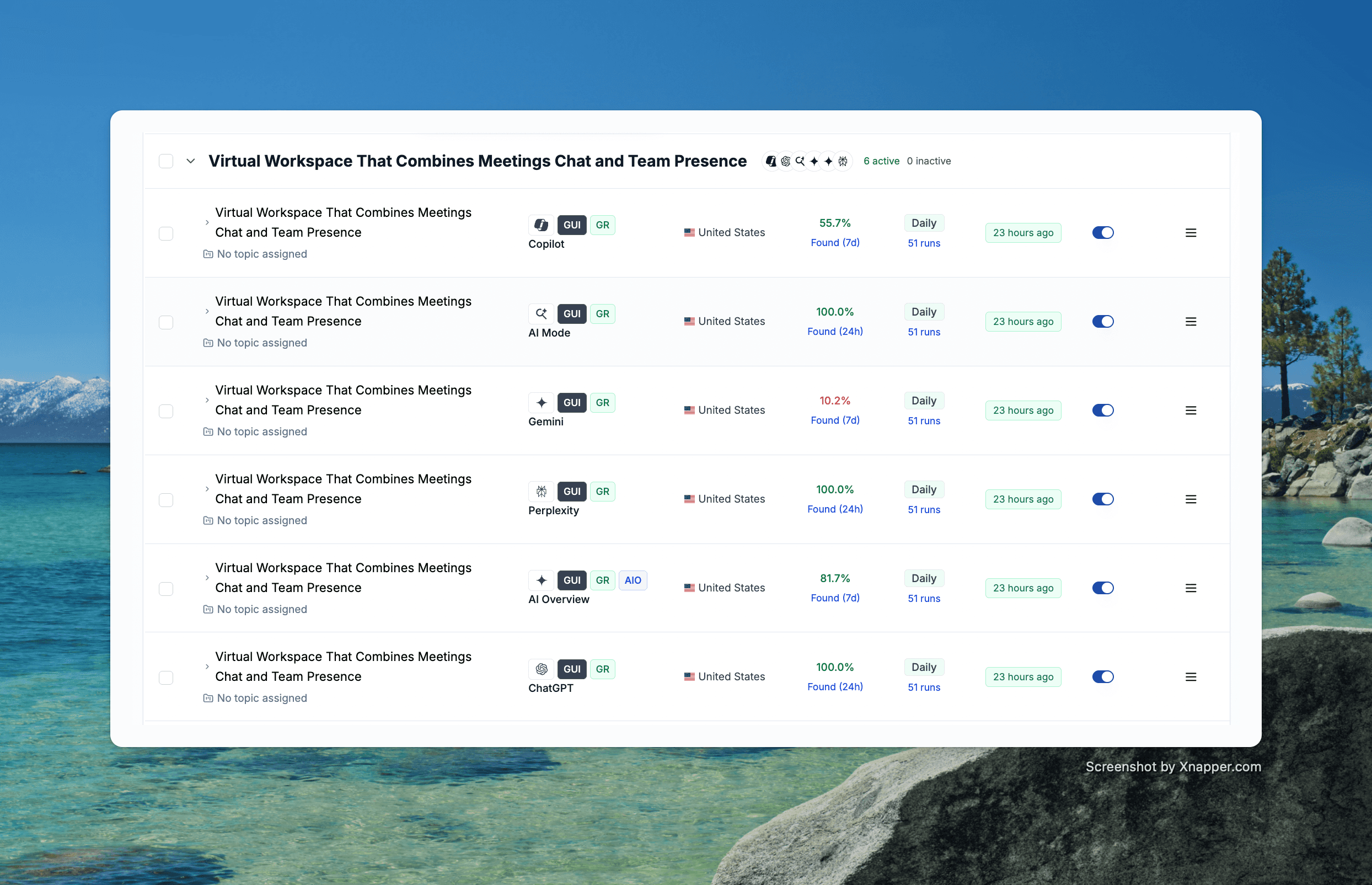
Money prompts are bottom-funnel search queries that decision-makers ask when they are close to making a decision. Strategic prompt optimization for AI visibility focuses exactly on these money prompts. These money prompts are often so-called long-tail keywords, i.e., specific, less competitive search terms that can be used specifically to optimize visibility. “Best virtual office for distributed teams.” “SoWork vs Gather.” “Virtual workspace that combines meetings, chat, and team presence.”
If you are not visible for these prompts, you lose the deal before it even begins.
“Best virtual office for distributed team” — March 2026:
AI engine | Visibility |
|---|---|
Perplexity | 100% |
AI Overview | 100% |
AI Mode | 100% |
Copilot | 100% |
Gemini | 100% |
ChatGPT | 100% |
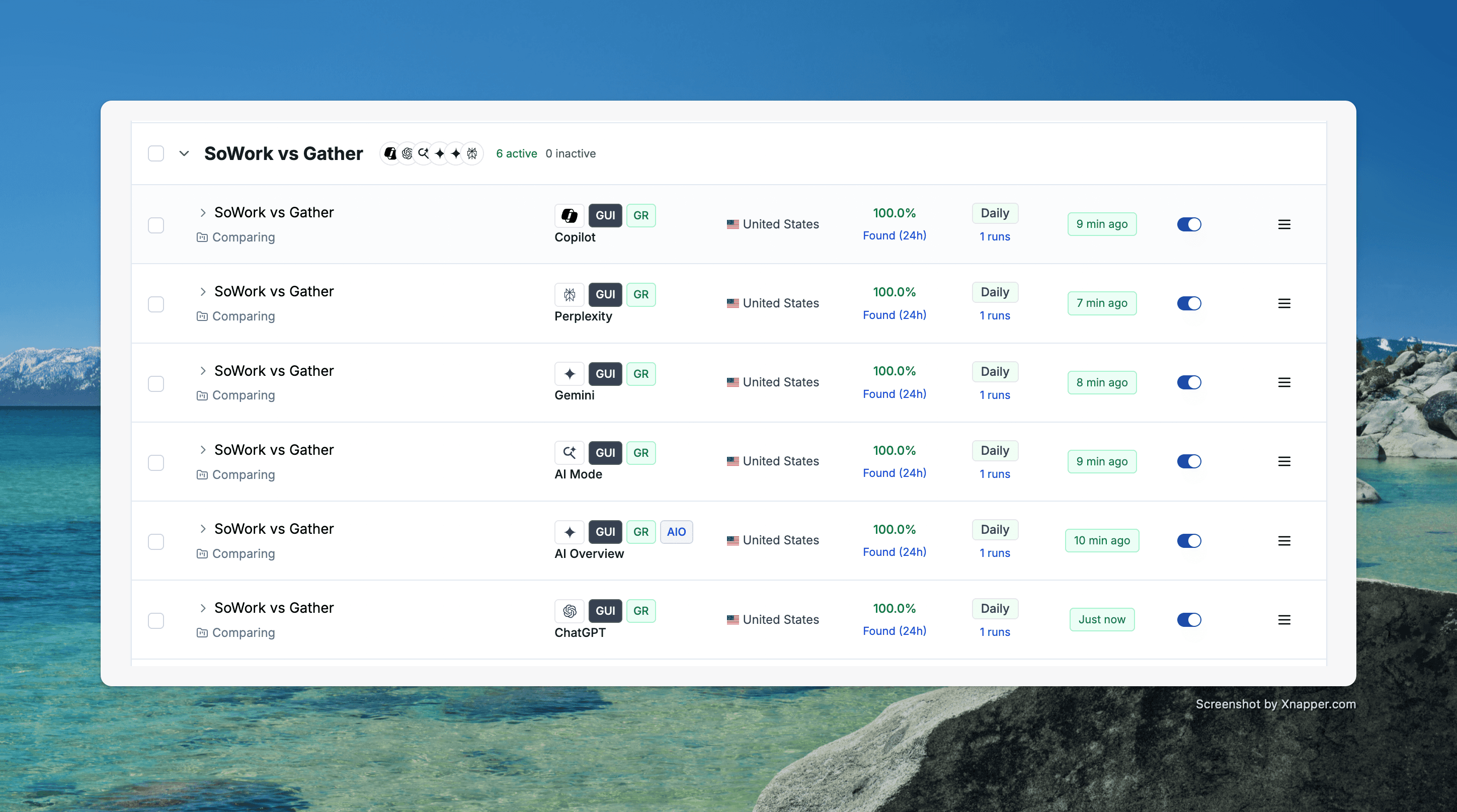
“SoWork vs Gather” — March 2026: |
AI engine | Visibility |
|---|---|
Copilot | 100% |
Perplexity | 100% |
Gemini | 100% |
AI Mode | 100% |
AI Overview | 100% |
ChatGPT | 100% |
The causal chain: Why this worked
What is remarkable about this case study is not only what was achieved. It is why it worked and why it is reproducible.
Technical visibility → AI citability → organic traffic → qualified conversions → MRR growth.
A central success factor for increasing AI visibility is the consistent application of search engine optimization (SEO). It forms the foundation so content is recognized, indexed, and rated as relevant by search engines and AI systems and is a core lever in iGrow’s approach as a B2B growth partner.
This is not correlation. This is a causal chain.
When machines were first able to read and index the website reliably, AI systems began including SoWork in their answers. When structured, bottom-funnel content was published, share of citations measurably increased. As AI visibility increased, organic traffic with purchase intent increased. And when that traffic landed on pages clearly communicating why SoWork wins, conversions increased.
Each step was prepared before the next step was taken. That is the difference between a system and a campaign.
What would not have been possible without iGrow
Dimension | Before | After |
|---|---|---|
Conversion tracking | Pageviews as conversions | onboarding_completed as hard conversion |
AI visibility | 16.6% | 100% in all 7 engines |
Organic conversions | Not measurable | 100.8 onboarding_completed from Organic Search |
Competitive position | Invisible | Market leader in AI visibility and share of citations |
Business result | Stagnation | +XX% MRR in 90 days |
An experienced expert is crucial to successfully implement measures for increasing AI visibility and achieve sustainable results.
What you take away from this case study
You are probably running a product that is stronger than its visibility. That is the most common situation we see. Not bad products. But good products that are simply not readable for search engines and AI systems.
Concretely, this means:
First: If two-thirds of your website pages are not indexable for search engines, no ad budget in the world will help you. The technical foundation comes first.
Second: If you optimize for pageviews, you optimize for the wrong goal. This is not just a reporting problem, it is a strategy problem. You are steering in the wrong direction, with full budget.
Third: AI Search is not a channel of the future. It is the channel through which your potential customers evaluate alternatives today. Gather users, Zoom users, HubSpot users—they ask AI systems before they Google. If you are not visible there, you do not exist in this buyer journey.
Fourth: Visibility without citability is worthless. It is not enough for AI systems to know your product. They must be able to actively recommend your product because you are the clearest, most structured, and most trustworthy source in your category.
SoWork did not have a product problem. SoWork had a structure problem—for search engines, for AI systems, and for the measurability of its own marketing. All three problems were systematically solved in 90 days.
About iGrow
iGrow is a revenue marketing agency and B2B growth partner for SaaS, tech, IT, and B2B companies in the DACH region. We build systems that generate qualified pipeline, not vanity metrics.
What we deliver: visibility that sells. Turn Visibility Into Revenue.
If you want to know what your current AI visibility looks like and where your conversion tracking has gaps, talk to us.
Terms and definitions
AI Visibility Score: Percentage share of defined money prompts for which a product is visible in AI systems. Measured daily across multiple AI engines.
Money Prompt: Bottom-funnel search query with direct decision intent. Example: "Best virtual office software for remote teams."
Share of Citations: Share of AI answers in a category in which a product is cited as a source.
onboarding_completed: Hard-conversion event in GA4: a user has fully created a virtual office — the hardest measurable proof of a real conversion.
Detection Rate: Percentage share of tests in which a product is recognized in AI systems at all.
Share of Voice: Share of brand mentions in AI answers relative to all competitors.
Grounding Page: Structured page that explains to AI systems what a product is, for whom it is relevant, and which category it occupies.
First Click Attribution: Conversion is attributed to the channel through which the user first came to the website. Shows which channel initiates the purchase decision.
GEO (Generative Engine Optimization): Optimization for AI-generated search answers — the evolution of classic SEO in the age of AI Search.
4XX Error: HTTP error code for pages not found. Every such error actively blocks AI crawlers and search engines.
This case study is based on real data from January to March 2026. All metrics are supported by screenshots and come from RankScale AI Dashboard, Google Ads, GA4 Looker Studio, and Microsoft Bing Webmaster Tools.
iGrow Revenue Marketing Agency × SoWork — 90-day project documentation
SoWork was invisible to AI systems. 90 days later: 100% AI Visibility in 7 engines, Increase in MRR, and 190 real hard conversions. Here’s how.
Increase in MRR. 190+ real hard conversions. And conversion tracking that simply didn’t exist before. This is what happens when you stop optimizing for pageviews and start optimizing for real business outcomes.
AI Search Optimization plays a key role here, as it significantly increases the visibility and efficiency of modern SaaS companies through the targeted use of artificial intelligence.
What you’ll learn in this case study
If you run a SaaS product and are wondering why your marketing is burning money without delivering results, then this case study was written for you.
You’ll see how a product that almost always won in direct comparisons still attracted hardly any new customers. Not because the product was bad. But because it simply wasn’t readable for search engines and AI systems, and because the targeted use of AI technologies to optimize visibility was missing.
You’ll understand why AI Search in B2B marketing is no longer a nice-to-have, but the channel through which a growing share of your potential customers make purchasing decisions today. And you’ll see what happens when you approach this systematically instead of running ads blindly and hoping for traffic. The intelligence of modern AI systems plays a crucial role here, as they analyze complex data and contribute specifically to improving your visibility.
The product: SoWork
SoWork is an AI-powered Digital HQ for remote teams. The product combines a persistent virtual office space, spatial video and chat, an AI meeting library, and team analytics in a single system. It replaces Zoom, Slack, and AI transcription tools at the same time.
That is an exceptionally strong product promise. Anyone who compared SoWork directly with Gather, Kumospace, or Roam almost always chose SoWork.
The problem: most potential customers never made that comparison. Because they didn’t find SoWork beforehand.
The starting point: A strong product nobody saw
What the audit revealed
Before iGrow took over the work, a complete technical and content analysis of the SoWork website was carried out. The findings were clear:
What was checked | What was found | What it means |
|---|---|---|
Website Health Score | 66 out of 100 | Critical, the technical foundation is not working |
Non-indexable pages | 65.8% | Two-thirds of the website do not exist for Google |
Active 4XX errors | 65+ active errors | Crawlers are actively blocked, crawl budget is lost |
AI Visibility Score | 16.6% | SoWork appears in fewer than 1 in 6 AI answers |
AI grounding (llm.txt etc.) | Not present | AI has no structured explanation of the product |
Internal linking | Very thin | No semantic connection between topic areas |
The result of this analysis was: SoWork wins almost every direct comparison but is not found before that comparison. The product was stronger than its visibility.
The real problem: No functioning conversion tracking
Even before visibility could be addressed, a more fundamental problem had to be solved. What was measured as a conversion was not a business result.
What was counted as a conversion: a pageview. A page load of the website.
No onboarding_completed. No funnel entry. No measurable business event.
That means: campaigns were running blind. Money was spent without knowing whether even a single user had ever created an office. And optimizing for the wrong goal means: more budget equals more waste.
The numbers before takeover (01/01–01/27/2026)
Metric | Value | Assessment |
|---|---|---|
Clicks | 37,464 | Very high — but without quality control |
Impressions | 115,116 | High reach — wrong target audience |
Cost | XXXXXX | 27 days without measurable business impact |
CTR | 32.54% | High — due to high-volume keywords without purchase intent |
CPC | USD 0.13 | Low — because wrong target audience |
Conv. rate | 0.6% | Measured on pageviews — no business value |
onboarding_completed | Not tracked | Not a single hard business event measured |
This was not a traffic problem. It was a measurement and visibility problem at the same time
How purchase decisions are really made today
Before you understand why these measures worked, you need to understand how the buyer journey in this category works.
It doesn’t start with a brand search. It starts with frustration.
A team has been using Gather for months. The video lags. The UX is annoying. Someone on the team says: “Isn’t there something better?” and five minutes later someone types into ChatGPT or Perplexity: “Best virtual office alternative to Gather.”
At that moment, it is decided whether SoWork is in the conversation. Or not.
If you are not visible at that moment, you lose the deal before it even begins. And this doesn’t happen in Google alone. It happens in ChatGPT, Gemini, Perplexity, Microsoft Copilot, and Google AI Overview.
AI Search does not reward volume. AI Search rewards clarity, structure, and citability in AI search systems. And that was exactly the bottleneck that had to be resolved.
AI search in particular now plays a decisive role in ranking and discoverability of content, because it determines which solutions users are shown at all in AI-based search systems like ChatGPT or Perplexity.
The strategy: First structure, then scaling
In week 0, a clear decision was made: no additional content without a technical foundation. No ads without clean conversion tracking. First make it measurable, then scale.
Especially in the era of AI-based search systems, the development and continuous adaptation of modern SEO strategies for generative engines is crucial to sustainably increase visibility in AI systems and remain successful in digital competition.
The three strategic pillars
Pillar 1: Technical visibility Machines must be able to read, understand, and index the website. Everything else is secondary. No content push on an unstable foundation.
Pillar 2: Bottom-funnel content Comparison and alternative pages for users ready to switch. This is the most common entry point in the buyer journey in this category. Whoever searches “Gather alternative” already has purchase intent.
Pillar 3: AI citability Structured content that AI systems can directly use as an answer. This is not the same as classic SEO; the goal is to be a trustworthy source for language models. Targeted content optimization for AI visibility is crucial here, as high-quality, relevant, and clearly structured content significantly increases visibility and citability in AI systems.
The 90-day roadmap
Here you can find a roadmap for increasing AI visibility that combines various methods—from traditional SEO methods to innovative AI-based approaches—to optimize visibility:
Phase | Timeframe | Focus | Concrete measures |
|---|---|---|---|
Phase 1 | Days 0–14 | Technical foundation | Eliminate 4XX errors, sitemap, canonicals, titles/metas, first /vs pages, fix conversion tracking |
Phase 2 | Days 15–45 | Build authority surfaces | Alternative pages, use-case pages, first money-prompt articles |
Phase 3 | Days 46–90 | Scale and distribute | Case studies, comparison tables, , topic cluster, entity structure, internal linking |
The role of E-E-A-T for AI visibility
In the AI era, this applies: Pure keyword optimization is dead. What matters now is quality, credibility, and authority of content. E-E-A-T (expertise, experience, authority, trustworthiness)—these four factors determine visibility. Mandatory for every company: appear as a relevant source in AI-generated search results.
AI systems like Google Gemini and ChatGPT evaluate according to clear rules: well-founded, trustworthy, user-centered. No exceptions. Companies that align content strategies with E-E-A-T principles gain a decisive advantage in online marketing. Result: more frequent mentions in AI answers. Positioning as the preferred solution. Measurable. Reproducible.
Expertise – Rule number 1: high-quality, in-depth content. Precisely aligned with user questions. No superficial texts. Companies must share knowledge transparently. Prepare complex topics in an understandable way. Result: AI tools recognize expert status. Preferred delivery guaranteed.
Experience and authority – demonstrable through: customer reviews, certifications, case studies, partnerships. No empty claims. These signals strengthen perception as a leading provider. Direct effect: increased likelihood of reference mentions in AI search results. Verifiable. Traceable.
Trustworthiness – indispensable in digital marketing. Mandatory elements: transparent information, secure website, clear privacy policies, traceable sources. No trust = no visibility. Especially in the AI era: users trust AI answers. A trustworthy online presence becomes a decisive competitive advantage. Non-negotiable.
Execution: What happened when
Week 0 (approx. Jan 15–27, 2026): Diagnosis
Complete technical and content audit. Finding: Health Score 66/100, 65.8% of pages not indexable, 65+ active 4XX errors, AI visibility 16.6%, no conversion tracking for real business events.
Strategic finding: The product wins every direct comparison — but isn’t found beforehand.
Decision: Build structure first, then scale.
Week 1 (Jan 28, 2026): Technical foundation and Google Ads 2.0
On day 1 of active execution, the following measures were implemented:
All 60+ active 4XX errors eliminated — crawl blockages fully resolved
Sitemap cleaned up, restructured, and submitted to Google and Bing
Canonical URLs set correctly and enforced for all critical pages
Duplicate titles and meta descriptions removed and rewritten
First /vs pages live: SoWork vs. Gather, SoWork vs. Kumospace, SoWork vs. Roam
Google Ads 2.0 live: conversion tracking switched from pageviews to onboarding_completed (Office Creation Completed)
Brazil Gather ad campaign launched — keywords: gather town, gathertown, gather town alternatives
Modern technologies such as AI-supported systems and tools were used in implementing these measures to specifically support the effectiveness of the SEO and Google Ads strategy and to increase AI visibility.
Result of the first ads week (01/28–02/05): 3,533 clicks, USD 1,108.44 spend, 32.58 onboarding_completed hard conversions — conversion rate 1.01% versus 0.6% before. Factor 1.7x in the first week of operation with real tracking.
January 24, 2026: First AI visibility peak
Already in the first measurement period after the technical cleanup, the AI dashboard showed a dramatic signal. The AI Visibility Score jumped to 100% — a weekly increase of +60.5 percentage points.
AI engine | Visibility score | Change |
|---|---|---|
Gemini | 100% | +58.3 pp |
AI Mode | 100% | +50.0 pp |
AI Overview | 100% | +100.0 pp |
Perplexity | 100% | +100.0 pp |
Copilot | 100% | stable |
ChatGPT | 45.5% | +45.5 pp |
Share of Citations: 52.6% — more than every second AI source citation in the category went to SoWork. Share of Voice on par with Gather (45.5%). Within days, SoWork had become the most cited alternative in the category.
To increase AI visibility, a structured GEO Visibility Audit and continuous monitoring of AI visibility are essential. This is the only way to detect changes early and adapt the content strategy in a targeted way to strengthen your position versus competitors.
Feb 2/3, 2026: First money-prompt article
The first money-prompt article was published: “Best virtual office for distributed teams.”
Within 24 hours of publication: 100% visibility in 6 of 6 AI engines for this specific prompt. This is no coincidence — this is structured, AI-optimized content with measurable impact. AI models improve their ability to analyze and predict by continuously learning from new content and steadily optimizing their results through machine learning.
Feb 11, 2026: #1 on Google and Bing AI milestone — day 22
A double milestone:
Organically, SoWork reached position 1 on Google for a money-prompt keyword — the day after publication.
At the same time, a historic data point from Microsoft Bing was confirmed: 3,600 AI citations from Microsoft Copilot and partner systems. Not through an internal tracking tool, but directly from Microsoft Bing Webmaster Tools — first-party data.
A decisive factor: both search engines rely on LLMs (Large Language Models) like GPT-4 as the basis of their generative AI engines. These models enable human-like language processing and semantic understanding, which is essential for increasing AI visibility and optimizing content in the AI context.
That was day 22 after project start. SoWork was officially anchored in the Bing AI infrastructure.
March 4, 2026: End state — 100% in all 7 AI engines
AI engine | Final score | Change vs. start |
|---|---|---|
ChatGPT | 100% | +58.2 pp |
AI Overview | 100% | +23.6 pp |
AI Mode | 100% | +25.7 pp |
Gemini | 100% | +26.0 pp |
Perplexity | 100% | +59.7 pp |
Grok | 100% | +25.6 pp |
Copilot | 100% | +32.4 pp |
AI Visibility Score: 100%. Share of Citations: 41.7% — SoWork ahead of Gather (16.7%) and all other competitors. Position #1.0 in average position. Detection rate: 100%. Total citations from Bing Webmaster Tools: +10,000, and +13,000 citations measured in RankScale over the entire duration of our collaboration.
For long-term growth in AI visibility, it is crucial to continuously monitor and optimize the perception and mentions of your brand in AI systems in order to sustainably strengthen brand authority and visibility.
The results: What was concretely achieved in 90 days
AI Search and visibility
KPI | Start | End | Change |
|---|---|---|---|
AI Visibility Score | 16.6% | 100% | +83.4 percentage points |
Share of Citations | 22.7% | 41.7% | +19 pp |
Top 3 visibility | 53.8% | 100% | +46.2 pp |
Position (when found) | — | #1.0 | March 2026 average |
Detection rate | — | 100% | All 7 engines |
Total AI citations | — | +23.000 | April 2026 |
Visibility in AI answers is a decisive indicator of the success of optimization measures, because it shows how often and in what context the brand appears in AI-generated responses.
Google Ads: From flying blind to precise control
Metric | Before | After |
|---|---|---|
Measured conversions | 215 pageviews | 190.74 onboarding_completed |
Conversion rate | 0.6% (on pageviews) | 1.53% (Phase 1, on hard conv.) |
CPC | USD 0.13 | USD 0.24 (overall period) |
Cost per conversion | Not measurable | USD XX per hard conv. |
Business value | Zero | 190+ real users who created an office |
Important regarding the CPC increase: The higher CPC is not a worse result. It is the direct consequence of refined targeting. Away from cheap volume traffic without purchase intent, toward users with real switching intent. Clicking cheaper but never creating an office costs more in the end.
Organic growth (GA4, 01/28–03/21/2026)
Channel | onboarding_completed | Attribution |
|---|---|---|
Paid Search | 189.37 | Directly from Google Ads |
Organic Search | 100.80 | Direct result of SEO and AI measures |
Referral | 58.36 | Referral traffic |
Total | 348.53 | All channels |
First Click Attribution: Organic Search leads with 430 onboarding_completed. Last Click: Organic Search leads with 436.
This is direct proof: the organic and AI measures generate real conversions. No detour via assisted attribution. Organic is both the initiation channel and the closing channel.
Business impact: MRR growth
MRR growth increased by a double-digit percentage from January to March 2026. Directly attributable to the combined measures of AI visibility, Google Ads with real conversion tracking, and organic SEO.
Since the project started, SoWork and iGrow have met weekly in OKR meetings. Growth was not only measured, but actively managed.
Competitive position: How SoWork took over the category
Competitor | AI Visibility March 2026 | Share of Citations | Assessment |
|---|---|---|---|
SoWork | 100.0% | 41.7% | Market leader — highest visibility, highest citation share |
Gather | 87.8% | 16.7% | Strongest follower — but 25 pp behind SoWork |
Sococo | 70.6% | 5.6% | Catching up — far behind |
Microsoft Teams | 44.6% | 5.6% | Established — generic, no niche focus |
Kumospace | — | 2.8% | Citations declining |
Teamflow | 0.0% | — | Out of the market |
Visibility across different AI platforms is now a decisive factor for competitive positioning, because brands are found there specifically and traffic and performance can be measurably optimized.
SoWork didn’t just catch up. SoWork took over the category.
Money prompts: How SoWork is visible for the most important questions
Money prompts are bottom-funnel search queries that decision-makers ask when they are close to making a decision. Strategic prompt optimization for AI visibility focuses exactly on these money prompts. These money prompts are often so-called long-tail keywords, i.e., specific, less competitive search terms that can be used specifically to optimize visibility. “Best virtual office for distributed teams.” “SoWork vs Gather.” “Virtual workspace that combines meetings, chat, and team presence.”
If you are not visible for these prompts, you lose the deal before it even begins.
“Best virtual office for distributed team” — March 2026:
AI engine | Visibility |
|---|---|
Perplexity | 100% |
AI Overview | 100% |
AI Mode | 100% |
Copilot | 100% |
Gemini | 100% |
ChatGPT | 100% |
“SoWork vs Gather” — March 2026: |
AI engine | Visibility |
|---|---|
Copilot | 100% |
Perplexity | 100% |
Gemini | 100% |
AI Mode | 100% |
AI Overview | 100% |
ChatGPT | 100% |
The causal chain: Why this worked
What is remarkable about this case study is not only what was achieved. It is why it worked and why it is reproducible.
Technical visibility → AI citability → organic traffic → qualified conversions → MRR growth.
A central success factor for increasing AI visibility is the consistent application of search engine optimization (SEO). It forms the foundation so content is recognized, indexed, and rated as relevant by search engines and AI systems and is a core lever in iGrow’s approach as a B2B growth partner.
This is not correlation. This is a causal chain.
When machines were first able to read and index the website reliably, AI systems began including SoWork in their answers. When structured, bottom-funnel content was published, share of citations measurably increased. As AI visibility increased, organic traffic with purchase intent increased. And when that traffic landed on pages clearly communicating why SoWork wins, conversions increased.
Each step was prepared before the next step was taken. That is the difference between a system and a campaign.
What would not have been possible without iGrow
Dimension | Before | After |
|---|---|---|
Conversion tracking | Pageviews as conversions | onboarding_completed as hard conversion |
AI visibility | 16.6% | 100% in all 7 engines |
Organic conversions | Not measurable | 100.8 onboarding_completed from Organic Search |
Competitive position | Invisible | Market leader in AI visibility and share of citations |
Business result | Stagnation | +XX% MRR in 90 days |
An experienced expert is crucial to successfully implement measures for increasing AI visibility and achieve sustainable results.
What you take away from this case study
You are probably running a product that is stronger than its visibility. That is the most common situation we see. Not bad products. But good products that are simply not readable for search engines and AI systems.
Concretely, this means:
First: If two-thirds of your website pages are not indexable for search engines, no ad budget in the world will help you. The technical foundation comes first.
Second: If you optimize for pageviews, you optimize for the wrong goal. This is not just a reporting problem, it is a strategy problem. You are steering in the wrong direction, with full budget.
Third: AI Search is not a channel of the future. It is the channel through which your potential customers evaluate alternatives today. Gather users, Zoom users, HubSpot users—they ask AI systems before they Google. If you are not visible there, you do not exist in this buyer journey.
Fourth: Visibility without citability is worthless. It is not enough for AI systems to know your product. They must be able to actively recommend your product because you are the clearest, most structured, and most trustworthy source in your category.
SoWork did not have a product problem. SoWork had a structure problem—for search engines, for AI systems, and for the measurability of its own marketing. All three problems were systematically solved in 90 days.
About iGrow
iGrow is a revenue marketing agency and B2B growth partner for SaaS, tech, IT, and B2B companies in the DACH region. We build systems that generate qualified pipeline, not vanity metrics.
What we deliver: visibility that sells. Turn Visibility Into Revenue.
If you want to know what your current AI visibility looks like and where your conversion tracking has gaps, talk to us.
Terms and definitions
AI Visibility Score: Percentage share of defined money prompts for which a product is visible in AI systems. Measured daily across multiple AI engines.
Money Prompt: Bottom-funnel search query with direct decision intent. Example: "Best virtual office software for remote teams."
Share of Citations: Share of AI answers in a category in which a product is cited as a source.
onboarding_completed: Hard-conversion event in GA4: a user has fully created a virtual office — the hardest measurable proof of a real conversion.
Detection Rate: Percentage share of tests in which a product is recognized in AI systems at all.
Share of Voice: Share of brand mentions in AI answers relative to all competitors.
Grounding Page: Structured page that explains to AI systems what a product is, for whom it is relevant, and which category it occupies.
First Click Attribution: Conversion is attributed to the channel through which the user first came to the website. Shows which channel initiates the purchase decision.
GEO (Generative Engine Optimization): Optimization for AI-generated search answers — the evolution of classic SEO in the age of AI Search.
4XX Error: HTTP error code for pages not found. Every such error actively blocks AI crawlers and search engines.
This case study is based on real data from January to March 2026. All metrics are supported by screenshots and come from RankScale AI Dashboard, Google Ads, GA4 Looker Studio, and Microsoft Bing Webmaster Tools.
iGrow Revenue Marketing Agency × SoWork — 90-day project documentation
Written by:

Edin
Author & Founder
Share this article
Share on X
Share on f
Share on in
What exactly does iGrow do differently than other SEO agencies?
Most agencies deliver traffic reports. iGrow delivers pipeline. The difference sounds simple, but it isn’t. We don’t build campaigns that look good — we build systems that measure what’s really happening. In SoWork’s case, the first step wasn’t a new blog post or a new campaign. It was the question: Do we even know whether a single user has ever created an office? The answer was no. Only once you know that can you scale. This mindset — understand first, then build — is at the core of what we do.
Does AI visibility optimization also work for smaller SaaS companies, or only for established brands?
AI Visibility is especially the most interesting channel for smaller SaaS companies—because it levels the playing field. Established brands dominate traditional SEO through backlink profiles you can’t catch up with in two years. But AI systems evaluate clarity, structure, and topical relevance. If you offer the best-structured, most clearly formulated explanatory content in your niche, you’ll be cited—regardless of your domain authority. At the beginning, SoWork had an AI Visibility Score of 16.6%. Gather was more established, better known, and larger. Even so, SoWork overtook Gather in AI citations. Not through budget, but through better structure.
How long does it take before I see the first results with AI Search?
Faster than you think—if the technical foundation is right. At SoWork, the first measurable jump in AI visibility became apparent in less than a week after the technical fixes. The first money-prompt article achieved 100% visibility in 6 out of 6 AI engines for that prompt within 24 hours of publication. Traditional SEO takes months. AI search responds faster to structured content—because AI systems actively look for citable sources and process new, well-structured content immediately. The bottleneck is almost never the AI engine. The bottleneck is almost always the technical foundation underneath it.
What is the difference between AI Visibility and what Google AI Overview does?
Google AI Overview is one of several surfaces where your AI Visibility is measured — but not the only one. When you build AI Visibility, you optimize for your product to be cited as a trusted source in ChatGPT, Gemini, Perplexity, Microsoft Copilot, Google AI Mode, Google AI Overview, and Grok simultaneously. Google AI Overview is particularly relevant for purchase-oriented search queries in classic Google search. However, a growing share of your potential customers today ask directly in ChatGPT or Perplexity — without even opening Google. Anyone who only optimizes for AI Overview loses exactly these users.
Do I have to restructure my entire marketing to get AI visibility?
No. You need to improve the right areas—not tear everything down. In practice, there are usually three problem areas: the technical foundation of the website, the lack of purchase-intent content like comparison pages and alternative pages, and the lack of structured content that AI systems can use as a source. These are not massive projects. The 60+ 4XX errors at SoWork were fixed within a week. The first three comparison pages went live at the same time. The first money-prompt article was published within a few days. What happened afterward was reflected in the numbers.


What exactly does iGrow do differently than other SEO agencies?
Most agencies deliver traffic reports. iGrow delivers pipeline. The difference sounds simple, but it isn’t. We don’t build campaigns that look good — we build systems that measure what’s really happening. In SoWork’s case, the first step wasn’t a new blog post or a new campaign. It was the question: Do we even know whether a single user has ever created an office? The answer was no. Only once you know that can you scale. This mindset — understand first, then build — is at the core of what we do.
Does AI visibility optimization also work for smaller SaaS companies, or only for established brands?
AI Visibility is especially the most interesting channel for smaller SaaS companies—because it levels the playing field. Established brands dominate traditional SEO through backlink profiles you can’t catch up with in two years. But AI systems evaluate clarity, structure, and topical relevance. If you offer the best-structured, most clearly formulated explanatory content in your niche, you’ll be cited—regardless of your domain authority. At the beginning, SoWork had an AI Visibility Score of 16.6%. Gather was more established, better known, and larger. Even so, SoWork overtook Gather in AI citations. Not through budget, but through better structure.
How long does it take before I see the first results with AI Search?
Faster than you think—if the technical foundation is right. At SoWork, the first measurable jump in AI visibility became apparent in less than a week after the technical fixes. The first money-prompt article achieved 100% visibility in 6 out of 6 AI engines for that prompt within 24 hours of publication. Traditional SEO takes months. AI search responds faster to structured content—because AI systems actively look for citable sources and process new, well-structured content immediately. The bottleneck is almost never the AI engine. The bottleneck is almost always the technical foundation underneath it.
What is the difference between AI Visibility and what Google AI Overview does?
Google AI Overview is one of several surfaces where your AI Visibility is measured — but not the only one. When you build AI Visibility, you optimize for your product to be cited as a trusted source in ChatGPT, Gemini, Perplexity, Microsoft Copilot, Google AI Mode, Google AI Overview, and Grok simultaneously. Google AI Overview is particularly relevant for purchase-oriented search queries in classic Google search. However, a growing share of your potential customers today ask directly in ChatGPT or Perplexity — without even opening Google. Anyone who only optimizes for AI Overview loses exactly these users.
Do I have to restructure my entire marketing to get AI visibility?
No. You need to improve the right areas—not tear everything down. In practice, there are usually three problem areas: the technical foundation of the website, the lack of purchase-intent content like comparison pages and alternative pages, and the lack of structured content that AI systems can use as a source. These are not massive projects. The 60+ 4XX errors at SoWork were fixed within a week. The first three comparison pages went live at the same time. The first money-prompt article was published within a few days. What happened afterward was reflected in the numbers.
What exactly does iGrow do differently than other SEO agencies?
Most agencies deliver traffic reports. iGrow delivers pipeline. The difference sounds simple, but it isn’t. We don’t build campaigns that look good — we build systems that measure what’s really happening. In SoWork’s case, the first step wasn’t a new blog post or a new campaign. It was the question: Do we even know whether a single user has ever created an office? The answer was no. Only once you know that can you scale. This mindset — understand first, then build — is at the core of what we do.
Does AI visibility optimization also work for smaller SaaS companies, or only for established brands?
AI Visibility is especially the most interesting channel for smaller SaaS companies—because it levels the playing field. Established brands dominate traditional SEO through backlink profiles you can’t catch up with in two years. But AI systems evaluate clarity, structure, and topical relevance. If you offer the best-structured, most clearly formulated explanatory content in your niche, you’ll be cited—regardless of your domain authority. At the beginning, SoWork had an AI Visibility Score of 16.6%. Gather was more established, better known, and larger. Even so, SoWork overtook Gather in AI citations. Not through budget, but through better structure.
How long does it take before I see the first results with AI Search?
Faster than you think—if the technical foundation is right. At SoWork, the first measurable jump in AI visibility became apparent in less than a week after the technical fixes. The first money-prompt article achieved 100% visibility in 6 out of 6 AI engines for that prompt within 24 hours of publication. Traditional SEO takes months. AI search responds faster to structured content—because AI systems actively look for citable sources and process new, well-structured content immediately. The bottleneck is almost never the AI engine. The bottleneck is almost always the technical foundation underneath it.
What is the difference between AI Visibility and what Google AI Overview does?
Google AI Overview is one of several surfaces where your AI Visibility is measured — but not the only one. When you build AI Visibility, you optimize for your product to be cited as a trusted source in ChatGPT, Gemini, Perplexity, Microsoft Copilot, Google AI Mode, Google AI Overview, and Grok simultaneously. Google AI Overview is particularly relevant for purchase-oriented search queries in classic Google search. However, a growing share of your potential customers today ask directly in ChatGPT or Perplexity — without even opening Google. Anyone who only optimizes for AI Overview loses exactly these users.
Do I have to restructure my entire marketing to get AI visibility?
No. You need to improve the right areas—not tear everything down. In practice, there are usually three problem areas: the technical foundation of the website, the lack of purchase-intent content like comparison pages and alternative pages, and the lack of structured content that AI systems can use as a source. These are not massive projects. The 60+ 4XX errors at SoWork were fixed within a week. The first three comparison pages went live at the same time. The first money-prompt article was published within a few days. What happened afterward was reflected in the numbers.