March 6, 2026
Which B2B SaaS marketing agency can reduce customer acquisition costs? [2026 Guide]
Which B2B SaaS marketing agency can reduce customer acquisition costs? [2026 Guide]
![Welche B2B SaaS Marketing Agentur kann Customer Acquisition Costs senken? [2026 Leitfaden]](https://framerusercontent.com/images/kLm3SoFXa6EHIKVpXxcUplXmTU.jpeg?width=6720&height=4480)
Specialized B2B SaaS marketing agencies reduce customer acquisition costs through integrated strategies such as SEO, AI search, and performance marketing, building scalable pipelines instead of short-term lead campaigns.
Introduction
Specialized B2B SaaS growth agencies like iGrow sustainably lower customer acquisition costs (CAC) through the strategic combination of SEO, AI search visibility, and Google Ads. Specialized agencies are particularly recommended because they specifically address the challenges in the B2B SaaS sector and provide effective measures for CAC reduction. In contrast to traditional marketing agencies that operate individual channels in isolation, these specialists create an integrated growth architecture that systematically captures existing demand and converts it into a qualified pipeline.
This article analyzes different types of agencies, their CAC reduction strategies, and measurable approaches for the DACH region. A particular focus is placed on inbound marketing, SEO, and content marketing, as well as a strong content marketing strategy, as these methods enable sustainable and scalable lead generation and lower CAC in the long term. Target audience analysis is essential to develop relevant buyer personas and optimize outreach. Success measurement is based on key metrics such as conversion rate, CAC, and customer lifetime value (CLV) to assess the profitability and efficiency of the measures. LinkedIn is a leading platform for customer acquisition in B2B marketing in the DACH region, with average CAC values for LinkedIn campaigns ranging from €900 to €1,500. Communities and review portals play an important role in visibility and trust, while marketplaces open up additional sales channels. Effective budget allocation across various marketing channels is crucial to optimizing CAC and achieving predictable growth. Modern data strategies support data-driven marketing measures and continuous improvement.
The direct answer: B2B SaaS marketing agencies effectively reduce CAC when they act as strategic growth architecture partners—not just as pure campaign service providers. Agencies like iGrow achieve 40-60% CAC reduction by connecting SEO structures, AI search readiness, and precise performance marketing.
What you take away from this article:
Clear agency selection criteria for sustainable CAC reduction
Comparison of different agency types and their CAC reduction potential
Concrete strategies for integrating SEO, AI search, and Google Ads
ROI measurement methods and revenue attribution for transparent success control
Practical implementation steps for your agency collaboration
Understanding customer acquisition costs in B2B SaaS
Customer acquisition cost (CAC) refers to the total marketing and sales costs in the SaaS context, divided by the number of newly acquired customers in a defined time frame. CAC is a central KPI for SaaS companies to evaluate the efficiency and cost-effectiveness of their marketing and sales efforts. The calculation includes: marketing budget, sales team costs, software licenses, content production, and all external agency expenses.
Many SaaS companies underestimate hidden costs such as internal time commitments, tool subscriptions, or opportunity costs from inefficient channels. A complete CAC calculation lays the foundation for any meaningful agency evaluation—and this is where generic marketing approaches regularly fail. The conversion rate is another essential metric, as it shows how effectively marketing measures turn leads into paying customers, thereby directly impacting the level of CAC and the cost-benefit ratio.
Besides CAC, the churn rate is a crucial metric for SaaS companies. It measures the percentage of customers who cancel their subscription within a specified period. A high churn rate can negatively affect the efficiency of marketing measures, as acquired customers quickly get lost again. The churn rate is typically calculated using the formula: (number of lost customers / total number of customers at the beginning of the period) x 100.
For assessing the profitability of marketing strategies, the ratio of customer lifetime value (CLV) to CAC is also critical. Only if the CLV is significantly higher than the CAC are the marketing measures economically viable in the long term and contribute to the sustainable growth of the SaaS company.
SaaS-specific CAC challenges
B2B SaaS products typically go through 6-12 touchpoints during the purchasing process. Sales cycles of 90 to 180 days in the B2B sector are normal in the DACH market—significantly longer than the global average of 60 days. These extended decision paths significantly increase customer acquisition costs since each additional touchpoint and each delay in the decision-making process drive up CAC. Targeted customer acquisition through various marketing channels such as SEO, paid search, or webinars is therefore critical to increase efficiency and secure profitability.
SaaS companies are characterized by a business model with recurring revenues and a strong focus on long-term customer relationships. Therefore, it is particularly important to tailor the outreach and support of the customer to the needs of the target audience and continuously maximize customer benefits to create sustainable attachment—a solid foundation for sustainable B2B customer acquisition.
Buying committees of 4-8 decision-makers further complicate targeting. While B2C marketing directly targets end customers, B2B SaaS marketing must address various stakeholders with different information needs. Traditional B2B marketing, focused on cold acquisition or email marketing, achieves response rates of only 2-5%.
DACH market benchmarks for B2B SaaS CAC
The current benchmarks for customer acquisition costs in the German-speaking region show significant differences by company size:
Company phase | Average CAC | ACV ratio |
|---|---|---|
Startups (Seed-Series A) | €350 - €600 | 1:3 to 1:4 |
Scale-ups (Series B+) | €150 - €300 | 1:4 to 1:6 |
Established SaaS | €200 - €400 | 1:5 to 1:8 |
These values are based on aggregated industry data. Key for agency selection: Specialized B2B SaaS growth agencies achieve CAC reductions of 30-50% compared to generic marketing approaches—a realistic goal for most SaaS companies. |
To achieve these benchmarks and sustainably reduce customer acquisition costs, a well-thought-out pricing strategy and a holistic SaaS marketing strategy are essential.
Content marketing: An effective method for customer acquisition
Content marketing is one of the most effective methods in B2B marketing for SaaS companies to sustainably lower customer acquisition costs (CAC) and make customer acquisition more efficient. By deliberately creating and distributing high-quality, relevant content, companies can not only increase their visibility in the market but also generate qualified leads and improve the return on investment (ROI) of their marketing measures.
A well-thought-out content marketing approach begins with a clear target audience analysis: What topics are relevant to your potential customers? Which challenges do they want to solve? Based on these insights, SaaS companies develop content such as practical blog articles, in-depth whitepapers, case studies, or industry-specific guides. Especially whitepapers and data-based benchmarks provide substantial value in the B2B sector, as they deliver decision-makers with well-founded information for their purchasing decision, effectively supporting typical inbound marketing strategies in B2B.
It is essential that content marketing is not seen as a mere advertising measure. Instead, the focus is on building trust and expertise. By integrating SEO strategies, the content is made optimally discoverable by search engines, which promotes organic lead generation and further reduces customer acquisition costs (CAC)—especially when a specialized B2B SEO agency for stable leads without ads is involved. Companies that regularly publish relevant content and optimize it based on data achieve demonstrably better benchmarks in lead quality and the ROI of their marketing expenditures.
Another advantage: Content marketing works long-term. While paid campaigns often achieve only short-term effects, high-quality content builds a sustainable pipeline and strengthens the positioning of the SaaS company as a thought leader in the market. Thus, content marketing becomes a key lever to lower customer acquisition costs and make customer acquisition in the B2B sector more efficient.
Account-based marketing: A targeted approach
Account-based marketing (ABM) is one of the most effective strategies for SaaS companies to specifically lower customer acquisition costs (CAC) and maximize ROI in B2B marketing. In contrast to broad marketing measures, ABM focuses on the individual outreach of selected target accounts that offer the highest potential for successful customer acquisition.
The key to success lies in the precise selection and segmentation of target companies. With the help of modern targeting options and data-driven strategies, SaaS companies identify the accounts that best fit their product and growth strategy. Subsequently, personalized marketing measures are developed—from tailored email campaigns to individual landing pages and exclusive webinars or events that specifically address the needs and challenges of the target accounts.
An example from practice: Through the use of marketing automation, personalized emails can be automated and sent to relevant decision-makers within a target company. These emails address specific pain points and offer individual solutions, which significantly increases the likelihood of a positive response and ultimately conversion. Continuous analysis of benchmarks and performance data allows for constant optimization of ABM strategies and further enhances the efficiency of customer acquisition.
Account-based marketing thus offers SaaS companies in the B2B sector the opportunity to deploy their resources effectively, minimize wastage, and significantly lower customer acquisition costs (CAC)—especially when ABM is combined with a clear AI search strategy for B2B marketing. At the same time, the ROI increases as the measures are precisely targeted at the accounts that provide the most value to the company. ABM is therefore an indispensable part of a modern SaaS marketing strategy for achieving sustainable growth and measurable success.
Types of agencies and their CAC reduction approaches
Not all marketing agencies can effectively lower SaaS customer acquisition costs. Successful agencies pursue a holistic approach that integrates all relevant aspects of SaaS marketing—from target audience outreach and content creation to cross-channel implementation—to sustainably reduce CAC. The choice of the right type of agency directly impacts the sustainability of your CAC optimization and the return on investment of your marketing expenditures.
Four main categories dominate the market—with fundamental differences in strategy, time horizon, and CAC reduction potential.
Traditional marketing agencies
Traditional agencies bring strengths in branding, content marketing, and social media. They understand classic B2B marketing and have established processes for campaign management.
The weaknesses for B2B SaaS marketing lie in the lack of understanding of complex buying journeys, weak revenue attribution, and poor integration of performance channels. Generic approaches often lead to higher CAC because they optimize for reach rather than qualified leads. The focus on awareness rather than demand capture ignores the fact that 70% of B2B SaaS demand already exists—it just needs to be captured.
Performance marketing agencies
Performance agencies focus on short-term lead generation through Google Ads, LinkedIn marketing, and paid ads. They deliver quick results and transparent costs per lead.
For complex SaaS products, this approach has its limits. Without an SEO foundation, acquisition costs continuously rise—up to 40% annually in the DACH market due to pure ads dependence. CPCs for relevant SaaS keywords like "CRM software" already exceed €10-€20. Performance-only strategies also neglect sustainable positioning in AI search platforms like ChatGPT and Perplexity.
Specialized B2B SaaS growth agencies
Specialized growth agencies like iGrow systematically lower CAC by integrating SEO, AI search visibility, and Google Ads. They act as strategic growth architecture partners, not just as campaign executors.
iGrow positions itself as the strategic layer above operational tools like CRMs and analytics platforms. The integration starts with market positioning and ICP definition, extends through SEO structures and targeted AI search & geo positioning to the conversion infrastructure. This approach delivers leads that are 40% cheaper than pure ads strategies and creates lasting visibility at a time when 15-20% of all search queries are already answered by AI overviews.
Hybrid revenue marketing agencies
Hybrid agencies combine marketing and sales enablement for a comprehensive revenue perspective. They understand the entire funnel from awareness to closure and integrate sales into the marketing strategy, similar to what a holistic revenue marketing approach from lead generation to revenue machine demands.
Benefits for larger SaaS companies: alignment between marketing and sales teams, integrated pipeline management. Disadvantages for startups: higher complexity, longer implementation times, larger minimum budgets. The right choice depends on company size and internal resources.
The iGrow approach to CAC reduction
iGrow acts as a growth architecture partner for B2B SaaS companies in the DACH region. The approach fundamentally differs from classic agencies: Instead of operating individual marketing channels, iGrow structures the entire system of demand generation, lead qualification, and revenue attribution. Specialized SaaS teams focus specifically on data-driven strategies by integrating CRM and automation systems and using first-party data to sustainably lower customer acquisition costs (CAC).
The multi-stage methodology addresses the most common pain points of SaaS companies: lack of qualified leads despite traffic, fragmented channels without attribution, and unclear ROI of marketing measures.
Growth architecture setup
The first step involves a complete analysis: market positioning, ICP definition, and revenue attribution form the foundation. iGrow identifies where existing demand exists and which channels can capture it most efficiently.
Technical SEO fundamentals: Topic clusters for organic growth, structured data for AI search readiness, content architectures that are understood and recommended by ChatGPT and Perplexity—all embedded in a sales-oriented B2B SEO strategy.
Conversion infrastructure: Landing pages for specific buying intent stages, comparison content for research phases, qualification tracking for genuine lead quality instead of volume metrics.
Time frame: 4-6 weeks for full implementation. During this phase, no campaigns are launched; instead, the strategic foundations are laid that enable sustainable CAC reduction.
Integrated demand capture strategy
iGrow combines SEO and Google Ads to capture existing demand—70% of B2B SaaS search queries already show a concrete buying intent. Ignoring this demand and instead focusing on awareness wastes marketing budget.
AI-optimized content structures: Content that platforms like ChatGPT, Perplexity, and Google AI overviews understand. By 2027, it is estimated that 50% of all B2B searches will occur through AI interfaces. SaaS companies lacking AI search readiness will lose this visibility entirely.
Problem-solution mapping: Comparison content like "SaaS CRM comparison" converts 5x better than generic awareness content. iGrow structures this content systematically for each stage of the buying journey.
Typical results: CAC reduction of 40-60% within 6 months, doubling of qualified pipeline, and 2-4x increase in organic traffic through SEO topic clusters.
Revenue attribution and optimization
Multi-touch attribution replaces the guessing about marketing effectiveness. iGrow implements tracking systems that measure the actual revenue contribution of each channel and each campaign—not just clicks or leads, but real pipeline and revenue, addressing the common pipeline rather than lead problem in B2B.
Continuous funnel optimization: A/B tests at critical conversion points typically deliver a 15-25% uplift. Monthly performance reviews identify optimization potential and adjust strategies.
Qualified pipeline generation: The focus is on MQL-to-SQL conversion rather than lead quantity. While typical B2B SaaS funnels show an 80% drop-off between MQL and SQL, iGrow optimized funnels achieve a 40-50% conversion through better qualification—provided the differences between MQL and SQL in B2B sales are clearly defined.
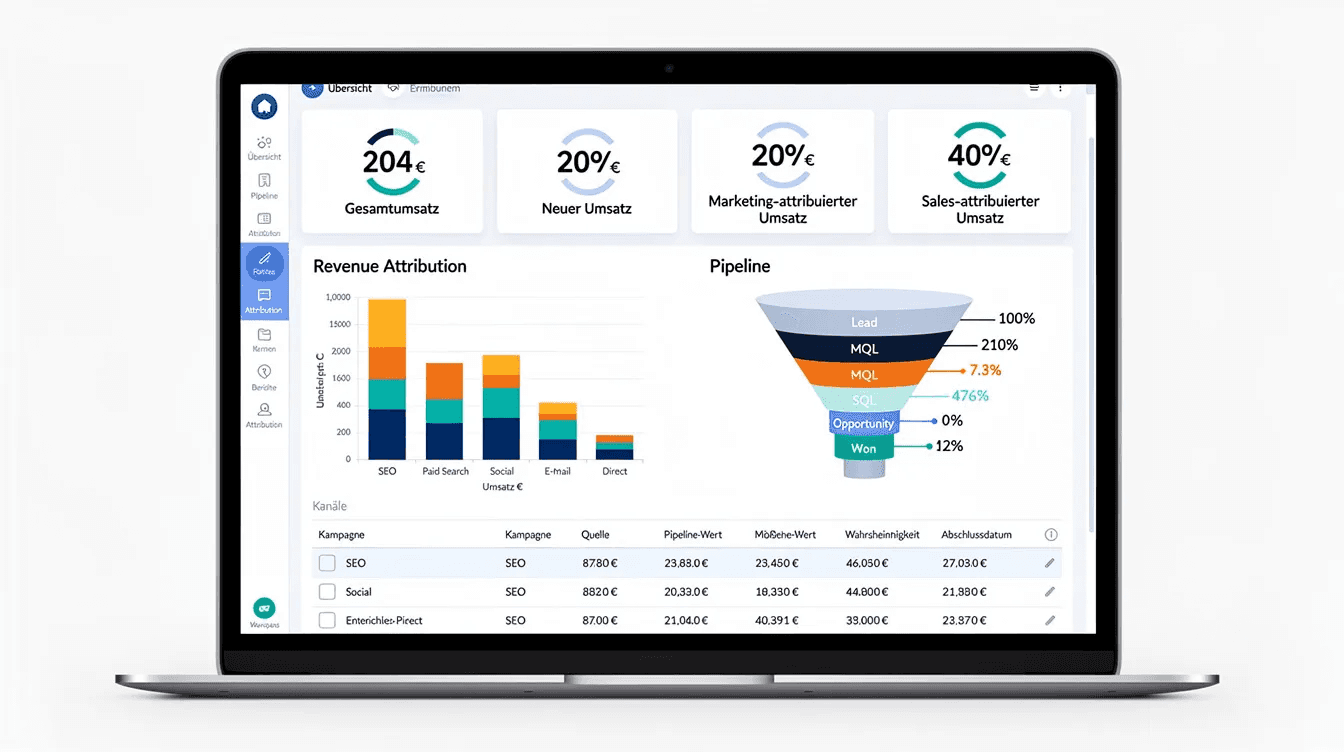
Comparison table: Agency approaches to CAC reduction
The following table summarizes the various types of agencies and their CAC reduction potential. Use this as a decision-making aid based on your specific business situation.
Criterion | iGrow / Growth Architecture | Traditional agency | Performance agency | Freelancer |
|---|---|---|---|---|
Time to result | 3-6 months | 6-12 months | 1-3 months | 2-4 months |
CAC reduction potential | 40-60% | 10-20% | 20-30% | 15-25% |
Sustainability | High | Medium | Low | Variable |
Monthly investment | €5,000-15,000 | €3,000-10,000 | €2,000-8,000 | €1,000-4,000 |
AI search readiness | Fully | None | Partly | Rarely |
Revenue attribution | Integrated | Optional | Basic | None |
Interpretation for different situations:
Startups with tight budgets: Freelancer for initial activities, then move to specialized agencies
Scale-ups under growth pressure: Growth architecture partners like iGrow for sustainable scaling
Established SaaS with fragmented channels: Consolidation under a strategic growth agency
The lowest monthly investment rarely leads to the best CAC reduction. Return on investment—measured by actual pipeline and customer lifetime value—determines economic efficiency.
Common CAC problems and solutions
Collaboration with marketing agencies often fails due to recurring problems. Knowing these stumbling blocks helps with agency selection and expectation management.
Rising CAC despite marketing investment
The problem: SaaS companies continuously invest more in marketing, yet customer acquisition costs keep rising. Google Ads become more expensive, organic reach decreases, and each new customer costs more than the previous one—a pattern often stemming from systemic causes of inadequate lead generation as outlined in 7 causes why marketing fails to generate leads.
The solution: Strategic growth architecture instead of tactical campaigns. iGrow structures demand capture so that cheaper channels (SEO, AI search) relieve the expensive channels (paid ads). Integrating multiple channels delivers 2.5x better ROAS than single-channel strategies.
Unclear attribution and hidden costs
The problem: 60% of B2B marketers lack multi-touch attribution. They don't know which channels actually help acquire customers and which costs just produce vanity metrics.
The solution: Complete revenue attribution from the first impression to the contract signing. iGrow implements tracking systems that transparently calculate actual costs per qualified lead and per acquired customer—inclusive of the effects of new SERP features like Google AI overviews in the DACH region. Hidden costs become visible and are eliminated.
Low lead quality with high volume
The problem: Marketing generates thousands of leads, but only a fraction qualify for sales. MQL-to-SQL conversion is at 10-15%, and the sales team spends time on unqualified contacts.
The solution: Qualified demand capture instead of wide lead generation. Content for specific buying stages, qualification scoring before handover to sales, and a focus on intent signals rather than form fills. iGrow prioritizes pipeline quality over lead quantity—measured by MQL-to-SQL rates of 40-50% instead of the industry standard of 15% and acts as a B2B growth partner and external revenue engine.
Summary and next steps
The main finding: Specialized B2B SaaS growth agencies reduce customer acquisition costs more sustainably than generic marketing providers. The difference lies in the strategic integration of SEO, AI search visibility, and performance marketing into a coherent demand capture strategy.
Agencies like iGrow act as growth architecture partners—they do not replace your CRM or marketing automation but structure the strategic layer above it: market positioning, AI search readiness, revenue attribution, and conversion infrastructure.
Immediate actions: If you cannot implement these steps internally, a specialized B2B growth partner like iGrow can assist in operational and strategic implementation.
Conduct a CAC audit: Capture all direct and hidden acquisition costs
ICP validation: Check whether your current marketing activities target the right customers
Channel analysis: Identify which channels deliver genuine pipeline and which only incur costs
Medium-term steps: If you are already working with an agency, a structured agency switch service for performance marketing can facilitate the transition to a growth partner with a stronger CAC focus.
Growth architecture assessment with a specialized agency like iGrow
Pilot project for integrated demand capture (SEO + AI search + Google Ads)
Stepwise scaling based on revenue attribution and proven CAC reduction

Further topics for your B2B SaaS marketing strategy:
AI search optimization and GEO (generative engine optimization)
Revenue attribution and multi-touch tracking
Growth marketing automation for complex sales cycles
Customer success and net revenue retention as CAC compensation
Additional resources
CAC benchmark calculator for B2B SaaS: Compare your current customer acquisition costs with industry averages by company size, ACV, and region. Contact us to arrange this together in our non-binding strategy call.
Agency selection checklist with SaaS-specific criteria:
Proven experience with B2B SaaS products
Integration of SEO, AI search, and performance marketing
Revenue attribution capabilities
DACH market expertise
Case studies with measurable CAC reduction
iGrow growth architecture framework: A structured approach to demand capture, consisting of a strategic level (market positioning, ICP, revenue strategy), channel level (SEO, AI search, Google Ads), and operational level (CRM, analytics, automation)—supported by a team that is committed to measurable results in about us at iGrow.
DACH B2B SaaS marketing trends 2026: AI search disruption, rising ad costs, consolidation of marketing channels, and revenue marketing as the standard for growth-oriented SaaS companies.
Specialized B2B SaaS marketing agencies reduce customer acquisition costs through integrated strategies such as SEO, AI search, and performance marketing, building scalable pipelines instead of short-term lead campaigns.
Introduction
Specialized B2B SaaS growth agencies like iGrow sustainably lower customer acquisition costs (CAC) through the strategic combination of SEO, AI search visibility, and Google Ads. Specialized agencies are particularly recommended because they specifically address the challenges in the B2B SaaS sector and provide effective measures for CAC reduction. In contrast to traditional marketing agencies that operate individual channels in isolation, these specialists create an integrated growth architecture that systematically captures existing demand and converts it into a qualified pipeline.
This article analyzes different types of agencies, their CAC reduction strategies, and measurable approaches for the DACH region. A particular focus is placed on inbound marketing, SEO, and content marketing, as well as a strong content marketing strategy, as these methods enable sustainable and scalable lead generation and lower CAC in the long term. Target audience analysis is essential to develop relevant buyer personas and optimize outreach. Success measurement is based on key metrics such as conversion rate, CAC, and customer lifetime value (CLV) to assess the profitability and efficiency of the measures. LinkedIn is a leading platform for customer acquisition in B2B marketing in the DACH region, with average CAC values for LinkedIn campaigns ranging from €900 to €1,500. Communities and review portals play an important role in visibility and trust, while marketplaces open up additional sales channels. Effective budget allocation across various marketing channels is crucial to optimizing CAC and achieving predictable growth. Modern data strategies support data-driven marketing measures and continuous improvement.
The direct answer: B2B SaaS marketing agencies effectively reduce CAC when they act as strategic growth architecture partners—not just as pure campaign service providers. Agencies like iGrow achieve 40-60% CAC reduction by connecting SEO structures, AI search readiness, and precise performance marketing.
What you take away from this article:
Clear agency selection criteria for sustainable CAC reduction
Comparison of different agency types and their CAC reduction potential
Concrete strategies for integrating SEO, AI search, and Google Ads
ROI measurement methods and revenue attribution for transparent success control
Practical implementation steps for your agency collaboration
Understanding customer acquisition costs in B2B SaaS
Customer acquisition cost (CAC) refers to the total marketing and sales costs in the SaaS context, divided by the number of newly acquired customers in a defined time frame. CAC is a central KPI for SaaS companies to evaluate the efficiency and cost-effectiveness of their marketing and sales efforts. The calculation includes: marketing budget, sales team costs, software licenses, content production, and all external agency expenses.
Many SaaS companies underestimate hidden costs such as internal time commitments, tool subscriptions, or opportunity costs from inefficient channels. A complete CAC calculation lays the foundation for any meaningful agency evaluation—and this is where generic marketing approaches regularly fail. The conversion rate is another essential metric, as it shows how effectively marketing measures turn leads into paying customers, thereby directly impacting the level of CAC and the cost-benefit ratio.
Besides CAC, the churn rate is a crucial metric for SaaS companies. It measures the percentage of customers who cancel their subscription within a specified period. A high churn rate can negatively affect the efficiency of marketing measures, as acquired customers quickly get lost again. The churn rate is typically calculated using the formula: (number of lost customers / total number of customers at the beginning of the period) x 100.
For assessing the profitability of marketing strategies, the ratio of customer lifetime value (CLV) to CAC is also critical. Only if the CLV is significantly higher than the CAC are the marketing measures economically viable in the long term and contribute to the sustainable growth of the SaaS company.
SaaS-specific CAC challenges
B2B SaaS products typically go through 6-12 touchpoints during the purchasing process. Sales cycles of 90 to 180 days in the B2B sector are normal in the DACH market—significantly longer than the global average of 60 days. These extended decision paths significantly increase customer acquisition costs since each additional touchpoint and each delay in the decision-making process drive up CAC. Targeted customer acquisition through various marketing channels such as SEO, paid search, or webinars is therefore critical to increase efficiency and secure profitability.
SaaS companies are characterized by a business model with recurring revenues and a strong focus on long-term customer relationships. Therefore, it is particularly important to tailor the outreach and support of the customer to the needs of the target audience and continuously maximize customer benefits to create sustainable attachment—a solid foundation for sustainable B2B customer acquisition.
Buying committees of 4-8 decision-makers further complicate targeting. While B2C marketing directly targets end customers, B2B SaaS marketing must address various stakeholders with different information needs. Traditional B2B marketing, focused on cold acquisition or email marketing, achieves response rates of only 2-5%.
DACH market benchmarks for B2B SaaS CAC
The current benchmarks for customer acquisition costs in the German-speaking region show significant differences by company size:
Company phase | Average CAC | ACV ratio |
|---|---|---|
Startups (Seed-Series A) | €350 - €600 | 1:3 to 1:4 |
Scale-ups (Series B+) | €150 - €300 | 1:4 to 1:6 |
Established SaaS | €200 - €400 | 1:5 to 1:8 |
These values are based on aggregated industry data. Key for agency selection: Specialized B2B SaaS growth agencies achieve CAC reductions of 30-50% compared to generic marketing approaches—a realistic goal for most SaaS companies. |
To achieve these benchmarks and sustainably reduce customer acquisition costs, a well-thought-out pricing strategy and a holistic SaaS marketing strategy are essential.
Content marketing: An effective method for customer acquisition
Content marketing is one of the most effective methods in B2B marketing for SaaS companies to sustainably lower customer acquisition costs (CAC) and make customer acquisition more efficient. By deliberately creating and distributing high-quality, relevant content, companies can not only increase their visibility in the market but also generate qualified leads and improve the return on investment (ROI) of their marketing measures.
A well-thought-out content marketing approach begins with a clear target audience analysis: What topics are relevant to your potential customers? Which challenges do they want to solve? Based on these insights, SaaS companies develop content such as practical blog articles, in-depth whitepapers, case studies, or industry-specific guides. Especially whitepapers and data-based benchmarks provide substantial value in the B2B sector, as they deliver decision-makers with well-founded information for their purchasing decision, effectively supporting typical inbound marketing strategies in B2B.
It is essential that content marketing is not seen as a mere advertising measure. Instead, the focus is on building trust and expertise. By integrating SEO strategies, the content is made optimally discoverable by search engines, which promotes organic lead generation and further reduces customer acquisition costs (CAC)—especially when a specialized B2B SEO agency for stable leads without ads is involved. Companies that regularly publish relevant content and optimize it based on data achieve demonstrably better benchmarks in lead quality and the ROI of their marketing expenditures.
Another advantage: Content marketing works long-term. While paid campaigns often achieve only short-term effects, high-quality content builds a sustainable pipeline and strengthens the positioning of the SaaS company as a thought leader in the market. Thus, content marketing becomes a key lever to lower customer acquisition costs and make customer acquisition in the B2B sector more efficient.
Account-based marketing: A targeted approach
Account-based marketing (ABM) is one of the most effective strategies for SaaS companies to specifically lower customer acquisition costs (CAC) and maximize ROI in B2B marketing. In contrast to broad marketing measures, ABM focuses on the individual outreach of selected target accounts that offer the highest potential for successful customer acquisition.
The key to success lies in the precise selection and segmentation of target companies. With the help of modern targeting options and data-driven strategies, SaaS companies identify the accounts that best fit their product and growth strategy. Subsequently, personalized marketing measures are developed—from tailored email campaigns to individual landing pages and exclusive webinars or events that specifically address the needs and challenges of the target accounts.
An example from practice: Through the use of marketing automation, personalized emails can be automated and sent to relevant decision-makers within a target company. These emails address specific pain points and offer individual solutions, which significantly increases the likelihood of a positive response and ultimately conversion. Continuous analysis of benchmarks and performance data allows for constant optimization of ABM strategies and further enhances the efficiency of customer acquisition.
Account-based marketing thus offers SaaS companies in the B2B sector the opportunity to deploy their resources effectively, minimize wastage, and significantly lower customer acquisition costs (CAC)—especially when ABM is combined with a clear AI search strategy for B2B marketing. At the same time, the ROI increases as the measures are precisely targeted at the accounts that provide the most value to the company. ABM is therefore an indispensable part of a modern SaaS marketing strategy for achieving sustainable growth and measurable success.
Types of agencies and their CAC reduction approaches
Not all marketing agencies can effectively lower SaaS customer acquisition costs. Successful agencies pursue a holistic approach that integrates all relevant aspects of SaaS marketing—from target audience outreach and content creation to cross-channel implementation—to sustainably reduce CAC. The choice of the right type of agency directly impacts the sustainability of your CAC optimization and the return on investment of your marketing expenditures.
Four main categories dominate the market—with fundamental differences in strategy, time horizon, and CAC reduction potential.
Traditional marketing agencies
Traditional agencies bring strengths in branding, content marketing, and social media. They understand classic B2B marketing and have established processes for campaign management.
The weaknesses for B2B SaaS marketing lie in the lack of understanding of complex buying journeys, weak revenue attribution, and poor integration of performance channels. Generic approaches often lead to higher CAC because they optimize for reach rather than qualified leads. The focus on awareness rather than demand capture ignores the fact that 70% of B2B SaaS demand already exists—it just needs to be captured.
Performance marketing agencies
Performance agencies focus on short-term lead generation through Google Ads, LinkedIn marketing, and paid ads. They deliver quick results and transparent costs per lead.
For complex SaaS products, this approach has its limits. Without an SEO foundation, acquisition costs continuously rise—up to 40% annually in the DACH market due to pure ads dependence. CPCs for relevant SaaS keywords like "CRM software" already exceed €10-€20. Performance-only strategies also neglect sustainable positioning in AI search platforms like ChatGPT and Perplexity.
Specialized B2B SaaS growth agencies
Specialized growth agencies like iGrow systematically lower CAC by integrating SEO, AI search visibility, and Google Ads. They act as strategic growth architecture partners, not just as campaign executors.
iGrow positions itself as the strategic layer above operational tools like CRMs and analytics platforms. The integration starts with market positioning and ICP definition, extends through SEO structures and targeted AI search & geo positioning to the conversion infrastructure. This approach delivers leads that are 40% cheaper than pure ads strategies and creates lasting visibility at a time when 15-20% of all search queries are already answered by AI overviews.
Hybrid revenue marketing agencies
Hybrid agencies combine marketing and sales enablement for a comprehensive revenue perspective. They understand the entire funnel from awareness to closure and integrate sales into the marketing strategy, similar to what a holistic revenue marketing approach from lead generation to revenue machine demands.
Benefits for larger SaaS companies: alignment between marketing and sales teams, integrated pipeline management. Disadvantages for startups: higher complexity, longer implementation times, larger minimum budgets. The right choice depends on company size and internal resources.
The iGrow approach to CAC reduction
iGrow acts as a growth architecture partner for B2B SaaS companies in the DACH region. The approach fundamentally differs from classic agencies: Instead of operating individual marketing channels, iGrow structures the entire system of demand generation, lead qualification, and revenue attribution. Specialized SaaS teams focus specifically on data-driven strategies by integrating CRM and automation systems and using first-party data to sustainably lower customer acquisition costs (CAC).
The multi-stage methodology addresses the most common pain points of SaaS companies: lack of qualified leads despite traffic, fragmented channels without attribution, and unclear ROI of marketing measures.
Growth architecture setup
The first step involves a complete analysis: market positioning, ICP definition, and revenue attribution form the foundation. iGrow identifies where existing demand exists and which channels can capture it most efficiently.
Technical SEO fundamentals: Topic clusters for organic growth, structured data for AI search readiness, content architectures that are understood and recommended by ChatGPT and Perplexity—all embedded in a sales-oriented B2B SEO strategy.
Conversion infrastructure: Landing pages for specific buying intent stages, comparison content for research phases, qualification tracking for genuine lead quality instead of volume metrics.
Time frame: 4-6 weeks for full implementation. During this phase, no campaigns are launched; instead, the strategic foundations are laid that enable sustainable CAC reduction.
Integrated demand capture strategy
iGrow combines SEO and Google Ads to capture existing demand—70% of B2B SaaS search queries already show a concrete buying intent. Ignoring this demand and instead focusing on awareness wastes marketing budget.
AI-optimized content structures: Content that platforms like ChatGPT, Perplexity, and Google AI overviews understand. By 2027, it is estimated that 50% of all B2B searches will occur through AI interfaces. SaaS companies lacking AI search readiness will lose this visibility entirely.
Problem-solution mapping: Comparison content like "SaaS CRM comparison" converts 5x better than generic awareness content. iGrow structures this content systematically for each stage of the buying journey.
Typical results: CAC reduction of 40-60% within 6 months, doubling of qualified pipeline, and 2-4x increase in organic traffic through SEO topic clusters.
Revenue attribution and optimization
Multi-touch attribution replaces the guessing about marketing effectiveness. iGrow implements tracking systems that measure the actual revenue contribution of each channel and each campaign—not just clicks or leads, but real pipeline and revenue, addressing the common pipeline rather than lead problem in B2B.
Continuous funnel optimization: A/B tests at critical conversion points typically deliver a 15-25% uplift. Monthly performance reviews identify optimization potential and adjust strategies.
Qualified pipeline generation: The focus is on MQL-to-SQL conversion rather than lead quantity. While typical B2B SaaS funnels show an 80% drop-off between MQL and SQL, iGrow optimized funnels achieve a 40-50% conversion through better qualification—provided the differences between MQL and SQL in B2B sales are clearly defined.
Comparison table: Agency approaches to CAC reduction
The following table summarizes the various types of agencies and their CAC reduction potential. Use this as a decision-making aid based on your specific business situation.
Criterion | iGrow / Growth Architecture | Traditional agency | Performance agency | Freelancer |
|---|---|---|---|---|
Time to result | 3-6 months | 6-12 months | 1-3 months | 2-4 months |
CAC reduction potential | 40-60% | 10-20% | 20-30% | 15-25% |
Sustainability | High | Medium | Low | Variable |
Monthly investment | €5,000-15,000 | €3,000-10,000 | €2,000-8,000 | €1,000-4,000 |
AI search readiness | Fully | None | Partly | Rarely |
Revenue attribution | Integrated | Optional | Basic | None |
Interpretation for different situations:
Startups with tight budgets: Freelancer for initial activities, then move to specialized agencies
Scale-ups under growth pressure: Growth architecture partners like iGrow for sustainable scaling
Established SaaS with fragmented channels: Consolidation under a strategic growth agency
The lowest monthly investment rarely leads to the best CAC reduction. Return on investment—measured by actual pipeline and customer lifetime value—determines economic efficiency.
Common CAC problems and solutions
Collaboration with marketing agencies often fails due to recurring problems. Knowing these stumbling blocks helps with agency selection and expectation management.
Rising CAC despite marketing investment
The problem: SaaS companies continuously invest more in marketing, yet customer acquisition costs keep rising. Google Ads become more expensive, organic reach decreases, and each new customer costs more than the previous one—a pattern often stemming from systemic causes of inadequate lead generation as outlined in 7 causes why marketing fails to generate leads.
The solution: Strategic growth architecture instead of tactical campaigns. iGrow structures demand capture so that cheaper channels (SEO, AI search) relieve the expensive channels (paid ads). Integrating multiple channels delivers 2.5x better ROAS than single-channel strategies.
Unclear attribution and hidden costs
The problem: 60% of B2B marketers lack multi-touch attribution. They don't know which channels actually help acquire customers and which costs just produce vanity metrics.
The solution: Complete revenue attribution from the first impression to the contract signing. iGrow implements tracking systems that transparently calculate actual costs per qualified lead and per acquired customer—inclusive of the effects of new SERP features like Google AI overviews in the DACH region. Hidden costs become visible and are eliminated.
Low lead quality with high volume
The problem: Marketing generates thousands of leads, but only a fraction qualify for sales. MQL-to-SQL conversion is at 10-15%, and the sales team spends time on unqualified contacts.
The solution: Qualified demand capture instead of wide lead generation. Content for specific buying stages, qualification scoring before handover to sales, and a focus on intent signals rather than form fills. iGrow prioritizes pipeline quality over lead quantity—measured by MQL-to-SQL rates of 40-50% instead of the industry standard of 15% and acts as a B2B growth partner and external revenue engine.
Summary and next steps
The main finding: Specialized B2B SaaS growth agencies reduce customer acquisition costs more sustainably than generic marketing providers. The difference lies in the strategic integration of SEO, AI search visibility, and performance marketing into a coherent demand capture strategy.
Agencies like iGrow act as growth architecture partners—they do not replace your CRM or marketing automation but structure the strategic layer above it: market positioning, AI search readiness, revenue attribution, and conversion infrastructure.
Immediate actions: If you cannot implement these steps internally, a specialized B2B growth partner like iGrow can assist in operational and strategic implementation.
Conduct a CAC audit: Capture all direct and hidden acquisition costs
ICP validation: Check whether your current marketing activities target the right customers
Channel analysis: Identify which channels deliver genuine pipeline and which only incur costs
Medium-term steps: If you are already working with an agency, a structured agency switch service for performance marketing can facilitate the transition to a growth partner with a stronger CAC focus.
Growth architecture assessment with a specialized agency like iGrow
Pilot project for integrated demand capture (SEO + AI search + Google Ads)
Stepwise scaling based on revenue attribution and proven CAC reduction
Further topics for your B2B SaaS marketing strategy:
AI search optimization and GEO (generative engine optimization)
Revenue attribution and multi-touch tracking
Growth marketing automation for complex sales cycles
Customer success and net revenue retention as CAC compensation
Additional resources
CAC benchmark calculator for B2B SaaS: Compare your current customer acquisition costs with industry averages by company size, ACV, and region. Contact us to arrange this together in our non-binding strategy call.
Agency selection checklist with SaaS-specific criteria:
Proven experience with B2B SaaS products
Integration of SEO, AI search, and performance marketing
Revenue attribution capabilities
DACH market expertise
Case studies with measurable CAC reduction
iGrow growth architecture framework: A structured approach to demand capture, consisting of a strategic level (market positioning, ICP, revenue strategy), channel level (SEO, AI search, Google Ads), and operational level (CRM, analytics, automation)—supported by a team that is committed to measurable results in about us at iGrow.
DACH B2B SaaS marketing trends 2026: AI search disruption, rising ad costs, consolidation of marketing channels, and revenue marketing as the standard for growth-oriented SaaS companies.
Written by:

Edin
Author & Founder
Share this article
Share on X
Share on f
Share on in
What is Customer Acquisition Cost (CAC) in SaaS marketing?
CAC describes the total costs of acquiring a new customer. This includes marketing budget, sales costs, tools, content production, and agency services. In the SaaS model, CAC is one of the most important metrics because it directly determines whether growth is profitable.
Why are CAC in B2B SaaS often so high?
B2B SaaS hat lange Entscheidungszyklen und mehrere Stakeholder. Typisch sind 6–12 Touchpoints und Sales-Zyklen von 90–180 Tagen. Jeder zusätzliche Kontaktpunkt erhöht die Kosten der Kundengewinnung.
Which marketing strategy effectively reduces CAC the most?
Die effektivste Strategie kombiniert mehrere Kanäle: SEO, AI Search Visibility und Performance Marketing. So wird bestehende Nachfrage erfasst und in qualifizierte Leads umgewandelt. Reine Ads-Strategien treiben die Kosten langfristig nach oben.
Warum reichen reine Performance Ads für SaaS oft nicht aus?Tools sind für den Mittelstand unverzichtbar?
Ads liefern schnell Leads, aber ohne SEO-Fundament steigen die Kosten kontinuierlich. Besonders im SaaS-Bereich sind Keywords oft teuer. Viele relevante Keywords liegen bereits bei 10–20 € CPC oder mehr.
What role does content marketing play in reducing CAC?
Content Marketing generiert organische Nachfrage. Hochwertige Inhalte wie Guides, Whitepaper oder Case Studies bauen Vertrauen auf und liefern langfristig qualifizierte Leads. Dadurch sinken die Kosten pro Kunde deutlich.
Related Insights for Success
What is Customer Acquisition Cost (CAC) in SaaS marketing?
CAC describes the total costs of acquiring a new customer. This includes marketing budget, sales costs, tools, content production, and agency services. In the SaaS model, CAC is one of the most important metrics because it directly determines whether growth is profitable.
Why are CAC in B2B SaaS often so high?
B2B SaaS hat lange Entscheidungszyklen und mehrere Stakeholder. Typisch sind 6–12 Touchpoints und Sales-Zyklen von 90–180 Tagen. Jeder zusätzliche Kontaktpunkt erhöht die Kosten der Kundengewinnung.
Which marketing strategy effectively reduces CAC the most?
Die effektivste Strategie kombiniert mehrere Kanäle: SEO, AI Search Visibility und Performance Marketing. So wird bestehende Nachfrage erfasst und in qualifizierte Leads umgewandelt. Reine Ads-Strategien treiben die Kosten langfristig nach oben.
Warum reichen reine Performance Ads für SaaS oft nicht aus?Tools sind für den Mittelstand unverzichtbar?
Ads liefern schnell Leads, aber ohne SEO-Fundament steigen die Kosten kontinuierlich. Besonders im SaaS-Bereich sind Keywords oft teuer. Viele relevante Keywords liegen bereits bei 10–20 € CPC oder mehr.
What role does content marketing play in reducing CAC?
Content Marketing generiert organische Nachfrage. Hochwertige Inhalte wie Guides, Whitepaper oder Case Studies bauen Vertrauen auf und liefern langfristig qualifizierte Leads. Dadurch sinken die Kosten pro Kunde deutlich.
Related Insights for Success
What is Customer Acquisition Cost (CAC) in SaaS marketing?
CAC describes the total costs of acquiring a new customer. This includes marketing budget, sales costs, tools, content production, and agency services. In the SaaS model, CAC is one of the most important metrics because it directly determines whether growth is profitable.
Why are CAC in B2B SaaS often so high?
B2B SaaS hat lange Entscheidungszyklen und mehrere Stakeholder. Typisch sind 6–12 Touchpoints und Sales-Zyklen von 90–180 Tagen. Jeder zusätzliche Kontaktpunkt erhöht die Kosten der Kundengewinnung.
Which marketing strategy effectively reduces CAC the most?
Die effektivste Strategie kombiniert mehrere Kanäle: SEO, AI Search Visibility und Performance Marketing. So wird bestehende Nachfrage erfasst und in qualifizierte Leads umgewandelt. Reine Ads-Strategien treiben die Kosten langfristig nach oben.
Warum reichen reine Performance Ads für SaaS oft nicht aus?Tools sind für den Mittelstand unverzichtbar?
Ads liefern schnell Leads, aber ohne SEO-Fundament steigen die Kosten kontinuierlich. Besonders im SaaS-Bereich sind Keywords oft teuer. Viele relevante Keywords liegen bereits bei 10–20 € CPC oder mehr.
What role does content marketing play in reducing CAC?
Content Marketing generiert organische Nachfrage. Hochwertige Inhalte wie Guides, Whitepaper oder Case Studies bauen Vertrauen auf und liefern langfristig qualifizierte Leads. Dadurch sinken die Kosten pro Kunde deutlich.