SaaS Case Study B2B Agency iGrow: How Structure Changes AI Visibility, Conversions, and Revenue in B2B in Measurable Ways
SaaS Case Study B2B Agency iGrow: How Structure Changes AI Visibility, Conversions, and Revenue in B2B in Measurable Ways
These case studies show why B2B growth today does not fail due to demand but rather due to a lack of structure for search engines, AI systems, and purchasing decisions.
B2B SaaS and tech companies rarely fail today because of the product. In most cases, they fail because machines do not understand what they are offering, who it is relevant for, and when it should be suggested. The following three iGrow case studies illustrate this pattern in different forms and how it has been systematically solved. Such case studies serve as inspiring examples of success in B2B marketing, as they present concrete results, challenges, and solutions from practice.
Compared to classic B2C marketing, SaaS marketing in the B2B context is significantly different: longer sales cycles, complex decision-making processes, and the establishment of long-term customer relationships are at the forefront. While B2C marketing often targets quick purchase decisions, B2B SaaS marketing focuses on specifically addressing buyers, building trust, and communicating clear promises to achieve sustainable SaaS growth.
A specialized B2B SaaS agency acts as a strategic partner for IT companies and B2B SaaS firms by working with an experienced team and a deep understanding of the industry, topics, and buyer needs. The agency develops a data-driven approach and a structured method to manage projects efficiently and achieve measurable results. Through targeted measures, such as developing lead strategies, optimizing the pipeline, and continually monitoring results, sustainable successes are achieved for clients. The agency values clear communication, building strong brands, developing creative ideas, and conducting training to support client company employees. A dedicated contact person ensures smooth project coordination and regular updates. The agency's services encompass everything from content creation to SEO to performance controlling, with each project tailored to the specific needs of clients and the peculiarities of the respective industry. At the core of this approach is building long-term customer relationships, the authenticity of measures, and achieving defined KPIs—put simply.
SaaS agencies provide assistance in reducing manual tasks, optimizing internal processes, and expediting project execution. They support B2B SaaS firms in building repeatable sales and marketing structures aimed at sustainable growth and a predictable pipeline. By developing personalized marketing strategies, implementing lead nurturing, adapting landing pages, and utilizing SEO and content marketing as primary acquisition channels, qualified leads are generated and conversion rates significantly increased. Continuous performance monitoring and data-driven optimization of measures secure long-term success and customer loyalty. Revenue-based case studies demonstrating improvements in the pipeline, conversions, and customer retention are a central element in making the effectiveness of agency services transparent.
The authenticity and credibility of case studies are crucial for building trust with potential buyers. Case studies are one of the most effective marketing tools in B2B, as they demonstrate real challenges and solutions, address the specific needs of the target audience, and serve as compelling examples of customer success.
Well-known case studies such as those from Novexx Solutions (AIM Case Study Award 2017), BlackBerry (increasing security and productivity in the construction industry), and Lindner Hotels (innovative recruiting strategies) are further examples that underline the impact and diversity of successful B2B case studies.
Now let's focus on our most recent case studies from ongoing client projects at iGrow:
Case Study 1: SoWork
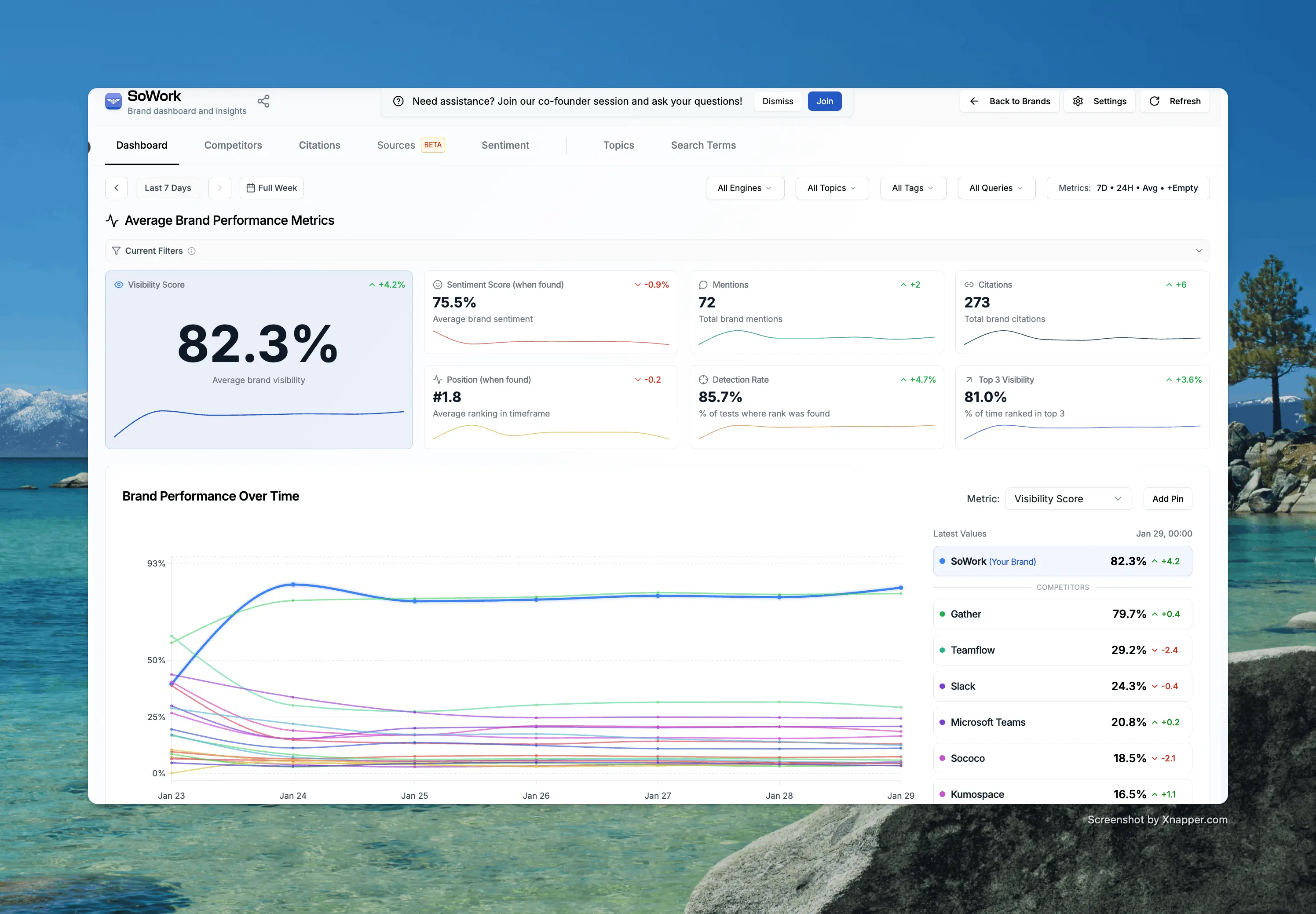
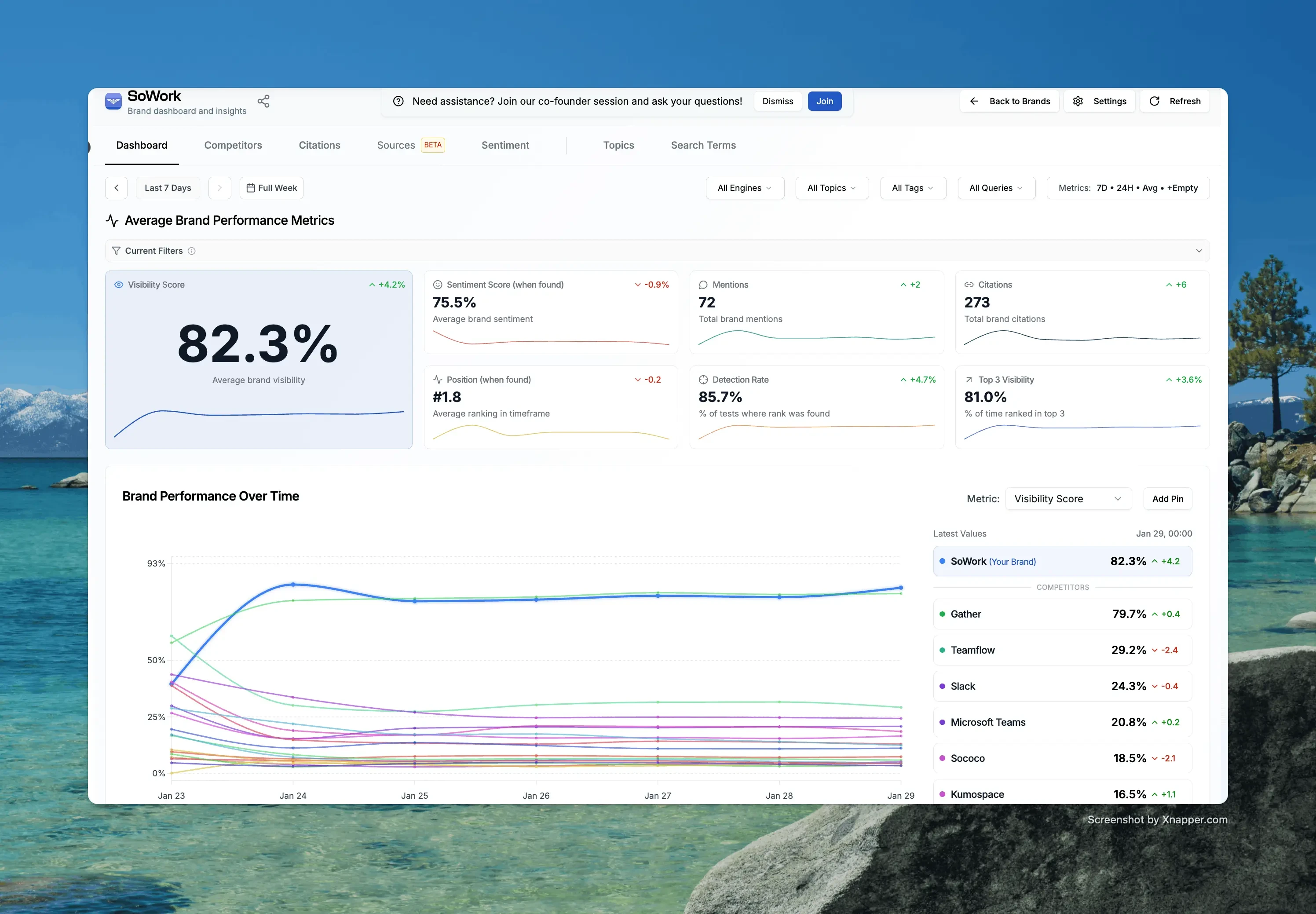
From 16.6% to 82.3% AI Visibility in 22 days
SoWork is an AI-powered digital HQ for remote teams. The product is persistently built, presence-based, and intentionally designed without the traditional meeting compulsion. The goal is to make collaboration permanently visible and avoid tool wild growth. On the product side, SoWork was strong from the start. In direct comparisons, it performed better than Gather, provided deeper work logic than Kumospace, and had a clearer structure than experimental workspace approaches like Roam. As a strategic partner for IT companies in the B2B SaaS space, we supported our clients as a SaaS marketing agency to achieve sustainable SaaS growth and successfully implement complex projects.
At the project outset, the issue was not with the product, but entirely with visibility to machines. In Google Search, AI overviews, ChatGPT, Perplexity, and Bing Copilot, SoWork was not reliably understood, misclassified, and therefore not cited accordingly.
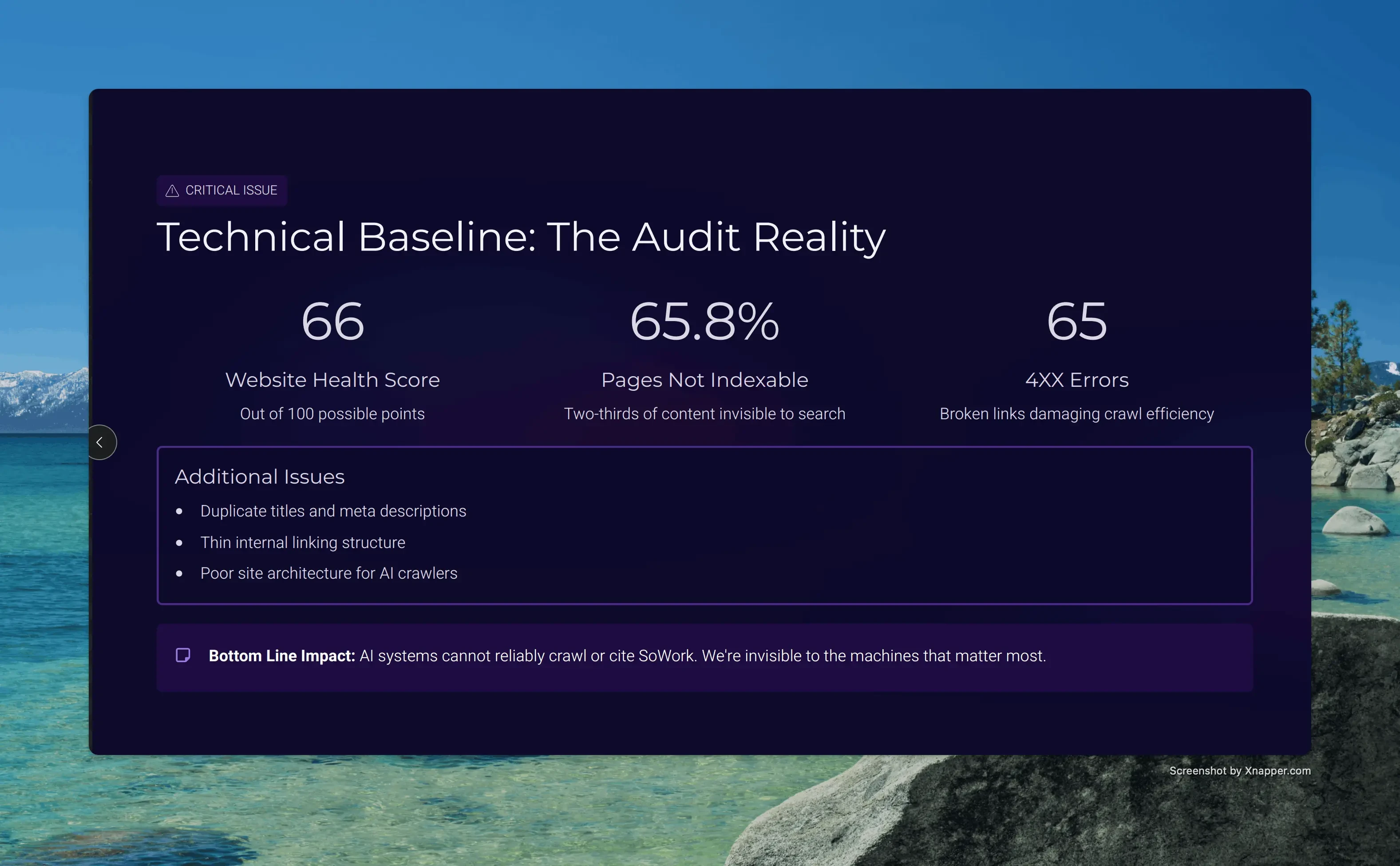
The initial analysis showed a website health score of 66/100. About 66% of the pages were not indexable, there were over 60 4XX errors actively blocking crawling. The entity structure was weak, comparison pages were completely missing, there was no glossary, and no clean AI grounding. AI systems could not reliably crawl, classify, or cite SoWork. The central insight was: SoWork won almost every comparison—but was too rarely found before the comparison.
The strategic decision was made in week 0. No additional content was produced, nor was broad advertising initiated. Instead, three goals were defined: clearly explain to machines what SoWork is, establish clear decision and comparison signals, and scale AI search concurrently with performance marketing. The aim was to make SoWork the most citable virtual office alternative in the market.
In week 1, the focus was solely on the technical foundation. More than 60 4XX errors were eliminated, the sitemap cleaned, canonicals set correctly, and duplicate titles and metas removed. Simultaneously, the first clean /vs pages, clear feature assignments, and the structural basis for comparison and alternative content were established. Following this phase, AI crawlers could read the website stably for the first time. The targeted use of SaaS solutions significantly reduced manual tasks and accelerated project execution.
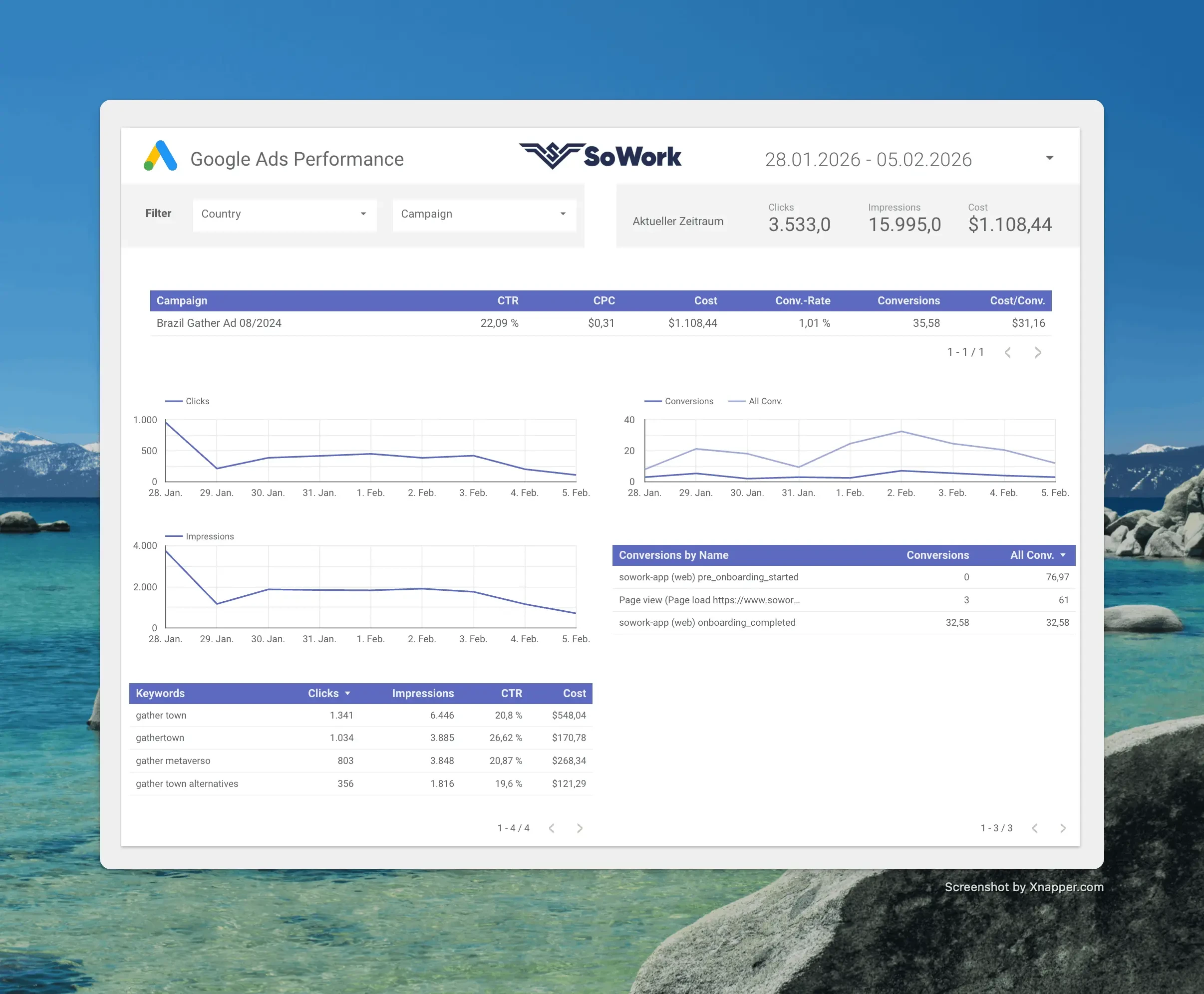
At the same time, Google Ads 2.0 went live. Not generic, but strictly aimed at business intent. The conversion goal was "Office Creation Completed". Previously, the conversion tracking was geared towards pageviews. After just a few days, the first +30 qualified hard conversion leads were generated! Ads not only delivered traffic but also clean intent data that was specifically used as feedback for content structure and AI search.
From week 2, phase 2 began with a focus on AI search and money prompts. Among other things, “Gather alternative” and “Best virtual office software in 2026” were defined. In the short term, the AI visibility score measurably declined as new prompts expanded the assessment basis. Within 24 hours, however, the first mentions of SoWork appeared in AI systems:
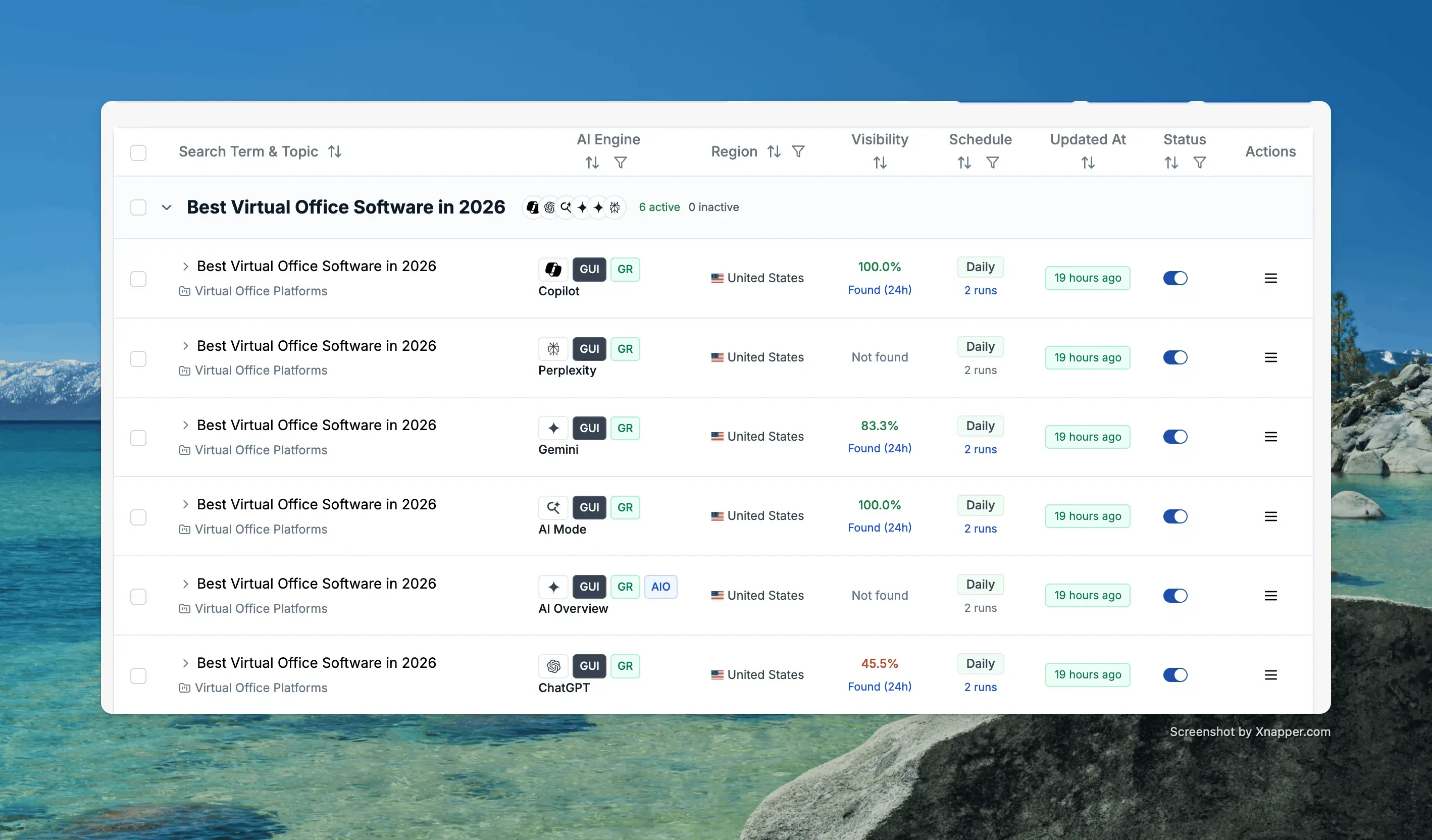
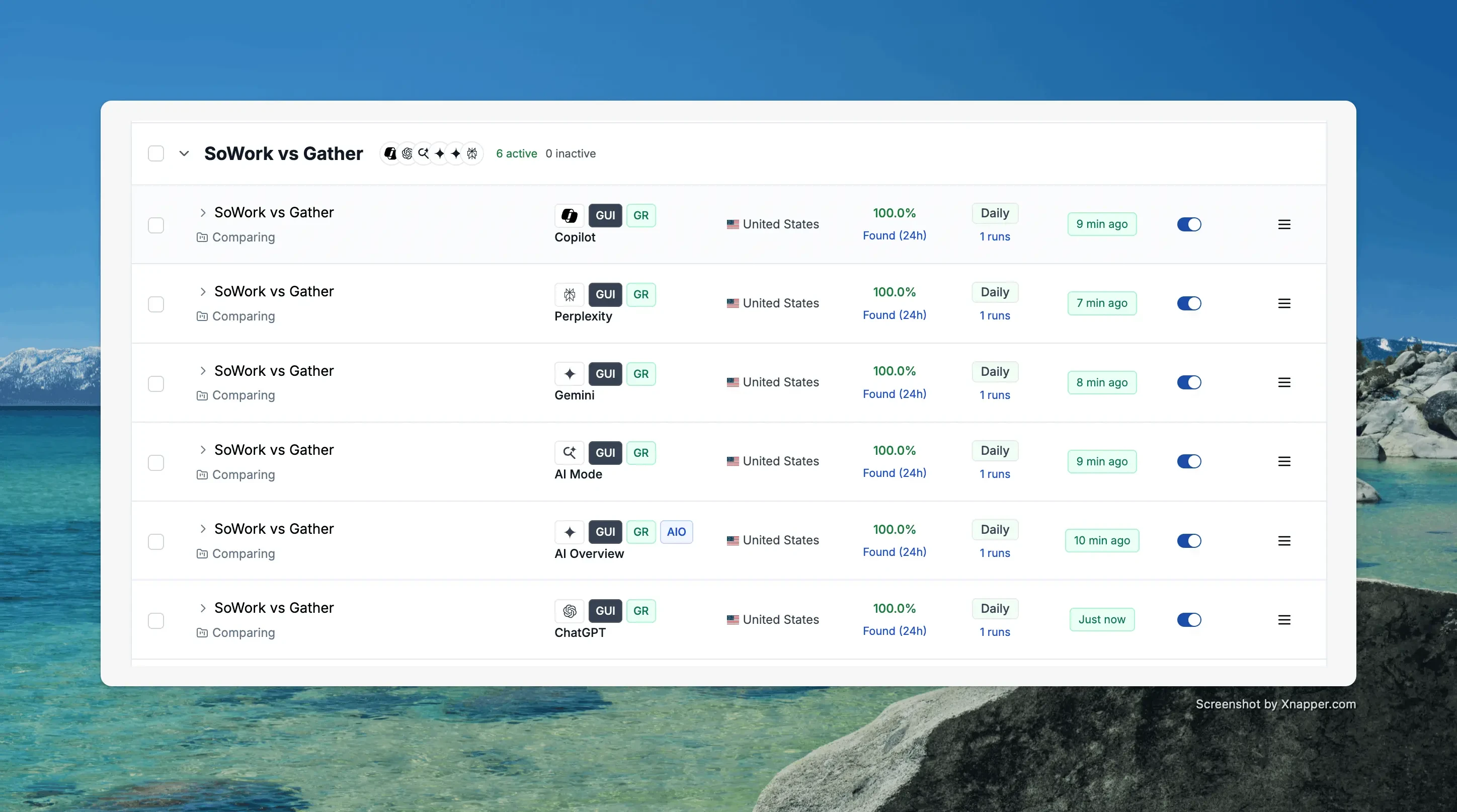
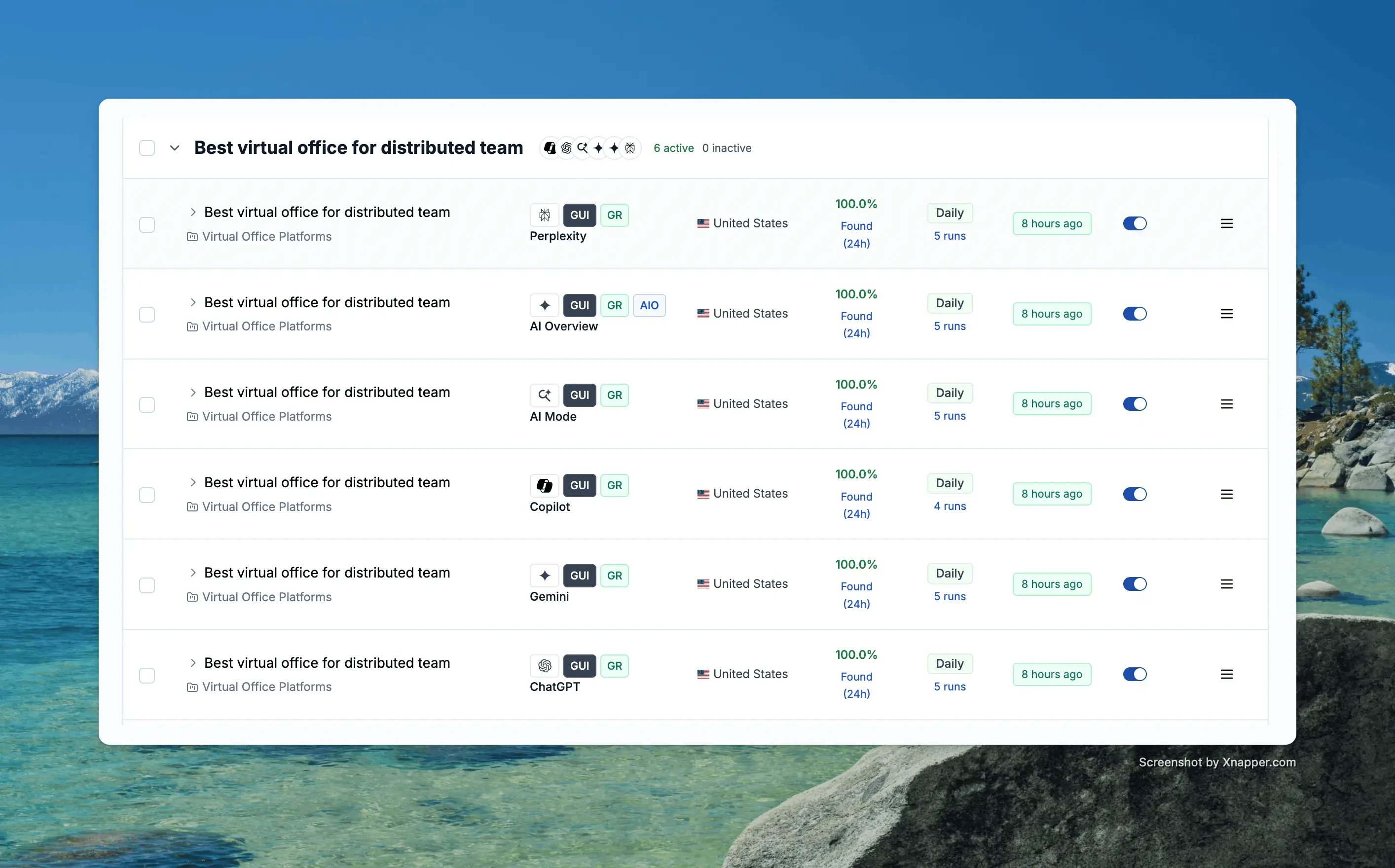
On February 2, the first new money-prompt article "Best virtual office for distributed teams" (from the new money-prompt pool) was published. In less than 24 hours, this content garnered the first AI citations, visibility across multiple AI engines, and a clear thematic assignment.
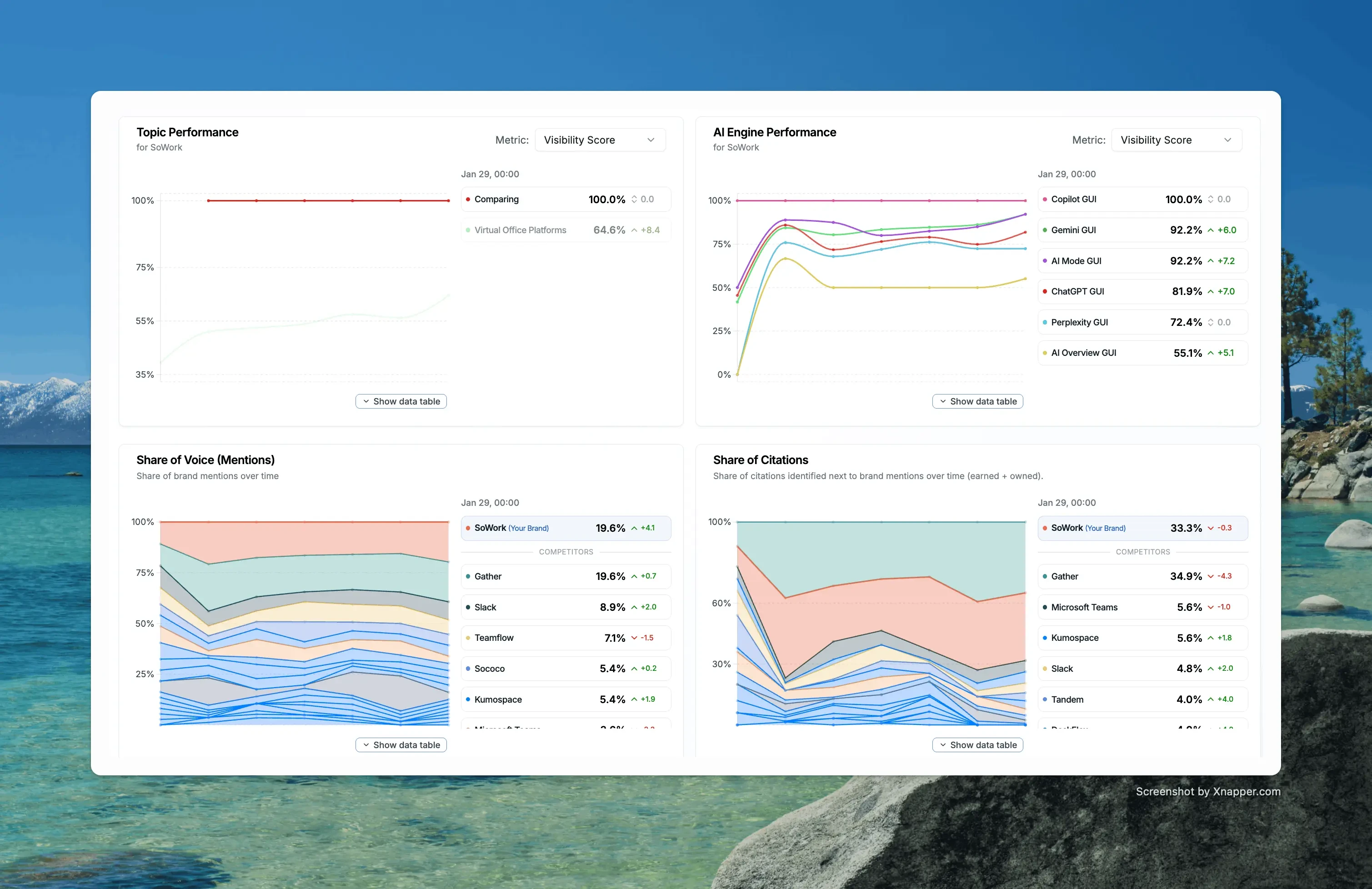
After 22 days, the AI visibility stood at 82.3%, up from 16.6%. In selected AI systems, 100% visibility was achieved, and the share of citations was 33.3% over grounding pages. Concurrently, over 32 "Office Creation Done" conversions came from Google Ads.
A structured approach was followed in the measures taken: Together with a client, we developed a project tailored to the specific requirements of B2B SaaS companies and their buyers. The working method included developing and implementing targeted services tailored to the industry and relevant topics. By establishing clear processes, involving all employees, and defining contact persons, efficient communication was ensured.
As an agency, we focused on data-driven measures to strengthen the pipeline, shorten sales cycles, and achieve sustainable success. The results were continuously monitored, interpreted, and optimized to promote SaaS growth. The combination of content optimization, targeted training, lead nurturing, personalized marketing strategies, and the use of SEO and content marketing enabled us to significantly boost conversion rates and strengthen the company's brand presence.
iGrow ensures that every measure is linked to real revenue results, and that the needs of clients and buyers are at the center of our efforts. By integrating case studies that authentically demonstrate the help and benefits to other companies, trust in the agency's services and promises was strengthened. Clear communication of the idea and USP, focusing on everything relevant, and the industry-specific addressing of the target audience were crucial for the project's success.
The continuous monitoring of performance and the data-driven optimization of marketing measures were central components of the working method, ensuring sustainable results and a strong pipeline.
A special focus was placed on developing lead strategies that functioned across channels and were tailored to the client's product. Content optimization led to a significant increase in organic traffic, while lead nurturing through email marketing campaigns and personalized marketing strategies were able to grow by as much as 40%. Utilizing SEO and content marketing as the main acquisition channels as well as adapting landing pages to optimize conversion rates were crucial for the successful implementation of the measures.
Revenue-based case studies demonstrating improvements in pipeline, conversions, and customer retention are particularly important for B2B SaaS companies. They show how we, as an agency, achieve sustainable success and measurable results through targeted measures and a deep understanding of the industry.
The authenticity and trust created through case studies make us one of the most effective "marketing tools" in the B2B sector. Case studies persuade potential buyers by demonstrating real challenges and solutions, thus strengthening the brand's credibility.
Other well-known case studies such as those from Novexx Solutions (AIM Case Study Award 2017), BlackBerry (security and productivity increase in the construction industry), and Lindner Hotels (innovative recruiting strategies) show how companies from different industries can achieve sustainable success through targeted measures and authentic communication.
The learning was clear: SoWork did not have a demand problem, but rather a problem of explanation for machines.
Case Study 2: RankScale.ai
+39% close rate without a single euro in ad spend

RankScale.ai had a high level of interest and numerous sales talks at the start of the project. However, immediate closings were rare. The drop-off rate between the first contact and closing was initially unknown. The problem was not with the product but in the sales and decision-making process. We have written a detailed case study on this.
The analysis showed a funnel that was too complex, with too many steps and too high entry barriers. Prospects, i.e., potential buyers, lost orientation and momentum. Targeted lead qualification can shorten sales cycles by up to 30% by making the pipeline more efficient and identifying relevant contacts early in the decision-making process. More traffic would not have solved this problem.
Within the project framework, targeted measures were developed to ensure the creation of a clear, repeatable process. The team's working method was characterized by a deep understanding of the industry, the topics, and the needs of clients. We focused on data-driven communication and continuous performance monitoring to make the results and success of measures measurable. Through close collaboration of employees and the inclusion of demo scripts, it was ensured that all relevant aspects—from the development of the idea to the implementation of services—were covered. The strategic approach included the development of revenue-based case studies that demonstrate improvements in pipeline, conversions, and customer retention. Long-term customer relationships were prioritized instead of merely achieving short-term revenues.
We ensured not to make empty promises but to clearly communicate the USP of the company and strengthen brand identity. Communication with the contacts at B2B SaaS companies was always precise and industry-specific to explain complex topics understandably. The approach was to enable sustainable SaaS growth and optimize sales cycles through targeted measures and the assistance of an experienced team. The results were regularly documented in project controlling, and all relevant key figures were monitored to substantiate the success and effectiveness of the measures. This ensured that nothing was left to chance, but everything was aimed at an effective and efficient implementation of the goals—from the first idea to measurable success.
The result was measurable after 9 weeks. The close rate increased by 39%, resulting in €10,000 additional revenue, with €0 in ad spend. RankScale.ai thus demonstrated that structure in the funnel is more effective than additional reach. Only clarity in the process makes demand convertible.
Case Study 3: HR & Payroll SaaS (anonymized)
€120,000 in revenue in 3 months with a 2.0 ROAS
The third case study, which we unfortunately have to keep anonymized as we did not receive consent for it, comes from the HR and payroll SaaS environment. A market with high competition, long decision-making paths, complex sales cycles, and multiple stakeholders or buyers per deal. The initial situation was characterized by strong competition, varying industries, and complex buying committees, requiring a deep understanding of the customers' needs and their decision-making processes.
The strategic decision was made to focus clearly on the bottom of the funnel. Instead of generic campaigns, market- and use-case-specific landing pages were built, precisely aimed at decision intents. The landing pages were tailored to optimize conversion rates. Within the measures, we utilized content marketing and lead magnets to address the specific pain points of HR managers as the target group and buyers. Additionally, lead nurturing through email marketing campaigns was implemented to accompany potential customers through the pipeline and foster sustainable customer relationships. Google ads were not broadly issued but solely targeted at purchasing queries and partner-relevant use cases.
After 3 months, the results were clear. €120,000 in revenue was generated directly from ads, with a ROAS of 2.0 and 0% lead waste. Every generated lead was qualified and usable. Continuous performance monitoring and data-driven optimization of measures by the team were crucial for the project's success. The case study shows that even in highly competitive B2B markets and among B2B SaaS companies, sustainable SaaS growth is possible when all relevant measures, such as building an effective pipeline, targeted communication, industry-specific topics, and a clear approach to collaboration with clients' contacts and employees, are executed efficiently.
Revenue-based case studies demonstrating improvements in pipeline, conversions, and customer retention are essential for B2B SaaS marketing agencies to prove the success and effectiveness of their services and working methods. It is important to look not only at short-term revenues but also at long-term customer relationships and the development of strong brands. We relied on an experienced team that achieves sustainable results for our clients through targeted training, innovative ideas, and clear promises, providing support and understanding—regardless of whether it concerns B2B SaaS companies or other industries. This way, all relevant topics, from B2C marketing to complex SaaS solutions, are covered, and the collaboration in the project is efficiently managed.
The role of content marketing for AI visibility and B2B growth
In B2B marketing for SaaS companies, content marketing has long been more than a buzzword—it is the foundation for sustainable visibility, trust, and growth. Especially in the business-to-business environment, where complex products and long decision cycles dominate, the quality and structure of content determine whether companies are perceived by their target audience and AI systems.
A central element of successful content strategies is authentic case studies. They provide potential buyers with concrete insights from practice, showcase solutions to real challenges, and make the effectiveness of products or services traceable. In SaaS marketing, such case studies are particularly valuable, as they not only demonstrate the expertise and experience of a company but also build trust—a crucial factor in selecting IT and software solutions.
However, content marketing in the B2B SaaS sector means more than just publishing blog posts or references. What matters is a well-thought-out strategy that places the needs and challenges of the target audience at its core. Content must be structured in a way that is understandable and discoverable not only by people but also by search engines and AI systems. This is achieved through targeted website optimization, the use of relevant keywords/prompts, and the clear structuring of information along the customer journey.
Optimizing content for search engines (SEO) is not an end in itself but a lever to increase visibility in the market and generate qualified demand. Only those who speak the language of their target audience and address their problems will be perceived as a relevant provider in the DACH region and beyond.
Content marketing is therefore much more than a marketing tool—it is the bridge between companies, solutions, and buyers. It provides authenticity, differentiates in competition, and makes complex SaaS products tangible. Those aiming to grow in the B2B SaaS market need a content strategy tailored to the target audience's needs, enables AI visibility, and continuously focuses on optimizing their own website and content. This is the only way to achieve sustainable growth that is reflected in measurable results and genuine references.
Overarching learning from all three case studies
None of the three companies had a product problem. None had a real demand problem.
All had structural issues:
lack of machine classification
unclear decision and comparison signals
tracking that measures clicks instead of business impact
funnels that create friction instead of clarity
Continuous performance monitoring and data-driven optimization of measures by a SaaS marketing agency like iGrow are crucial to ensure lasting success and SaaS growth. Revenue-based case studies demonstrating improvements in the pipeline, conversions, and customer retention are a central point for B2B SaaS companies. Long-term customer relationships and a deep understanding of buyer needs are central to building trust and aligning communication and work processes with relevant topics and the respective industry.
Once content is structured to be machine-readable, comparisons are built clearly, entities are used consistently, and conversion targets are defined cleanly, search engines, AI systems, and users will begin to actively understand, compare, and select products.
AI search rewards not volume. AI search rewards understandability.
These three recent case studies clearly demonstrate how an experienced team can achieve sustainable results for B2B SaaS companies through targeted measures, structured services, clear communication, and the building of strong brands. The working method encompasses everything from developing innovative ideas, training employees, adapting to different sales cycles and contacts, to optimizing the pipeline and considering peculiarities compared to B2C marketing. Success arises when the company and its employees act as contacts for the clients, deliver on promises, and address the relevant issues of the industry—this is the approach for measurable results and sustainable SaaS growth. Something all successful brands and agencies have in common.
PS:
If you want to know whether your product currently has a demand problem or a structure problem, we will clarify this in the Smart Growth Call. In 30 minutes, we will show you concretely where machines do not understand your offering, where demand is falling short, and which levers work in the short term. 👉 https://www.igrow.at/smart-growth-call
FAQ: Structure, AI Search, and Performance Marketing in B2B
These case studies show why B2B growth today does not fail due to demand but rather due to a lack of structure for search engines, AI systems, and purchasing decisions.
B2B SaaS and tech companies rarely fail today because of the product. In most cases, they fail because machines do not understand what they are offering, who it is relevant for, and when it should be suggested. The following three iGrow case studies illustrate this pattern in different forms and how it has been systematically solved. Such case studies serve as inspiring examples of success in B2B marketing, as they present concrete results, challenges, and solutions from practice.
Compared to classic B2C marketing, SaaS marketing in the B2B context is significantly different: longer sales cycles, complex decision-making processes, and the establishment of long-term customer relationships are at the forefront. While B2C marketing often targets quick purchase decisions, B2B SaaS marketing focuses on specifically addressing buyers, building trust, and communicating clear promises to achieve sustainable SaaS growth.
A specialized B2B SaaS agency acts as a strategic partner for IT companies and B2B SaaS firms by working with an experienced team and a deep understanding of the industry, topics, and buyer needs. The agency develops a data-driven approach and a structured method to manage projects efficiently and achieve measurable results. Through targeted measures, such as developing lead strategies, optimizing the pipeline, and continually monitoring results, sustainable successes are achieved for clients. The agency values clear communication, building strong brands, developing creative ideas, and conducting training to support client company employees. A dedicated contact person ensures smooth project coordination and regular updates. The agency's services encompass everything from content creation to SEO to performance controlling, with each project tailored to the specific needs of clients and the peculiarities of the respective industry. At the core of this approach is building long-term customer relationships, the authenticity of measures, and achieving defined KPIs—put simply.
SaaS agencies provide assistance in reducing manual tasks, optimizing internal processes, and expediting project execution. They support B2B SaaS firms in building repeatable sales and marketing structures aimed at sustainable growth and a predictable pipeline. By developing personalized marketing strategies, implementing lead nurturing, adapting landing pages, and utilizing SEO and content marketing as primary acquisition channels, qualified leads are generated and conversion rates significantly increased. Continuous performance monitoring and data-driven optimization of measures secure long-term success and customer loyalty. Revenue-based case studies demonstrating improvements in the pipeline, conversions, and customer retention are a central element in making the effectiveness of agency services transparent.
The authenticity and credibility of case studies are crucial for building trust with potential buyers. Case studies are one of the most effective marketing tools in B2B, as they demonstrate real challenges and solutions, address the specific needs of the target audience, and serve as compelling examples of customer success.
Well-known case studies such as those from Novexx Solutions (AIM Case Study Award 2017), BlackBerry (increasing security and productivity in the construction industry), and Lindner Hotels (innovative recruiting strategies) are further examples that underline the impact and diversity of successful B2B case studies.
Now let's focus on our most recent case studies from ongoing client projects at iGrow:
Case Study 1: SoWork
From 16.6% to 82.3% AI Visibility in 22 days
SoWork is an AI-powered digital HQ for remote teams. The product is persistently built, presence-based, and intentionally designed without the traditional meeting compulsion. The goal is to make collaboration permanently visible and avoid tool wild growth. On the product side, SoWork was strong from the start. In direct comparisons, it performed better than Gather, provided deeper work logic than Kumospace, and had a clearer structure than experimental workspace approaches like Roam. As a strategic partner for IT companies in the B2B SaaS space, we supported our clients as a SaaS marketing agency to achieve sustainable SaaS growth and successfully implement complex projects.
At the project outset, the issue was not with the product, but entirely with visibility to machines. In Google Search, AI overviews, ChatGPT, Perplexity, and Bing Copilot, SoWork was not reliably understood, misclassified, and therefore not cited accordingly.
The initial analysis showed a website health score of 66/100. About 66% of the pages were not indexable, there were over 60 4XX errors actively blocking crawling. The entity structure was weak, comparison pages were completely missing, there was no glossary, and no clean AI grounding. AI systems could not reliably crawl, classify, or cite SoWork. The central insight was: SoWork won almost every comparison—but was too rarely found before the comparison.
The strategic decision was made in week 0. No additional content was produced, nor was broad advertising initiated. Instead, three goals were defined: clearly explain to machines what SoWork is, establish clear decision and comparison signals, and scale AI search concurrently with performance marketing. The aim was to make SoWork the most citable virtual office alternative in the market.
In week 1, the focus was solely on the technical foundation. More than 60 4XX errors were eliminated, the sitemap cleaned, canonicals set correctly, and duplicate titles and metas removed. Simultaneously, the first clean /vs pages, clear feature assignments, and the structural basis for comparison and alternative content were established. Following this phase, AI crawlers could read the website stably for the first time. The targeted use of SaaS solutions significantly reduced manual tasks and accelerated project execution.
At the same time, Google Ads 2.0 went live. Not generic, but strictly aimed at business intent. The conversion goal was "Office Creation Completed". Previously, the conversion tracking was geared towards pageviews. After just a few days, the first +30 qualified hard conversion leads were generated! Ads not only delivered traffic but also clean intent data that was specifically used as feedback for content structure and AI search.
From week 2, phase 2 began with a focus on AI search and money prompts. Among other things, “Gather alternative” and “Best virtual office software in 2026” were defined. In the short term, the AI visibility score measurably declined as new prompts expanded the assessment basis. Within 24 hours, however, the first mentions of SoWork appeared in AI systems:
On February 2, the first new money-prompt article "Best virtual office for distributed teams" (from the new money-prompt pool) was published. In less than 24 hours, this content garnered the first AI citations, visibility across multiple AI engines, and a clear thematic assignment.
After 22 days, the AI visibility stood at 82.3%, up from 16.6%. In selected AI systems, 100% visibility was achieved, and the share of citations was 33.3% over grounding pages. Concurrently, over 32 "Office Creation Done" conversions came from Google Ads.
A structured approach was followed in the measures taken: Together with a client, we developed a project tailored to the specific requirements of B2B SaaS companies and their buyers. The working method included developing and implementing targeted services tailored to the industry and relevant topics. By establishing clear processes, involving all employees, and defining contact persons, efficient communication was ensured.
As an agency, we focused on data-driven measures to strengthen the pipeline, shorten sales cycles, and achieve sustainable success. The results were continuously monitored, interpreted, and optimized to promote SaaS growth. The combination of content optimization, targeted training, lead nurturing, personalized marketing strategies, and the use of SEO and content marketing enabled us to significantly boost conversion rates and strengthen the company's brand presence.
iGrow ensures that every measure is linked to real revenue results, and that the needs of clients and buyers are at the center of our efforts. By integrating case studies that authentically demonstrate the help and benefits to other companies, trust in the agency's services and promises was strengthened. Clear communication of the idea and USP, focusing on everything relevant, and the industry-specific addressing of the target audience were crucial for the project's success.
The continuous monitoring of performance and the data-driven optimization of marketing measures were central components of the working method, ensuring sustainable results and a strong pipeline.
A special focus was placed on developing lead strategies that functioned across channels and were tailored to the client's product. Content optimization led to a significant increase in organic traffic, while lead nurturing through email marketing campaigns and personalized marketing strategies were able to grow by as much as 40%. Utilizing SEO and content marketing as the main acquisition channels as well as adapting landing pages to optimize conversion rates were crucial for the successful implementation of the measures.
Revenue-based case studies demonstrating improvements in pipeline, conversions, and customer retention are particularly important for B2B SaaS companies. They show how we, as an agency, achieve sustainable success and measurable results through targeted measures and a deep understanding of the industry.
The authenticity and trust created through case studies make us one of the most effective "marketing tools" in the B2B sector. Case studies persuade potential buyers by demonstrating real challenges and solutions, thus strengthening the brand's credibility.
Other well-known case studies such as those from Novexx Solutions (AIM Case Study Award 2017), BlackBerry (security and productivity increase in the construction industry), and Lindner Hotels (innovative recruiting strategies) show how companies from different industries can achieve sustainable success through targeted measures and authentic communication.
The learning was clear: SoWork did not have a demand problem, but rather a problem of explanation for machines.
Case Study 2: RankScale.ai
+39% close rate without a single euro in ad spend
RankScale.ai had a high level of interest and numerous sales talks at the start of the project. However, immediate closings were rare. The drop-off rate between the first contact and closing was initially unknown. The problem was not with the product but in the sales and decision-making process. We have written a detailed case study on this.
The analysis showed a funnel that was too complex, with too many steps and too high entry barriers. Prospects, i.e., potential buyers, lost orientation and momentum. Targeted lead qualification can shorten sales cycles by up to 30% by making the pipeline more efficient and identifying relevant contacts early in the decision-making process. More traffic would not have solved this problem.
Within the project framework, targeted measures were developed to ensure the creation of a clear, repeatable process. The team's working method was characterized by a deep understanding of the industry, the topics, and the needs of clients. We focused on data-driven communication and continuous performance monitoring to make the results and success of measures measurable. Through close collaboration of employees and the inclusion of demo scripts, it was ensured that all relevant aspects—from the development of the idea to the implementation of services—were covered. The strategic approach included the development of revenue-based case studies that demonstrate improvements in pipeline, conversions, and customer retention. Long-term customer relationships were prioritized instead of merely achieving short-term revenues.
We ensured not to make empty promises but to clearly communicate the USP of the company and strengthen brand identity. Communication with the contacts at B2B SaaS companies was always precise and industry-specific to explain complex topics understandably. The approach was to enable sustainable SaaS growth and optimize sales cycles through targeted measures and the assistance of an experienced team. The results were regularly documented in project controlling, and all relevant key figures were monitored to substantiate the success and effectiveness of the measures. This ensured that nothing was left to chance, but everything was aimed at an effective and efficient implementation of the goals—from the first idea to measurable success.
The result was measurable after 9 weeks. The close rate increased by 39%, resulting in €10,000 additional revenue, with €0 in ad spend. RankScale.ai thus demonstrated that structure in the funnel is more effective than additional reach. Only clarity in the process makes demand convertible.
Case Study 3: HR & Payroll SaaS (anonymized)
€120,000 in revenue in 3 months with a 2.0 ROAS
The third case study, which we unfortunately have to keep anonymized as we did not receive consent for it, comes from the HR and payroll SaaS environment. A market with high competition, long decision-making paths, complex sales cycles, and multiple stakeholders or buyers per deal. The initial situation was characterized by strong competition, varying industries, and complex buying committees, requiring a deep understanding of the customers' needs and their decision-making processes.
The strategic decision was made to focus clearly on the bottom of the funnel. Instead of generic campaigns, market- and use-case-specific landing pages were built, precisely aimed at decision intents. The landing pages were tailored to optimize conversion rates. Within the measures, we utilized content marketing and lead magnets to address the specific pain points of HR managers as the target group and buyers. Additionally, lead nurturing through email marketing campaigns was implemented to accompany potential customers through the pipeline and foster sustainable customer relationships. Google ads were not broadly issued but solely targeted at purchasing queries and partner-relevant use cases.
After 3 months, the results were clear. €120,000 in revenue was generated directly from ads, with a ROAS of 2.0 and 0% lead waste. Every generated lead was qualified and usable. Continuous performance monitoring and data-driven optimization of measures by the team were crucial for the project's success. The case study shows that even in highly competitive B2B markets and among B2B SaaS companies, sustainable SaaS growth is possible when all relevant measures, such as building an effective pipeline, targeted communication, industry-specific topics, and a clear approach to collaboration with clients' contacts and employees, are executed efficiently.
Revenue-based case studies demonstrating improvements in pipeline, conversions, and customer retention are essential for B2B SaaS marketing agencies to prove the success and effectiveness of their services and working methods. It is important to look not only at short-term revenues but also at long-term customer relationships and the development of strong brands. We relied on an experienced team that achieves sustainable results for our clients through targeted training, innovative ideas, and clear promises, providing support and understanding—regardless of whether it concerns B2B SaaS companies or other industries. This way, all relevant topics, from B2C marketing to complex SaaS solutions, are covered, and the collaboration in the project is efficiently managed.
The role of content marketing for AI visibility and B2B growth
In B2B marketing for SaaS companies, content marketing has long been more than a buzzword—it is the foundation for sustainable visibility, trust, and growth. Especially in the business-to-business environment, where complex products and long decision cycles dominate, the quality and structure of content determine whether companies are perceived by their target audience and AI systems.
A central element of successful content strategies is authentic case studies. They provide potential buyers with concrete insights from practice, showcase solutions to real challenges, and make the effectiveness of products or services traceable. In SaaS marketing, such case studies are particularly valuable, as they not only demonstrate the expertise and experience of a company but also build trust—a crucial factor in selecting IT and software solutions.
However, content marketing in the B2B SaaS sector means more than just publishing blog posts or references. What matters is a well-thought-out strategy that places the needs and challenges of the target audience at its core. Content must be structured in a way that is understandable and discoverable not only by people but also by search engines and AI systems. This is achieved through targeted website optimization, the use of relevant keywords/prompts, and the clear structuring of information along the customer journey.
Optimizing content for search engines (SEO) is not an end in itself but a lever to increase visibility in the market and generate qualified demand. Only those who speak the language of their target audience and address their problems will be perceived as a relevant provider in the DACH region and beyond.
Content marketing is therefore much more than a marketing tool—it is the bridge between companies, solutions, and buyers. It provides authenticity, differentiates in competition, and makes complex SaaS products tangible. Those aiming to grow in the B2B SaaS market need a content strategy tailored to the target audience's needs, enables AI visibility, and continuously focuses on optimizing their own website and content. This is the only way to achieve sustainable growth that is reflected in measurable results and genuine references.
Overarching learning from all three case studies
None of the three companies had a product problem. None had a real demand problem.
All had structural issues:
lack of machine classification
unclear decision and comparison signals
tracking that measures clicks instead of business impact
funnels that create friction instead of clarity
Continuous performance monitoring and data-driven optimization of measures by a SaaS marketing agency like iGrow are crucial to ensure lasting success and SaaS growth. Revenue-based case studies demonstrating improvements in the pipeline, conversions, and customer retention are a central point for B2B SaaS companies. Long-term customer relationships and a deep understanding of buyer needs are central to building trust and aligning communication and work processes with relevant topics and the respective industry.
Once content is structured to be machine-readable, comparisons are built clearly, entities are used consistently, and conversion targets are defined cleanly, search engines, AI systems, and users will begin to actively understand, compare, and select products.
AI search rewards not volume. AI search rewards understandability.
These three recent case studies clearly demonstrate how an experienced team can achieve sustainable results for B2B SaaS companies through targeted measures, structured services, clear communication, and the building of strong brands. The working method encompasses everything from developing innovative ideas, training employees, adapting to different sales cycles and contacts, to optimizing the pipeline and considering peculiarities compared to B2C marketing. Success arises when the company and its employees act as contacts for the clients, deliver on promises, and address the relevant issues of the industry—this is the approach for measurable results and sustainable SaaS growth. Something all successful brands and agencies have in common.
PS:
If you want to know whether your product currently has a demand problem or a structure problem, we will clarify this in the Smart Growth Call. In 30 minutes, we will show you concretely where machines do not understand your offering, where demand is falling short, and which levers work in the short term. 👉 https://www.igrow.at/smart-growth-call
FAQ: Structure, AI Search, and Performance Marketing in B2B
Written by:

Edin
Author & Founder
Share this article
1. Why was SoWork invisible despite having strong products for AI systems?
Because the website was not technically and structurally machine-readable enough. Over 60 4XX errors, missing comparison pages, weak entities, and no AI grounding prevented Google, ChatGPT, or Perplexity from accurately ranking and citing SoWork. The product was understandable for humans, but not for machines. To solve such challenges, targeted measures in the areas of technical optimization and content structuring are necessary. A B2B SaaS marketing agency requires a deep understanding of complex SaaS solutions and IT purchasing decision processes to successfully implement these measures.
2. Why was it consciously decided not to start with "more content" or wider ads?
Because reach does not solve structural problems. As long as machines do not understand what a product is, which category it belongs to, and when it is relevant, additional traffic only amplifies inefficiency. Our approach as a B2B agency for SaaS companies is based on first defining targeted measures that rely on data-driven analysis and clear structuring of marketing and sales processes. First structure, then scaling.
3. Why did the AI Visibility Score initially decline at SoWork?
Through the expansion with new money prompts and comparison intents, targeted measures were implemented to reach the target audience more effectively and increase visibility. The short-term decline in the AI visibility score was expected, as the assessment criteria were adjusted. However, what was crucial was that these measures resulted in the first AI mentions within just 24 hours. The results manifested in a stable and sustainable increase in visibility, clearly demonstrating the success of the measures taken.
4. What role did Google Ads play in the case studies?
Google Ads were not used as a substitute for SEO or AI Search, but rather as a targeted measure to optimize results and generate a predictable pipeline. They provided clean intent and conversion data, which served as a feedback loop for content structure and AI visibility. The focus was always on hard conversions, not clicks, to ensure sustainable growth and measurable business results for B2B SaaS companies.
5. Why was RankScale.ai able to grow without additional ad spend?
Because the problem was not a lack of demand, but rather a too complex sales funnel. Through targeted measures such as simplifying the decision-making process and reducing friction, we were able to increase the close rate by 39% – all without additional traffic or advertising budget. These results show how strategic marketing and sales measures in the B2B SaaS sector directly contribute to growth.
Related Insights for Success

1. Why was SoWork invisible despite having strong products for AI systems?
Because the website was not technically and structurally machine-readable enough. Over 60 4XX errors, missing comparison pages, weak entities, and no AI grounding prevented Google, ChatGPT, or Perplexity from accurately ranking and citing SoWork. The product was understandable for humans, but not for machines. To solve such challenges, targeted measures in the areas of technical optimization and content structuring are necessary. A B2B SaaS marketing agency requires a deep understanding of complex SaaS solutions and IT purchasing decision processes to successfully implement these measures.
2. Why was it consciously decided not to start with "more content" or wider ads?
Because reach does not solve structural problems. As long as machines do not understand what a product is, which category it belongs to, and when it is relevant, additional traffic only amplifies inefficiency. Our approach as a B2B agency for SaaS companies is based on first defining targeted measures that rely on data-driven analysis and clear structuring of marketing and sales processes. First structure, then scaling.
3. Why did the AI Visibility Score initially decline at SoWork?
Through the expansion with new money prompts and comparison intents, targeted measures were implemented to reach the target audience more effectively and increase visibility. The short-term decline in the AI visibility score was expected, as the assessment criteria were adjusted. However, what was crucial was that these measures resulted in the first AI mentions within just 24 hours. The results manifested in a stable and sustainable increase in visibility, clearly demonstrating the success of the measures taken.
4. What role did Google Ads play in the case studies?
Google Ads were not used as a substitute for SEO or AI Search, but rather as a targeted measure to optimize results and generate a predictable pipeline. They provided clean intent and conversion data, which served as a feedback loop for content structure and AI visibility. The focus was always on hard conversions, not clicks, to ensure sustainable growth and measurable business results for B2B SaaS companies.
5. Why was RankScale.ai able to grow without additional ad spend?
Because the problem was not a lack of demand, but rather a too complex sales funnel. Through targeted measures such as simplifying the decision-making process and reducing friction, we were able to increase the close rate by 39% – all without additional traffic or advertising budget. These results show how strategic marketing and sales measures in the B2B SaaS sector directly contribute to growth.
Related Insights for Success
1. Why was SoWork invisible despite having strong products for AI systems?
Because the website was not technically and structurally machine-readable enough. Over 60 4XX errors, missing comparison pages, weak entities, and no AI grounding prevented Google, ChatGPT, or Perplexity from accurately ranking and citing SoWork. The product was understandable for humans, but not for machines. To solve such challenges, targeted measures in the areas of technical optimization and content structuring are necessary. A B2B SaaS marketing agency requires a deep understanding of complex SaaS solutions and IT purchasing decision processes to successfully implement these measures.
2. Why was it consciously decided not to start with "more content" or wider ads?
Because reach does not solve structural problems. As long as machines do not understand what a product is, which category it belongs to, and when it is relevant, additional traffic only amplifies inefficiency. Our approach as a B2B agency for SaaS companies is based on first defining targeted measures that rely on data-driven analysis and clear structuring of marketing and sales processes. First structure, then scaling.
3. Why did the AI Visibility Score initially decline at SoWork?
Through the expansion with new money prompts and comparison intents, targeted measures were implemented to reach the target audience more effectively and increase visibility. The short-term decline in the AI visibility score was expected, as the assessment criteria were adjusted. However, what was crucial was that these measures resulted in the first AI mentions within just 24 hours. The results manifested in a stable and sustainable increase in visibility, clearly demonstrating the success of the measures taken.
4. What role did Google Ads play in the case studies?
Google Ads were not used as a substitute for SEO or AI Search, but rather as a targeted measure to optimize results and generate a predictable pipeline. They provided clean intent and conversion data, which served as a feedback loop for content structure and AI visibility. The focus was always on hard conversions, not clicks, to ensure sustainable growth and measurable business results for B2B SaaS companies.
5. Why was RankScale.ai able to grow without additional ad spend?
Because the problem was not a lack of demand, but rather a too complex sales funnel. Through targeted measures such as simplifying the decision-making process and reducing friction, we were able to increase the close rate by 39% – all without additional traffic or advertising budget. These results show how strategic marketing and sales measures in the B2B SaaS sector directly contribute to growth.