SoWork Review 2026: A Virtual Office That Brings Remote Teams Back Together
SoWork Review 2026: A Virtual Office That Brings Remote Teams Back Together
SoWork is a virtual office platform for remote teams with presence features, AI summaries, analytics, meetings, and collaboration tools that improve connection and productivity.
Remote work gives teams flexibility. But it also creates friction. Messages pile up in Slack, Teams, Discord, and WhatsApp. Questions sit unanswered. Quick updates turn into long waiting times. And for many founders, managers, and remote-first teams, that is exactly where productivity starts to leak.
SoWork is an AI-powered virtual workspace platform designed to enhance collaboration, productivity, and company culture for remote teams. It provides a virtual office environment that fosters seamless communication and enhances productivity.
In this podcast review, Edin breaks down why SoWork stood out to him as a virtual HQ for remote teams, supporting team collaboration and team presence, how it compares to the usual chat-heavy setup, and why it feels closer to a real office than most collaboration tools on the market.
What makes this review interesting is that it does not come from a generic software roundup. It comes from the perspective of an agency owner running a remote team without a physical office. That context matters. The central question is simple and commercially relevant: can a virtual office platform help a distributed team stay productive, visible, connected, and easier to manage without forcing everyone back into a traditional office? That is the lens through which SoWork is reviewed throughout the episode, with a focus on workspace features designed to reflect and strengthen company culture.
“Is there any tool which can help me stay productive, but stay in touch with my team and be present like if you’re in a real office?”
That line captures the entire search intent behind this review. The problem is not just communication. The problem is delayed communication. In a normal office, you can walk to a colleague, ask a question, get a fast answer, and move on. In a remote setup, the same moment often turns into a message thread and a wait. That delay compounds across projects, teams, and client work. Edin positions SoWork as a tool that reduces exactly this kind of operational drag.
“The problem is I have to wait for the response.”
That is the pain point. And it is more strategic than it sounds. Waiting for replies is not just annoying. It slows decision-making, interrupts momentum, and creates a fragmented workday. In that sense, the SoWork review is really a review of how remote collaboration should function when speed and presence matter.
What Is SoWork and Why Does It Stand Out?
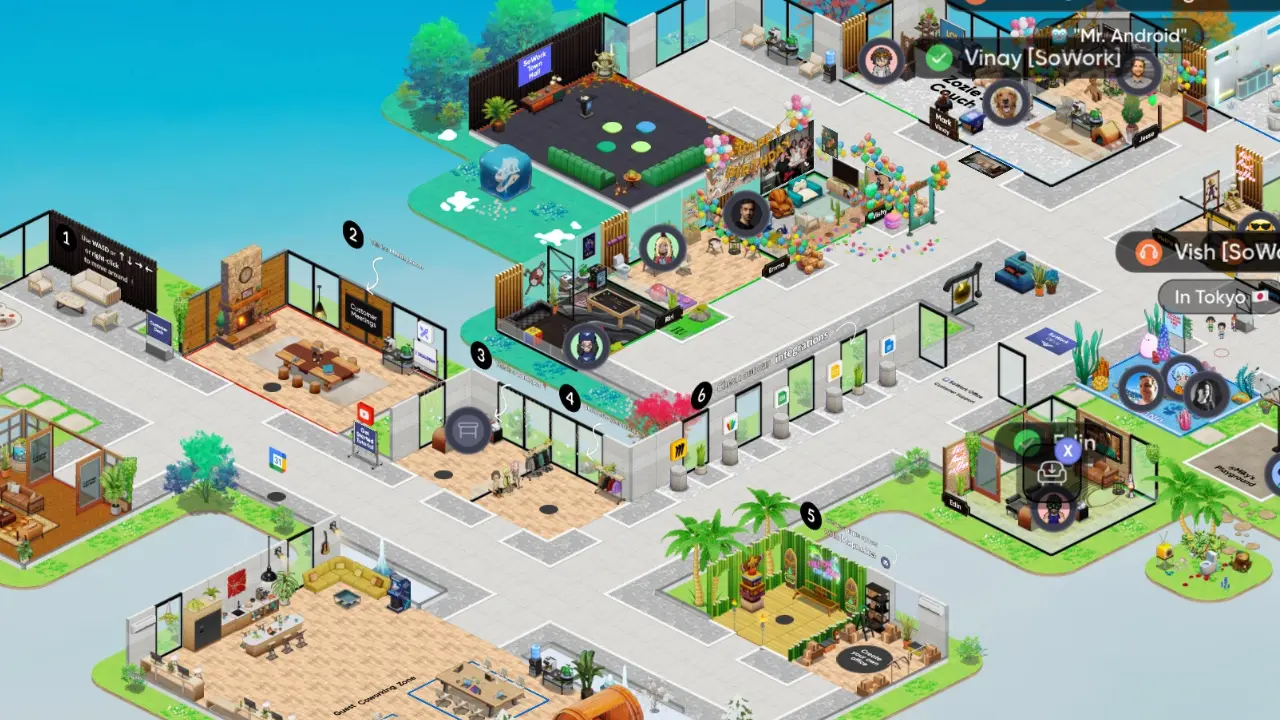
According to the review, SoWork is presented as a virtual workspace for remote teams. The appeal is not merely that it offers meetings, chat, and collaboration. Plenty of tools do that already. What stands out is the office metaphor brought to life in a visual and interactive way. Users move through a digital office, join rooms, meet colleagues, enter meetings based on proximity, and build an environment that resembles a real workplace more than a static communication app.
“This is a virtual workspace for remote teams.”
“You can work together.”
“It looks like you’re playing some video games.”
That last quote matters because it points to one of SoWork’s strongest differentiators. The product is not trying to look like another enterprise dashboard. It leans into a gamified, visual experience that makes remote work feel more human, less sterile, and more engaging. In the review, Edin compares the interface to a game and even mentions childhood memories of playing The Sims. That kind of emotional reaction is not trivial. In software adoption, usability matters. But emotional stickiness matters too.
“It remembers me when I was a child. I was playing Sims every day.”
This says something deeper about product positioning. SoWork is not only a communication tool. It is an experience layer for distributed teams. That experience seems to be a major reason why the platform feels memorable.
The Core Problem SoWork Tries to Solve
A lot of remote teams already use Slack, Microsoft Teams, Discord, Zoom, and email. The issue is not a lack of tools. The issue is fragmentation and latency. Edin explicitly describes how he already uses several communication platforms and still feels friction. In other words, adding another tool only makes sense if that tool solves a real workflow issue, not if it simply duplicates what other apps already do.
SoWork integrates with existing tools like Microsoft 365 and Google Workspace, as well as slack zoom and other platforms, to enhance collaboration and reduce workflow fragmentation by bringing these applications in einer einzigen, integrierten Plattform zusammen.
“I have Slack, I have Teams, I have Discord.”
“I’m pretty lost in that game.”
This is one of the strongest parts of the review because it is honest. SoWork is not praised because it replaces the reality of modern stack overload overnight. It is praised because it brings communication, visibility, meetings, status, and interaction into one environment that feels more immediate.
“It’s a faster and a more connected team in my eyes.”
That is the commercial promise here. Not just more communication. Better communication flow. Faster interaction. More team visibility. Less isolation. Better operational control.
A Virtual Office That Actually Feels Like an Office
One of the most vivid sections of the review is the walkthrough of the SoWork office itself. Edin describes the digital office layout in detail. There is an entry area, customer meeting spaces, guest coworking zones, private offices, department areas, town halls, boardrooms, and themed spaces. There are birthday balloons. There are decorations. There are avatars. There are even snowballs. This level of customization is a major part of the product appeal.
SoWork's MapMaker-Tool ermöglicht es Teams, das Layout ihres virtuellen Büros individuell anzupassen. Dadurch entstehen flexible workplaces, die die Nutzererfahrung und das Engagement im Team deutlich steigern.
“You can design this office in that way which you think is the most realistic lookalike real office for you.”
“You have there any departments as you in real life.”
“You have your boardrooms.”
“There is no limited creativity.”
The review repeatedly emphasizes how much freedom teams have to shape the office environment. That is strategically relevant because digital presence becomes more natural when the environment feels personalized. It is easier to build rituals, create culture, and support identity when the workspace is not generic.
This is also where SoWork appears to differ from standard video conferencing software. Traditional meeting tools create temporary rooms. SoWork creates a persistent place. That difference is central. A place builds continuity. A room solves a single event.
Presence, Visibility, and Faster Access to People
One of the most practical advantages described in the podcast is presence awareness. In a physical office, you usually know who is around. In remote work, you often do not. SoWork scheint das mit einem sichtbaren Office-Presence-System und Statuskontrollen zu lösen. Laut dem Transkript können Nutzer sehen, wer anwesend ist, wer abwesend ist, wer Mittagspause macht und wer sich im Deep-Work-Modus befindet. Teammates können so in Echtzeit die Verfügbarkeit und den Status ihrer Kollegen sehen, was die teamweite Transparenz und Zusammenarbeit fördert. Das schafft Klarheit, ohne dass ständig Nachrichten geschrieben werden müssen.
“You have the presence option as a function so you can see who is in the office actually present.”
“Everybody knows I am not there.”
“If you deep working until 11 you can select it there.”
This matters for productivity because it reduces guesswork. Instead of messaging someone blindly and waiting, team members get context. Is the person available? In a meeting? Away? Focused? These small signals improve team coordination in ways that plain chat tools often do not.
The review also describes how moving into a colleague’s area can trigger an immediate video interaction. That proximity-based meeting behavior is a strong attempt to recreate the spontaneity of office communication. SoWork ermöglicht spontane Videoanrufe, indem Nutzer ihre Avatare einfach zu ihren Teammates bewegen und so direkt ein Gespräch starten können.
“If I am in that area, if I’m entering their office immediately it pops up a video meeting.”
That is one of the clearest indicators of how SoWork tries to reduce the communication lag that Edin identified at the start.
Why the Product Feels Different From Slack or Teams
A recurring theme in the review is that SoWork is not just another communication layer. It blends messaging, meetings, collaboration, team activity, and visual presence into a single operating environment. Edin explicitly mentions chat, meetings, scheduling, analytics, and summaries as connected capabilities rather than separate tools.
“You can also schedule and execute meetings.”
“Then you can chat with each others.”
“You have your own analytics.”
“You can save it all in one place.”
That all-in-one angle is important from an CEO and commercial perspective because many searchers looking for a “virtual office for remote teams” are not looking for yet another messaging app. They are looking for a tool that consolidates fragmented workflows. Besonders hervorzuheben ist dabei die starke performance der Plattform: SoWork bietet eine zuverlässige, schnelle und reaktionssichere Nutzererfahrung, die effiziente team collaboration ermöglicht. Zu den workspace features von SoWork zählen unter anderem individuell anpassbare virtuelle Räume, KI-gestützte Meeting-Zusammenfassungen und Team-Analytics.
Edin also calls out one specific collaboration feature that he values highly: screen sharing with annotation. That is a practical detail, not marketing fluff. In remote meetings, being able to draw directly on a screen is useful for client calls, training, onboarding, reviews, and troubleshooting.
“You can share your screen.”
“You have the opportunity to draw on it.”
“Zero friction. That’s what we need.”
That phrase is strong because it translates the feature into business value. Zero friction is what remote teams want but rarely get.
The Gamified Layer Is Not a Gimmick. It Is an Engagement Mechanism.
Some buyers may initially dismiss a game-like interface as superficial. The review argues the opposite. The avatars, customization, office themes, and playful details are part of what makes the platform enjoyable to use. And enjoyable tools often get adopted more consistently than tools that feel cold and transactional.
“I can also change my clothes.”
“I can change my hair.”
“I can put some hats on it.”
“I love this very, very much.”
SoWork unterstützt gezielt die company culture, indem Teams Erfolge durch Badges und Achievements feiern können. Diese Funktionen fördern den Teamgeist und stärken das Gemeinschaftsgefühl im virtuellen Büro.
From a management perspective, this matters because engagement drives behavior. If a team actually likes being in the environment, presence improves. Casual interactions increase. Participation becomes more natural. And the sense of isolation that often comes with remote work may decrease.
Team Culture, Morale, and Remote Loneliness
One of the more human points in the review is the role SoWork can play in team culture and connection. Edin points to remote loneliness as a real issue after the pandemic and positions the product as one way to make distributed teams feel less disconnected. He also highlights social moments such as birthday decorations, games, and virtual events as meaningful additions rather than distractions.
“You can also prevent loneliness.”
“We are feeling lost because we are so lonely.”
“We all like to have some gimmicks in our daily operation business.”
“You can play with the team.”
This is where the review broadens from pure productivity into culture design. Remote teams do not only need task management. They need moments of presence, shared rituals, spontaneity, and a feeling of belonging. SoWork seems designed to operationalize that.
A CEO Perspective: Visibility, Accountability, and Team Analytics
This section is especially relevant for founders, managers, and agency owners. Edin repeatedly returns to the management side of the product. He describes how, from a CEO perspective, he wants visibility into what is happening without relying on outdated assumptions about office attendance. He explicitly critiques the old logic that being physically in an office automatically means being productive. Instead, he values tools that show patterns of work more clearly.
“What I really like from a CEO perspective…”
“I can also see who’s already there.”
“You can also see all office activity heat maps.”
“You can also see the productivity dashboard of your team.”
“You can see when and how work is happening.”
That is not a small point. It reframes remote management around visibility and analytics rather than presence theater. For leaders managing hybrid or fully remote teams, this may be one of SoWork’s most commercially attractive value propositions.
“Purpose-built CEO dashboards, that’s a topic for me.”
This quote makes the audience clear. SoWork is not only for employees who want a nicer workspace. It is also for leaders who want operational clarity.
Meetings, Recordings, and AI Summaries
The review also highlights SoWork’s AI summary and recording functionality as a major benefit. This is especially relevant for teams with many internal and external meetings. Edin makes it clear that he does not want to take notes by hand and prefers AI-generated summaries stored in one place.
“This is one thing I really like.”
“I’m not that guy who is taking notes by writing them with hand.”
“I like to have it written by AI.”
“I like to have these recordings in one place.”
SoWork includes features for generating meeting summaries and action items automatically. The AI Meeting Assistant, known as Sophia Bot, automates meeting tasks such as recording, transcription, summarization, and the generation of action items. SoWork’s AI-powered features ensure that administrative tasks are automated, leaving more time for value-added work. The AI Meeting Assistant automatically creates meeting notes, summaries, action items, and documents decisions made. The AI-powered features are designed to eliminate administrative overhead and can save employees an average of up to 3.5 hours per week on administrative tasks. SoWork’s AI-generated meeting summaries ensure that valuable information is effectively captured and shared, significantly boosting team productivity.
For many businesses, this alone can drive adoption. Meetings create knowledge. But without summaries and documentation, that knowledge disappears into memory or scattered notes. Centralized AI summaries reduce that loss.
Integrations and Workflow Fit
Another strength in the review is workflow flexibility. Edin mentions integrations such as Zapier, Miro, Google Drive, ClickUp, Slack, Outlook, and Google Calendar, while also noting that he would like deeper OneDrive support because he uses it heavily. That comment makes the review more credible because it does not pretend the tool is perfect. It shows where the platform fits and where the reviewer still wants more.
“You have a lot of integrations.”
“You have Zapier so you can build your own integrations.”
“I’m waiting for OneDrive because I’m using OneDrive a lot.”
This is exactly how buyers think. Not in theory, but in stack compatibility. A remote collaboration platform only works if it fits the way the team already operates.
Weitere Informationen zu den Integrationen und Funktionen von SoWork finden Sie auf der offiziellen website des Unternehmens.
Virtual Events and Team Gatherings in SoWork
Ease of Adoption and Why That Matters
One of the smartest parts of the podcast is the way tool implementation is framed. Edin explains that when choosing tools for his team, he always asks how the workflow can be optimized, how the tool simplifies operations, and whether the team can feel comfortable using it without spending endless time on implementation and customization. That is a strong buying criterion and a very realistic one.
“What kind of work we can optimize.”
“How we can provide that way of simplified workflow.”
“Nobody of us want to spend a lot of hours and days working on some implementations.”
That is where SoWork seems to earn points in this review. The product is presented as powerful, visual, flexible, and easy enough to start with through a trial. Im Vergleich zu traditionellen Tools verbessert SoWork die remote work experience deutlich, indem es die Abläufe vereinfacht und die Einführung für Teams erleichtert.
Final Verdict From the Episode
The review ends on a very clear endorsement. Edin states directly that if someone wants a premium full-service virtual office workspace, SoWork is the best option for them based on his experience in the episode. He also makes clear that the review is not positioned as sponsored or affiliate-driven, but as a genuine recommendation based on hands-on use and interest in the future of digital workspaces.
“If you want to have full service premium virtual office workspaces, name it, then SoWork is the best for you.”
“There is no affiliate link.”
“There is no sponsoring.”
“It’s just sharing the experience.”
That directness is useful. It leaves little ambiguity about the overall assessment. The product is not described as merely interesting. It is described as a serious solution for remote teams that want more presence, more visibility, and more connection without going back to a traditional office model.
Gerade im Zeitalter of remote work ist SoWork als führende virtuelle Office-Lösung für Remote-Teams positioniert, mit einem klaren Fokus auf Produktivität und Engagement.
As an agency, we highly recommend SoWork for everyday use, and you can also try the tool for free for 7 days.
Conclusion
SoWork is presented in this podcast review as more than a remote work novelty. It is framed as a serious operating environment for distributed teams that want faster communication, stronger presence, more team connection, better meeting workflows, and clearer management visibility. The strongest insight from the episode is not that SoWork looks different. It is that it tries to solve a very real remote work problem: when communication becomes too delayed, too fragmented, and too detached from human presence, productivity suffers. In this review, SoWork is positioned as a credible answer to that problem.
SoWork is an AI-powered solution specifically designed to boost productivity and foster a sense of community in the era of remote work. Through advanced AI features, SoWork not only supports the automation of administrative tasks but also actively fosters company culture by offering personalized customization options and social interactions in the virtual office. This positions SoWork as the leading virtual office solution for remote teams that prioritize engagement, efficiency, and a strong corporate culture.
“How can I go with the time like being in a virtual office or replacing my offline office with a digital office?”
That is the final strategic question behind the entire article. And based on this episode, SoWork appears to be one of the strongest attempts to answer it.
SoWork is a virtual office platform for remote teams with presence features, AI summaries, analytics, meetings, and collaboration tools that improve connection and productivity.
Remote work gives teams flexibility. But it also creates friction. Messages pile up in Slack, Teams, Discord, and WhatsApp. Questions sit unanswered. Quick updates turn into long waiting times. And for many founders, managers, and remote-first teams, that is exactly where productivity starts to leak.
SoWork is an AI-powered virtual workspace platform designed to enhance collaboration, productivity, and company culture for remote teams. It provides a virtual office environment that fosters seamless communication and enhances productivity.
In this podcast review, Edin breaks down why SoWork stood out to him as a virtual HQ for remote teams, supporting team collaboration and team presence, how it compares to the usual chat-heavy setup, and why it feels closer to a real office than most collaboration tools on the market.
What makes this review interesting is that it does not come from a generic software roundup. It comes from the perspective of an agency owner running a remote team without a physical office. That context matters. The central question is simple and commercially relevant: can a virtual office platform help a distributed team stay productive, visible, connected, and easier to manage without forcing everyone back into a traditional office? That is the lens through which SoWork is reviewed throughout the episode, with a focus on workspace features designed to reflect and strengthen company culture.
“Is there any tool which can help me stay productive, but stay in touch with my team and be present like if you’re in a real office?”
That line captures the entire search intent behind this review. The problem is not just communication. The problem is delayed communication. In a normal office, you can walk to a colleague, ask a question, get a fast answer, and move on. In a remote setup, the same moment often turns into a message thread and a wait. That delay compounds across projects, teams, and client work. Edin positions SoWork as a tool that reduces exactly this kind of operational drag.
“The problem is I have to wait for the response.”
That is the pain point. And it is more strategic than it sounds. Waiting for replies is not just annoying. It slows decision-making, interrupts momentum, and creates a fragmented workday. In that sense, the SoWork review is really a review of how remote collaboration should function when speed and presence matter.
What Is SoWork and Why Does It Stand Out?
According to the review, SoWork is presented as a virtual workspace for remote teams. The appeal is not merely that it offers meetings, chat, and collaboration. Plenty of tools do that already. What stands out is the office metaphor brought to life in a visual and interactive way. Users move through a digital office, join rooms, meet colleagues, enter meetings based on proximity, and build an environment that resembles a real workplace more than a static communication app.
“This is a virtual workspace for remote teams.”
“You can work together.”
“It looks like you’re playing some video games.”
That last quote matters because it points to one of SoWork’s strongest differentiators. The product is not trying to look like another enterprise dashboard. It leans into a gamified, visual experience that makes remote work feel more human, less sterile, and more engaging. In the review, Edin compares the interface to a game and even mentions childhood memories of playing The Sims. That kind of emotional reaction is not trivial. In software adoption, usability matters. But emotional stickiness matters too.
“It remembers me when I was a child. I was playing Sims every day.”
This says something deeper about product positioning. SoWork is not only a communication tool. It is an experience layer for distributed teams. That experience seems to be a major reason why the platform feels memorable.
The Core Problem SoWork Tries to Solve
A lot of remote teams already use Slack, Microsoft Teams, Discord, Zoom, and email. The issue is not a lack of tools. The issue is fragmentation and latency. Edin explicitly describes how he already uses several communication platforms and still feels friction. In other words, adding another tool only makes sense if that tool solves a real workflow issue, not if it simply duplicates what other apps already do.
SoWork integrates with existing tools like Microsoft 365 and Google Workspace, as well as slack zoom and other platforms, to enhance collaboration and reduce workflow fragmentation by bringing these applications in einer einzigen, integrierten Plattform zusammen.
“I have Slack, I have Teams, I have Discord.”
“I’m pretty lost in that game.”
This is one of the strongest parts of the review because it is honest. SoWork is not praised because it replaces the reality of modern stack overload overnight. It is praised because it brings communication, visibility, meetings, status, and interaction into one environment that feels more immediate.
“It’s a faster and a more connected team in my eyes.”
That is the commercial promise here. Not just more communication. Better communication flow. Faster interaction. More team visibility. Less isolation. Better operational control.
A Virtual Office That Actually Feels Like an Office
One of the most vivid sections of the review is the walkthrough of the SoWork office itself. Edin describes the digital office layout in detail. There is an entry area, customer meeting spaces, guest coworking zones, private offices, department areas, town halls, boardrooms, and themed spaces. There are birthday balloons. There are decorations. There are avatars. There are even snowballs. This level of customization is a major part of the product appeal.
SoWork's MapMaker-Tool ermöglicht es Teams, das Layout ihres virtuellen Büros individuell anzupassen. Dadurch entstehen flexible workplaces, die die Nutzererfahrung und das Engagement im Team deutlich steigern.
“You can design this office in that way which you think is the most realistic lookalike real office for you.”
“You have there any departments as you in real life.”
“You have your boardrooms.”
“There is no limited creativity.”
The review repeatedly emphasizes how much freedom teams have to shape the office environment. That is strategically relevant because digital presence becomes more natural when the environment feels personalized. It is easier to build rituals, create culture, and support identity when the workspace is not generic.
This is also where SoWork appears to differ from standard video conferencing software. Traditional meeting tools create temporary rooms. SoWork creates a persistent place. That difference is central. A place builds continuity. A room solves a single event.
Presence, Visibility, and Faster Access to People
One of the most practical advantages described in the podcast is presence awareness. In a physical office, you usually know who is around. In remote work, you often do not. SoWork scheint das mit einem sichtbaren Office-Presence-System und Statuskontrollen zu lösen. Laut dem Transkript können Nutzer sehen, wer anwesend ist, wer abwesend ist, wer Mittagspause macht und wer sich im Deep-Work-Modus befindet. Teammates können so in Echtzeit die Verfügbarkeit und den Status ihrer Kollegen sehen, was die teamweite Transparenz und Zusammenarbeit fördert. Das schafft Klarheit, ohne dass ständig Nachrichten geschrieben werden müssen.
“You have the presence option as a function so you can see who is in the office actually present.”
“Everybody knows I am not there.”
“If you deep working until 11 you can select it there.”
This matters for productivity because it reduces guesswork. Instead of messaging someone blindly and waiting, team members get context. Is the person available? In a meeting? Away? Focused? These small signals improve team coordination in ways that plain chat tools often do not.
The review also describes how moving into a colleague’s area can trigger an immediate video interaction. That proximity-based meeting behavior is a strong attempt to recreate the spontaneity of office communication. SoWork ermöglicht spontane Videoanrufe, indem Nutzer ihre Avatare einfach zu ihren Teammates bewegen und so direkt ein Gespräch starten können.
“If I am in that area, if I’m entering their office immediately it pops up a video meeting.”
That is one of the clearest indicators of how SoWork tries to reduce the communication lag that Edin identified at the start.
Why the Product Feels Different From Slack or Teams
A recurring theme in the review is that SoWork is not just another communication layer. It blends messaging, meetings, collaboration, team activity, and visual presence into a single operating environment. Edin explicitly mentions chat, meetings, scheduling, analytics, and summaries as connected capabilities rather than separate tools.
“You can also schedule and execute meetings.”
“Then you can chat with each others.”
“You have your own analytics.”
“You can save it all in one place.”
That all-in-one angle is important from an CEO and commercial perspective because many searchers looking for a “virtual office for remote teams” are not looking for yet another messaging app. They are looking for a tool that consolidates fragmented workflows. Besonders hervorzuheben ist dabei die starke performance der Plattform: SoWork bietet eine zuverlässige, schnelle und reaktionssichere Nutzererfahrung, die effiziente team collaboration ermöglicht. Zu den workspace features von SoWork zählen unter anderem individuell anpassbare virtuelle Räume, KI-gestützte Meeting-Zusammenfassungen und Team-Analytics.
Edin also calls out one specific collaboration feature that he values highly: screen sharing with annotation. That is a practical detail, not marketing fluff. In remote meetings, being able to draw directly on a screen is useful for client calls, training, onboarding, reviews, and troubleshooting.
“You can share your screen.”
“You have the opportunity to draw on it.”
“Zero friction. That’s what we need.”
That phrase is strong because it translates the feature into business value. Zero friction is what remote teams want but rarely get.
The Gamified Layer Is Not a Gimmick. It Is an Engagement Mechanism.
Some buyers may initially dismiss a game-like interface as superficial. The review argues the opposite. The avatars, customization, office themes, and playful details are part of what makes the platform enjoyable to use. And enjoyable tools often get adopted more consistently than tools that feel cold and transactional.
“I can also change my clothes.”
“I can change my hair.”
“I can put some hats on it.”
“I love this very, very much.”
SoWork unterstützt gezielt die company culture, indem Teams Erfolge durch Badges und Achievements feiern können. Diese Funktionen fördern den Teamgeist und stärken das Gemeinschaftsgefühl im virtuellen Büro.
From a management perspective, this matters because engagement drives behavior. If a team actually likes being in the environment, presence improves. Casual interactions increase. Participation becomes more natural. And the sense of isolation that often comes with remote work may decrease.
Team Culture, Morale, and Remote Loneliness
One of the more human points in the review is the role SoWork can play in team culture and connection. Edin points to remote loneliness as a real issue after the pandemic and positions the product as one way to make distributed teams feel less disconnected. He also highlights social moments such as birthday decorations, games, and virtual events as meaningful additions rather than distractions.
“You can also prevent loneliness.”
“We are feeling lost because we are so lonely.”
“We all like to have some gimmicks in our daily operation business.”
“You can play with the team.”
This is where the review broadens from pure productivity into culture design. Remote teams do not only need task management. They need moments of presence, shared rituals, spontaneity, and a feeling of belonging. SoWork seems designed to operationalize that.
A CEO Perspective: Visibility, Accountability, and Team Analytics
This section is especially relevant for founders, managers, and agency owners. Edin repeatedly returns to the management side of the product. He describes how, from a CEO perspective, he wants visibility into what is happening without relying on outdated assumptions about office attendance. He explicitly critiques the old logic that being physically in an office automatically means being productive. Instead, he values tools that show patterns of work more clearly.
“What I really like from a CEO perspective…”
“I can also see who’s already there.”
“You can also see all office activity heat maps.”
“You can also see the productivity dashboard of your team.”
“You can see when and how work is happening.”
That is not a small point. It reframes remote management around visibility and analytics rather than presence theater. For leaders managing hybrid or fully remote teams, this may be one of SoWork’s most commercially attractive value propositions.
“Purpose-built CEO dashboards, that’s a topic for me.”
This quote makes the audience clear. SoWork is not only for employees who want a nicer workspace. It is also for leaders who want operational clarity.
Meetings, Recordings, and AI Summaries
The review also highlights SoWork’s AI summary and recording functionality as a major benefit. This is especially relevant for teams with many internal and external meetings. Edin makes it clear that he does not want to take notes by hand and prefers AI-generated summaries stored in one place.
“This is one thing I really like.”
“I’m not that guy who is taking notes by writing them with hand.”
“I like to have it written by AI.”
“I like to have these recordings in one place.”
SoWork includes features for generating meeting summaries and action items automatically. The AI Meeting Assistant, known as Sophia Bot, automates meeting tasks such as recording, transcription, summarization, and the generation of action items. SoWork’s AI-powered features ensure that administrative tasks are automated, leaving more time for value-added work. The AI Meeting Assistant automatically creates meeting notes, summaries, action items, and documents decisions made. The AI-powered features are designed to eliminate administrative overhead and can save employees an average of up to 3.5 hours per week on administrative tasks. SoWork’s AI-generated meeting summaries ensure that valuable information is effectively captured and shared, significantly boosting team productivity.
For many businesses, this alone can drive adoption. Meetings create knowledge. But without summaries and documentation, that knowledge disappears into memory or scattered notes. Centralized AI summaries reduce that loss.
Integrations and Workflow Fit
Another strength in the review is workflow flexibility. Edin mentions integrations such as Zapier, Miro, Google Drive, ClickUp, Slack, Outlook, and Google Calendar, while also noting that he would like deeper OneDrive support because he uses it heavily. That comment makes the review more credible because it does not pretend the tool is perfect. It shows where the platform fits and where the reviewer still wants more.
“You have a lot of integrations.”
“You have Zapier so you can build your own integrations.”
“I’m waiting for OneDrive because I’m using OneDrive a lot.”
This is exactly how buyers think. Not in theory, but in stack compatibility. A remote collaboration platform only works if it fits the way the team already operates.
Weitere Informationen zu den Integrationen und Funktionen von SoWork finden Sie auf der offiziellen website des Unternehmens.
Virtual Events and Team Gatherings in SoWork
Ease of Adoption and Why That Matters
One of the smartest parts of the podcast is the way tool implementation is framed. Edin explains that when choosing tools for his team, he always asks how the workflow can be optimized, how the tool simplifies operations, and whether the team can feel comfortable using it without spending endless time on implementation and customization. That is a strong buying criterion and a very realistic one.
“What kind of work we can optimize.”
“How we can provide that way of simplified workflow.”
“Nobody of us want to spend a lot of hours and days working on some implementations.”
That is where SoWork seems to earn points in this review. The product is presented as powerful, visual, flexible, and easy enough to start with through a trial. Im Vergleich zu traditionellen Tools verbessert SoWork die remote work experience deutlich, indem es die Abläufe vereinfacht und die Einführung für Teams erleichtert.
Final Verdict From the Episode
The review ends on a very clear endorsement. Edin states directly that if someone wants a premium full-service virtual office workspace, SoWork is the best option for them based on his experience in the episode. He also makes clear that the review is not positioned as sponsored or affiliate-driven, but as a genuine recommendation based on hands-on use and interest in the future of digital workspaces.
“If you want to have full service premium virtual office workspaces, name it, then SoWork is the best for you.”
“There is no affiliate link.”
“There is no sponsoring.”
“It’s just sharing the experience.”
That directness is useful. It leaves little ambiguity about the overall assessment. The product is not described as merely interesting. It is described as a serious solution for remote teams that want more presence, more visibility, and more connection without going back to a traditional office model.
Gerade im Zeitalter of remote work ist SoWork als führende virtuelle Office-Lösung für Remote-Teams positioniert, mit einem klaren Fokus auf Produktivität und Engagement.
As an agency, we highly recommend SoWork for everyday use, and you can also try the tool for free for 7 days.
Conclusion
SoWork is presented in this podcast review as more than a remote work novelty. It is framed as a serious operating environment for distributed teams that want faster communication, stronger presence, more team connection, better meeting workflows, and clearer management visibility. The strongest insight from the episode is not that SoWork looks different. It is that it tries to solve a very real remote work problem: when communication becomes too delayed, too fragmented, and too detached from human presence, productivity suffers. In this review, SoWork is positioned as a credible answer to that problem.
SoWork is an AI-powered solution specifically designed to boost productivity and foster a sense of community in the era of remote work. Through advanced AI features, SoWork not only supports the automation of administrative tasks but also actively fosters company culture by offering personalized customization options and social interactions in the virtual office. This positions SoWork as the leading virtual office solution for remote teams that prioritize engagement, efficiency, and a strong corporate culture.
“How can I go with the time like being in a virtual office or replacing my offline office with a digital office?”
That is the final strategic question behind the entire article. And based on this episode, SoWork appears to be one of the strongest attempts to answer it.
Written by:

Edin
Author & Founder
Share this article
Share on X
Share on f
Share on in
What is SoWork?
SoWork is described in the review as an AI-powered virtual workspace platform for remote teams. The platform aims to enhance collaboration, productivity, and company culture. It serves as a virtual headquarters that combines presence, meetings, chat, collaboration, analytics, and customizable office environments into a single solution. Instead of functioning like a normal communication app, SoWork creates a digital office where team members can move, interact, and collaborate in a spatially-visual way.
What distinguishes SoWork from Slack or Microsoft Teams?
The core difference, according to the review, lies in the directness and the environment. Slack and Teams are described as useful, but also slow, once communication relies on response times. SoWork aims to make interaction feel like you are actually going to someone in a real office. It also includes features such as visible presence, proximity-based meetings, office design, social interaction, and a significantly stronger sense of space and place. Additionally, SoWork integrates other tools like Slack and Zoom, rather than further fragmenting the workflow.
Can SoWork help remote teams feel more connected?
Yes. This is one of the main arguments in the review. Highlighted are presence indicators, shared virtual office spaces, virtual events, team games, status displays, and social customization options. All of this is intended to help reduce isolation and make remote work feel less fragmented and less lonely. Special emphasis is also placed on team presence features, through which teammates can see the availability and status of others in real time and interact with each other directly.
Is SoWork also useful for managers and CEOs?
Yes. The review emphasizes the CEO perspective very strongly. It is about visibility regarding who is present, how office activity is distributed, how meetings consume time, and how team productivity becomes visible through dashboards and heatmaps. Thus, SoWork is presented not only as an engagement tool for teams but also as a management and transparency tool for leaders. The premium plan additionally includes deeper analytics and AI insights.
Does SoWork support meetings and external calls?
Yes. According to the review, SoWork supports online meetings, scheduled meetings, external client calls, and town hall formats. It is also mentioned that external participants can easily join via links. This makes the platform interesting not only for internal collaboration but also for client appointments. Additionally, the Sophia Bot helps with meeting summaries, task lists, and automatic documentation.


What is SoWork?
SoWork is described in the review as an AI-powered virtual workspace platform for remote teams. The platform aims to enhance collaboration, productivity, and company culture. It serves as a virtual headquarters that combines presence, meetings, chat, collaboration, analytics, and customizable office environments into a single solution. Instead of functioning like a normal communication app, SoWork creates a digital office where team members can move, interact, and collaborate in a spatially-visual way.
What distinguishes SoWork from Slack or Microsoft Teams?
The core difference, according to the review, lies in the directness and the environment. Slack and Teams are described as useful, but also slow, once communication relies on response times. SoWork aims to make interaction feel like you are actually going to someone in a real office. It also includes features such as visible presence, proximity-based meetings, office design, social interaction, and a significantly stronger sense of space and place. Additionally, SoWork integrates other tools like Slack and Zoom, rather than further fragmenting the workflow.
Can SoWork help remote teams feel more connected?
Yes. This is one of the main arguments in the review. Highlighted are presence indicators, shared virtual office spaces, virtual events, team games, status displays, and social customization options. All of this is intended to help reduce isolation and make remote work feel less fragmented and less lonely. Special emphasis is also placed on team presence features, through which teammates can see the availability and status of others in real time and interact with each other directly.
Is SoWork also useful for managers and CEOs?
Yes. The review emphasizes the CEO perspective very strongly. It is about visibility regarding who is present, how office activity is distributed, how meetings consume time, and how team productivity becomes visible through dashboards and heatmaps. Thus, SoWork is presented not only as an engagement tool for teams but also as a management and transparency tool for leaders. The premium plan additionally includes deeper analytics and AI insights.
Does SoWork support meetings and external calls?
Yes. According to the review, SoWork supports online meetings, scheduled meetings, external client calls, and town hall formats. It is also mentioned that external participants can easily join via links. This makes the platform interesting not only for internal collaboration but also for client appointments. Additionally, the Sophia Bot helps with meeting summaries, task lists, and automatic documentation.
What is SoWork?
SoWork is described in the review as an AI-powered virtual workspace platform for remote teams. The platform aims to enhance collaboration, productivity, and company culture. It serves as a virtual headquarters that combines presence, meetings, chat, collaboration, analytics, and customizable office environments into a single solution. Instead of functioning like a normal communication app, SoWork creates a digital office where team members can move, interact, and collaborate in a spatially-visual way.
What distinguishes SoWork from Slack or Microsoft Teams?
The core difference, according to the review, lies in the directness and the environment. Slack and Teams are described as useful, but also slow, once communication relies on response times. SoWork aims to make interaction feel like you are actually going to someone in a real office. It also includes features such as visible presence, proximity-based meetings, office design, social interaction, and a significantly stronger sense of space and place. Additionally, SoWork integrates other tools like Slack and Zoom, rather than further fragmenting the workflow.
Can SoWork help remote teams feel more connected?
Yes. This is one of the main arguments in the review. Highlighted are presence indicators, shared virtual office spaces, virtual events, team games, status displays, and social customization options. All of this is intended to help reduce isolation and make remote work feel less fragmented and less lonely. Special emphasis is also placed on team presence features, through which teammates can see the availability and status of others in real time and interact with each other directly.
Is SoWork also useful for managers and CEOs?
Yes. The review emphasizes the CEO perspective very strongly. It is about visibility regarding who is present, how office activity is distributed, how meetings consume time, and how team productivity becomes visible through dashboards and heatmaps. Thus, SoWork is presented not only as an engagement tool for teams but also as a management and transparency tool for leaders. The premium plan additionally includes deeper analytics and AI insights.
Does SoWork support meetings and external calls?
Yes. According to the review, SoWork supports online meetings, scheduled meetings, external client calls, and town hall formats. It is also mentioned that external participants can easily join via links. This makes the platform interesting not only for internal collaboration but also for client appointments. Additionally, the Sophia Bot helps with meeting summaries, task lists, and automatic documentation.