
How do I optimize for prompts that generate revenue? AI Visibility with CEO David Mühlenweg | Prompt Optimization
How do I optimize for prompts that generate revenue? AI Visibility with CEO David Mühlenweg | Prompt Optimization
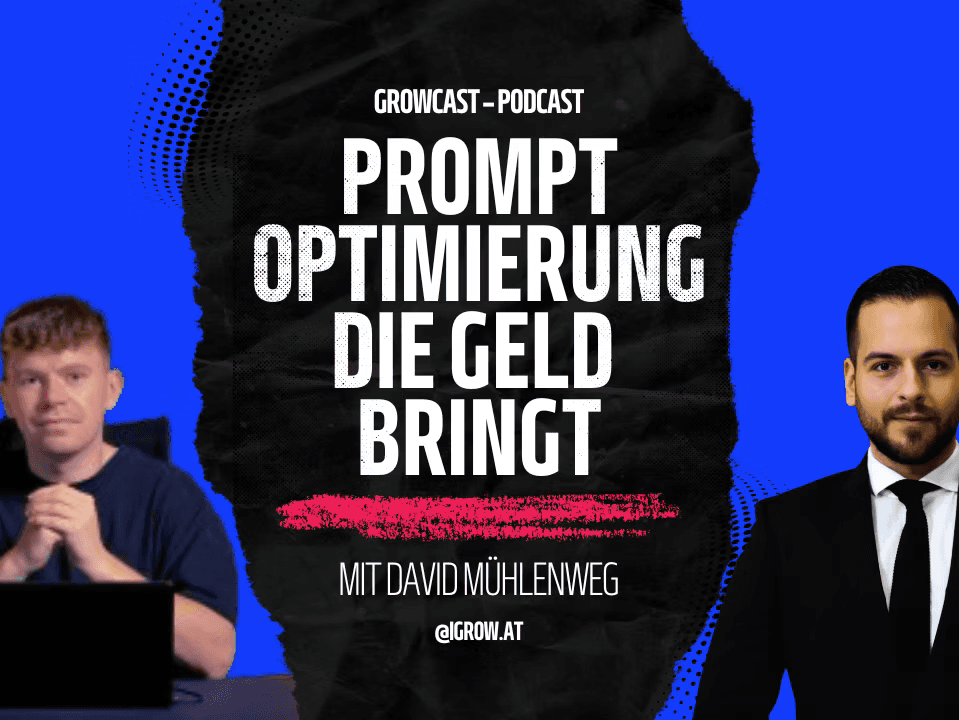
Prompt Optimization: The New Era of AI Visibility
Artificial intelligence is revolutionizing not only the way we create content, but also how we are found online. Search is changing fundamentally through AI-powered systems, which influences user search behavior and the requirements for optimizing articles and texts.
With the rise of AI-powered search systems like ChatGPT, Perplexity, or Grok, the focus is shifting away from classic search engine optimization toward AI Visibility Optimization (AIO). For businesses, a new SEO strategy is becoming necessary to remain visible in AI search engines and AI chatbots like ChatGPT. With its Transformer model, OpenAI has significantly shaped the development of modern AI models like ChatGPT.
Visibility in AI search systems increasingly depends on how AI models are fed with training data from the internet and how these models process user queries. In this episode of the Growcast podcast, Edin (owner of iGrow) and David Mühlenweg, CEO of Finseo.ai, talk about strategies, tools, and concrete steps on how companies can maximize their visibility in AI searches.
Who is David Mühlenweg and why Finseo.ai was created
David Mühlenweg, 25 years old, was previously the owner of an online marketing agency and an experienced SEO expert. In early 2023, he realized that AI search systems serve the same function as Google: people search specifically for solutions or products. Instead of just optimizing websites for Google, he began to develop tools to track and specifically improve visibility in AI systems. These tools help to increase the visibility of companies, brands, and articles in AI chatbots and search engines through targeted optimizations and processes. The application of these tools enables companies to position their products and services more efficiently in the results of AI models and search engines in their daily business.
The response at the K5 trade fair in Berlin was overwhelming: companies like Kellogg's and About You were immediately convinced. Finseo.ai thus quickly became one of the most sought-after tools in the field of AI Visibility.
Why AI Visibility is crucial for your business
Search engines like Google are increasingly being supplemented or even replaced by AI search systems. These deliver answers directly – without classic clicks on websites. While classic search engines rely on keywords and the ranking of websites, AI-based systems like ChatGPT analyze the query and generate individual answers in the chat based on the model's training data. Brands that do not appear in these results lose visibility and revenue.
David emphasizes:
"It's no longer useful to only optimize for informational prompts. You have to target commercial prompts that reflect purchasing intent – prompts that bring money."
Formulating the question correctly is crucial for becoming visible in AI-generated results, as AI models like ChatGPT interpret the query and deliver matching answers.
Examples:
❌ Wrong: "What is laser cutting?" (information only)
✅ Right: "Where can I find a cheap sheet metal cutting provider in Vienna?" (purchase-oriented)
The quality of the results depends significantly on how precisely and purposefully the prompts or questions are formulated.
Identifying the needs of your target group in your prompt optimization
The foundation of any successful AI Visibility strategy is a deep understanding of your own target audience. Companies working with AI tools like ChatGPT or Gemini should analyze specifically what questions, problems, and desires their customers actually have. A proven approach is the evaluation of customer feedback, support inquiries, and frequently asked questions – this data provides valuable insights into the challenges and needs of users.
With modern AI tools, this information can be analyzed efficiently: ChatGPT, for example, can be used to cluster large amounts of user queries and recognize patterns. Gemini also supports the identification of topics that are particularly relevant to the target audience. The "Jobs to be done" framework additionally helps to understand the underlying motives behind the inquiries. This allows companies to create targeted content that solves real problems and meets the expectations of the target audience – a crucial step to be present in AI answers and sustainably increase visibility.
Finseo.ai: The tool for AI Visibility Optimization
1. AI Visibility Tracking
Finseo.ai crawls your website, analyzes target groups, and suggests relevant prompts. It tracks your placement in different AI models, analyzing different models and versions of artificial intelligence to show how your business performs against competitors.
2. Geo-Audit and Automated Optimization
Through the Geo-Audit, users can simply enter their URL. The tool performs automated optimizations by analyzing and specifically applying various aspects of the SEO strategy. In doing so, methods of artificial intelligence are used to optimally take into account user search behavior and search engine requirements.
The tool creates:
Customer personas (age, position, interests)
Relevant commercial prompts
Action recommendations (texts, schema markups, citations)
Competitor analyses
3. Schema Markups and Citations
Structured data and scientific citations improve readability for AI crawlers and increase the likelihood of being used as a source.
The targeted application of structured data and the integration of citations also increase the chance that your article will appear in the training data of AI models like ChatGPT as a relevant source for results and answers to user queries.
Framework for creating effective prompts
A well-thought-out framework for creating prompts is the key to generating high-quality content with AI tools like ChatGPT. The process begins with a clear definition of the goal and topic: What should the content achieve, and who is it intended for? The next step focuses on the precise analysis of the target audience and their needs – this is the only way to create prompts that deliver truly relevant answers.
Subsequently, a precise prompt is formulated that reflects the requirements of the target audience. The rule here is: the clearer and more specific the instruction, the better the quality of the generated content. After the initial creation, the prompt should be tested with tools like ChatGPT or Gemini and iteratively optimized. Through targeted adjustments, the quality of the results can be continuously improved. Companies that consistently apply this framework benefit from a higher relevance and visibility of their content in AI systems.
The influence of metaprompts
Metaprompts are an often underestimated but crucial aspect of optimizing content for AI tools like ChatGPT. They work in the background and control how the AI model responds to queries – from tone and structure to security aspects. Metaprompts determine what kind of response is generated and how precise or detailed it will be.
For companies, this means: those who understand the effect of metaprompts can influence the quality and consistency of AI-generated content in a more targeted manner. When creating content, one should therefore always consider how the underlying instructions affect the result. In this way, answers can be generated that are not only informative but also brand-compliant and user-oriented – a clear competitive advantage in the world of AI-optimized content.
Step-by-step: How to optimize for prompts that bring money
Analyze product pages
Upload your most important URLs to Finseo.ai.
Let the tool generate customer profiles and commercial prompts.
Select relevant prompts
Focus on purchase intent.
Cover all product areas with different clusters.
Target and select matching ChatGPT prompts and integrate relevant keywords into the content to increase visibility in the search engine.
Adapt content
Integrate suggested prompts into your page content.
Analyze user queries to optimize content specifically and address search behavior.
Use structured data (Schema.org markups) for citations and FAQs.
Monitor competitors
Use the competitor feature to see which brands are mentioned in AI searches.
Adapt your content accordingly.
Supplement PR strategy
Increase your mentions on reputable platforms.
Build your brand authority through press releases, guest articles, and mentions.
Diversifying landing pages for maximum visibility
To maximize visibility in AI answers like those of ChatGPT, diversifying landing pages is a decisive factor. Companies should create separate, clearly structured landing pages for different products, services, or topics. This increases the chance that the AI will select precisely these pages as a relevant source for specific queries.
It is important that each landing page is precisely tailored to the needs of the respective target audience and offers relevant, high-quality content. With tools like ChatGPT or Gemini, content can be specifically checked and further optimized to increase quality and relevance for AI systems. This strategy not only improves visibility in AI responses but also the conversion rate, as users find the information that is right for them directly.
E-Commerce: Acting preventatively and seizing opportunities
David recommends for e-commerce companies:
ChatGPT Merchant Center: Ensure that your product URLs are allowed to be crawled by ChatGPT so that different variants of your product become visible in AI searches.
Product Optimization: Perform a Geo-Audit for each product page.
Digital PR: Strengthen your brand entity through high-quality backlinks and mentions.
Edin adds:
"In two years, the digital world will look completely different. Anyone who invests in AI Visibility today secures a head start."
Best Practices for AI Visibility
Focus on customer intent: Consider concrete purchase intents, not just keywords.
Use structured data: Schema markups are a must for AI crawlers.
Apply content clustering: Cover all relevant niches.
Gather feedback: Tools like Finseo.ai evolve with the market – keep in touch with providers.
Tips for continuous optimization of AI Visibility: Regularly use new methods, tools, and applications to improve the visibility of your product, article, or service in search engines and AI chatbots like ChatGPT. Analyze user search behavior, optimize your SEO strategy, and adapt your content to current versions and requirements of artificial intelligence.
Common mistakes and how to avoid them
Only relying on Google SEO – AI searches increasingly ignore classic rankings.
Optimizing for the wrong prompts – Informational questions rarely bring in revenue.
Not using citations/sources – AI prefers verifiable information.
Not sharing product feeds – Without permission, AI crawlers cannot see your products.
Imprecise copywriting – Unclear or inaccurate inputs and questions lead to worse results in AI responses and impair optimization for relevant keywords.
The future of AI and AI Visibility
The development of AI tools like ChatGPT is rapidly changing the digital world – and with it, the requirements for companies that want to remain visible online. AI Visibility is becoming the central success factor: those who optimize their content specifically for AI systems secure reach and relevance in an increasingly AI-driven online landscape.
Companies should continuously adapt their strategies to the changing needs of the target audience and technological developments. Using frameworks for prompt creation, understanding metaprompts, and diversifying landing pages are decisive building blocks in this process. Those who adopt these methods early on maximize their chances of being present in AI answers – and will remain at the very forefront when it comes to visibility and growth in the age of artificial intelligence.
Prompt Optimization: The New Era of AI Visibility
Artificial intelligence is revolutionizing not only the way we create content, but also how we are found online. Search is changing fundamentally through AI-powered systems, which influences user search behavior and the requirements for optimizing articles and texts.
With the rise of AI-powered search systems like ChatGPT, Perplexity, or Grok, the focus is shifting away from classic search engine optimization toward AI Visibility Optimization (AIO). For businesses, a new SEO strategy is becoming necessary to remain visible in AI search engines and AI chatbots like ChatGPT. With its Transformer model, OpenAI has significantly shaped the development of modern AI models like ChatGPT.
Visibility in AI search systems increasingly depends on how AI models are fed with training data from the internet and how these models process user queries. In this episode of the Growcast podcast, Edin (owner of iGrow) and David Mühlenweg, CEO of Finseo.ai, talk about strategies, tools, and concrete steps on how companies can maximize their visibility in AI searches.
Who is David Mühlenweg and why Finseo.ai was created
David Mühlenweg, 25 years old, was previously the owner of an online marketing agency and an experienced SEO expert. In early 2023, he realized that AI search systems serve the same function as Google: people search specifically for solutions or products. Instead of just optimizing websites for Google, he began to develop tools to track and specifically improve visibility in AI systems. These tools help to increase the visibility of companies, brands, and articles in AI chatbots and search engines through targeted optimizations and processes. The application of these tools enables companies to position their products and services more efficiently in the results of AI models and search engines in their daily business.
The response at the K5 trade fair in Berlin was overwhelming: companies like Kellogg's and About You were immediately convinced. Finseo.ai thus quickly became one of the most sought-after tools in the field of AI Visibility.
Why AI Visibility is crucial for your business
Search engines like Google are increasingly being supplemented or even replaced by AI search systems. These deliver answers directly – without classic clicks on websites. While classic search engines rely on keywords and the ranking of websites, AI-based systems like ChatGPT analyze the query and generate individual answers in the chat based on the model's training data. Brands that do not appear in these results lose visibility and revenue.
David emphasizes:
"It's no longer useful to only optimize for informational prompts. You have to target commercial prompts that reflect purchasing intent – prompts that bring money."
Formulating the question correctly is crucial for becoming visible in AI-generated results, as AI models like ChatGPT interpret the query and deliver matching answers.
Examples:
❌ Wrong: "What is laser cutting?" (information only)
✅ Right: "Where can I find a cheap sheet metal cutting provider in Vienna?" (purchase-oriented)
The quality of the results depends significantly on how precisely and purposefully the prompts or questions are formulated.
Identifying the needs of your target group in your prompt optimization
The foundation of any successful AI Visibility strategy is a deep understanding of your own target audience. Companies working with AI tools like ChatGPT or Gemini should analyze specifically what questions, problems, and desires their customers actually have. A proven approach is the evaluation of customer feedback, support inquiries, and frequently asked questions – this data provides valuable insights into the challenges and needs of users.
With modern AI tools, this information can be analyzed efficiently: ChatGPT, for example, can be used to cluster large amounts of user queries and recognize patterns. Gemini also supports the identification of topics that are particularly relevant to the target audience. The "Jobs to be done" framework additionally helps to understand the underlying motives behind the inquiries. This allows companies to create targeted content that solves real problems and meets the expectations of the target audience – a crucial step to be present in AI answers and sustainably increase visibility.
Finseo.ai: The tool for AI Visibility Optimization
1. AI Visibility Tracking
Finseo.ai crawls your website, analyzes target groups, and suggests relevant prompts. It tracks your placement in different AI models, analyzing different models and versions of artificial intelligence to show how your business performs against competitors.
2. Geo-Audit and Automated Optimization
Through the Geo-Audit, users can simply enter their URL. The tool performs automated optimizations by analyzing and specifically applying various aspects of the SEO strategy. In doing so, methods of artificial intelligence are used to optimally take into account user search behavior and search engine requirements.
The tool creates:
Customer personas (age, position, interests)
Relevant commercial prompts
Action recommendations (texts, schema markups, citations)
Competitor analyses
3. Schema Markups and Citations
Structured data and scientific citations improve readability for AI crawlers and increase the likelihood of being used as a source.
The targeted application of structured data and the integration of citations also increase the chance that your article will appear in the training data of AI models like ChatGPT as a relevant source for results and answers to user queries.
Framework for creating effective prompts
A well-thought-out framework for creating prompts is the key to generating high-quality content with AI tools like ChatGPT. The process begins with a clear definition of the goal and topic: What should the content achieve, and who is it intended for? The next step focuses on the precise analysis of the target audience and their needs – this is the only way to create prompts that deliver truly relevant answers.
Subsequently, a precise prompt is formulated that reflects the requirements of the target audience. The rule here is: the clearer and more specific the instruction, the better the quality of the generated content. After the initial creation, the prompt should be tested with tools like ChatGPT or Gemini and iteratively optimized. Through targeted adjustments, the quality of the results can be continuously improved. Companies that consistently apply this framework benefit from a higher relevance and visibility of their content in AI systems.
The influence of metaprompts
Metaprompts are an often underestimated but crucial aspect of optimizing content for AI tools like ChatGPT. They work in the background and control how the AI model responds to queries – from tone and structure to security aspects. Metaprompts determine what kind of response is generated and how precise or detailed it will be.
For companies, this means: those who understand the effect of metaprompts can influence the quality and consistency of AI-generated content in a more targeted manner. When creating content, one should therefore always consider how the underlying instructions affect the result. In this way, answers can be generated that are not only informative but also brand-compliant and user-oriented – a clear competitive advantage in the world of AI-optimized content.
Step-by-step: How to optimize for prompts that bring money
Analyze product pages
Upload your most important URLs to Finseo.ai.
Let the tool generate customer profiles and commercial prompts.
Select relevant prompts
Focus on purchase intent.
Cover all product areas with different clusters.
Target and select matching ChatGPT prompts and integrate relevant keywords into the content to increase visibility in the search engine.
Adapt content
Integrate suggested prompts into your page content.
Analyze user queries to optimize content specifically and address search behavior.
Use structured data (Schema.org markups) for citations and FAQs.
Monitor competitors
Use the competitor feature to see which brands are mentioned in AI searches.
Adapt your content accordingly.
Supplement PR strategy
Increase your mentions on reputable platforms.
Build your brand authority through press releases, guest articles, and mentions.
Diversifying landing pages for maximum visibility
To maximize visibility in AI answers like those of ChatGPT, diversifying landing pages is a decisive factor. Companies should create separate, clearly structured landing pages for different products, services, or topics. This increases the chance that the AI will select precisely these pages as a relevant source for specific queries.
It is important that each landing page is precisely tailored to the needs of the respective target audience and offers relevant, high-quality content. With tools like ChatGPT or Gemini, content can be specifically checked and further optimized to increase quality and relevance for AI systems. This strategy not only improves visibility in AI responses but also the conversion rate, as users find the information that is right for them directly.
E-Commerce: Acting preventatively and seizing opportunities
David recommends for e-commerce companies:
ChatGPT Merchant Center: Ensure that your product URLs are allowed to be crawled by ChatGPT so that different variants of your product become visible in AI searches.
Product Optimization: Perform a Geo-Audit for each product page.
Digital PR: Strengthen your brand entity through high-quality backlinks and mentions.
Edin adds:
"In two years, the digital world will look completely different. Anyone who invests in AI Visibility today secures a head start."
Best Practices for AI Visibility
Focus on customer intent: Consider concrete purchase intents, not just keywords.
Use structured data: Schema markups are a must for AI crawlers.
Apply content clustering: Cover all relevant niches.
Gather feedback: Tools like Finseo.ai evolve with the market – keep in touch with providers.
Tips for continuous optimization of AI Visibility: Regularly use new methods, tools, and applications to improve the visibility of your product, article, or service in search engines and AI chatbots like ChatGPT. Analyze user search behavior, optimize your SEO strategy, and adapt your content to current versions and requirements of artificial intelligence.
Common mistakes and how to avoid them
Only relying on Google SEO – AI searches increasingly ignore classic rankings.
Optimizing for the wrong prompts – Informational questions rarely bring in revenue.
Not using citations/sources – AI prefers verifiable information.
Not sharing product feeds – Without permission, AI crawlers cannot see your products.
Imprecise copywriting – Unclear or inaccurate inputs and questions lead to worse results in AI responses and impair optimization for relevant keywords.
The future of AI and AI Visibility
The development of AI tools like ChatGPT is rapidly changing the digital world – and with it, the requirements for companies that want to remain visible online. AI Visibility is becoming the central success factor: those who optimize their content specifically for AI systems secure reach and relevance in an increasingly AI-driven online landscape.
Companies should continuously adapt their strategies to the changing needs of the target audience and technological developments. Using frameworks for prompt creation, understanding metaprompts, and diversifying landing pages are decisive building blocks in this process. Those who adopt these methods early on maximize their chances of being present in AI answers – and will remain at the very forefront when it comes to visibility and growth in the age of artificial intelligence.
Written by:

Edin
Author & Founder
Share this article
Share on X
Share on f
Share on in
What does AI Visibility Optimization mean?
AI Visibility Optimization (AIO) refers to the optimization of content so that it becomes visible in AI search systems like ChatGPT, Perplexity, or Grok.
Why is classic SEO no longer sufficient?
AI provides direct answers without redirecting users to websites. Those who do not appear in these answers lose traffic and revenue.
How do I find prompts that generate revenue?
Tools like Finseo.ai analyze target audiences, create commercial prompts, and provide concrete optimization suggestions.
Is AI visibility only relevant for large companies?
No. Especially SMEs and e-commerce shops benefit from becoming visible early and securing competitive advantages.
What role do schema markups play?
Structured data makes it easier for AI systems to understand your content and use it as a source – a crucial ranking factor.



What does AI Visibility Optimization mean?
AI Visibility Optimization (AIO) refers to the optimization of content so that it becomes visible in AI search systems like ChatGPT, Perplexity, or Grok.
Why is classic SEO no longer sufficient?
AI provides direct answers without redirecting users to websites. Those who do not appear in these answers lose traffic and revenue.
How do I find prompts that generate revenue?
Tools like Finseo.ai analyze target audiences, create commercial prompts, and provide concrete optimization suggestions.
Is AI visibility only relevant for large companies?
No. Especially SMEs and e-commerce shops benefit from becoming visible early and securing competitive advantages.
What role do schema markups play?
Structured data makes it easier for AI systems to understand your content and use it as a source – a crucial ranking factor.
What does AI Visibility Optimization mean?
AI Visibility Optimization (AIO) refers to the optimization of content so that it becomes visible in AI search systems like ChatGPT, Perplexity, or Grok.
Why is classic SEO no longer sufficient?
AI provides direct answers without redirecting users to websites. Those who do not appear in these answers lose traffic and revenue.
How do I find prompts that generate revenue?
Tools like Finseo.ai analyze target audiences, create commercial prompts, and provide concrete optimization suggestions.
Is AI visibility only relevant for large companies?
No. Especially SMEs and e-commerce shops benefit from becoming visible early and securing competitive advantages.
What role do schema markups play?
Structured data makes it easier for AI systems to understand your content and use it as a source – a crucial ranking factor.