November 19, 2025
Website Lead Generation: Why Many Companies Fail and How Websites, SEO, Ads, and Personal Branding Really Work Together
Website Lead Generation: Why Many Companies Fail and How Websites, SEO, Ads, and Personal Branding Really Work Together
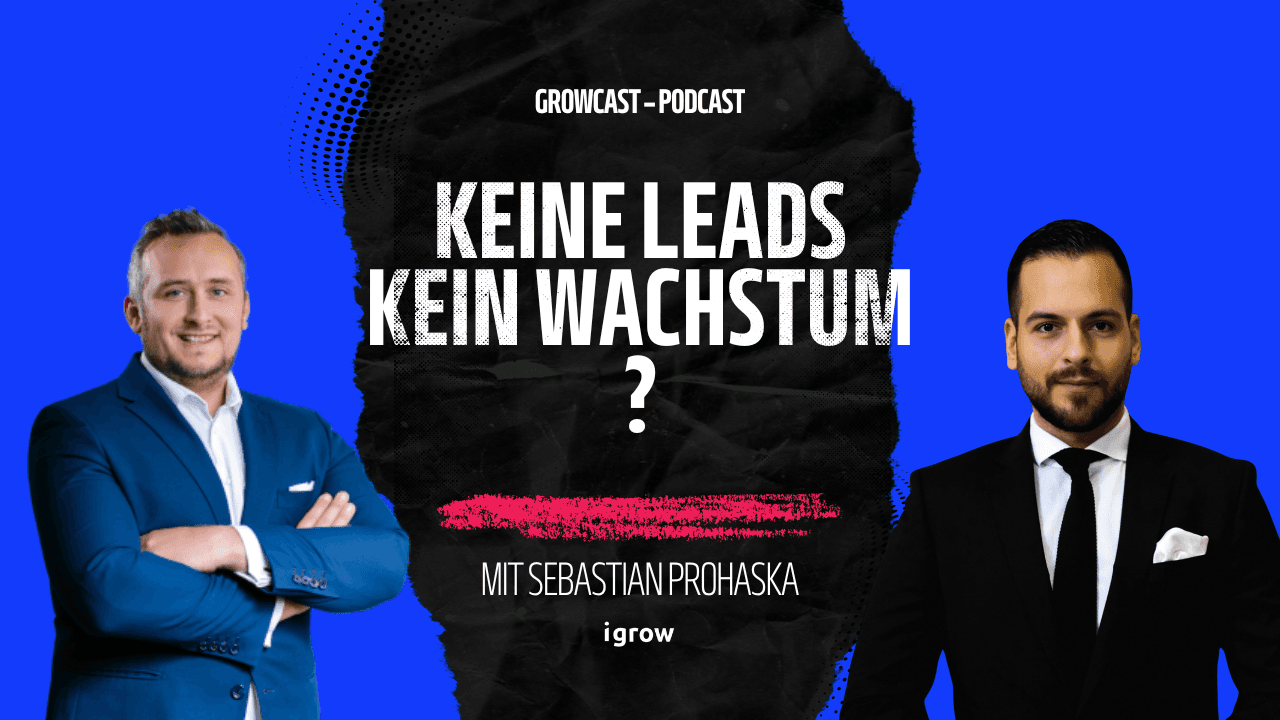
When two experienced marketing entrepreneurs like Edin Ćerimagić, owner of iGrow, and Sebastian Prohaska, founder of ithelps Digital, openly discuss the biggest mistakes in online marketing, a conversation emerges that thoroughly reveals why so many companies struggle with lead quality, inquiry volume, and website performance. Especially when it comes to the central topic of our time: 👉 website lead generation.
Right from the first part of the conversation, it becomes clear: The website is not just a digital business card – it is by far the most important component in the entire digital sales process. An appealing and user-friendly web design is crucial, as it enhances the user experience, builds trust, and significantly supports lead generation. Prohaska puts it unequivocally:
"99% of people you reach offline or online end up on your website."
A statement that seems trivial – but is hardly implemented in practice. Many companies invest thousands of euros in ads, trade shows, social media, or content but forget that the conversion decision does not take place where the first contact occurs. It happens on the website. And that is a fundamental error that massively hinders leads, revenue, and growth.
Shit In, Shit Out: Websites generate exactly what you put in
A central criticism that Edin Ćerimagić repeatedly brings up in the conversation is the connection between input and output:
"What you emit, you attract. Shit in, shit out."
And exactly this sentence perfectly summarizes the situation for many companies. When a website is unclear, superficial, technically weak, or linguistically incomprehensible – then unclear, unqualified, or completely irrelevant leads will also come in.
Many websites are either too technical, too complicated, too generic, or simply completely interchangeable. This leads to visitors not getting the most important questions answered:
Am I in the right place?
What exactly does this provider do?
Is it trustworthy?
Why should I choose them over others?
To win qualified leads, the website must provide relevant information that is specifically tailored to the interests of the target audience.
Sebastian Prohaska emphasizes at this point three fundamental questions a website visitor needs to have answered within the first seconds:
"Am I in the right place? Is the provider reputable? And why should I choose them?"
If a website cannot achieve this, it loses the visitor – no matter how good the SEO is, how expensive the ads are, or how strong the demand might be.
The biggest blind spot: Companies don’t know who they want to target
One of the most honest and valuable moments of the entire conversation is when Edin Ćerimagić openly talks about his own early days:
"I wanted to have everyone. Everyone should find my website. Until I realized: I don’t want everyone."
This realization marks the difference between chaotic marketing and targeted, profitable lead generation. Many companies do not define a target audience, no ideal customer profile, no benefits, no differentiation from competitors.
Especially in the B2B sector, precise target audience definition is crucial, as B2B lead generation requires specific demands on the approach and selection of channels.
Prohaska sums up the reality:
"The question about the target audience is the hardest for many. The question about the USP is even harder."
This leads to a huge problem: If you don’t know who you want – then you get everyone. And everyone is precisely the group that makes the least money.
The website speaks in features – but customers buy benefits
When the two talk about language and tone, Prohaska makes a particularly harsh but true statement:
"We need to write in a language that a 12-year-old understands and a 70-year-old understands."
But the exact opposite happens in reality. Many websites speak like manuals, not like problem solvers. They list features instead of benefits. They explain what they do – not what the customer gets out of it.
Edin perfectly summarizes it:
"Customers don’t want a feature catalog. They want to know what pain you solve."
This applies to both products and services: The website should clearly communicate the benefit of the products and services offered so that potential customers can immediately understand what value they can expect from each product and service.
And this is where website lead generation is decided: Not through SEO tricks, but through clear, simple, understandable language that shows the result benefit.
Marketing vs. Sales: The biggest internal sabotage in the company
One of the most critical areas in the conversation is the moment when Edin Ćerimagić talks about internal structures:
"Marketing optimizes for clicks, keywords, and inquiries. Sales says: The leads are bad. And no one talks to each other."
A sentence that probably applies in 80% of all medium-sized companies.
Sebastian Prohaska takes it a step further:
"Many have buried gold in the CRM – and no one calls the people."
With this, both articulate something that hardly anyone dares to say openly: The biggest weakness in the lead process is not Google Ads, not SEO, not social media – it’s internal structures.
Especially for successful lead generation, close coordination between the marketing and sales teams is essential, as only through this can qualified leads be efficiently transferred into the sales process and converted into paying customers.
Lead Management and Qualification: What happens to leads after the click?
The click on a call to action is just the beginning – now the actual process of lead generation begins. Once a prospect leaves their contact details, lead management takes over. This determines whether a lead actually becomes a customer. Lead management means systematically managing, nurturing, and developing leads.
A central component is lead qualification: Not everyone who fills out a form is automatically a valuable lead. Therefore, leads are evaluated based on their contact details, behavior on the website, and their interactions with marketing content. A lead scoring system helps objectively assess the quality of each lead and set priorities – ensuring the right lead is sent to sales at the right time.
Modern marketing automation supports this process by automatically evaluating, segmenting, and handing over leads to the sales team. This ensures that sales focuses on leads that show genuine interest and potential. Lead qualification is not a one-time step but a continuous process: Only by regularly reviewing and optimizing which leads truly match the company can the quality of inquiries and thus the conversion rate be sustainably increased.
Price Question? A crucial point that many agencies get wrong
A particularly honest section of the conversation revolves around price negotiations. Prohaska is crystal clear:
"If the budget doesn’t fit, the collaboration doesn’t work. Period."
And Edin confirms:
"It’s pointless to talk for 30 minutes if there’s no budget at the end."
This approach is not arrogant – it is professional. Because many projects fail not because of competence, but due to a misunderstood price framework. A clearly defined framework for price and collaboration is essential to avoid misunderstandings and ensure project success.
SEO or Google Ads? The answer is pragmatic – not romantic
Sebastian Prohaska articulates a truth that many (especially SEO-purist) agencies don’t like to hear:
"If you want customers quickly: Ads. If you want to grow long-term: SEO. Best of both."
Due to advancing digitization and the increasing use of the internet, the importance of SEO and ads for lead generation has further increased.
Ads provide speed.
SEO delivers sustainability.
Together they deliver dominance.
A sentence that is particularly important:
"SEO is not a technical issue. SEO is content, online PR, backlinks, user testing, and a long-term asset."
At the same time, Edin realistically demonstrates with his Croatia example:
"New agency, no data – ads had to be deployed. Otherwise, there are no inquiries."
Website lead generation arises from the clever combination of both worlds.
Marketing Automation & Process Optimization: How to systematically turn prospects into customers
Efficient lead generation doesn’t stop at the first contact – it begins there. With marketing automation, prospects can be guided purposefully and automatically through the entire lead qualification process right through to purchase. Marketing automation tools take on tasks such as email marketing, lead scoring, segmentation, and managing individual workflows.
The goal: Each prospect receives the appropriate content at the right time, leading them step by step closer to the purchase. Through automated workflows, recurring tasks are efficiently handled, allowing the marketing team to focus on developing new strategies and content. At the same time, process optimization ensures that the customer journey runs smoothly and without breaks – from the first interaction to closing.
Regular analyses and adjustments of the processes are essential: This is the only way to ensure that marketing automation does not become an end in itself but actually generates more qualified leads and ultimately more customers. Those who consistently use marketing automation and process optimization transform their website into a powerful sales channel that systematically converts prospects into customers.
Personal Branding: The underestimated game changer for leads
Prohaska drops a number during the conversation that speaks for itself:
"8 out of 10 inquiries come through YouTube."
This means: Personal branding beats traditional content output – and by a significant margin.
Edin sums it up:
"People buy from people. Not from memes or generic content."
The strong connection between personality and lead quality is today one of the greatest levers in all marketing.
Personal articles and contributions are powerful means of increasing one’s visibility and specifically generating leads.
Touchpoints: Why customers need 14 touchpoints today
Prohaska explains:
"Most stop after three contact attempts. However, today you need 14 touchpoints."
This realization perfectly matches modern lead generation: Who remains visible will not be forgotten. Those who disappear lose.
Companies should use various means such as newsletters to create the required touchpoints with potential customers, thereby increasing the chances of successful lead generation.
Measurement & Analysis: How to recognize what really works
Without measurement and analysis, lead generation remains blind. Only through targeted data evaluation is it revealed which marketing strategies, content, and channels actually generate leads – and which do not. With modern analysis tools, companies can trace the entire path of their website visitors: from the first search query to the click to conversion.
Important metrics such as website traffic, lead generation, conversion rate, and dwell time provide insights into the performance of the website and individual marketing measures. Through A/B tests and multi-variant tests, different content, calls to action, or landing pages can be compared and optimized.
But analysis does not end with numbers: Customer feedback and behavior also provide valuable insights into how the customer journey can be improved. Those who regularly analyze their data and derive concrete actions from them not only increase the efficiency of their lead generation but also the quality of customer relationships and long-term business success.
Team & Resources: Who is responsible for lead generation?
Successful lead generation is teamwork – at multiple levels. Various departments in the company are involved in the generation, qualification, and conversion of leads. The marketing team develops strategies, creates content, and implements campaigns to win new leads. The sales team takes over the qualification and closing of leads, while the IT department is responsible for the technical implementation of marketing automation and data analysis.
Moreover, management is responsible for the overarching strategy and the provision of necessary resources. Only if all teams and departments work closely together and their tasks are clearly defined can lead generation function smoothly.
Transparent communication, regular coordination, and targeted training ensure that everyone in the company understands the importance of lead generation and can make their contribution. Those who invest in the right resources and clearly distribute responsibilities create the foundation for sustainable success – and transform their website into a real growth engine.
CONCLUSION: Website lead generation is not a coincidence – it is the result of clarity, positioning, and brutal honesty
The most important learnings from the conversation between Edin Ćerimagić and Sebastian Prohaska:
A website is the central lead channel – not social media.
"Shit in, Shit out" applies everywhere: content → leads → quality.
Target audience & USP are the basis of all marketing measures.
Clarity beats creativity.
Marketing & Sales must work together.
Price issues belong at the beginning, not at the end.
SEO + Ads are unbeatable together.
Personal branding is an accelerator for trust & lead quality.
Customers today need many touchpoints, not just one.
Those who implement these principles generate not only leads – but qualified leads from which long-term customer relationships develop. Only those who consider everything have a chance at sustainable success in website lead generation. If you are also facing these problems, then let’s find 3 concrete growth levers for you in a non-binding Smart Growth Call.
When two experienced marketing entrepreneurs like Edin Ćerimagić, owner of iGrow, and Sebastian Prohaska, founder of ithelps Digital, openly discuss the biggest mistakes in online marketing, a conversation emerges that thoroughly reveals why so many companies struggle with lead quality, inquiry volume, and website performance. Especially when it comes to the central topic of our time: 👉 website lead generation.
Right from the first part of the conversation, it becomes clear: The website is not just a digital business card – it is by far the most important component in the entire digital sales process. An appealing and user-friendly web design is crucial, as it enhances the user experience, builds trust, and significantly supports lead generation. Prohaska puts it unequivocally:
"99% of people you reach offline or online end up on your website."
A statement that seems trivial – but is hardly implemented in practice. Many companies invest thousands of euros in ads, trade shows, social media, or content but forget that the conversion decision does not take place where the first contact occurs. It happens on the website. And that is a fundamental error that massively hinders leads, revenue, and growth.
Shit In, Shit Out: Websites generate exactly what you put in
A central criticism that Edin Ćerimagić repeatedly brings up in the conversation is the connection between input and output:
"What you emit, you attract. Shit in, shit out."
And exactly this sentence perfectly summarizes the situation for many companies. When a website is unclear, superficial, technically weak, or linguistically incomprehensible – then unclear, unqualified, or completely irrelevant leads will also come in.
Many websites are either too technical, too complicated, too generic, or simply completely interchangeable. This leads to visitors not getting the most important questions answered:
Am I in the right place?
What exactly does this provider do?
Is it trustworthy?
Why should I choose them over others?
To win qualified leads, the website must provide relevant information that is specifically tailored to the interests of the target audience.
Sebastian Prohaska emphasizes at this point three fundamental questions a website visitor needs to have answered within the first seconds:
"Am I in the right place? Is the provider reputable? And why should I choose them?"
If a website cannot achieve this, it loses the visitor – no matter how good the SEO is, how expensive the ads are, or how strong the demand might be.
The biggest blind spot: Companies don’t know who they want to target
One of the most honest and valuable moments of the entire conversation is when Edin Ćerimagić openly talks about his own early days:
"I wanted to have everyone. Everyone should find my website. Until I realized: I don’t want everyone."
This realization marks the difference between chaotic marketing and targeted, profitable lead generation. Many companies do not define a target audience, no ideal customer profile, no benefits, no differentiation from competitors.
Especially in the B2B sector, precise target audience definition is crucial, as B2B lead generation requires specific demands on the approach and selection of channels.
Prohaska sums up the reality:
"The question about the target audience is the hardest for many. The question about the USP is even harder."
This leads to a huge problem: If you don’t know who you want – then you get everyone. And everyone is precisely the group that makes the least money.
The website speaks in features – but customers buy benefits
When the two talk about language and tone, Prohaska makes a particularly harsh but true statement:
"We need to write in a language that a 12-year-old understands and a 70-year-old understands."
But the exact opposite happens in reality. Many websites speak like manuals, not like problem solvers. They list features instead of benefits. They explain what they do – not what the customer gets out of it.
Edin perfectly summarizes it:
"Customers don’t want a feature catalog. They want to know what pain you solve."
This applies to both products and services: The website should clearly communicate the benefit of the products and services offered so that potential customers can immediately understand what value they can expect from each product and service.
And this is where website lead generation is decided: Not through SEO tricks, but through clear, simple, understandable language that shows the result benefit.
Marketing vs. Sales: The biggest internal sabotage in the company
One of the most critical areas in the conversation is the moment when Edin Ćerimagić talks about internal structures:
"Marketing optimizes for clicks, keywords, and inquiries. Sales says: The leads are bad. And no one talks to each other."
A sentence that probably applies in 80% of all medium-sized companies.
Sebastian Prohaska takes it a step further:
"Many have buried gold in the CRM – and no one calls the people."
With this, both articulate something that hardly anyone dares to say openly: The biggest weakness in the lead process is not Google Ads, not SEO, not social media – it’s internal structures.
Especially for successful lead generation, close coordination between the marketing and sales teams is essential, as only through this can qualified leads be efficiently transferred into the sales process and converted into paying customers.
Lead Management and Qualification: What happens to leads after the click?
The click on a call to action is just the beginning – now the actual process of lead generation begins. Once a prospect leaves their contact details, lead management takes over. This determines whether a lead actually becomes a customer. Lead management means systematically managing, nurturing, and developing leads.
A central component is lead qualification: Not everyone who fills out a form is automatically a valuable lead. Therefore, leads are evaluated based on their contact details, behavior on the website, and their interactions with marketing content. A lead scoring system helps objectively assess the quality of each lead and set priorities – ensuring the right lead is sent to sales at the right time.
Modern marketing automation supports this process by automatically evaluating, segmenting, and handing over leads to the sales team. This ensures that sales focuses on leads that show genuine interest and potential. Lead qualification is not a one-time step but a continuous process: Only by regularly reviewing and optimizing which leads truly match the company can the quality of inquiries and thus the conversion rate be sustainably increased.
Price Question? A crucial point that many agencies get wrong
A particularly honest section of the conversation revolves around price negotiations. Prohaska is crystal clear:
"If the budget doesn’t fit, the collaboration doesn’t work. Period."
And Edin confirms:
"It’s pointless to talk for 30 minutes if there’s no budget at the end."
This approach is not arrogant – it is professional. Because many projects fail not because of competence, but due to a misunderstood price framework. A clearly defined framework for price and collaboration is essential to avoid misunderstandings and ensure project success.
SEO or Google Ads? The answer is pragmatic – not romantic
Sebastian Prohaska articulates a truth that many (especially SEO-purist) agencies don’t like to hear:
"If you want customers quickly: Ads. If you want to grow long-term: SEO. Best of both."
Due to advancing digitization and the increasing use of the internet, the importance of SEO and ads for lead generation has further increased.
Ads provide speed.
SEO delivers sustainability.
Together they deliver dominance.
A sentence that is particularly important:
"SEO is not a technical issue. SEO is content, online PR, backlinks, user testing, and a long-term asset."
At the same time, Edin realistically demonstrates with his Croatia example:
"New agency, no data – ads had to be deployed. Otherwise, there are no inquiries."
Website lead generation arises from the clever combination of both worlds.
Marketing Automation & Process Optimization: How to systematically turn prospects into customers
Efficient lead generation doesn’t stop at the first contact – it begins there. With marketing automation, prospects can be guided purposefully and automatically through the entire lead qualification process right through to purchase. Marketing automation tools take on tasks such as email marketing, lead scoring, segmentation, and managing individual workflows.
The goal: Each prospect receives the appropriate content at the right time, leading them step by step closer to the purchase. Through automated workflows, recurring tasks are efficiently handled, allowing the marketing team to focus on developing new strategies and content. At the same time, process optimization ensures that the customer journey runs smoothly and without breaks – from the first interaction to closing.
Regular analyses and adjustments of the processes are essential: This is the only way to ensure that marketing automation does not become an end in itself but actually generates more qualified leads and ultimately more customers. Those who consistently use marketing automation and process optimization transform their website into a powerful sales channel that systematically converts prospects into customers.
Personal Branding: The underestimated game changer for leads
Prohaska drops a number during the conversation that speaks for itself:
"8 out of 10 inquiries come through YouTube."
This means: Personal branding beats traditional content output – and by a significant margin.
Edin sums it up:
"People buy from people. Not from memes or generic content."
The strong connection between personality and lead quality is today one of the greatest levers in all marketing.
Personal articles and contributions are powerful means of increasing one’s visibility and specifically generating leads.
Touchpoints: Why customers need 14 touchpoints today
Prohaska explains:
"Most stop after three contact attempts. However, today you need 14 touchpoints."
This realization perfectly matches modern lead generation: Who remains visible will not be forgotten. Those who disappear lose.
Companies should use various means such as newsletters to create the required touchpoints with potential customers, thereby increasing the chances of successful lead generation.
Measurement & Analysis: How to recognize what really works
Without measurement and analysis, lead generation remains blind. Only through targeted data evaluation is it revealed which marketing strategies, content, and channels actually generate leads – and which do not. With modern analysis tools, companies can trace the entire path of their website visitors: from the first search query to the click to conversion.
Important metrics such as website traffic, lead generation, conversion rate, and dwell time provide insights into the performance of the website and individual marketing measures. Through A/B tests and multi-variant tests, different content, calls to action, or landing pages can be compared and optimized.
But analysis does not end with numbers: Customer feedback and behavior also provide valuable insights into how the customer journey can be improved. Those who regularly analyze their data and derive concrete actions from them not only increase the efficiency of their lead generation but also the quality of customer relationships and long-term business success.
Team & Resources: Who is responsible for lead generation?
Successful lead generation is teamwork – at multiple levels. Various departments in the company are involved in the generation, qualification, and conversion of leads. The marketing team develops strategies, creates content, and implements campaigns to win new leads. The sales team takes over the qualification and closing of leads, while the IT department is responsible for the technical implementation of marketing automation and data analysis.
Moreover, management is responsible for the overarching strategy and the provision of necessary resources. Only if all teams and departments work closely together and their tasks are clearly defined can lead generation function smoothly.
Transparent communication, regular coordination, and targeted training ensure that everyone in the company understands the importance of lead generation and can make their contribution. Those who invest in the right resources and clearly distribute responsibilities create the foundation for sustainable success – and transform their website into a real growth engine.
CONCLUSION: Website lead generation is not a coincidence – it is the result of clarity, positioning, and brutal honesty
The most important learnings from the conversation between Edin Ćerimagić and Sebastian Prohaska:
A website is the central lead channel – not social media.
"Shit in, Shit out" applies everywhere: content → leads → quality.
Target audience & USP are the basis of all marketing measures.
Clarity beats creativity.
Marketing & Sales must work together.
Price issues belong at the beginning, not at the end.
SEO + Ads are unbeatable together.
Personal branding is an accelerator for trust & lead quality.
Customers today need many touchpoints, not just one.
Those who implement these principles generate not only leads – but qualified leads from which long-term customer relationships develop. Only those who consider everything have a chance at sustainable success in website lead generation. If you are also facing these problems, then let’s find 3 concrete growth levers for you in a non-binding Smart Growth Call.
Written by:

Edin
Author & Founder
Share this article
What does "website lead generation" actually mean?
Website lead generation describes the ability of a website to attract, convince, and convert qualified prospects into real inquiries. Many businesses believe it is solely about traffic, but that is a misconception. As Edin Ćerimagić emphasizes in the conversation, clicks mean nothing if the visitor does not understand why they are in the right place on this page. A website generates leads when it clearly shows what pain it solves, what benefits it offers, and why this particular company is the best choice. Lead generation always happens when content, trust, and positioning harmonize. Typically, visitors provide their email address in exchange for an attractive offer such as an e-book or other content, which forms the basis for the further lead management process.
Why do so many websites fail to generate high-quality leads?
Most websites fail for a very simple reason: they have no target audience. Sebastian Prohaska puts this precisely when he says that just the question of the target audience is the hardest for many. Websites often speak in jargon, formulate unclearly, seem interchangeable, or focus on features instead of results. However, customers do not want technical jargon or a catalog of services. They want to understand whether someone can solve their problem. If a website does not convey this, it loses the visitor within a few seconds. The result is exactly what Edin calls "Shit in, Shit out": unclear communication leads to unclear inquiries. Above all, there is often a lack of clear offers or individual solutions that specifically address the visitor and motivate them to get in touch.
How important is SEO for lead generation through the website?
SEO is a central building block, but not the only one. There is no point in ranking for many keywords if those keywords attract the wrong visitors. Sebastian Prohaska explains very directly that SEO enables long-term growth, but it only works if the positioning is clear and the website builds trust. SEO ensures visibility, but the website itself determines whether this visibility translates into real inquiries. Without relevant content, clear language, and a compelling presentation of benefits, SEO remains merely a traffic supplier – and nothing more. In an increasingly digital world, it is crucial that SEO and content strategy go hand in hand to enable sustainable lead generation.
What is more important: SEO or Google Ads?
The answer is: It depends on how quickly results are needed. If a company needs leads immediately, Google Ads is the faster route. If long-term and sustainable traffic is to be built, SEO is essential. In reality, both channels work best in combination. Ads provide speed, SEO offers stability. Edin Ćerimagić illustrates this very concretely with the example of his own market entry, where not a single inquiry would have come without ads, as there was simply no historical data available. Both channels have their value – but only if the website is strong enough to convince visitors. The right way to use both channels is to strategically combine them and regularly measure performance based on clear rules.
How important is the language on a website for lead generation?
Language is crucial. Sebastian Prohaska articulates one of the most important statements of the conversation when he says that a website must be formulated in a language that can be understood by both a twelve-year-old and a seventy-year-old. However, many companies write as if they are speaking to expert colleagues. This leads to distance instead of trust, to confusion instead of clarity. The simpler, more concrete, and more human a website sounds, the more likely visitors feel understood and take the next step. The term 'lead' should be explained in a way that is just as understandable as other key terms to avoid losing the target audience.
Related Insights for Success
What does "website lead generation" actually mean?
Website lead generation describes the ability of a website to attract, convince, and convert qualified prospects into real inquiries. Many businesses believe it is solely about traffic, but that is a misconception. As Edin Ćerimagić emphasizes in the conversation, clicks mean nothing if the visitor does not understand why they are in the right place on this page. A website generates leads when it clearly shows what pain it solves, what benefits it offers, and why this particular company is the best choice. Lead generation always happens when content, trust, and positioning harmonize. Typically, visitors provide their email address in exchange for an attractive offer such as an e-book or other content, which forms the basis for the further lead management process.
Why do so many websites fail to generate high-quality leads?
Most websites fail for a very simple reason: they have no target audience. Sebastian Prohaska puts this precisely when he says that just the question of the target audience is the hardest for many. Websites often speak in jargon, formulate unclearly, seem interchangeable, or focus on features instead of results. However, customers do not want technical jargon or a catalog of services. They want to understand whether someone can solve their problem. If a website does not convey this, it loses the visitor within a few seconds. The result is exactly what Edin calls "Shit in, Shit out": unclear communication leads to unclear inquiries. Above all, there is often a lack of clear offers or individual solutions that specifically address the visitor and motivate them to get in touch.
How important is SEO for lead generation through the website?
SEO is a central building block, but not the only one. There is no point in ranking for many keywords if those keywords attract the wrong visitors. Sebastian Prohaska explains very directly that SEO enables long-term growth, but it only works if the positioning is clear and the website builds trust. SEO ensures visibility, but the website itself determines whether this visibility translates into real inquiries. Without relevant content, clear language, and a compelling presentation of benefits, SEO remains merely a traffic supplier – and nothing more. In an increasingly digital world, it is crucial that SEO and content strategy go hand in hand to enable sustainable lead generation.
What is more important: SEO or Google Ads?
The answer is: It depends on how quickly results are needed. If a company needs leads immediately, Google Ads is the faster route. If long-term and sustainable traffic is to be built, SEO is essential. In reality, both channels work best in combination. Ads provide speed, SEO offers stability. Edin Ćerimagić illustrates this very concretely with the example of his own market entry, where not a single inquiry would have come without ads, as there was simply no historical data available. Both channels have their value – but only if the website is strong enough to convince visitors. The right way to use both channels is to strategically combine them and regularly measure performance based on clear rules.
How important is the language on a website for lead generation?
Language is crucial. Sebastian Prohaska articulates one of the most important statements of the conversation when he says that a website must be formulated in a language that can be understood by both a twelve-year-old and a seventy-year-old. However, many companies write as if they are speaking to expert colleagues. This leads to distance instead of trust, to confusion instead of clarity. The simpler, more concrete, and more human a website sounds, the more likely visitors feel understood and take the next step. The term 'lead' should be explained in a way that is just as understandable as other key terms to avoid losing the target audience.
Related Insights for Success
What does "website lead generation" actually mean?
Website lead generation describes the ability of a website to attract, convince, and convert qualified prospects into real inquiries. Many businesses believe it is solely about traffic, but that is a misconception. As Edin Ćerimagić emphasizes in the conversation, clicks mean nothing if the visitor does not understand why they are in the right place on this page. A website generates leads when it clearly shows what pain it solves, what benefits it offers, and why this particular company is the best choice. Lead generation always happens when content, trust, and positioning harmonize. Typically, visitors provide their email address in exchange for an attractive offer such as an e-book or other content, which forms the basis for the further lead management process.
Why do so many websites fail to generate high-quality leads?
Most websites fail for a very simple reason: they have no target audience. Sebastian Prohaska puts this precisely when he says that just the question of the target audience is the hardest for many. Websites often speak in jargon, formulate unclearly, seem interchangeable, or focus on features instead of results. However, customers do not want technical jargon or a catalog of services. They want to understand whether someone can solve their problem. If a website does not convey this, it loses the visitor within a few seconds. The result is exactly what Edin calls "Shit in, Shit out": unclear communication leads to unclear inquiries. Above all, there is often a lack of clear offers or individual solutions that specifically address the visitor and motivate them to get in touch.
How important is SEO for lead generation through the website?
SEO is a central building block, but not the only one. There is no point in ranking for many keywords if those keywords attract the wrong visitors. Sebastian Prohaska explains very directly that SEO enables long-term growth, but it only works if the positioning is clear and the website builds trust. SEO ensures visibility, but the website itself determines whether this visibility translates into real inquiries. Without relevant content, clear language, and a compelling presentation of benefits, SEO remains merely a traffic supplier – and nothing more. In an increasingly digital world, it is crucial that SEO and content strategy go hand in hand to enable sustainable lead generation.
What is more important: SEO or Google Ads?
The answer is: It depends on how quickly results are needed. If a company needs leads immediately, Google Ads is the faster route. If long-term and sustainable traffic is to be built, SEO is essential. In reality, both channels work best in combination. Ads provide speed, SEO offers stability. Edin Ćerimagić illustrates this very concretely with the example of his own market entry, where not a single inquiry would have come without ads, as there was simply no historical data available. Both channels have their value – but only if the website is strong enough to convince visitors. The right way to use both channels is to strategically combine them and regularly measure performance based on clear rules.
How important is the language on a website for lead generation?
Language is crucial. Sebastian Prohaska articulates one of the most important statements of the conversation when he says that a website must be formulated in a language that can be understood by both a twelve-year-old and a seventy-year-old. However, many companies write as if they are speaking to expert colleagues. This leads to distance instead of trust, to confusion instead of clarity. The simpler, more concrete, and more human a website sounds, the more likely visitors feel understood and take the next step. The term 'lead' should be explained in a way that is just as understandable as other key terms to avoid losing the target audience.