58.2% AI visibility in just a few days: The amaiko.ai Case Study
58.2% AI visibility in just a few days: The amaiko.ai Case Study
How an AI knowledge assistant for Microsoft Teams became the most cited source in ChatGPT, Gemini, and Perplexity within a single month, leaving Copilot, Langdock, and meinGPT behind.
I, Edin Cerimagic, Founder of iGrow, share in my own words what we have built together with the amaiko team.
The starting point: A product that is the answer, but cannot be found
amaiko is an AI knowledge assistant that runs natively in Microsoft Teams. GDPR-compliant. On German servers. With persistent memory. Built for medium-sized businesses.
The product solves a concrete problem: Companies lose knowledge daily due to employee turnover, fragmented documentation, and a lack of context continuity in everyday work. amaiko makes this knowledge available, directly where teams are communicating anyway.
The problem at the start of our partnership: When a decision-maker in Germany asked ChatGPT which AI solution runs in Microsoft Teams, is GDPR-compliant, and has persistent memory, they didn't get an answer with amaiko. They got Copilot. Or Microsoft. Or nothing relevant at all.
amaiko was the best answer to this question. But the AI did not know it.
That was the starting point of our collaboration.
Kick-off on May 4th: Define prompts, establish strategy, start immediately
On May 4, 2026, we had our kick-off. On the very same day, the prompts were submitted, reviewed, supplemented, and approved.
This is not standard. Most agencies take weeks for onboarding, briefings, and approval feedback loops. We designed the process so that there is a maximum of 72 hours between the first conversation and the first published article.
On May 7, three days after the kick-off, the first articles went live.
What happened next surprised the amaiko team itself.
The Managing Director of amaiko wrote that very evening in the joint Microsoft Teams chat:
"wtf... I must say I am impressed 😎"
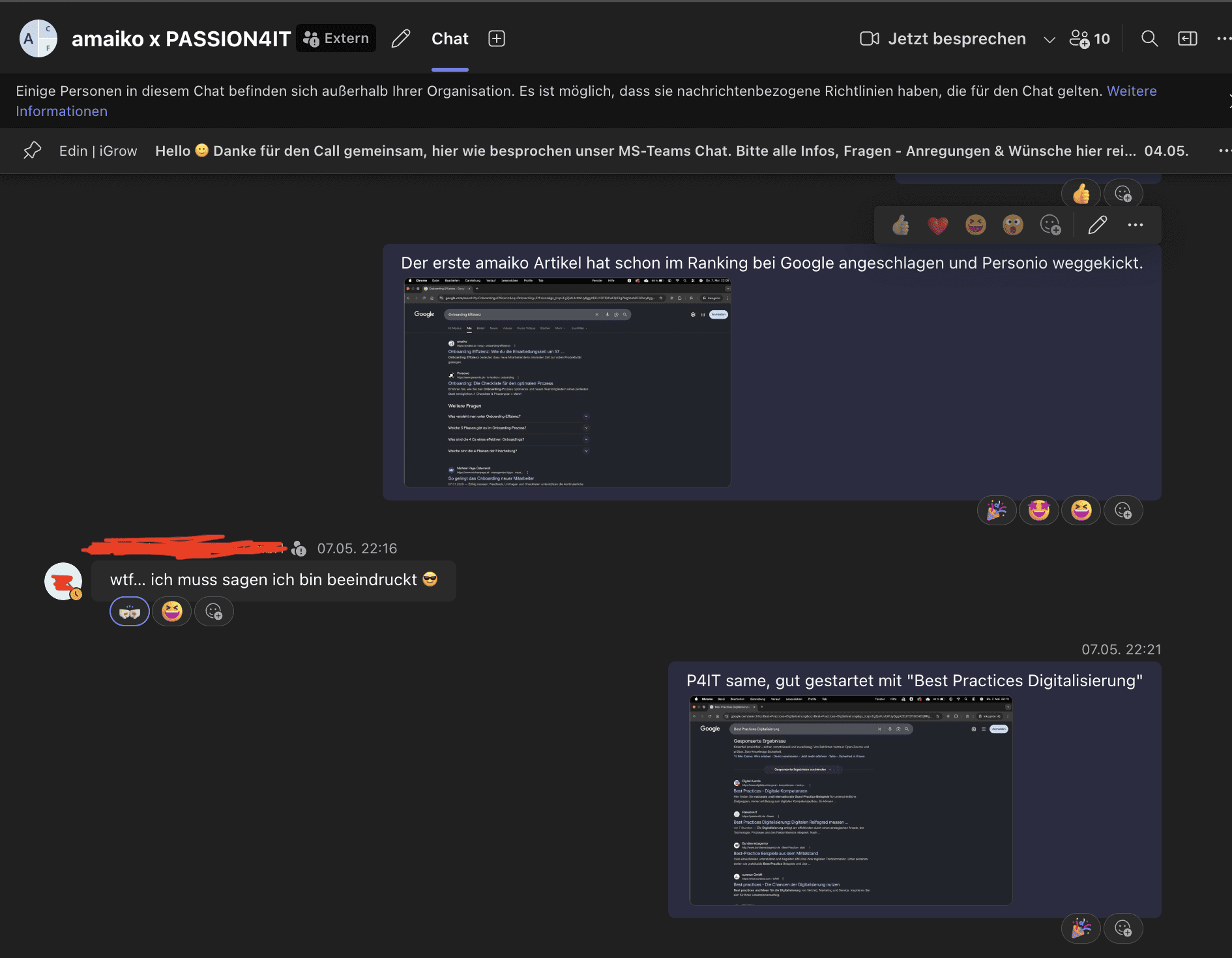
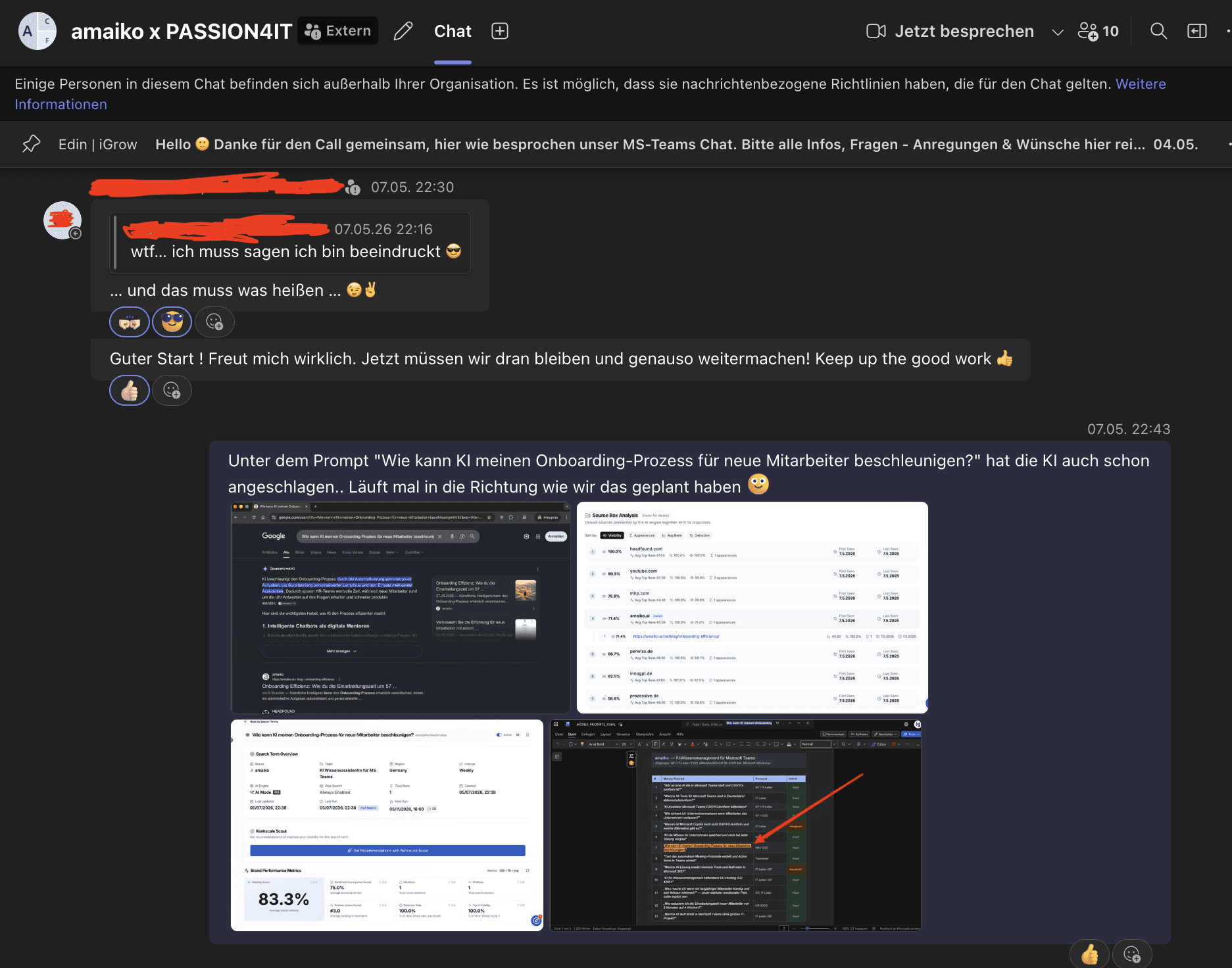
Another feedback, a Managing Director in this project, added:
"Great start! Really happy about this. Now we must stick with it and keep going exactly like this! Keep up the good work 👍"
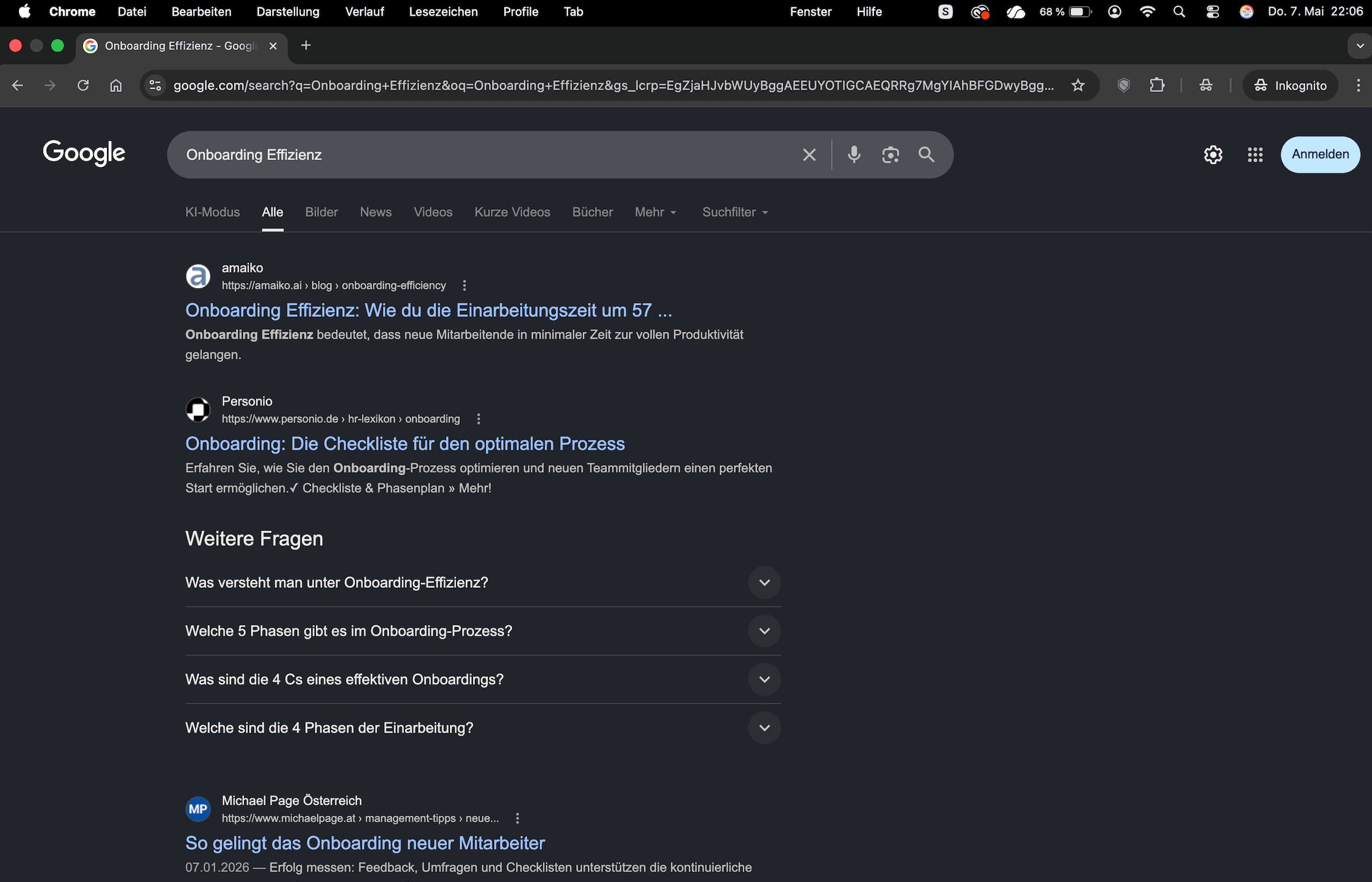
What had happened? The first published article on onboarding efficiency had reached Google #1 within a few hours, overtaking Personio and Michael Page Austria. Both are established providers with significantly stronger domains and years of a head start.
And that was just the beginning.
The first article: Case Study – 5 hours from indexing to rank 1
For the prompt "How can AI speed up my onboarding process for new employees?", the article delivered the following results immediately after indexing:
83.3% AI visibility score for this prompt alone. This means: In this case, the prompt was shown in AI Mode when someone asked this question.
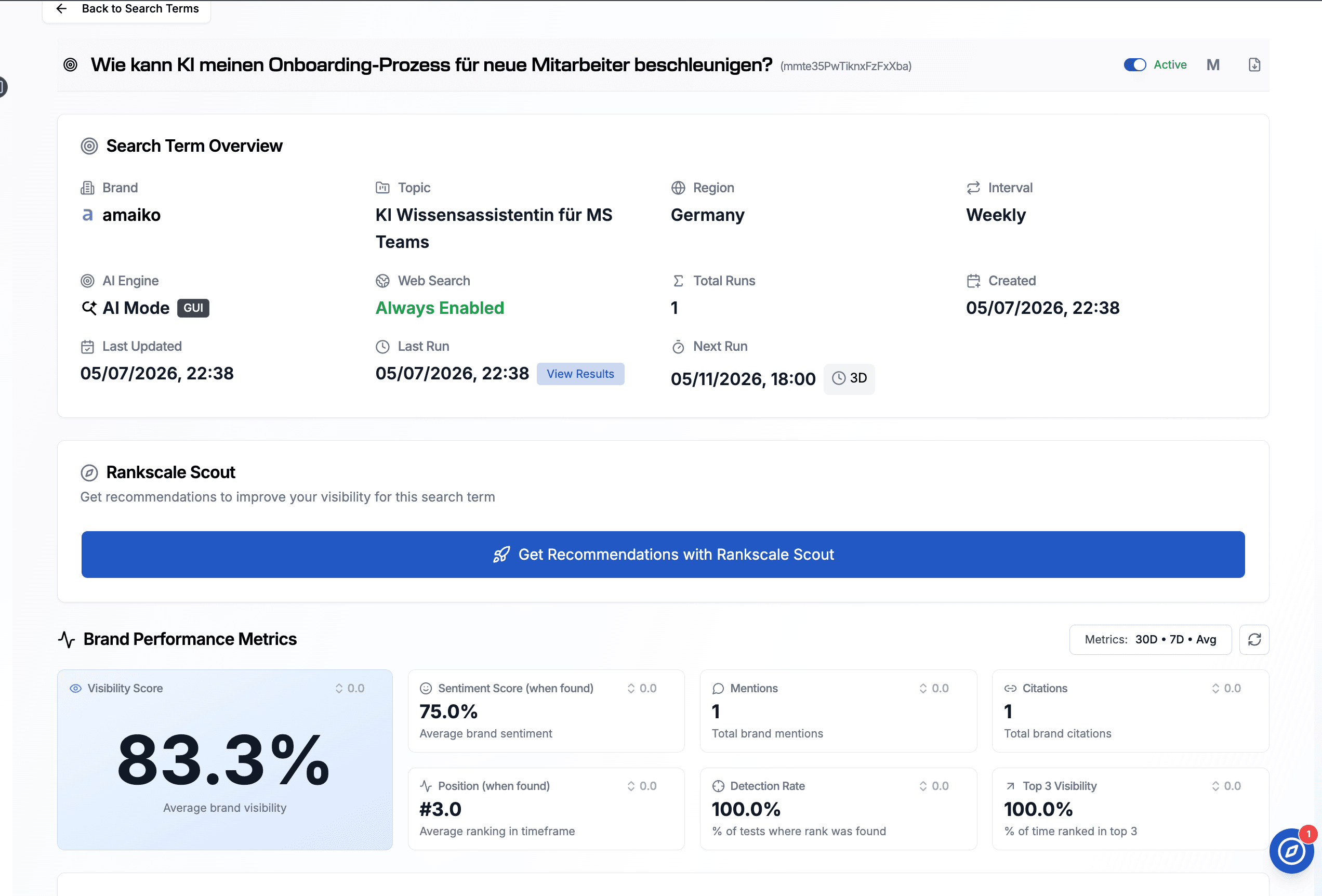
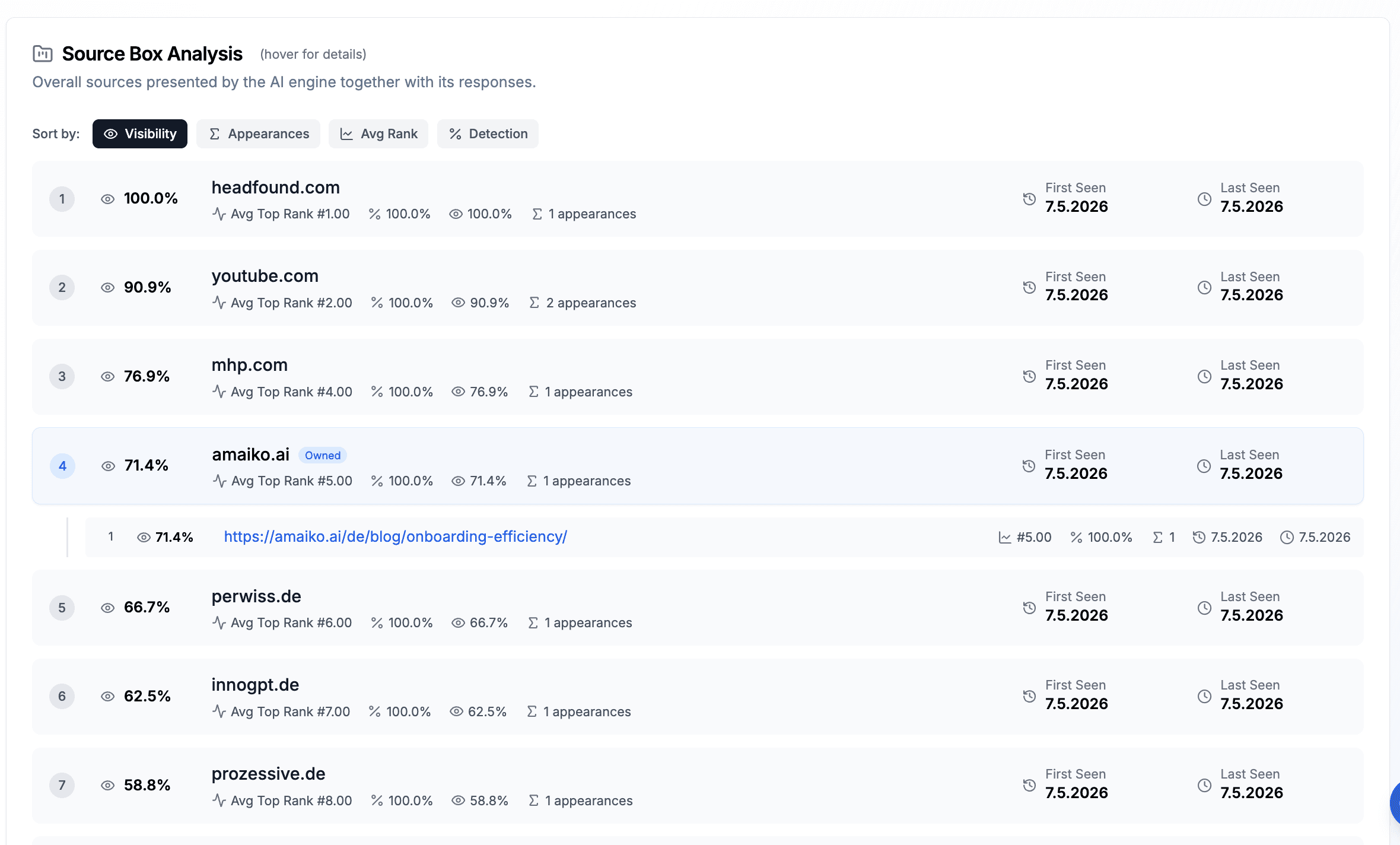
In parallel: #1 organically on Google. Within 5 hours after indexing.
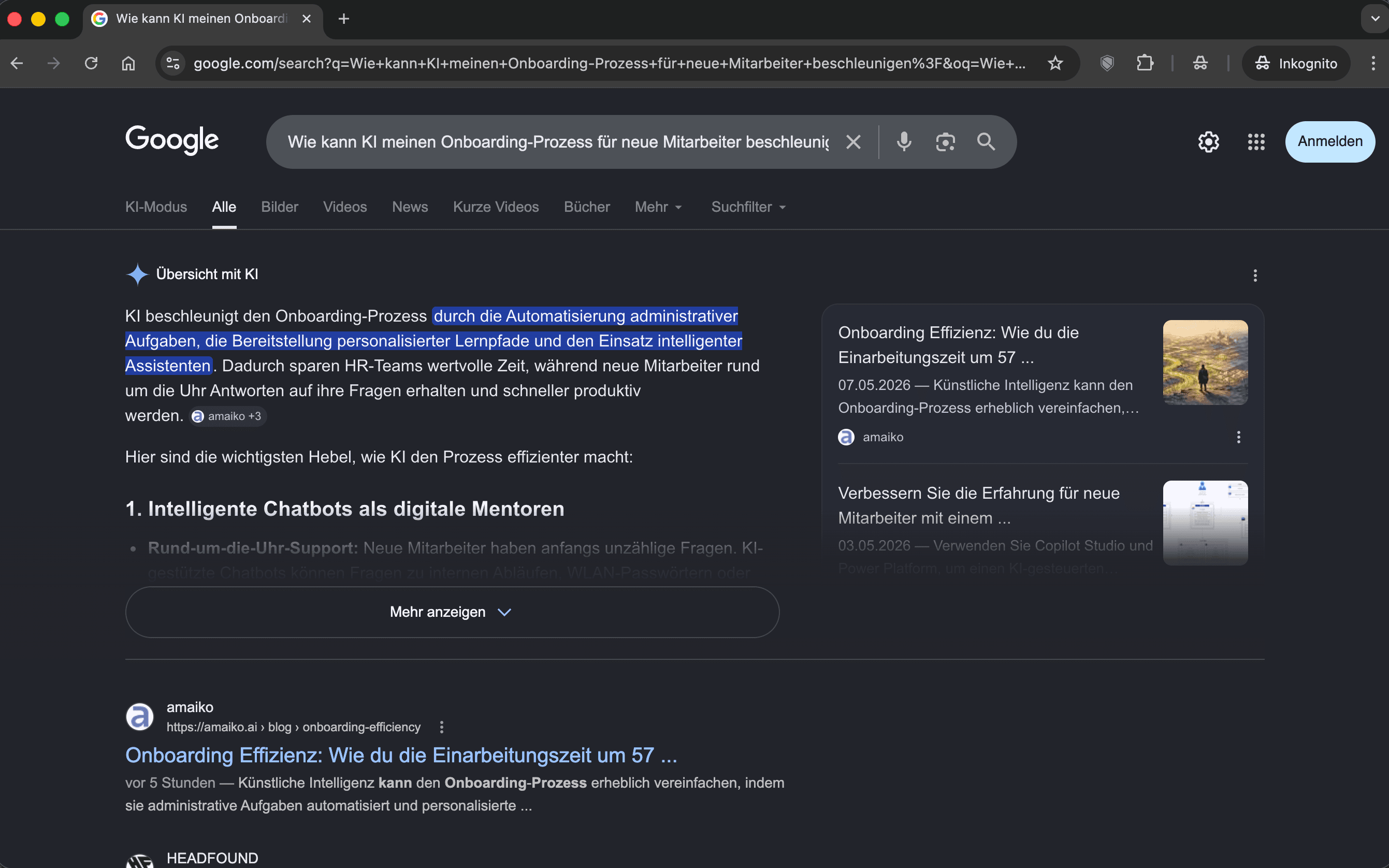
The Source Box analysis in RankScale confirmed what we saw in the dashboard: The blog article was actively used by AI engines as source material. amaiko.ai/de/blog/onboarding-efficiency appears in the top-20 list of the most highly cited URLs with a 62.7% visibility score and an 88.9% detection rate across 74 appearances.
The Source Box Inspector in the AI Rank Tracker tool RankScale now shows all blog articles overall, as of today, that were actively used by AI engines as source material:
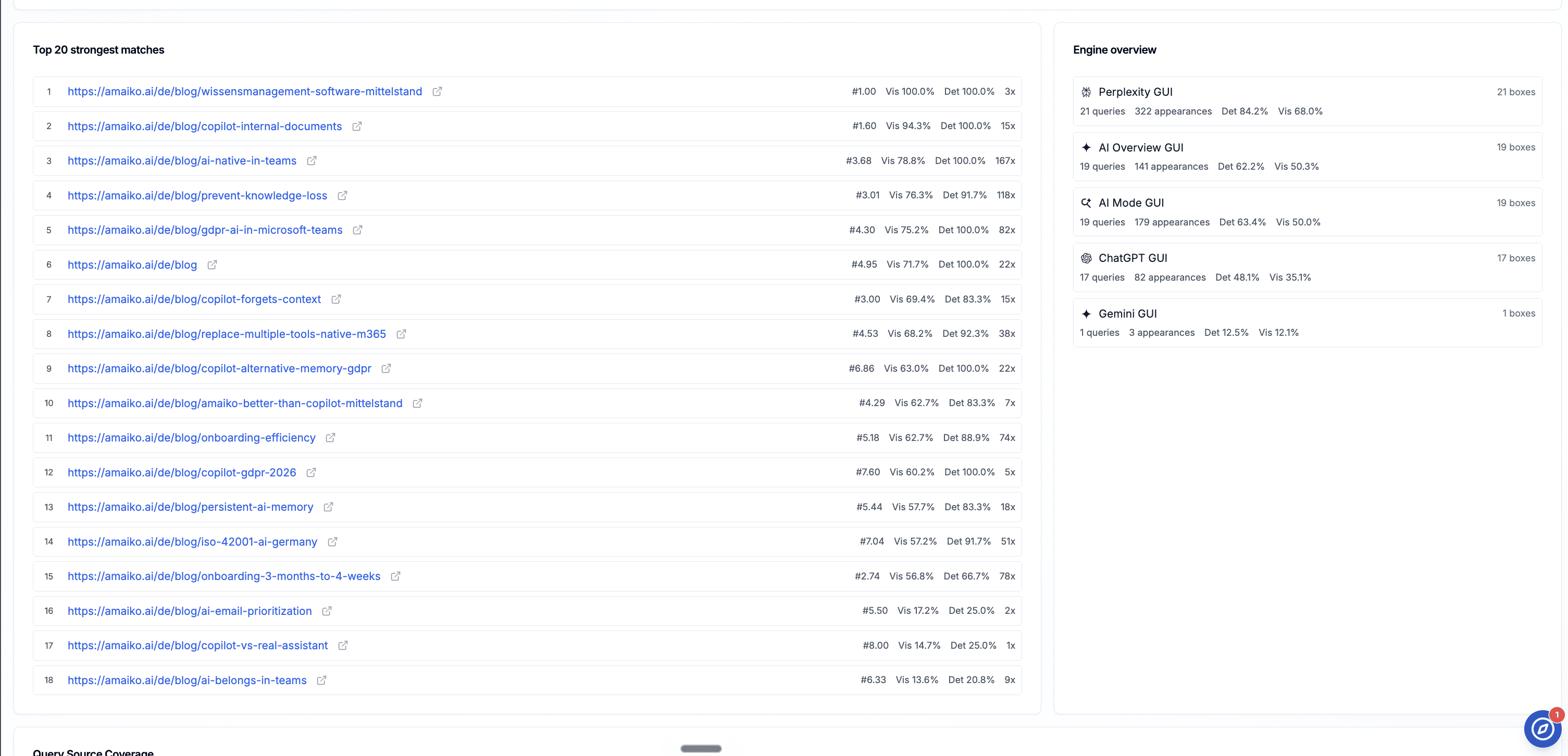
This is not a lucky shot. It is the direct result of a strategy that prioritizes bottom-of-funnel content and structures articles in such a way that AI systems classify them as a reliable source.
The strategy behind the results: Generative Engine Optimization
Before we show the numbers in detail, it is important to understand why the methodology works and why it works particularly well for amaiko.
Step 1: Prompt research instead of keyword research
This methodology is part of Generative Engine Optimization and focuses on appearing in AI responses with your content.
We don't ask ourselves which keywords are searched for a product. We ask what questions a decision-maker ready to buy in a medium-sized company poses to ChatGPT or Gemini when they are looking for an AI solution for their team.
These are different questions compared to classic search engine optimization: There, rankings and traffic are primarily measured; here, it is about visibility in AI with unique KPIs. They are longer, more specific, and contextual. And they have a clear purchase intent.
For amaiko, these prompts look like this:
Topic: AI Assistant for Microsoft Teams
"AI Assistant for Microsoft Teams: GDPR-compliant for medium-sized businesses"
"Is there an AI that runs in Microsoft Teams and is GDPR-compliant?"
"Which AI has persistent memory for Teams and runs on German servers?"
"Which AI tools for Microsoft Teams are data privacy compliant in Germany?"
"Which AI solution replaces multiple tools and runs natively in Microsoft 365?"
Intent classification: All of these prompts come from decision-makers who already know they want an AI solution. They are not looking for information. They are looking for the right provider.
Whoever appears as the first recommendation for these questions is already in the narrowest selection, even before a call has taken place.
Step 2: Bottom-of-funnel first
We never start with general informational articles. We start with the articles that are directly linked to a purchasing decision.
In the case of amaiko, this means: No generic "What is AI?" article to start. Instead: "AI Assistant for Microsoft Teams: GDPR-compliant for medium-sized businesses". Straight into the purchasing phase.
Step 3: Structure for AI citation
AI systems do not cite arbitrary texts. They prefer content that is clearly structured through conscious AI optimization, delivers direct answers, is factually sound, and pursues a clear goal.
We don't write for the algorithm. We write for the reader — in such a way that the optimization also works in practice, AI systems classify the content as a trustworthy source, and clean tracking makes sense in the first place.
The numbers: Documented week by week
First Update: May 11 (4 days after the first article)
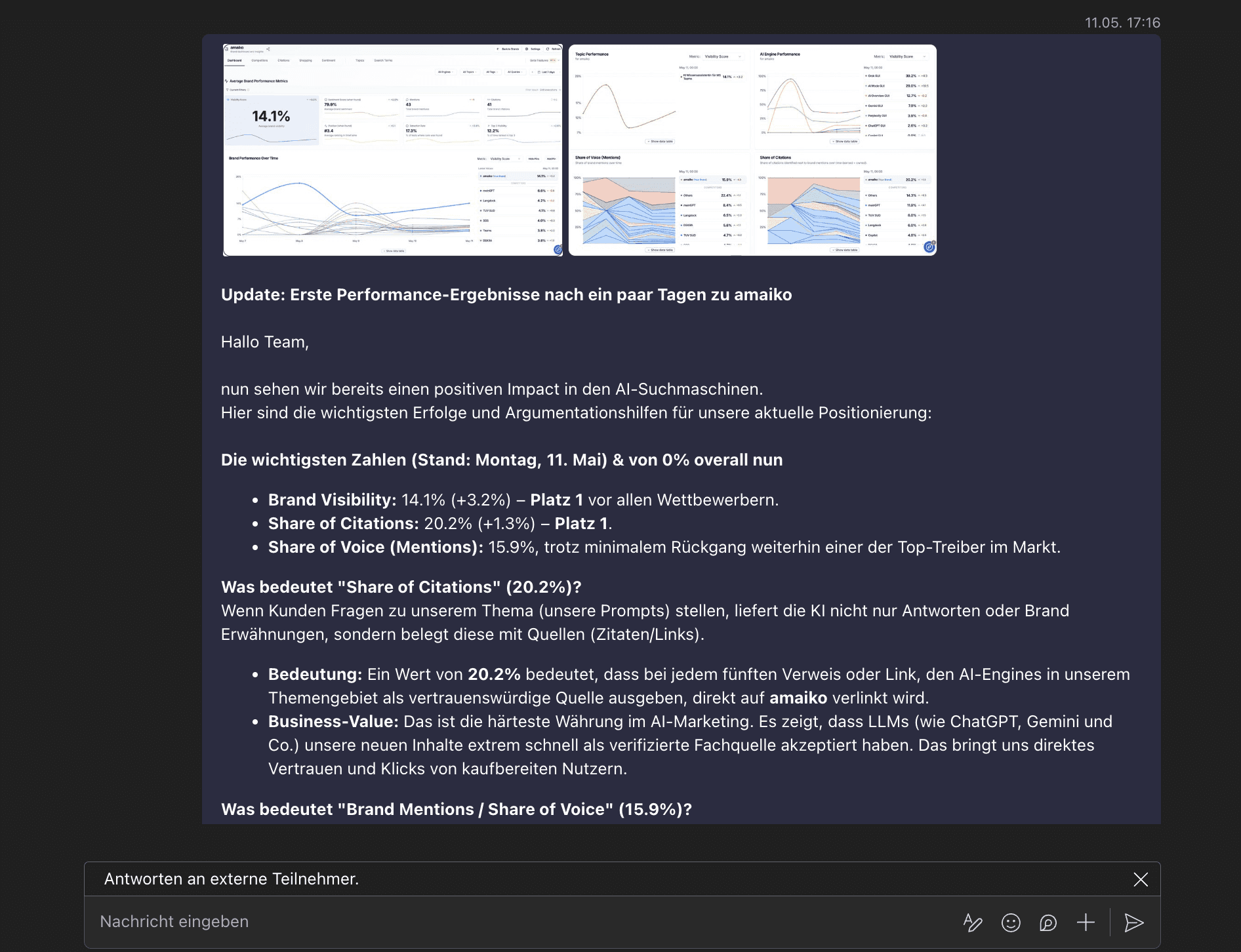
In the first performance update that we shared in the joint Teams chat, the following numbers were reported:
Brand Visibility: 14.1% (+3.2%) — #1 ahead of all competitors
Share of Citations: 20.2% (+1.3%) — #1
Share of Voice (Mentions): 15.9%
The significance of the 20.2% citation value, as we explained it to the amaiko team: For every fifth reference or link that AI engines output in this subject area as a trustworthy source, it leads directly to amaiko. This is the hardest currency in AI marketing. It shows that ChatGPT, Gemini, and others accepted our new content extremely quickly as a verified expert source.
Update May 20 (13 days after the first article)
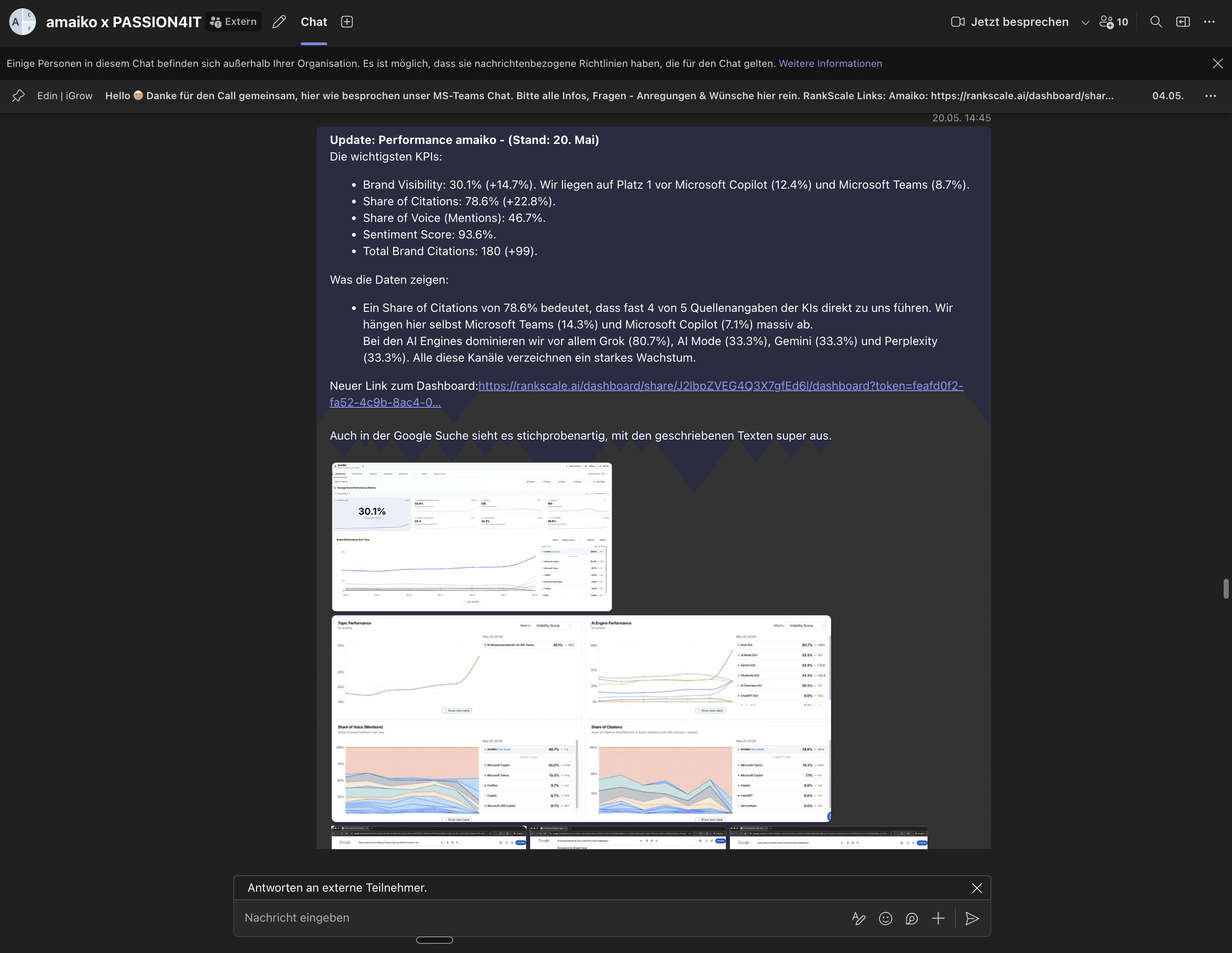
Brand Visibility: 30.1% (+14.7%) — #1 ahead of Microsoft Copilot (12.4%) and Microsoft Teams (8.7%)
Share of Citations: 78.6% (+22.8%)
Share of Voice (Mentions): 46.7%
Sentiment Score: 93.6%
Total Brand Citations: 180 (+99)
A Share of Citations of 78.6% means: Almost 4 out of 5 citations by the AIs in this subject area lead directly to amaiko. We are leaving Microsoft Teams (14.3%) and Microsoft Copilot (7.1%) far behind.
For context: Microsoft Copilot is the product of the company that built Teams itself. Yet amaiko, a young company with a domain that has a fraction of Microsoft's authority, dominates in AI search.
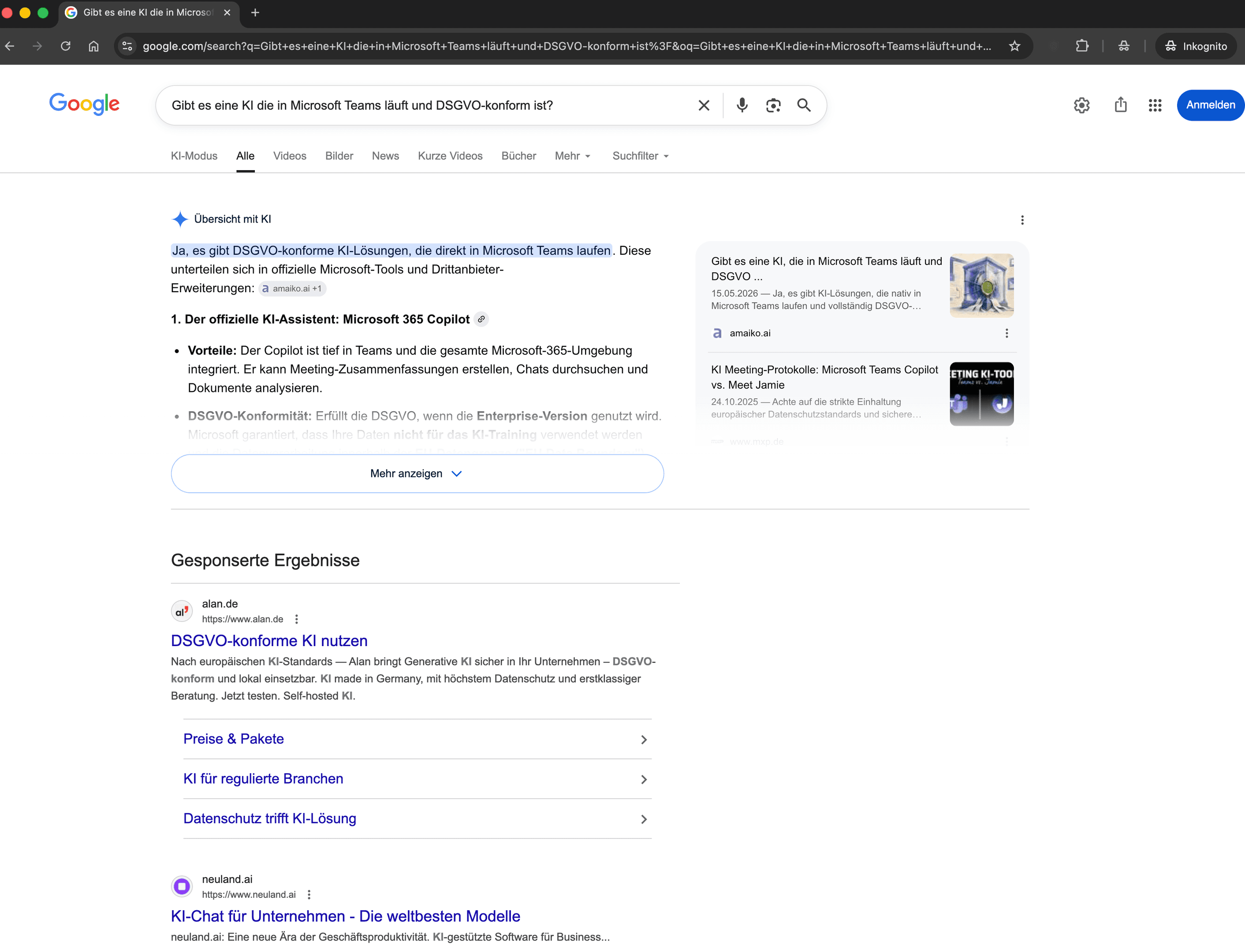
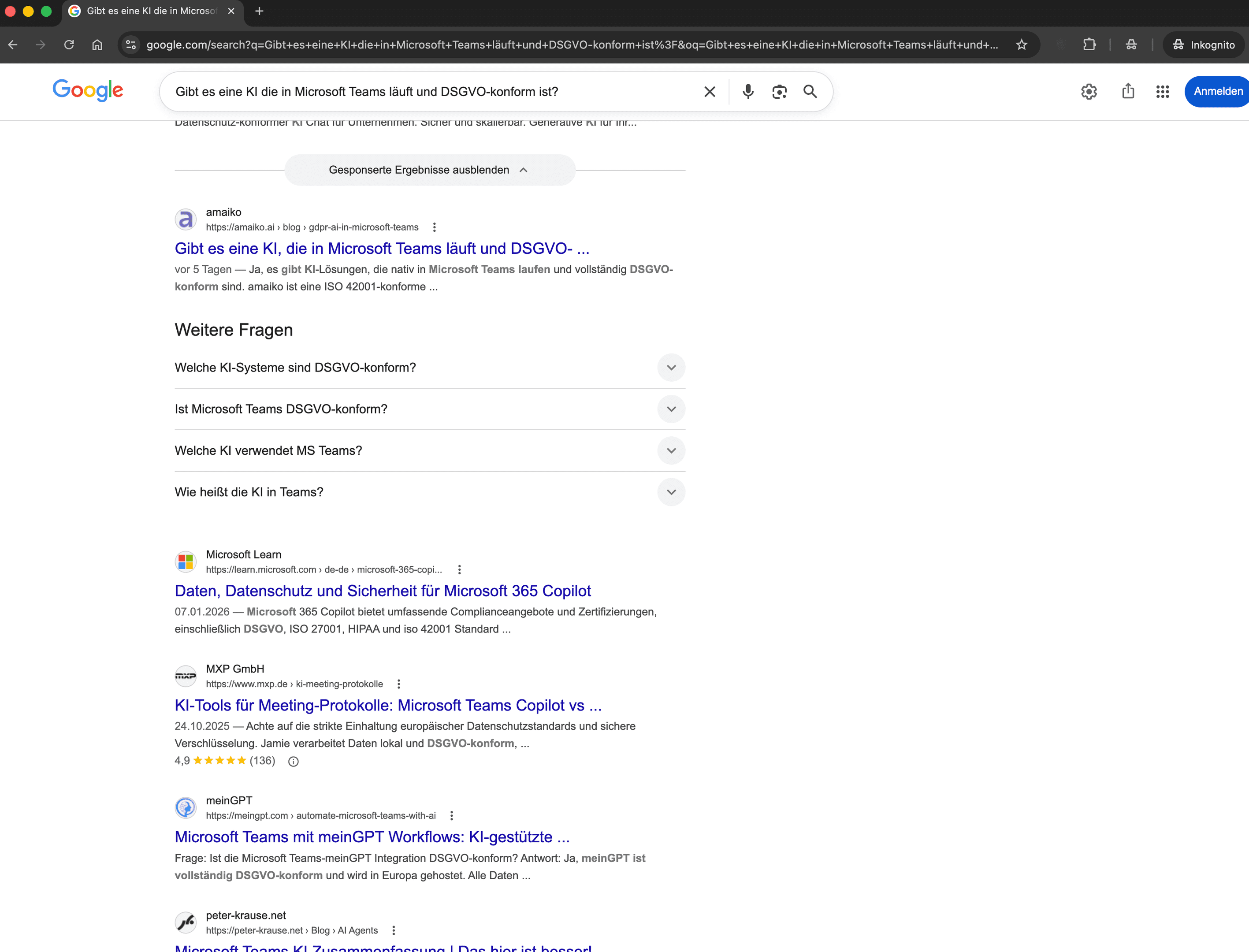
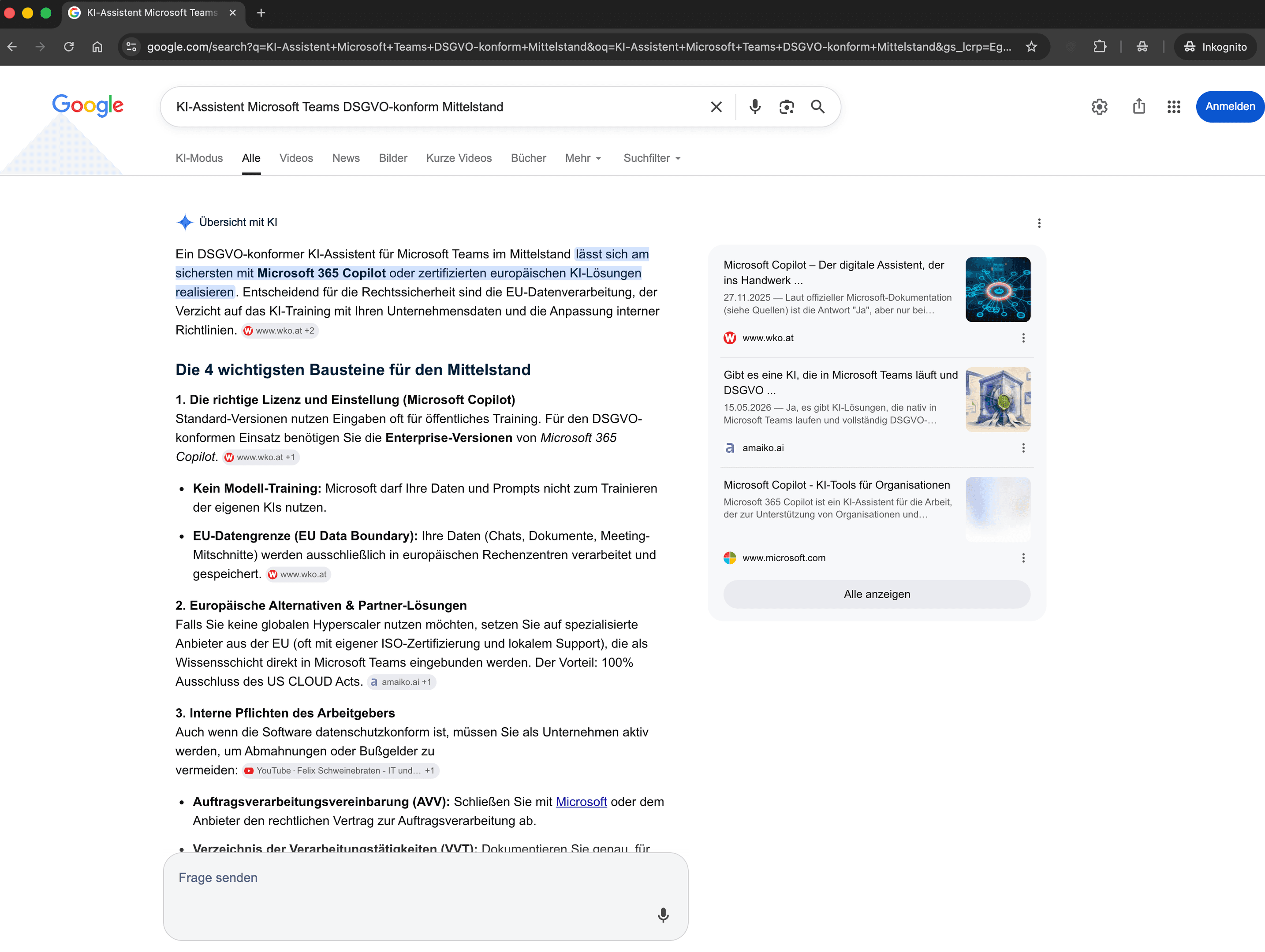
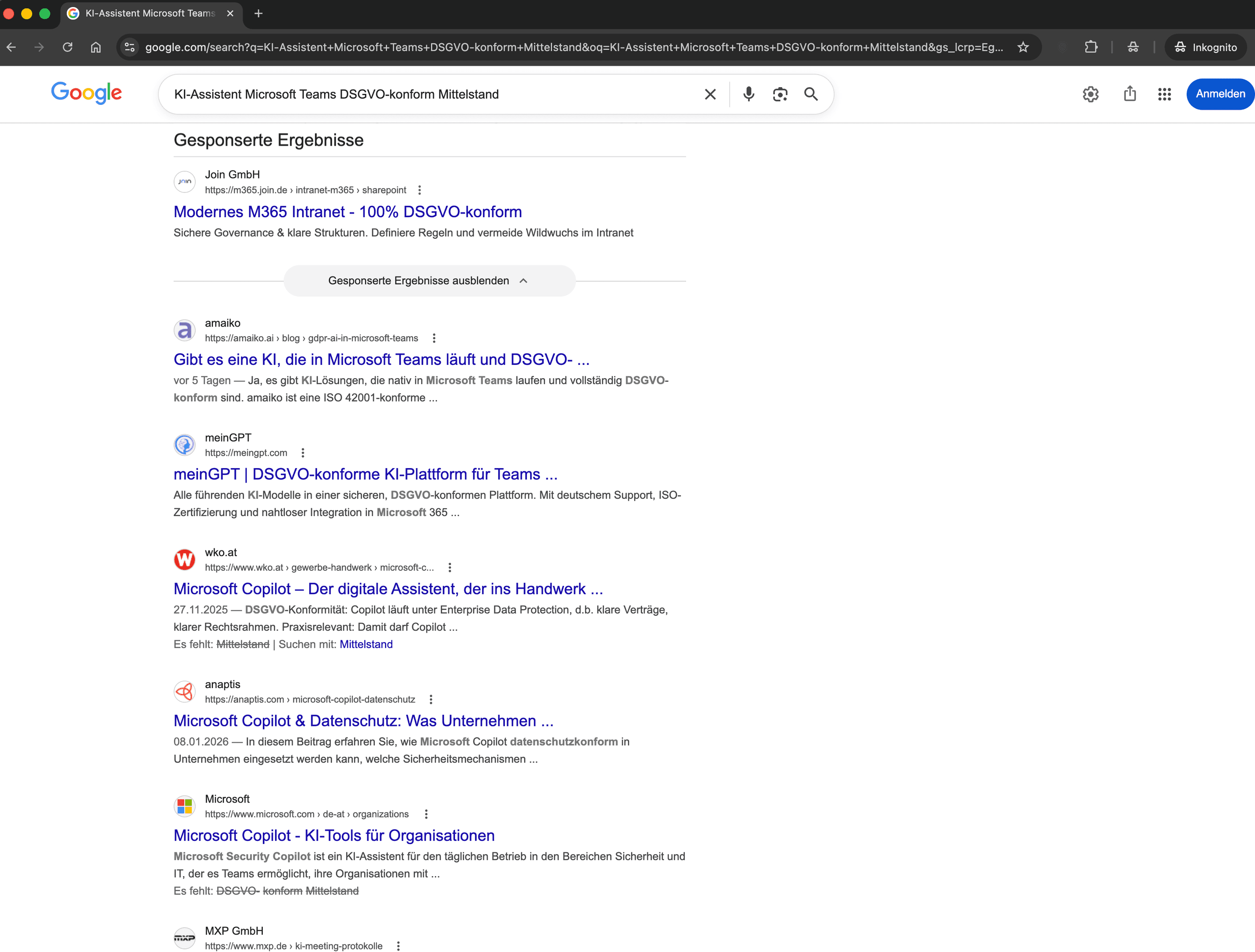
In Google Search too, spot checks looked great:
As of June 5 (29 days after the first article)
This is the final result after one month of working together.
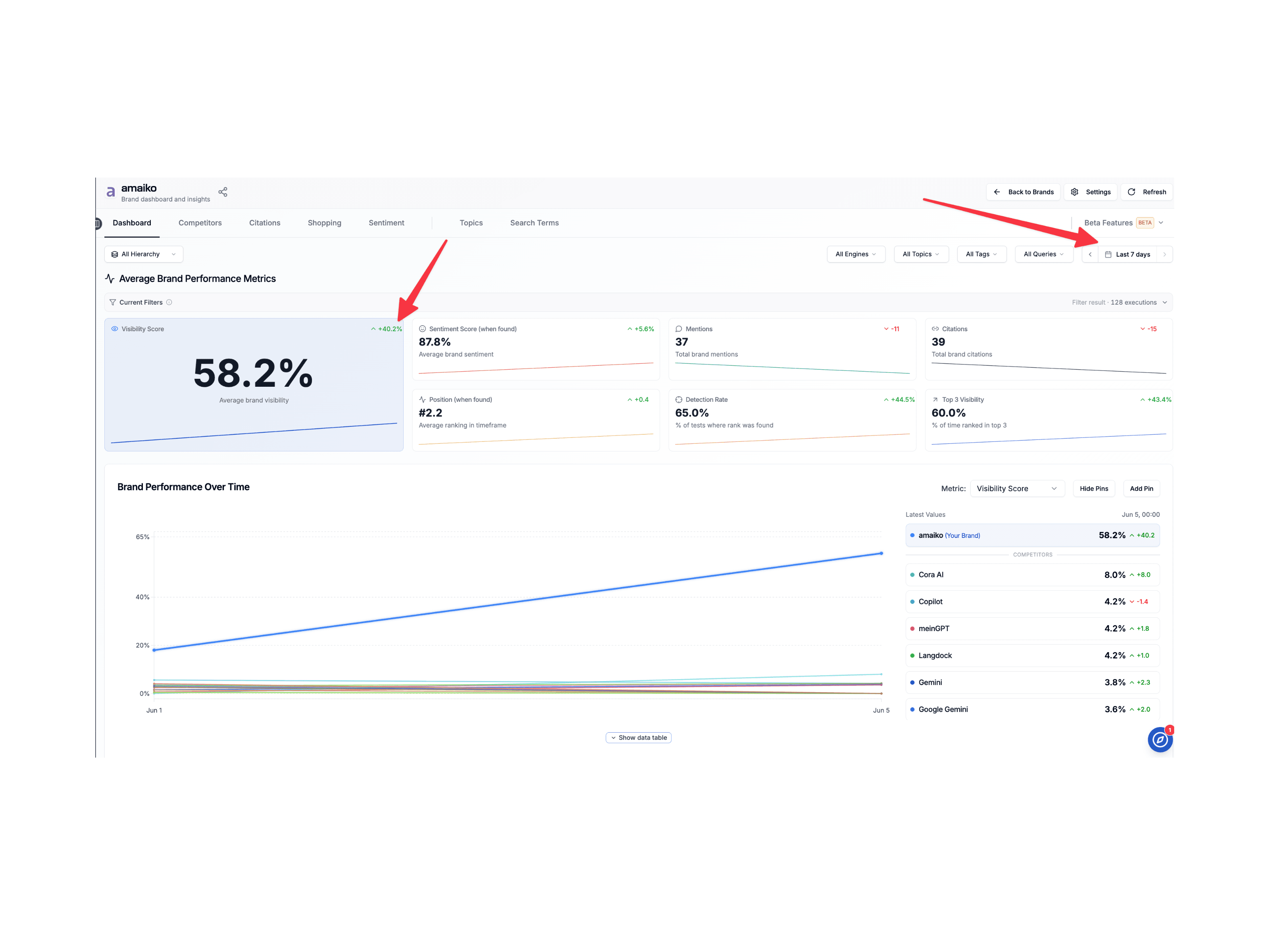
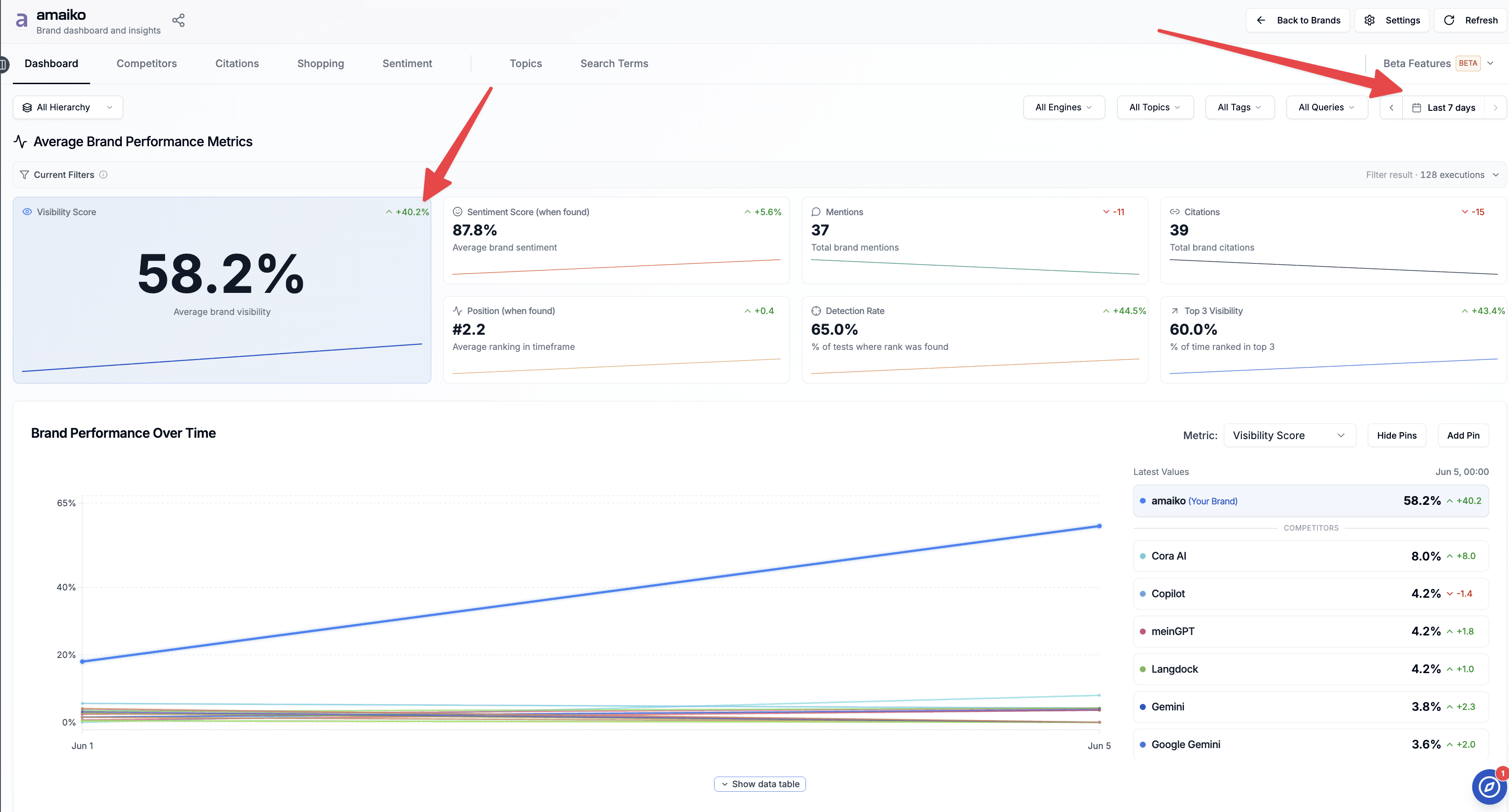
Overall Performance (last 7 days):
Metric | Value | Trend |
|---|---|---|
Average Visibility Score | 58.2% | +40.2% |
Sentiment Score (when found) | 87.8% | +5.6% |
Brand Mentions | 37 | -11 |
Citations | 39 | -15 |
Average Position (when found) | 2.2 | +0.4 |
Detection Rate | 65.0% | +44.5% |
Top 3 Visibility | 60.0% | +43.4% |
The most crucial KPIs for the ongoing measurement of brand performance are bundled here; a report makes the development over time, scores, and measures clearly comparable.
Competitor Comparison (Visibility Score, last 7 days):
Brand | Score | Trend |
|---|---|---|
amaiko | 58.2% | +40.2 |
Cora AI | 8.0% | +8.0 |
Copilot | 4.2% | -1.4 |
meinGPT | 4.2% | +1.8 |
Langdock | 4.2% | +1.0 |
Gemini | 3.8% | +2.3 |
Google Gemini | 3.6% | +2.0 |
Compared to the main competitors in the market, amaiko is clearly ahead.
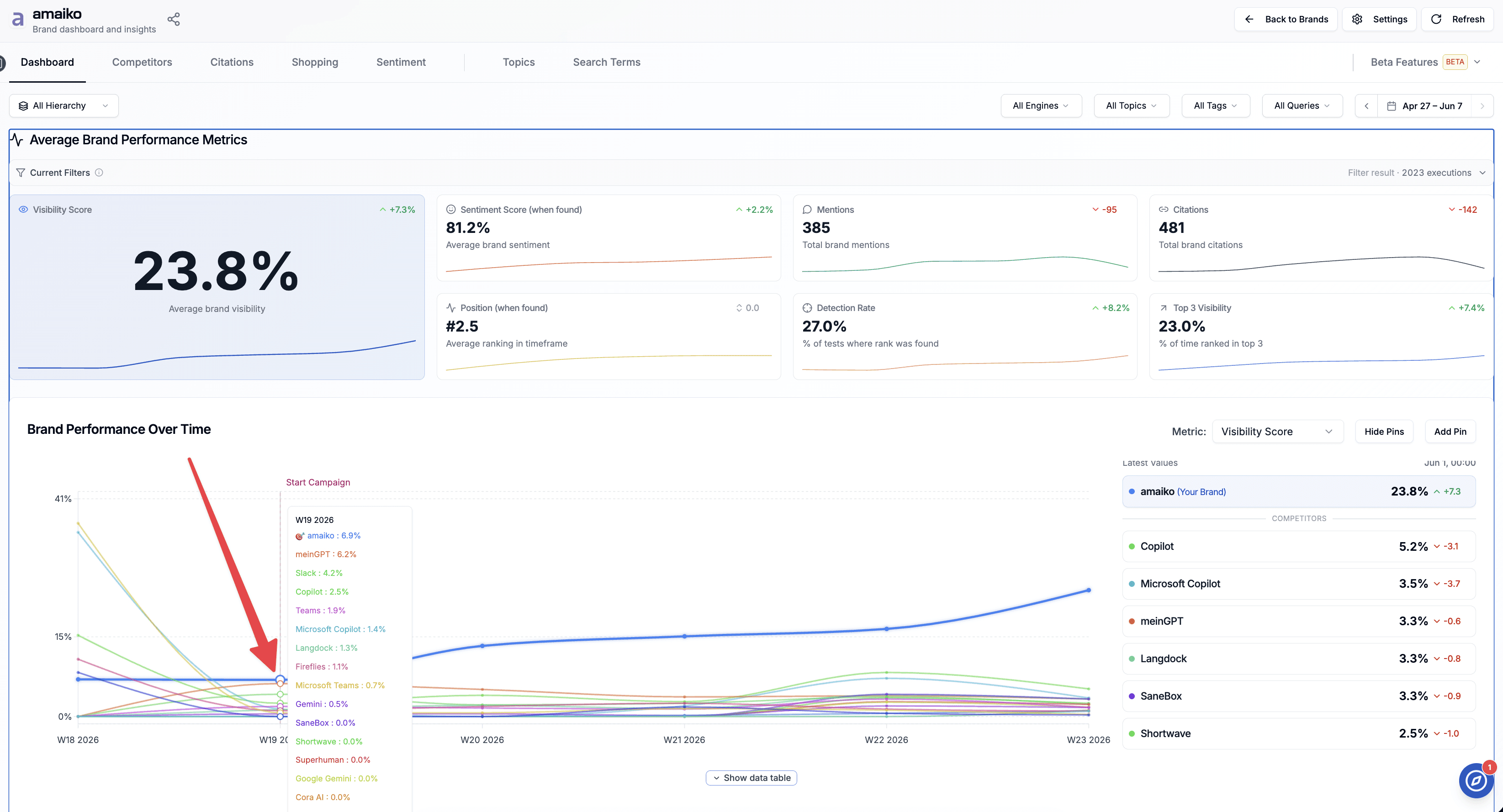
Overall Performance (entire period from April 27 to June 7):
Metric | Value |
|---|---|
Average Visibility Score | 23.8% |
Sentiment Score | 81.2% |
Total Brand Mentions | 385 |
Total Citations | 481 |
Average Position | 2.5 |
Detection Rate | 27.0% |
Top 3 Visibility | 23.0% |
Prompt Coverage shows in how many user queries amaiko appears at all; in practice, a suitable prompt set is often defined and regularly reviewed for this purpose.
The overall average over the entire period is lower in this measurement because it includes the first few weeks when few or no articles were live yet. The last 7 days show the current level after one month of consistent content work.
AI Engine Performance: All engines rise, Copilot remains at 0%
A notable detail in the data: Microsoft Copilot shows a 0.0% Visibility Score. This has nothing to do with our content; it is a "technical" phenomenon. Copilot generally indexes articles. Why this is the case is something we cannot comment on.
The other engines:
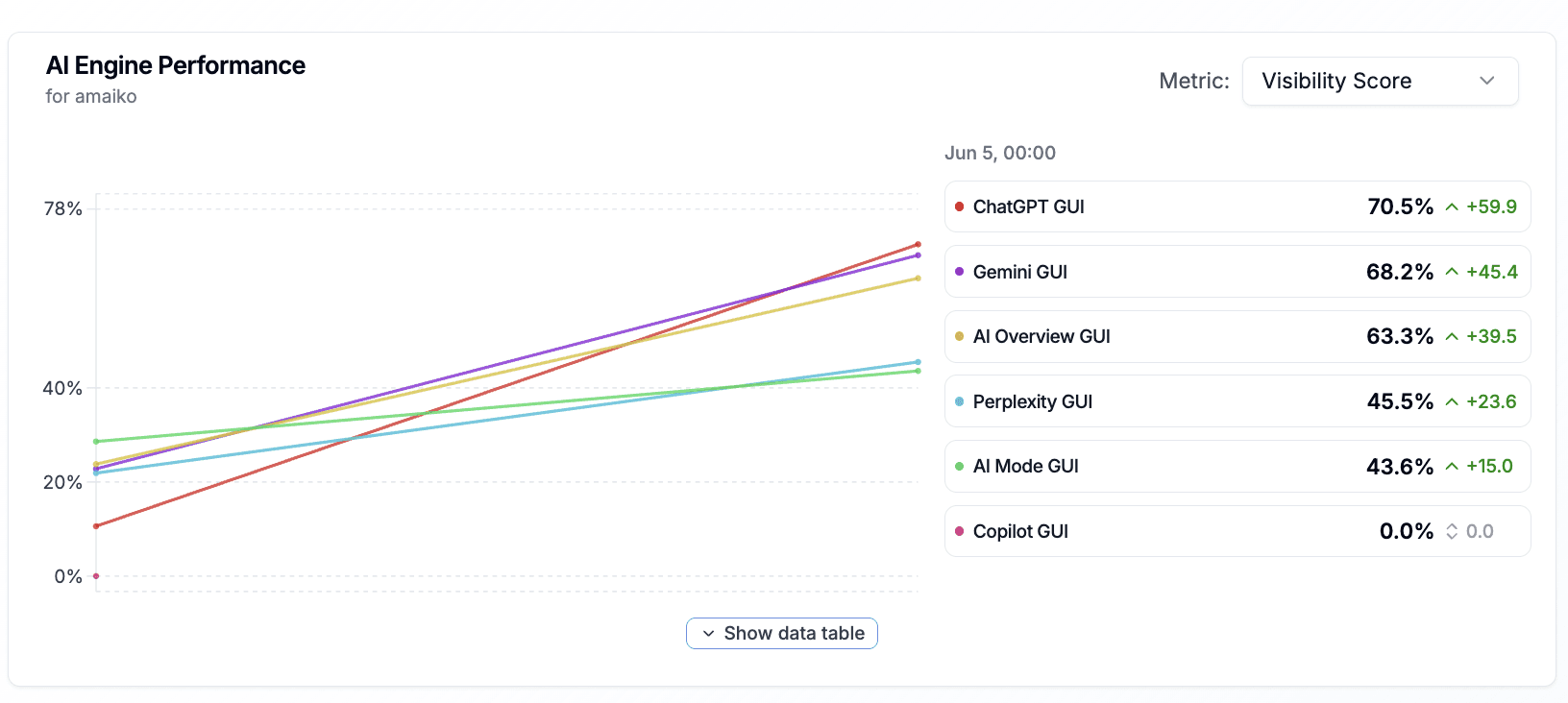
Engine | Visibility Score | Trend |
|---|---|---|
ChatGPT GUI | 70.5% | +59.9 |
Gemini GUI | 68.2% | +45.4 |
AI Overview GUI | 63.3% | +39.5 |
Perplexity GUI | 45.5% | +23.6 |
AI Mode GUI | 43.6% | +15.0 |
Copilot GUI | 0.0% | 0.0 |
ChatGPT is the engine with the strongest growth, gaining +59.9 points. This is highly relevant because ChatGPT is the most frequently used AI platform among German B2B decision-makers.
Share of Citations: 57.1%: every second source citation leads to amaiko
The Citations tab presents a picture that speaks for itself:
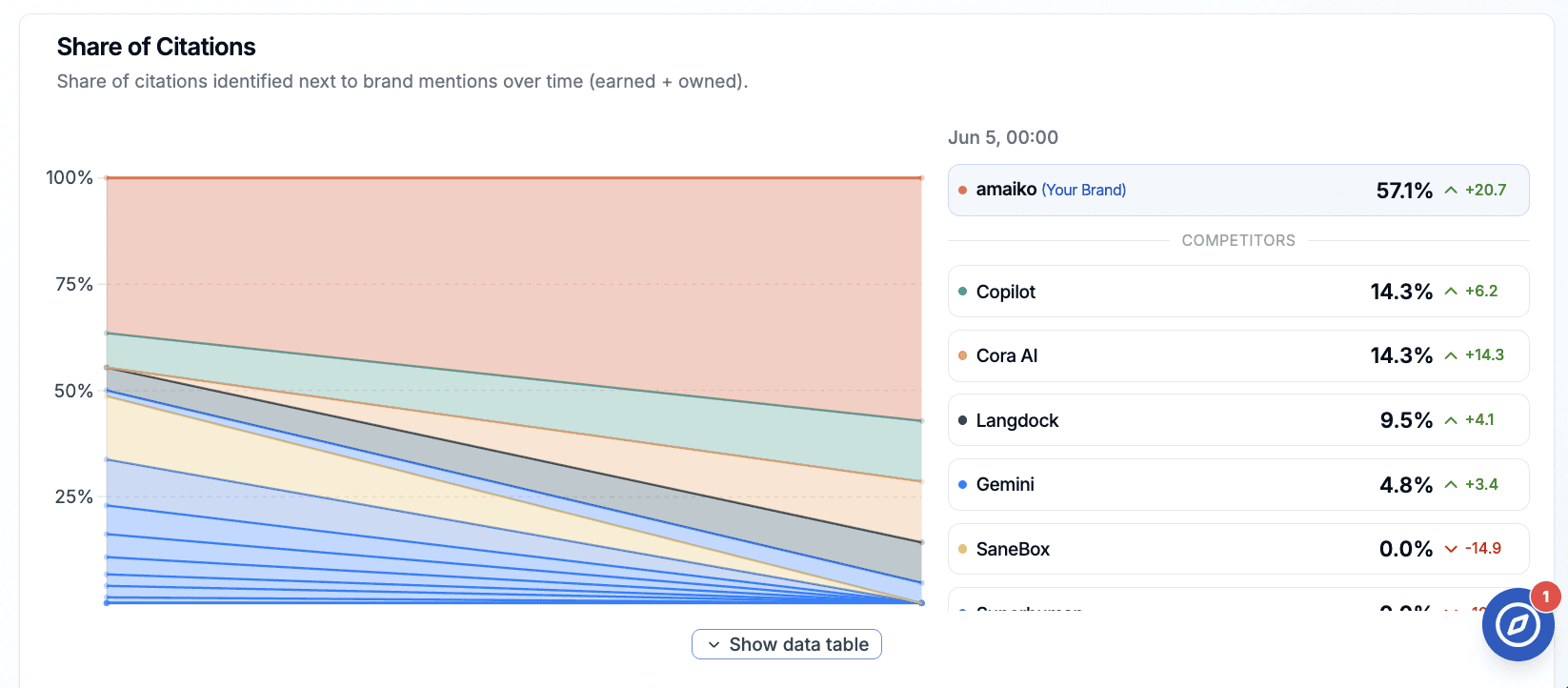
amaiko: 57.1% Share of Citations (+20.7)
Copilot: 14.3%
Cora AI: 14.3%
Langdock: 9.5%
When AI systems provide sources for answers within amaiko's domain, every second citation leads directly to amaiko. This is not a brand awareness metric. This is a measure of trust that AI systems actively award.
In Share of Voice (Mentions), amaiko stands at 61.9% (+26.6), with the nearest competitor Cora AI at 9.5%.
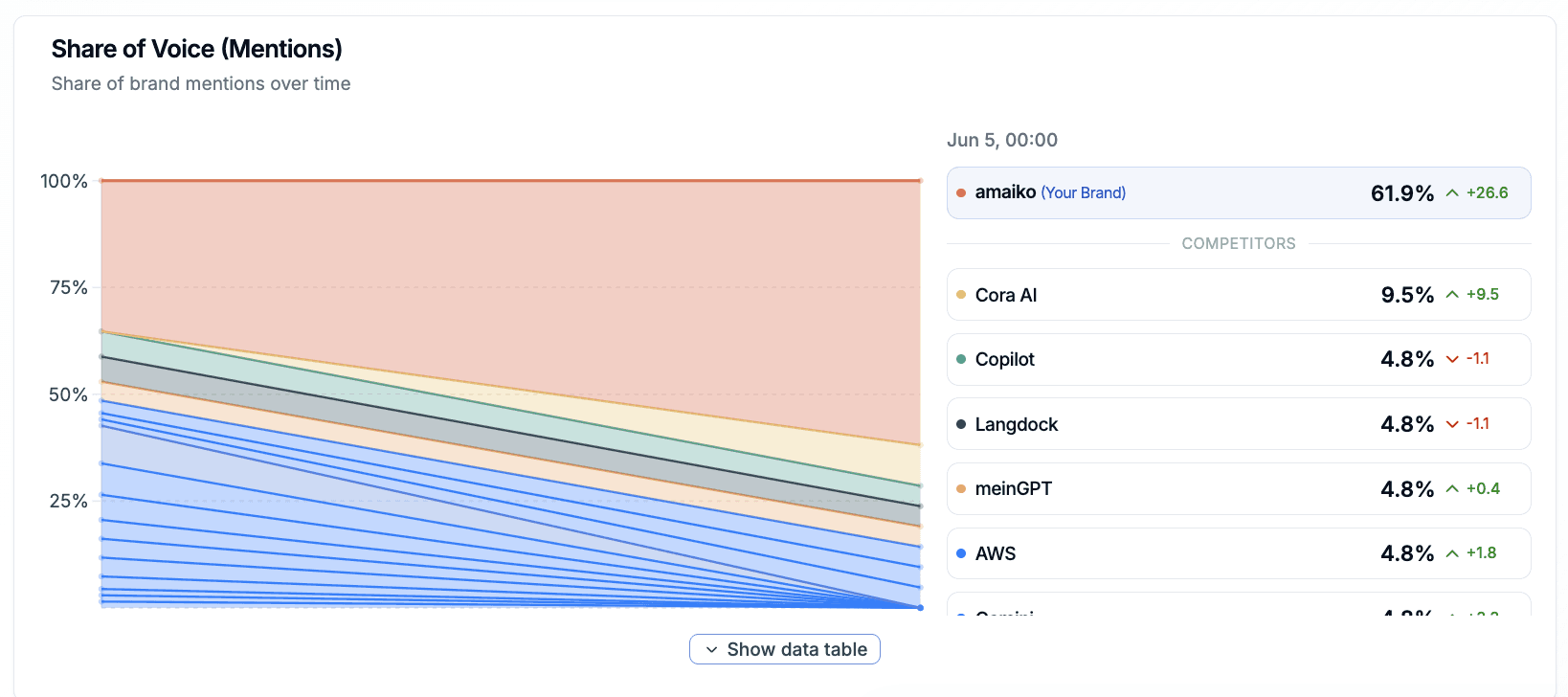
Source Box Inspector: The blog as the primary source
A detail that deserves special emphasis: The Source Box analysis in RankScale reveals what many clients fail to see, namely which specific URLs are being used as source material by AI engines.
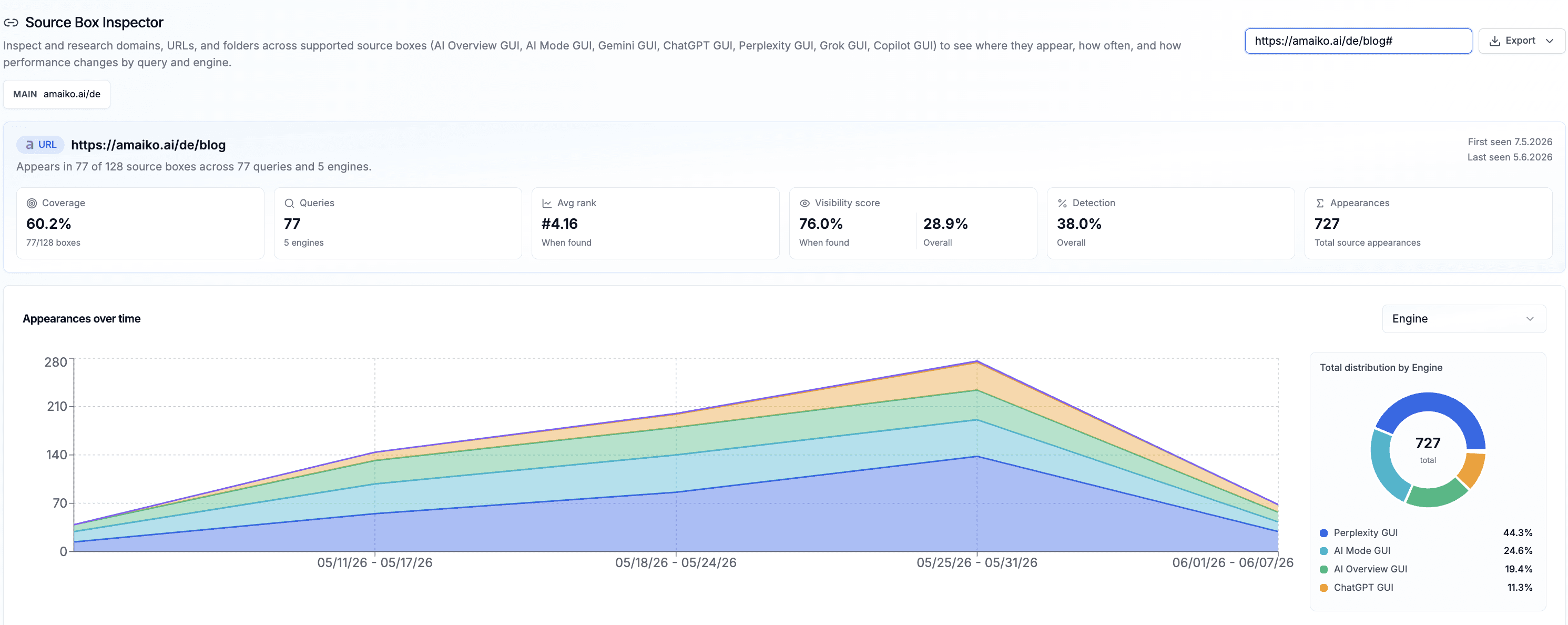
For amaiko.ai/de/blog, the dashboard shows:
727 total source appearances (total number of times featured as a source)
60.2% Coverage (77 out of 128 possible Source Boxes covered)
77 Queries across 5 engines
76.0% Visibility Score when found
First match: May 7, 2026 — directly on the day of the first article publication
The distribution by engine:
Perplexity GUI: 44.3% (321 Appearances)
AI Mode GUI: 24.6% (179 Appearances)
AI Overview GUI: 19.4% (141 Appearances)
ChatGPT GUI: 11.3% (82 Appearances)
This means: All major AI engines are actively utilizing the amaiko blog as source material. Not as a random encounter, but as a standard reference for relevant search queries.
The top URLs in the Source Box analysis:
amaiko.ai/de/blog/wissensmanagement-software-mittelstand — Rank 1, 100% Visibility, 100% Detection, appeared 3 times
amaiko.ai/de/blog/copilot-internal-documents — Rank 1.6, 94.3% Visibility, appeared 15 times
amaiko.ai/de/blog/ai-native-in-teams — Rank 3.68, 78.8% Visibility, appeared 167 times
amaiko.ai/de/blog/prevent-knowledge-loss — Rank 3.01, 76.3% Visibility, appeared 118 times
amaiko.ai/de/blog/gdpr-ai-in-microsoft-teams — Rank 4.30, 75.2% Visibility, appeared 82 times
Total Citation Appearances: 794 appearances in 5 weeks
The Citations dashboard provides the overview for the period from W19 to W23 2026:
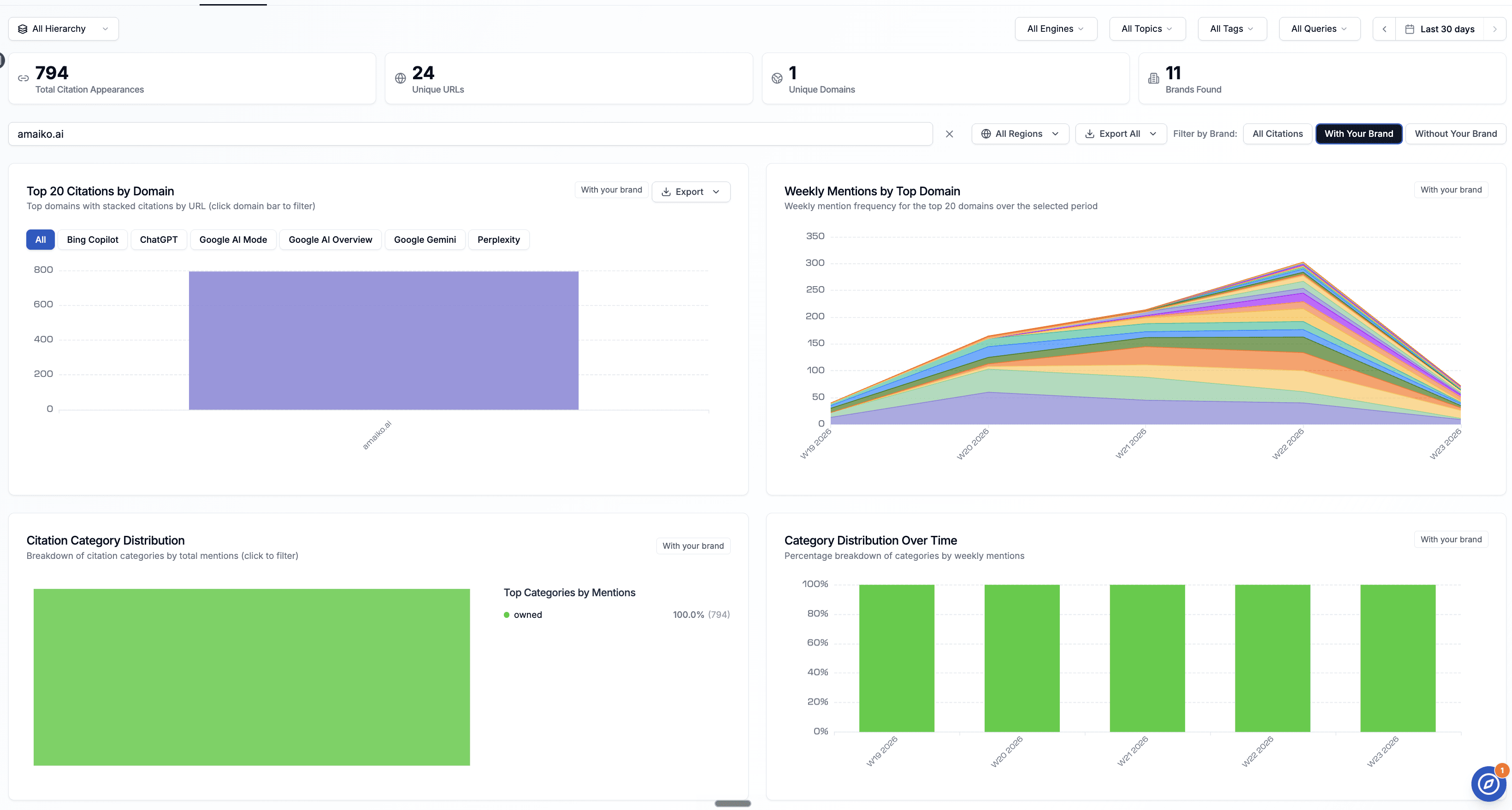
794 Total Citation Appearances
24 Unique URLs
1 Domain (amaiko.ai as the sole cited source)
The Citation Category Distribution shows: 100% of citations fall under the Owned category — all cited content originates directly from amaiko.ai. This means: The company's own domain is the only source AI systems are using for amaiko. For a company in this early phase, this is a strong signal, but it also highlights the potential for growth through external mentions, press coverage, and partner content.
This is strategically crucial: Blog content is the driving force behind AI visibility. Not the product pages. Not the homepage. Informative, structured, purchase-intent blog content is what AI systems prefer to quote. Today, it represents a core pillar of the content strategy for AI visibility.
And this is built systematically using data and ongoing tracking.
The prompt analysis: What decision-makers ready to buy really ask
Here is an excerpt of the tested prompts from the collaboration with amaiko, all of which generated measurable AI visibility. Such questions should ideally be formatted in clear ways to make it easier for AI systems to process and reliably integrate into AI answers:
Topic: AI Assistant for Microsoft Teams (GDPR, Data Protection)
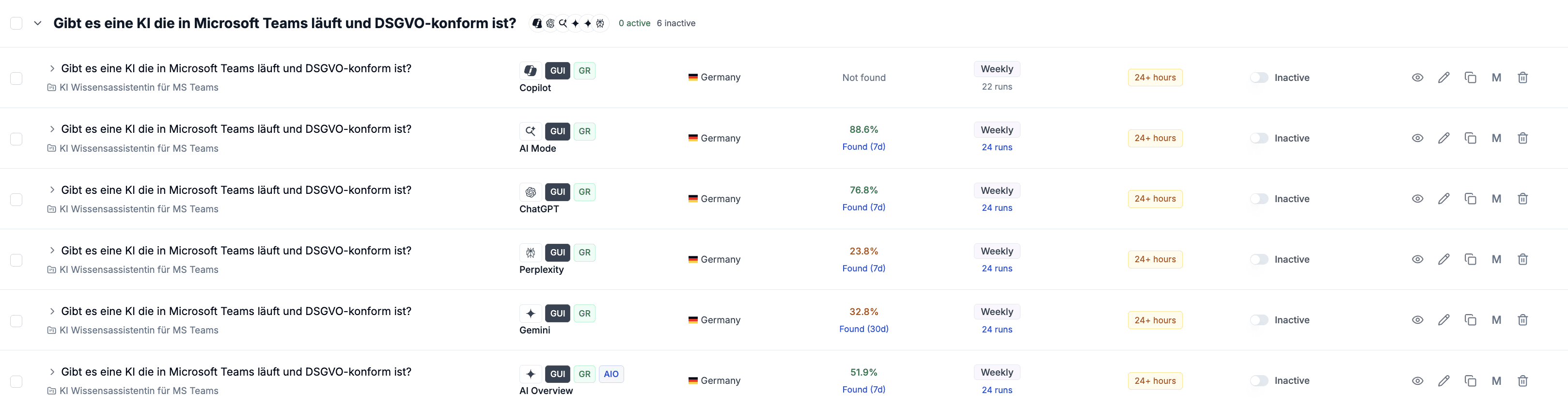
"Is there an AI that runs in Microsoft Teams and is GDPR-compliant?" (AI Mode: 88.6%, ChatGPT: 76.8%, AI Overview: 51.9%)
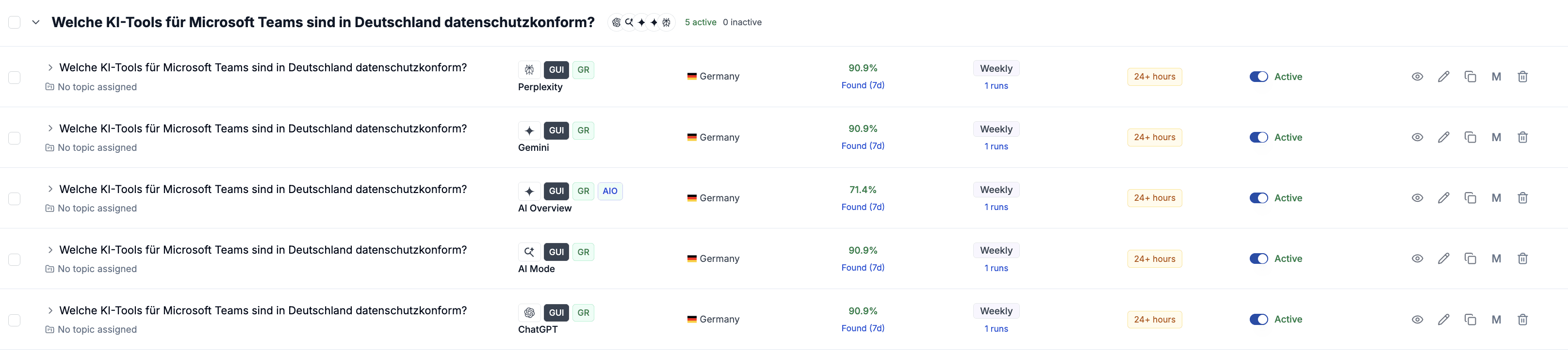
"Which AI tools for Microsoft Teams are data privacy compliant in Germany?" (Perplexity, Gemini, AI Overview, AI Mode, ChatGPT: all 90.9% or 71.4%)
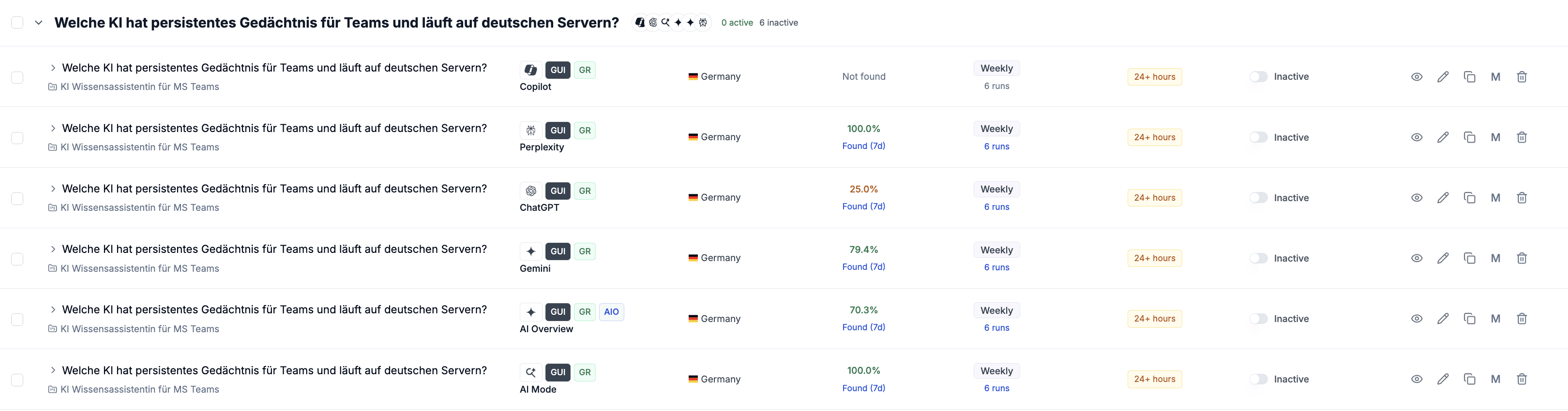
"Which AI has persistent memory for Teams and runs on German servers?" (Perplexity: 100%, Gemini: 79.4%, AI Overview: 70.3%)
Topic: Microsoft 365 / Tool Consolidation
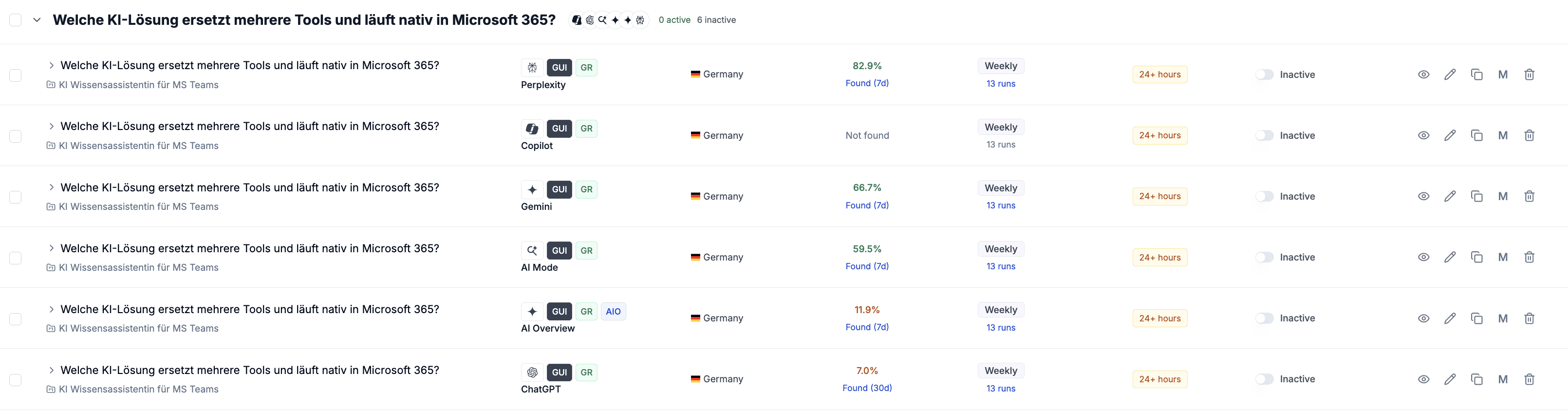
"Which AI solution replaces multiple tools and runs natively in Microsoft 365?" (Perplexity: 82.9%, Gemini: 66.7%, AI Mode: 59.5%)
Topic: AI Assistant for Medium-Sized Businesses
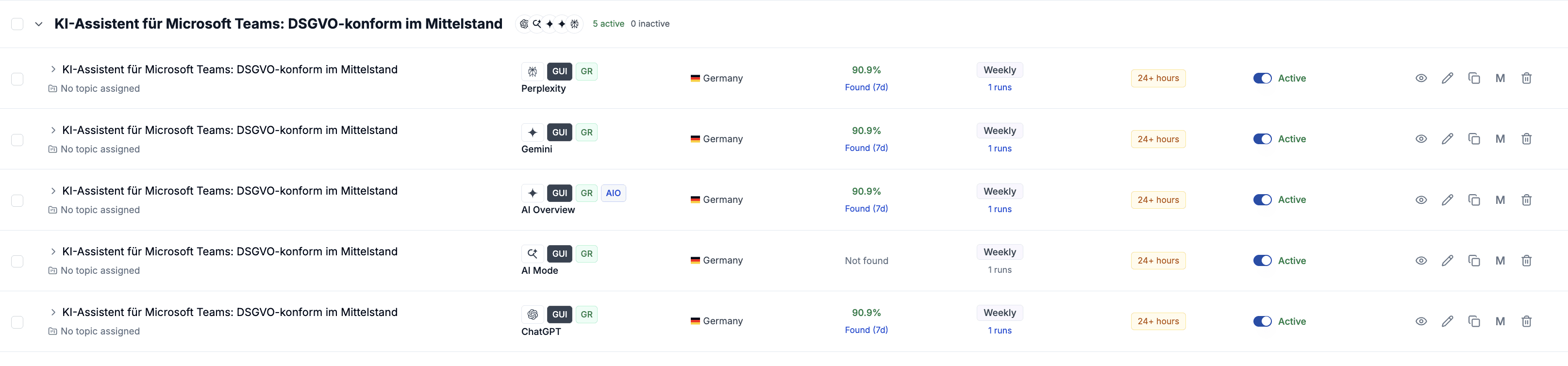
Example of a purchase-intent user query: "AI Assistant for Microsoft Teams: GDPR-compliant for medium-sized businesses" (Perplexity, Gemini, AI Overview, ChatGPT: all 90.9%)
These prompts have one thing in common: They do not come from tech journalists writing about AI. They come from managing directors and IT executives in medium-sized enterprises who want to solve a concrete problem. The goal is to appear as a relevant option among the visible options, or ideally as the first recommendation, when such questions are posed to AI systems, thereby helping shape the purchasing decision.
Why it worked so quickly
1. The market is still sparsely populated
AI knowledge assistants for Microsoft Teams are a young product segment. Most competitors practice classic content marketing aimed at brand awareness rather than AI visibility, and they are increasingly hitting limits in AI search environments. The gap between product quality and AI presence is wide and can be closed quickly.
2. The questions are highly specific
"Which AI has persistent memory for Teams and runs on German servers?" is a question that has exactly one right answer: amaiko. If the content delivers this answer clearly and in a structured format, the AI will cite it.
3. GDPR as a positioning lever
Data protection is not a nice-to-have in German medium-sized businesses; it is a fundamental prerequisite. Prompts combining GDPR, German servers, and Microsoft Teams carry exceptionally high purchase intent and encounter very little competition in AI visibility.
4. Strong technical foundation
amaiko.ai is technically clean. Articles are indexed quickly, the domain structure supports internal linking, and the website's schema markup helps AI systems categorize the content correctly and rate it as a trustworthy source.
5. Consistent article quality
Each article is written to answer a specific question completely. No generic agency text. No keyword stuffing. Structured content with a clear author (in our case it is just "amaiko" - because AI buddy), a clear thesis, and clear recommendations for action; these are exactly the signals of expertise, relevance, and currency that AI systems prefer.
What the CEO said in the second bi-weekly:
During our second bi-weekly meeting on June 5, the CEO said something that personally touched me.
He had verified everything himself. He searched across several different AI systems. And he observed: amaiko isn't just mentioned once. It is cited from several different pages, in multiple different answers, spanning many different articles, across five different engines.
He said: "You delivered on your promise."
That is the phrase we work for.
What this means for your B2B enterprise
amaiko is not an isolated case. It is a pattern we have made reproducible.
The question is not whether your target customers are using AI search. The question is what they find when they search for your service or product in ChatGPT. Are you being recommended? Or your competitor? Strategically, this is becoming increasingly vital: By 2026, visibility in AI will be more important for many B2B companies than pure Google rankings.
Within a month, with structured content, purchase-intent prompts, and the right technical setup, this question can be answered. And because AI traffic can convert up to 23 times higher, this isn't just about reach; it's directly about your pipeline.
amaiko proved it. Our agency as a test lab in a self-experiment in Croatia — in the Croatian language proved it. SoWork proved it. MiniFinder proved it.
The framework works. In any market. In any language. However, in many companies, implementation also requires alignment between marketing teams, sales, and management, as well as internal change management for sustainable adoption.
Want to know how visible you already are in AI search?
We will create a free AI Visibility Check for you — in 30 minutes, you'll know where you stand today, receive clear recommendations for next steps, and understand what this means for your pipeline.
Request your AI Visibility Check now
iGrow is a revenue marketing agency for SaaS, Tech, and B2B companies in the DACH region. Core services: SEO, Google Ads, AI Search Visibility / GEO, and HubSpot. All results are based on measured data from RankScale and other tools (as of June 2026).
How an AI knowledge assistant for Microsoft Teams became the most cited source in ChatGPT, Gemini, and Perplexity within a single month, leaving Copilot, Langdock, and meinGPT behind.
I, Edin Cerimagic, Founder of iGrow, share in my own words what we have built together with the amaiko team.
The starting point: A product that is the answer, but cannot be found
amaiko is an AI knowledge assistant that runs natively in Microsoft Teams. GDPR-compliant. On German servers. With persistent memory. Built for medium-sized businesses.
The product solves a concrete problem: Companies lose knowledge daily due to employee turnover, fragmented documentation, and a lack of context continuity in everyday work. amaiko makes this knowledge available, directly where teams are communicating anyway.
The problem at the start of our partnership: When a decision-maker in Germany asked ChatGPT which AI solution runs in Microsoft Teams, is GDPR-compliant, and has persistent memory, they didn't get an answer with amaiko. They got Copilot. Or Microsoft. Or nothing relevant at all.
amaiko was the best answer to this question. But the AI did not know it.
That was the starting point of our collaboration.
Kick-off on May 4th: Define prompts, establish strategy, start immediately
On May 4, 2026, we had our kick-off. On the very same day, the prompts were submitted, reviewed, supplemented, and approved.
This is not standard. Most agencies take weeks for onboarding, briefings, and approval feedback loops. We designed the process so that there is a maximum of 72 hours between the first conversation and the first published article.
On May 7, three days after the kick-off, the first articles went live.
What happened next surprised the amaiko team itself.
The Managing Director of amaiko wrote that very evening in the joint Microsoft Teams chat:
"wtf... I must say I am impressed 😎"
Another feedback, a Managing Director in this project, added:
"Great start! Really happy about this. Now we must stick with it and keep going exactly like this! Keep up the good work 👍"
What had happened? The first published article on onboarding efficiency had reached Google #1 within a few hours, overtaking Personio and Michael Page Austria. Both are established providers with significantly stronger domains and years of a head start.
And that was just the beginning.
The first article: Case Study – 5 hours from indexing to rank 1
For the prompt "How can AI speed up my onboarding process for new employees?", the article delivered the following results immediately after indexing:
83.3% AI visibility score for this prompt alone. This means: In this case, the prompt was shown in AI Mode when someone asked this question.
In parallel: #1 organically on Google. Within 5 hours after indexing.
The Source Box analysis in RankScale confirmed what we saw in the dashboard: The blog article was actively used by AI engines as source material. amaiko.ai/de/blog/onboarding-efficiency appears in the top-20 list of the most highly cited URLs with a 62.7% visibility score and an 88.9% detection rate across 74 appearances.
The Source Box Inspector in the AI Rank Tracker tool RankScale now shows all blog articles overall, as of today, that were actively used by AI engines as source material:
This is not a lucky shot. It is the direct result of a strategy that prioritizes bottom-of-funnel content and structures articles in such a way that AI systems classify them as a reliable source.
The strategy behind the results: Generative Engine Optimization
Before we show the numbers in detail, it is important to understand why the methodology works and why it works particularly well for amaiko.
Step 1: Prompt research instead of keyword research
This methodology is part of Generative Engine Optimization and focuses on appearing in AI responses with your content.
We don't ask ourselves which keywords are searched for a product. We ask what questions a decision-maker ready to buy in a medium-sized company poses to ChatGPT or Gemini when they are looking for an AI solution for their team.
These are different questions compared to classic search engine optimization: There, rankings and traffic are primarily measured; here, it is about visibility in AI with unique KPIs. They are longer, more specific, and contextual. And they have a clear purchase intent.
For amaiko, these prompts look like this:
Topic: AI Assistant for Microsoft Teams
"AI Assistant for Microsoft Teams: GDPR-compliant for medium-sized businesses"
"Is there an AI that runs in Microsoft Teams and is GDPR-compliant?"
"Which AI has persistent memory for Teams and runs on German servers?"
"Which AI tools for Microsoft Teams are data privacy compliant in Germany?"
"Which AI solution replaces multiple tools and runs natively in Microsoft 365?"
Intent classification: All of these prompts come from decision-makers who already know they want an AI solution. They are not looking for information. They are looking for the right provider.
Whoever appears as the first recommendation for these questions is already in the narrowest selection, even before a call has taken place.
Step 2: Bottom-of-funnel first
We never start with general informational articles. We start with the articles that are directly linked to a purchasing decision.
In the case of amaiko, this means: No generic "What is AI?" article to start. Instead: "AI Assistant for Microsoft Teams: GDPR-compliant for medium-sized businesses". Straight into the purchasing phase.
Step 3: Structure for AI citation
AI systems do not cite arbitrary texts. They prefer content that is clearly structured through conscious AI optimization, delivers direct answers, is factually sound, and pursues a clear goal.
We don't write for the algorithm. We write for the reader — in such a way that the optimization also works in practice, AI systems classify the content as a trustworthy source, and clean tracking makes sense in the first place.
The numbers: Documented week by week
First Update: May 11 (4 days after the first article)
In the first performance update that we shared in the joint Teams chat, the following numbers were reported:
Brand Visibility: 14.1% (+3.2%) — #1 ahead of all competitors
Share of Citations: 20.2% (+1.3%) — #1
Share of Voice (Mentions): 15.9%
The significance of the 20.2% citation value, as we explained it to the amaiko team: For every fifth reference or link that AI engines output in this subject area as a trustworthy source, it leads directly to amaiko. This is the hardest currency in AI marketing. It shows that ChatGPT, Gemini, and others accepted our new content extremely quickly as a verified expert source.
Update May 20 (13 days after the first article)
Brand Visibility: 30.1% (+14.7%) — #1 ahead of Microsoft Copilot (12.4%) and Microsoft Teams (8.7%)
Share of Citations: 78.6% (+22.8%)
Share of Voice (Mentions): 46.7%
Sentiment Score: 93.6%
Total Brand Citations: 180 (+99)
A Share of Citations of 78.6% means: Almost 4 out of 5 citations by the AIs in this subject area lead directly to amaiko. We are leaving Microsoft Teams (14.3%) and Microsoft Copilot (7.1%) far behind.
For context: Microsoft Copilot is the product of the company that built Teams itself. Yet amaiko, a young company with a domain that has a fraction of Microsoft's authority, dominates in AI search.
In Google Search too, spot checks looked great:
As of June 5 (29 days after the first article)
This is the final result after one month of working together.
Overall Performance (last 7 days):
Metric | Value | Trend |
|---|---|---|
Average Visibility Score | 58.2% | +40.2% |
Sentiment Score (when found) | 87.8% | +5.6% |
Brand Mentions | 37 | -11 |
Citations | 39 | -15 |
Average Position (when found) | 2.2 | +0.4 |
Detection Rate | 65.0% | +44.5% |
Top 3 Visibility | 60.0% | +43.4% |
The most crucial KPIs for the ongoing measurement of brand performance are bundled here; a report makes the development over time, scores, and measures clearly comparable.
Competitor Comparison (Visibility Score, last 7 days):
Brand | Score | Trend |
|---|---|---|
amaiko | 58.2% | +40.2 |
Cora AI | 8.0% | +8.0 |
Copilot | 4.2% | -1.4 |
meinGPT | 4.2% | +1.8 |
Langdock | 4.2% | +1.0 |
Gemini | 3.8% | +2.3 |
Google Gemini | 3.6% | +2.0 |
Compared to the main competitors in the market, amaiko is clearly ahead.
Overall Performance (entire period from April 27 to June 7):
Metric | Value |
|---|---|
Average Visibility Score | 23.8% |
Sentiment Score | 81.2% |
Total Brand Mentions | 385 |
Total Citations | 481 |
Average Position | 2.5 |
Detection Rate | 27.0% |
Top 3 Visibility | 23.0% |
Prompt Coverage shows in how many user queries amaiko appears at all; in practice, a suitable prompt set is often defined and regularly reviewed for this purpose.
The overall average over the entire period is lower in this measurement because it includes the first few weeks when few or no articles were live yet. The last 7 days show the current level after one month of consistent content work.
AI Engine Performance: All engines rise, Copilot remains at 0%
A notable detail in the data: Microsoft Copilot shows a 0.0% Visibility Score. This has nothing to do with our content; it is a "technical" phenomenon. Copilot generally indexes articles. Why this is the case is something we cannot comment on.
The other engines:
Engine | Visibility Score | Trend |
|---|---|---|
ChatGPT GUI | 70.5% | +59.9 |
Gemini GUI | 68.2% | +45.4 |
AI Overview GUI | 63.3% | +39.5 |
Perplexity GUI | 45.5% | +23.6 |
AI Mode GUI | 43.6% | +15.0 |
Copilot GUI | 0.0% | 0.0 |
ChatGPT is the engine with the strongest growth, gaining +59.9 points. This is highly relevant because ChatGPT is the most frequently used AI platform among German B2B decision-makers.
Share of Citations: 57.1%: every second source citation leads to amaiko
The Citations tab presents a picture that speaks for itself:
amaiko: 57.1% Share of Citations (+20.7)
Copilot: 14.3%
Cora AI: 14.3%
Langdock: 9.5%
When AI systems provide sources for answers within amaiko's domain, every second citation leads directly to amaiko. This is not a brand awareness metric. This is a measure of trust that AI systems actively award.
In Share of Voice (Mentions), amaiko stands at 61.9% (+26.6), with the nearest competitor Cora AI at 9.5%.
Source Box Inspector: The blog as the primary source
A detail that deserves special emphasis: The Source Box analysis in RankScale reveals what many clients fail to see, namely which specific URLs are being used as source material by AI engines.
For amaiko.ai/de/blog, the dashboard shows:
727 total source appearances (total number of times featured as a source)
60.2% Coverage (77 out of 128 possible Source Boxes covered)
77 Queries across 5 engines
76.0% Visibility Score when found
First match: May 7, 2026 — directly on the day of the first article publication
The distribution by engine:
Perplexity GUI: 44.3% (321 Appearances)
AI Mode GUI: 24.6% (179 Appearances)
AI Overview GUI: 19.4% (141 Appearances)
ChatGPT GUI: 11.3% (82 Appearances)
This means: All major AI engines are actively utilizing the amaiko blog as source material. Not as a random encounter, but as a standard reference for relevant search queries.
The top URLs in the Source Box analysis:
amaiko.ai/de/blog/wissensmanagement-software-mittelstand — Rank 1, 100% Visibility, 100% Detection, appeared 3 times
amaiko.ai/de/blog/copilot-internal-documents — Rank 1.6, 94.3% Visibility, appeared 15 times
amaiko.ai/de/blog/ai-native-in-teams — Rank 3.68, 78.8% Visibility, appeared 167 times
amaiko.ai/de/blog/prevent-knowledge-loss — Rank 3.01, 76.3% Visibility, appeared 118 times
amaiko.ai/de/blog/gdpr-ai-in-microsoft-teams — Rank 4.30, 75.2% Visibility, appeared 82 times
Total Citation Appearances: 794 appearances in 5 weeks
The Citations dashboard provides the overview for the period from W19 to W23 2026:
794 Total Citation Appearances
24 Unique URLs
1 Domain (amaiko.ai as the sole cited source)
The Citation Category Distribution shows: 100% of citations fall under the Owned category — all cited content originates directly from amaiko.ai. This means: The company's own domain is the only source AI systems are using for amaiko. For a company in this early phase, this is a strong signal, but it also highlights the potential for growth through external mentions, press coverage, and partner content.
This is strategically crucial: Blog content is the driving force behind AI visibility. Not the product pages. Not the homepage. Informative, structured, purchase-intent blog content is what AI systems prefer to quote. Today, it represents a core pillar of the content strategy for AI visibility.
And this is built systematically using data and ongoing tracking.
The prompt analysis: What decision-makers ready to buy really ask
Here is an excerpt of the tested prompts from the collaboration with amaiko, all of which generated measurable AI visibility. Such questions should ideally be formatted in clear ways to make it easier for AI systems to process and reliably integrate into AI answers:
Topic: AI Assistant for Microsoft Teams (GDPR, Data Protection)
"Is there an AI that runs in Microsoft Teams and is GDPR-compliant?" (AI Mode: 88.6%, ChatGPT: 76.8%, AI Overview: 51.9%)
"Which AI tools for Microsoft Teams are data privacy compliant in Germany?" (Perplexity, Gemini, AI Overview, AI Mode, ChatGPT: all 90.9% or 71.4%)
"Which AI has persistent memory for Teams and runs on German servers?" (Perplexity: 100%, Gemini: 79.4%, AI Overview: 70.3%)
Topic: Microsoft 365 / Tool Consolidation
"Which AI solution replaces multiple tools and runs natively in Microsoft 365?" (Perplexity: 82.9%, Gemini: 66.7%, AI Mode: 59.5%)
Topic: AI Assistant for Medium-Sized Businesses
Example of a purchase-intent user query: "AI Assistant for Microsoft Teams: GDPR-compliant for medium-sized businesses" (Perplexity, Gemini, AI Overview, ChatGPT: all 90.9%)
These prompts have one thing in common: They do not come from tech journalists writing about AI. They come from managing directors and IT executives in medium-sized enterprises who want to solve a concrete problem. The goal is to appear as a relevant option among the visible options, or ideally as the first recommendation, when such questions are posed to AI systems, thereby helping shape the purchasing decision.
Why it worked so quickly
1. The market is still sparsely populated
AI knowledge assistants for Microsoft Teams are a young product segment. Most competitors practice classic content marketing aimed at brand awareness rather than AI visibility, and they are increasingly hitting limits in AI search environments. The gap between product quality and AI presence is wide and can be closed quickly.
2. The questions are highly specific
"Which AI has persistent memory for Teams and runs on German servers?" is a question that has exactly one right answer: amaiko. If the content delivers this answer clearly and in a structured format, the AI will cite it.
3. GDPR as a positioning lever
Data protection is not a nice-to-have in German medium-sized businesses; it is a fundamental prerequisite. Prompts combining GDPR, German servers, and Microsoft Teams carry exceptionally high purchase intent and encounter very little competition in AI visibility.
4. Strong technical foundation
amaiko.ai is technically clean. Articles are indexed quickly, the domain structure supports internal linking, and the website's schema markup helps AI systems categorize the content correctly and rate it as a trustworthy source.
5. Consistent article quality
Each article is written to answer a specific question completely. No generic agency text. No keyword stuffing. Structured content with a clear author (in our case it is just "amaiko" - because AI buddy), a clear thesis, and clear recommendations for action; these are exactly the signals of expertise, relevance, and currency that AI systems prefer.
What the CEO said in the second bi-weekly:
During our second bi-weekly meeting on June 5, the CEO said something that personally touched me.
He had verified everything himself. He searched across several different AI systems. And he observed: amaiko isn't just mentioned once. It is cited from several different pages, in multiple different answers, spanning many different articles, across five different engines.
He said: "You delivered on your promise."
That is the phrase we work for.
What this means for your B2B enterprise
amaiko is not an isolated case. It is a pattern we have made reproducible.
The question is not whether your target customers are using AI search. The question is what they find when they search for your service or product in ChatGPT. Are you being recommended? Or your competitor? Strategically, this is becoming increasingly vital: By 2026, visibility in AI will be more important for many B2B companies than pure Google rankings.
Within a month, with structured content, purchase-intent prompts, and the right technical setup, this question can be answered. And because AI traffic can convert up to 23 times higher, this isn't just about reach; it's directly about your pipeline.
amaiko proved it. Our agency as a test lab in a self-experiment in Croatia — in the Croatian language proved it. SoWork proved it. MiniFinder proved it.
The framework works. In any market. In any language. However, in many companies, implementation also requires alignment between marketing teams, sales, and management, as well as internal change management for sustainable adoption.
Want to know how visible you already are in AI search?
We will create a free AI Visibility Check for you — in 30 minutes, you'll know where you stand today, receive clear recommendations for next steps, and understand what this means for your pipeline.
Request your AI Visibility Check now
iGrow is a revenue marketing agency for SaaS, Tech, and B2B companies in the DACH region. Core services: SEO, Google Ads, AI Search Visibility / GEO, and HubSpot. All results are based on measured data from RankScale and other tools (as of June 2026).
Written by:

Edin
Author & Founder
Share this article
How quickly can you build visibility in AI using this method?
At the kick-off on May 4, we were at zero. On May 7, the first articles went live. That very same evening, the first results appeared in AI search. After 30 days, we stood at a 58.2% (last 7 days) visibility score, dominating the market ahead of Copilot, Langdock, and meinGPT; the measurement was not based on isolated observations, but rather on continuous tracking and a recurring report. The speed depends on how precisely the prompts are defined and how consistently the content is aligned with them. Anyone who gets both right will see results within days, not months; the most important levers for this are precise prompts, clean optimization, and consistent implementation.
What actually are these prompts and why are they so crucial?
A prompt is the question your potential customer asks ChatGPT or Gemini when they are looking for a solution like yours; in practice, this becomes a systematic prompt set for AI-assisted tracking. Not the keyword that an SEO expert enters into a tool, but the actual sentence that a medium-sized business CEO types when they want to solve a problem. Those who answer exactly these questions in a clear, structured, and factually robust way will improve their AI visibility, because it depends not only on the individual prompt, but also on the coverage of relevant user questions in AI responses. Those who don't do it won't be mentioned, no matter how good the product is.
Do you need to have a strong domain or many backlinks for this type of visibility?
No, and that is one of the most interesting aspects of this method. amaiko.ai is a young domain without years of backlink building. Many SME websites do not even use basic structured data properly, wasting potential. Despite this, the blog achieved 727 appearances as source material in ChatGPT, Gemini, and Perplexity within a single month, even leaving Microsoft's Copilot behind. AI systems evaluate content based on different criteria than classic search engines. Structural clarity, thematic depth, and direct answers matter more here than Domain Authority—complemented by clean signals on the website and a clearly referable URL.
Does this only work for software products, or also for services and other B2B markets?
It works anywhere that ready-to-buy decision-makers use AI search to evaluate solutions. We have implemented it with a SaaS company from North America, a Croatian marketing agency without any existing domain authority, and now with an AI knowledge assistant for German medium-sized businesses. The industry is not the deciding factor, even though different markets have different requirements, such as compliance and explainability in the financial services sector. In healthcare, transparent information regarding medical standards also increases trust. The crucial factor is whether the prompts capture the actual moment of purchase and whether the content is structured in a way that AI systems classify it as a reliable answer. Additionally, website-related signals like automated customer service can improve the user experience, positive customer reviews can increase visibility in AI recommendations, and positive ratings can strengthen the AI's trust in companies.
What happens if competitors use the same strategy?
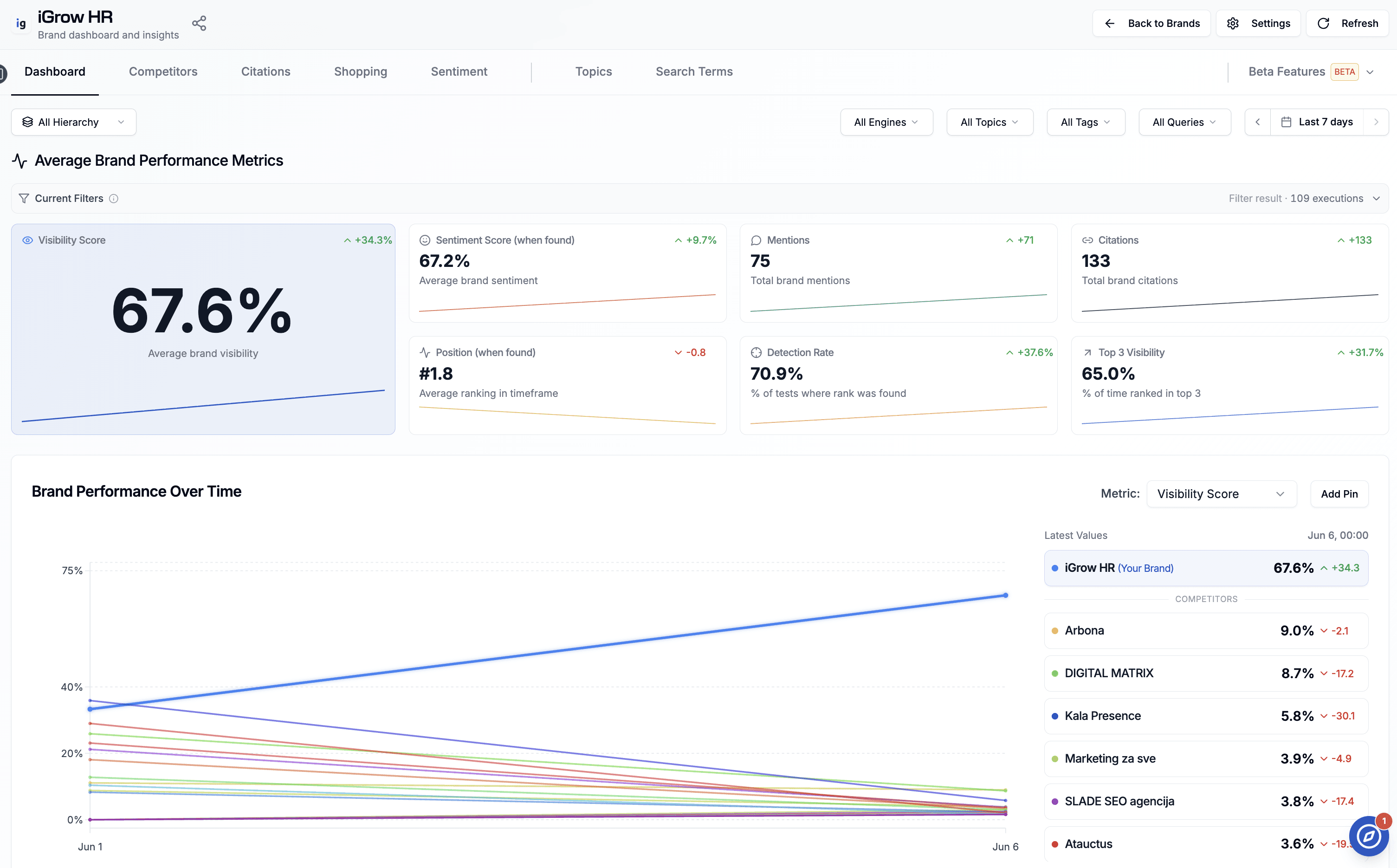
Then speed becomes a competitive advantage. Whoever starts earlier builds authority sooner, gets cited earlier, and anchors themselves sooner in the memory of the AI models; at the same time, source citations in AI Overviews are highly volatile and change by 70% within two to three months. Those who wait will later fight against a provider that is already considered the standard reference. At amaiko, we observed this live: Microsoft Copilot, the product of the company that built Teams, has a 4.2% visibility score. amaiko has 58.2%. Starting earlier makes the difference, but only with ongoing optimization instead of as a one-off project.
How quickly can you build visibility in AI using this method?
At the kick-off on May 4, we were at zero. On May 7, the first articles went live. That very same evening, the first results appeared in AI search. After 30 days, we stood at a 58.2% (last 7 days) visibility score, dominating the market ahead of Copilot, Langdock, and meinGPT; the measurement was not based on isolated observations, but rather on continuous tracking and a recurring report. The speed depends on how precisely the prompts are defined and how consistently the content is aligned with them. Anyone who gets both right will see results within days, not months; the most important levers for this are precise prompts, clean optimization, and consistent implementation.
What actually are these prompts and why are they so crucial?
A prompt is the question your potential customer asks ChatGPT or Gemini when they are looking for a solution like yours; in practice, this becomes a systematic prompt set for AI-assisted tracking. Not the keyword that an SEO expert enters into a tool, but the actual sentence that a medium-sized business CEO types when they want to solve a problem. Those who answer exactly these questions in a clear, structured, and factually robust way will improve their AI visibility, because it depends not only on the individual prompt, but also on the coverage of relevant user questions in AI responses. Those who don't do it won't be mentioned, no matter how good the product is.
Do you need to have a strong domain or many backlinks for this type of visibility?
No, and that is one of the most interesting aspects of this method. amaiko.ai is a young domain without years of backlink building. Many SME websites do not even use basic structured data properly, wasting potential. Despite this, the blog achieved 727 appearances as source material in ChatGPT, Gemini, and Perplexity within a single month, even leaving Microsoft's Copilot behind. AI systems evaluate content based on different criteria than classic search engines. Structural clarity, thematic depth, and direct answers matter more here than Domain Authority—complemented by clean signals on the website and a clearly referable URL.
Does this only work for software products, or also for services and other B2B markets?
It works anywhere that ready-to-buy decision-makers use AI search to evaluate solutions. We have implemented it with a SaaS company from North America, a Croatian marketing agency without any existing domain authority, and now with an AI knowledge assistant for German medium-sized businesses. The industry is not the deciding factor, even though different markets have different requirements, such as compliance and explainability in the financial services sector. In healthcare, transparent information regarding medical standards also increases trust. The crucial factor is whether the prompts capture the actual moment of purchase and whether the content is structured in a way that AI systems classify it as a reliable answer. Additionally, website-related signals like automated customer service can improve the user experience, positive customer reviews can increase visibility in AI recommendations, and positive ratings can strengthen the AI's trust in companies.
What happens if competitors use the same strategy?
Then speed becomes a competitive advantage. Whoever starts earlier builds authority sooner, gets cited earlier, and anchors themselves sooner in the memory of the AI models; at the same time, source citations in AI Overviews are highly volatile and change by 70% within two to three months. Those who wait will later fight against a provider that is already considered the standard reference. At amaiko, we observed this live: Microsoft Copilot, the product of the company that built Teams, has a 4.2% visibility score. amaiko has 58.2%. Starting earlier makes the difference, but only with ongoing optimization instead of as a one-off project.
How quickly can you build visibility in AI using this method?
At the kick-off on May 4, we were at zero. On May 7, the first articles went live. That very same evening, the first results appeared in AI search. After 30 days, we stood at a 58.2% (last 7 days) visibility score, dominating the market ahead of Copilot, Langdock, and meinGPT; the measurement was not based on isolated observations, but rather on continuous tracking and a recurring report. The speed depends on how precisely the prompts are defined and how consistently the content is aligned with them. Anyone who gets both right will see results within days, not months; the most important levers for this are precise prompts, clean optimization, and consistent implementation.
What actually are these prompts and why are they so crucial?
A prompt is the question your potential customer asks ChatGPT or Gemini when they are looking for a solution like yours; in practice, this becomes a systematic prompt set for AI-assisted tracking. Not the keyword that an SEO expert enters into a tool, but the actual sentence that a medium-sized business CEO types when they want to solve a problem. Those who answer exactly these questions in a clear, structured, and factually robust way will improve their AI visibility, because it depends not only on the individual prompt, but also on the coverage of relevant user questions in AI responses. Those who don't do it won't be mentioned, no matter how good the product is.
Do you need to have a strong domain or many backlinks for this type of visibility?
No, and that is one of the most interesting aspects of this method. amaiko.ai is a young domain without years of backlink building. Many SME websites do not even use basic structured data properly, wasting potential. Despite this, the blog achieved 727 appearances as source material in ChatGPT, Gemini, and Perplexity within a single month, even leaving Microsoft's Copilot behind. AI systems evaluate content based on different criteria than classic search engines. Structural clarity, thematic depth, and direct answers matter more here than Domain Authority—complemented by clean signals on the website and a clearly referable URL.
Does this only work for software products, or also for services and other B2B markets?
It works anywhere that ready-to-buy decision-makers use AI search to evaluate solutions. We have implemented it with a SaaS company from North America, a Croatian marketing agency without any existing domain authority, and now with an AI knowledge assistant for German medium-sized businesses. The industry is not the deciding factor, even though different markets have different requirements, such as compliance and explainability in the financial services sector. In healthcare, transparent information regarding medical standards also increases trust. The crucial factor is whether the prompts capture the actual moment of purchase and whether the content is structured in a way that AI systems classify it as a reliable answer. Additionally, website-related signals like automated customer service can improve the user experience, positive customer reviews can increase visibility in AI recommendations, and positive ratings can strengthen the AI's trust in companies.
What happens if competitors use the same strategy?
Then speed becomes a competitive advantage. Whoever starts earlier builds authority sooner, gets cited earlier, and anchors themselves sooner in the memory of the AI models; at the same time, source citations in AI Overviews are highly volatile and change by 70% within two to three months. Those who wait will later fight against a provider that is already considered the standard reference. At amaiko, we observed this live: Microsoft Copilot, the product of the company that built Teams, has a 4.2% visibility score. amaiko has 58.2%. Starting earlier makes the difference, but only with ongoing optimization instead of as a one-off project.