Generative Engine Optimization B2B: What the MiniFinder Strategy Proves for SEO, AI Visibility, and Tech Companies
Generative Engine Optimization B2B: What the MiniFinder Strategy Proves for SEO, AI Visibility, and Tech Companies
How SEO and Generative Engine Optimization together create the strongest and fastest-growing sales channel. A practical case study, with real numbers.
May 2026. A person types into ChatGPT: "Which GPS tracker for hunting dogs can you recommend?" The model's answer comes instantly. It contains a recommendation. We know the name: MiniFinder.
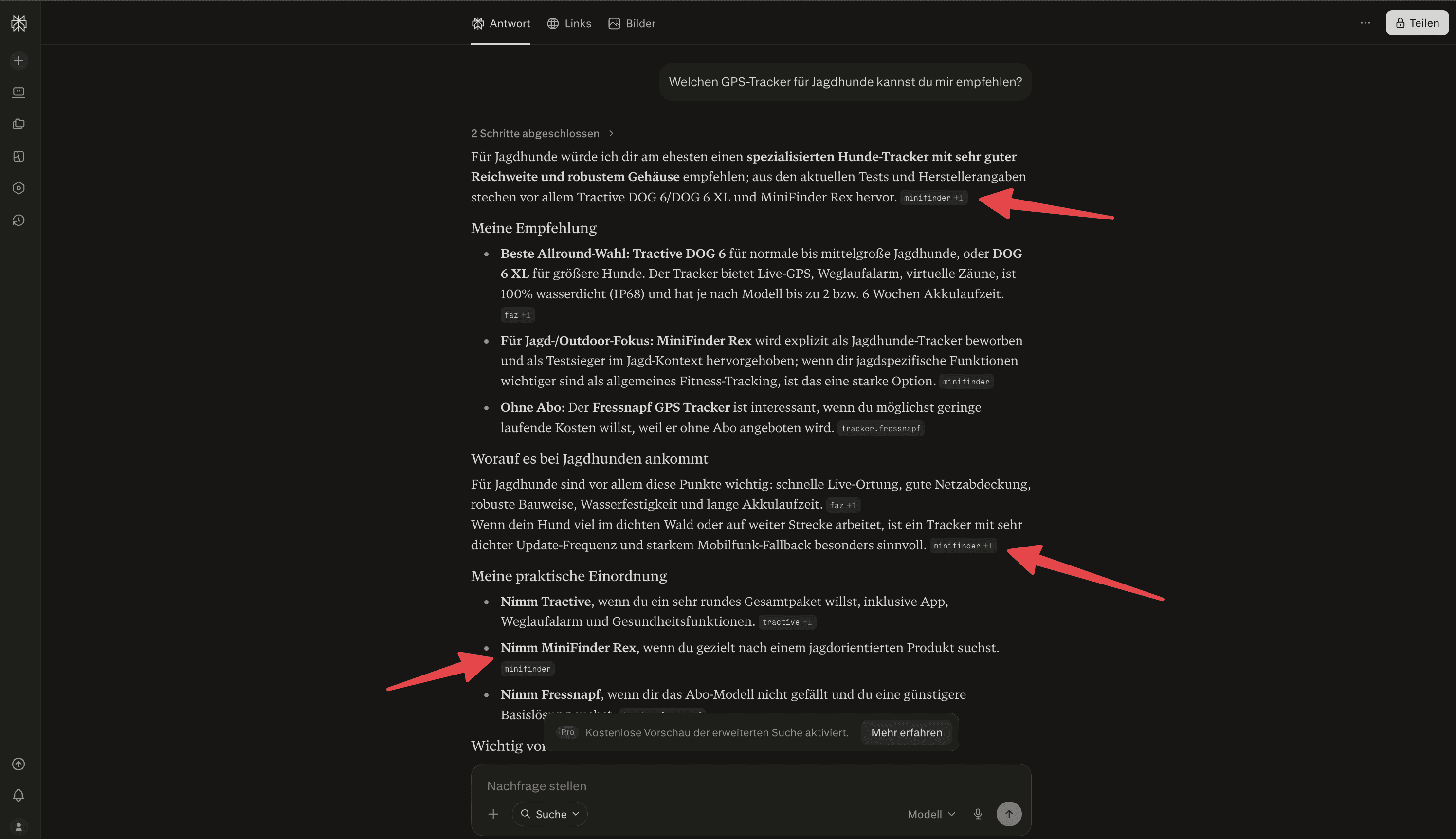
The same happens in Google AI Overview. In Perplexity. In Copilot. With various other prompts.
This is no coincidence. This is the result of a strategy that does not treat SEO and AI visibility as two different disciplines, but as an interconnected system for pipeline development.
This case study shows what this looks like in practice. What changed in the process. What numbers are behind it. And what this means for B2B, SaaS, and tech companies that are seriously thinking about organic growth.
What is Generative Engine Optimization, and why does it decide visibility in 2026?
When people talk about search engine optimization today, they mostly still think of Google, rankings, and organic traffic. That is the correct foundation. But it is no longer enough.
The reality in 2026 is different. Users no longer just ask questions in classic search engines or traditional search result lists. They ask in ChatGPT, Google AI Overview, Google AI Mode, Perplexity, Copilot, Gemini, and Grok – meaning in ChatGPT, Gemini & Co., via AI search engines, AI answer systems, and Large Language Models, where a specialized GEO agency for AI search results can make all the difference in visibility. And these systems no longer function like a classic search engine: instead of just providing links, they summarize the most important information directly. In this answer, either your company or your competitor's is listed.
Generative Engine Optimization (GEO), also GEO Generative Engine Optimization, is the systematic approach to gaining visibility in exactly these AI-generated answers – as a supplement to classic Search Engine Optimization and established search engine optimization, as described in the 10 reasons why SEO is no longer enough and GEO becomes crucial. It is about structuring and optimizing content so that AI models and AI assistants cite it as a reliable source. Clear answers to specific questions. Data. Trust signals. Timeliness. Depth of content.
GEO and SEO do not work against each other. They reinforce each other. Those who rank #1 on Google have better chances of also being cited in AI answers. Those recommended by AI models build brand trust before the user even clicks on a website. Today, the purchasing decision no longer begins with a click on an ad. It begins with a question.
And if you do not appear in that question, you simply do not exist for that user.
GPS trackers, proprietary software, e-commerce: Why MiniFinder serves as a benchmark
MiniFinder is a Scandinavian IoT company with a clear product strategy: GPS trackers for pets (dogs, cats), hunting dogs, seniors, vehicles, and fleets. Own app platform. Own hardware. Own subscription model. Direct sales via e-commerce – making it an ideal example for the GEO and AI visibility case study of MiniFinder.
Entering the German market was not an easy undertaking. The competition is strong: Tractive is the market leader in the pet sector with a years-long head start and a high media budget. Garmin is a global brand with massive brand recognition. PAJ is locally established. Fressnapf has reach through retail and digital presence.
The purchasing decision process in this category is information-heavy. Anyone buying a GPS tracker for hunting dogs does research beforehand. Anyone looking for a tracker for seniors with dementia first asks which device is truly recommendable. Anyone who needs a digital logbook checks steering tax requirements.
These exact information needs are the entry point for a combined SEO and GEO strategy.
The question was: How do you build organic visibility in a fragmented market with strong competitors that translates into sales results?
The answer, proven by the numbers: through patience, system, and the consistency of doing both.
Why SEO + AI visibility working together deliver more than any paid channel alone
The underlying logic is simple, yet most companies ignore it: Paid buys visibility. Organic earns it.
A Google Ads click is gone as soon as the budget is exhausted. An article that ranks #1 on Google and is simultaneously cited by three AI models as an answer source works around the clock without further budget. This is not an argument against Paid. It is an argument for the long-term profitability of the organic channel.
The combined strategy works in three steps:
Step 1: Content with commercial intent. Not "What is a GPS tracker?", but "Which GPS tracker is best suited for hunting dogs?" or "GPS bracelet for seniors with fall alarm" – this exact type of question was at the center of the MiniFinder GEO case study on German market entry. The difference is the psychological distance to the purchasing decision. The closer the content is to the actual purchase intent, the more directly it contributes to the pipeline.
Step 2: AI optimization of content. For AI engines to cite a source, content within a clear AI content and GEO strategy needs specific characteristics: clear, concise definitions for AI systems and hard facts that are verifiable. Clear, structured answers to concrete questions make it easier for AI engines to categorize; clear hierarchies and tables make it easier for AI models to summarize. Trust signals in the form of backlinks, reviews, and structured data remain essential, because implementing structured data for AI-dominated search environments makes content readable faster. Regular updates are also part of it, because there is no universal solution, but rather platform-specific strategies and concrete measures. At its core, GEO means: "Am I the most reliable answer for the AI model on this specific question?" Technical SEO tools additionally support readability for AI engines.
Step 3: Cluster building instead of single-keyword optimization. Instead of optimizing isolated keywords, thematic clusters are built. Each cluster strengthens the next. AI models prefer thematic authority. Google does too. GEO and SEO can work together synergistically – both combined is the fastest path to stable, high-intent visibility.
Keyword visibility in the German market: What the step from 30 to 82 keywords achieved
At the start of the German market entry, 30 keywords were tracked. Main focus was on informational long-tail queries. Those that bring traffic but are rarely directly purchase-intended.
The expansion to 82 commercial keywords in 7 thematic clusters was the decisive step toward a realistic visibility picture that actually reflects the pipeline.
The 7 commercial keyword clusters:
Hunting / Hunting Dog (Focus: REX, Atto Pro)
GPS Dog (Dog tracking, dog tracker, collar)
GPS Cat (Cat tracker, outdoor cats)
Seniors GPS (GPS bracelet, dementia tracker, emergency call)
Logbook & Fleet (Digital logbook, GPS vehicle tracking)
GPS Tracker generic (Mini GPS tracker, live GPS tracker)
People, Safety & Theft Protection
Result as of June 1, 2026:
Metric | Value |
|---|---|
Keywords on #1 | 13 |
Keywords in Top 3 | 22 |
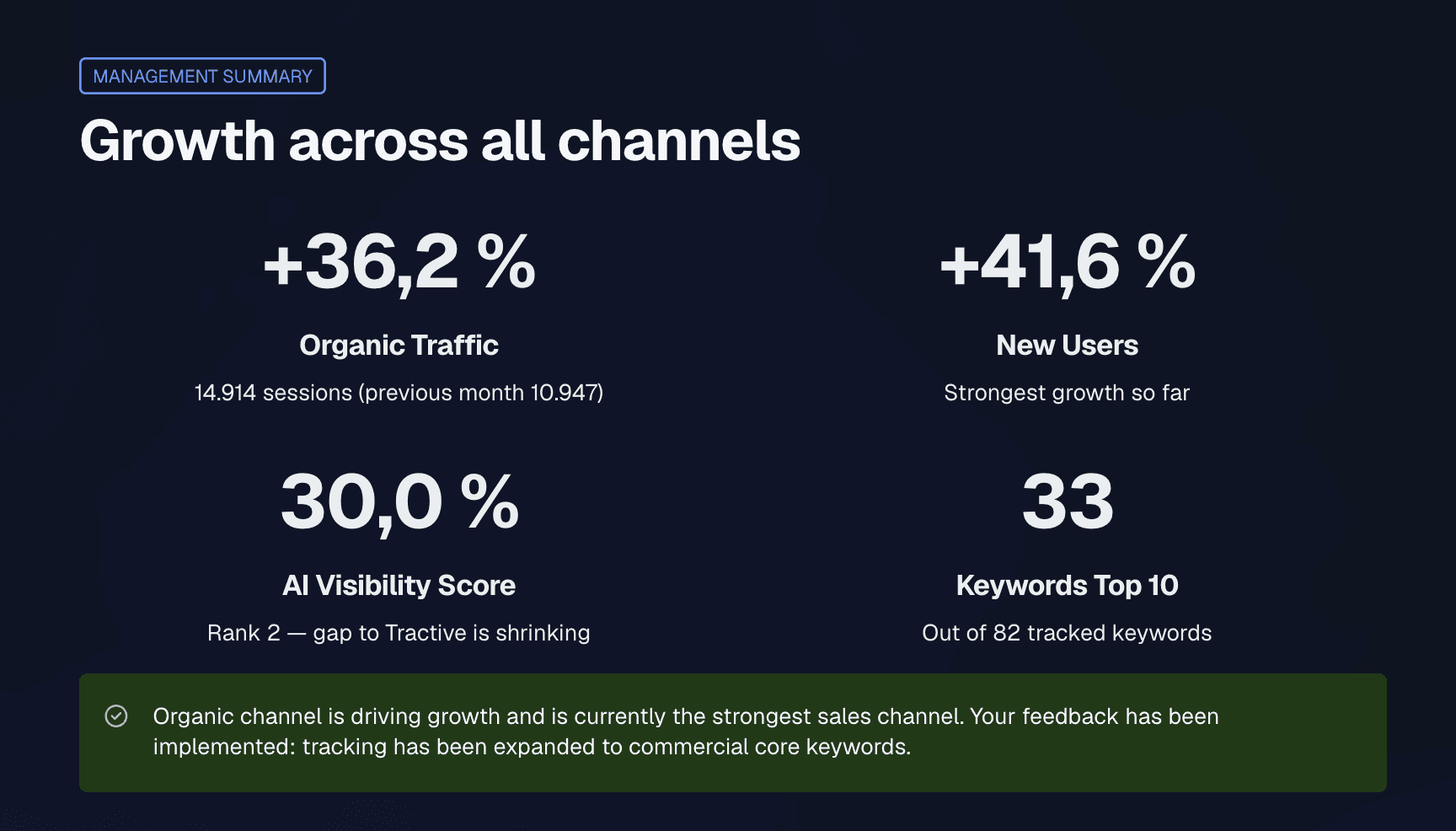
Keywords in Top 10 | 33 |
Keywords in Top 30 | 45 |
Total tracked keywords | 82 |
Biggest jumps in May 2026:
Keyword | Current Position | Change |
|---|---|---|
Dog tracking during after-search | Top 2 | from outside Top 100 |
Hunting dog GPS tracker comparison | 13 | +50 |
GPS people tracker | 19 | +48 |
Digital logbook | 18 | +23 |
Mini GPS tracker | 3 | +13 |
GPS bracelet for seniors | 3 | +12 |
Core keywords by cluster (as of June 1, 2026):
Cluster | Strongest Core Keyword | Position |
|---|---|---|
Hunting / Hunting Dog | Dog tracking hunt | #2 |
GPS Dog | Dog tracking | #2 |
GPS Cat | GPS collar cat | #3 |
Seniors GPS | GPS bracelet for seniors | #3 |
Logbook & Fleet | GPS logbook | #2 |
GPS Tracker generic | Mini GPS tracker | #3 |
The pattern is unique: keywords with the highest commercial intent rank first because they are backed by real, structured content.
AI visibility in practice: How visible a GPS company is across different AI models
This is the part that most marketing managers are not yet measuring. And that is exactly why it is the biggest competitive advantage for those who start now – because for GEO, not only visibility but also Share of Voice and AI traffic count as decisive metrics.
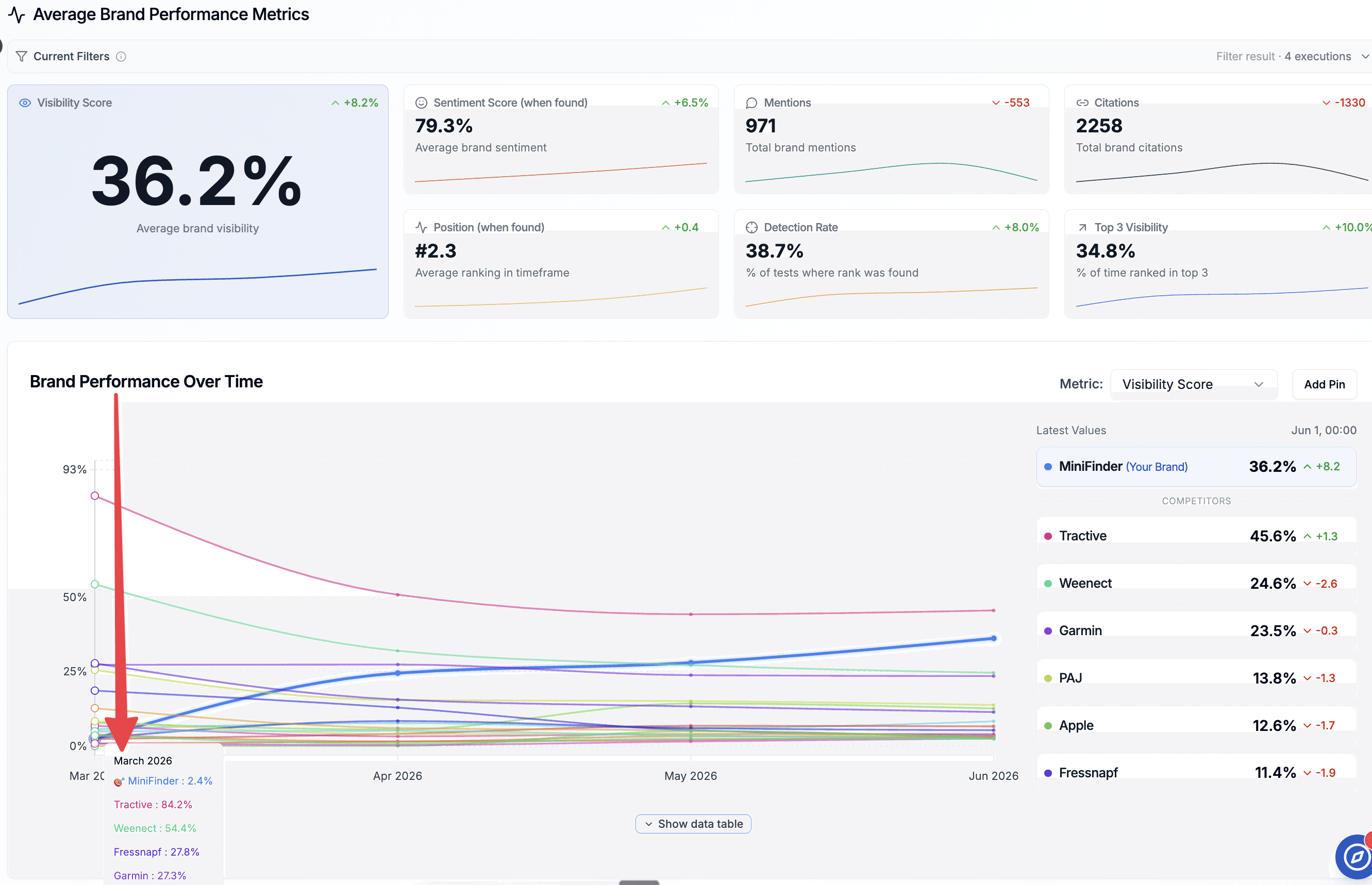
Overall picture of AI visibility, as of late May 2026 (updated):
Metric | Value |
|---|---|
AI Visibility Score | 36.2 % |
Trend (30 days) | +8.2 percentage points |
Average position when found | #2.3 |
Sentiment Score | 79.3 % |
Mentions in AI answers | 971 |
Citations as a source | 2,258 |
Detection Rate (share of tested queries) | 38.7 % |
Top 3 Visibility | 34.8 % |
Visibility in AI systems can also be measured with specialized tools like Profound; regular tests with industry-standard prompts form the basis for this.
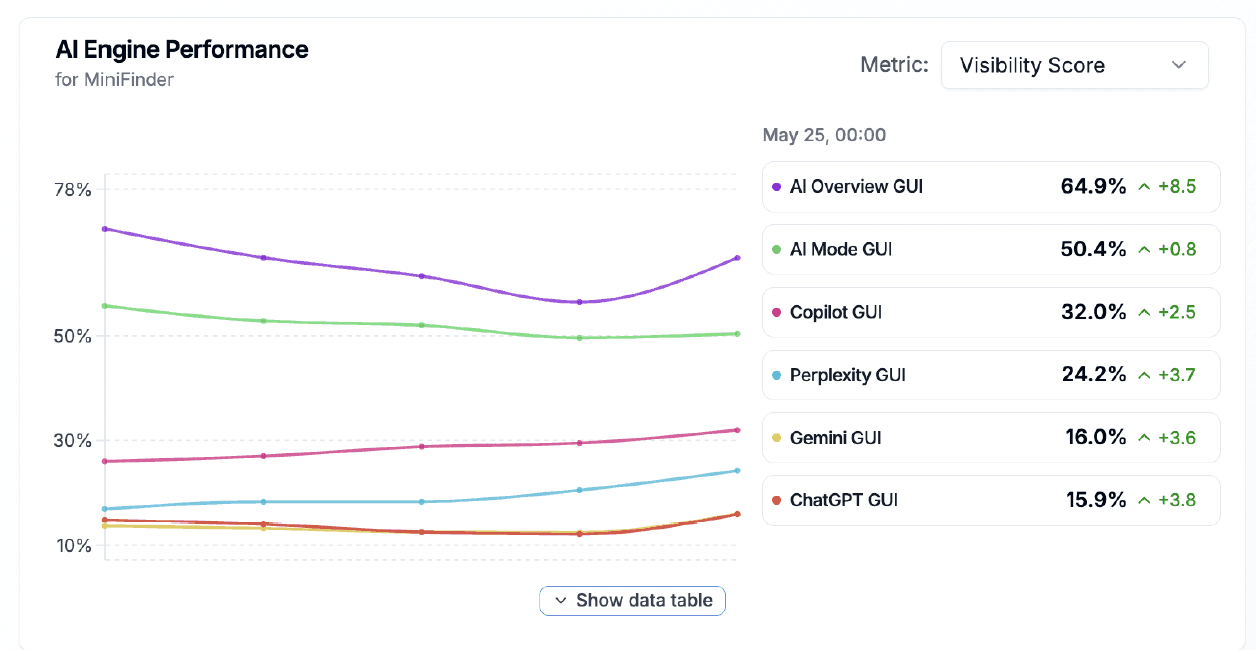
Visibility by AI engine:
AI Model | Visibility Score | Trend |
|---|---|---|
Google AI Overview | 64.9 % | +8.5 |
Google AI Mode | 50.4 % | +0.8 |
Copilot (Microsoft) | 32.0 % | +2.5 |
Perplexity | 24.2 % | +3.7 |
Gemini (Google) | 16.0 % | +3.6 |
ChatGPT (OpenAI) | 15.9 % | +3.8 |
This means in practice: In almost two out of three queries in Google AI Overview, MiniFinder shows up in the answer. In Copilot, in every third query. And in ChatGPT as well as Gemini, visibility via AI Overviews, classic AI engines, and other AI engines with transparent sources keeps growing constantly.
Particularly relevant for the Paid area: The hunting cluster dominates AI answers.
In response to the question "How does hunting with a GPS tracker work?", Google AI Mode states MiniFinder as an answer source in 98.8 % of all queries. To "Which GPS tracker is best suited for hunting dogs?", MiniFinder appears in 87.0 % of all AI answers.
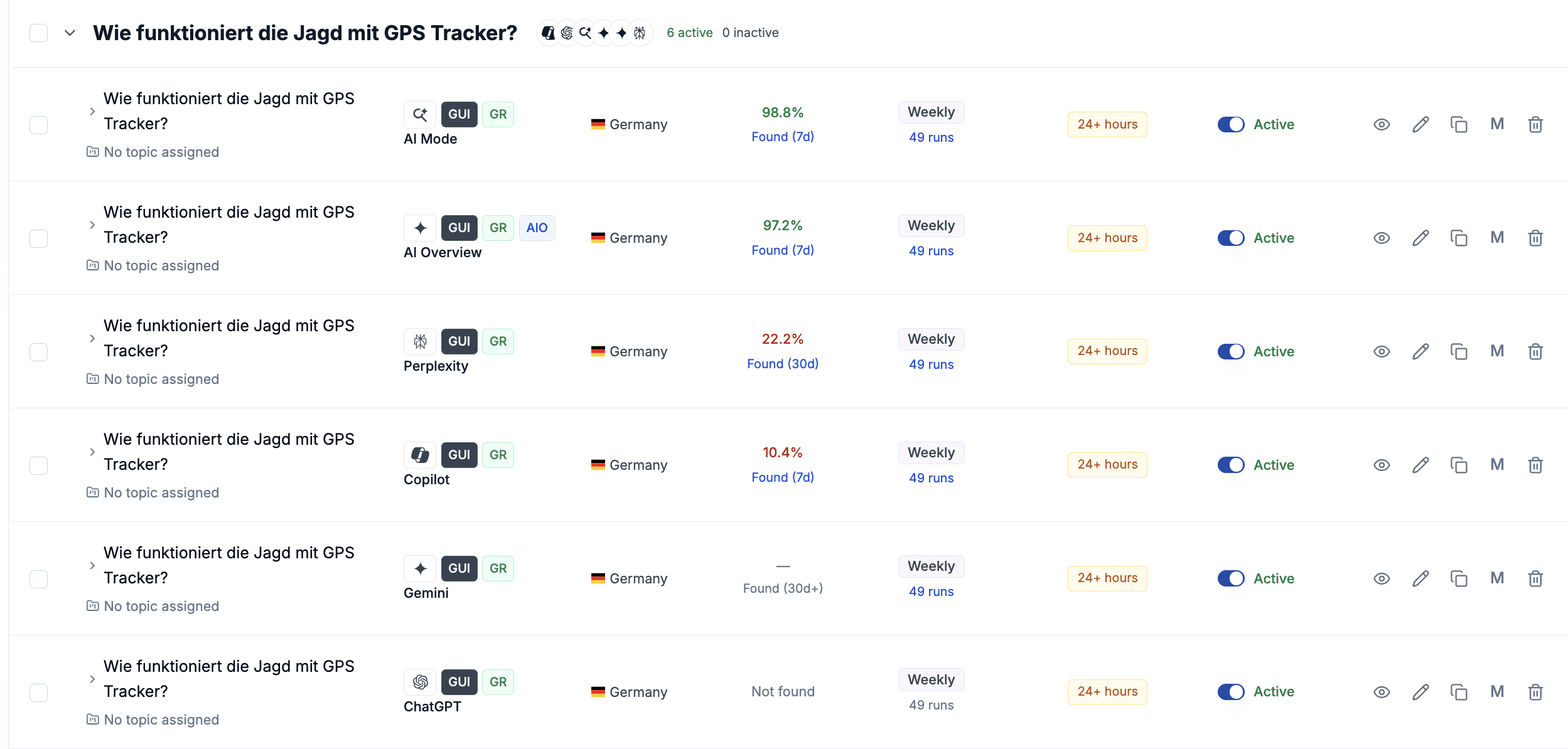
This is not a generic brand presence. This is market leadership in a highly commercial niche intent directly linked to the product REX and the paid strategy. Anyone bidding on hunting dog keywords on Google Ads while simultaneously appearing in 87 % of all AI answers on this topic builds a funnel that mutually reinforces itself.
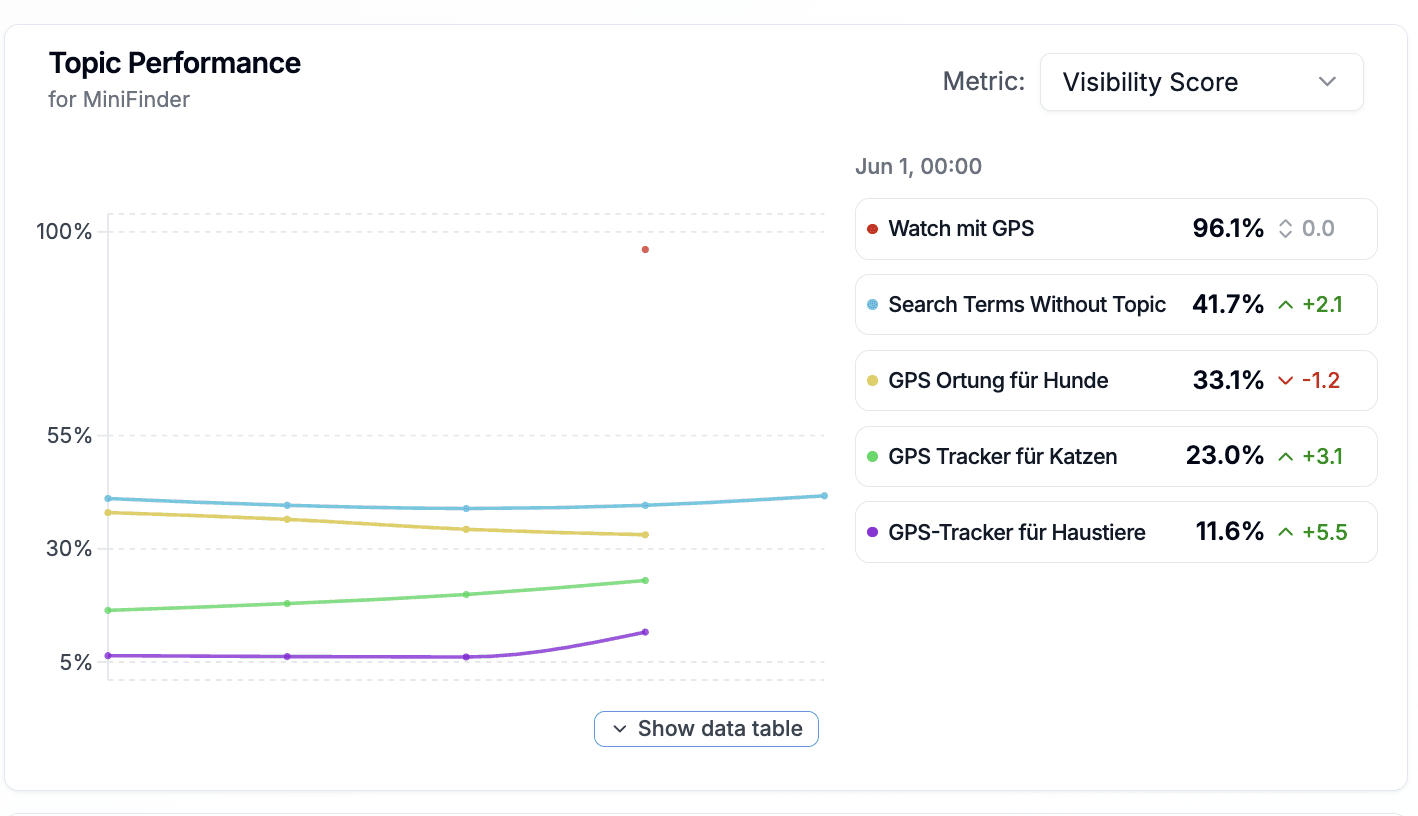
Category development of AI visibility:
Topic Area | Visibility | Trend |
|---|---|---|
Watch with GPS | 96.1 % | stable |
GPS tracking for dogs | 33.1 % | slightly declining |
GPS tracker for cats | 23.0 % | +3.1 |
GPS tracker for pets | 11.6 % | +5.5 |
Prompts without topics | 41.7% | +2.1 |
Competitive comparison: Why Tractive is losing and what this means for the market
Visibility is always relative. The crucial question is not only where you stand, but in which direction the market is moving.
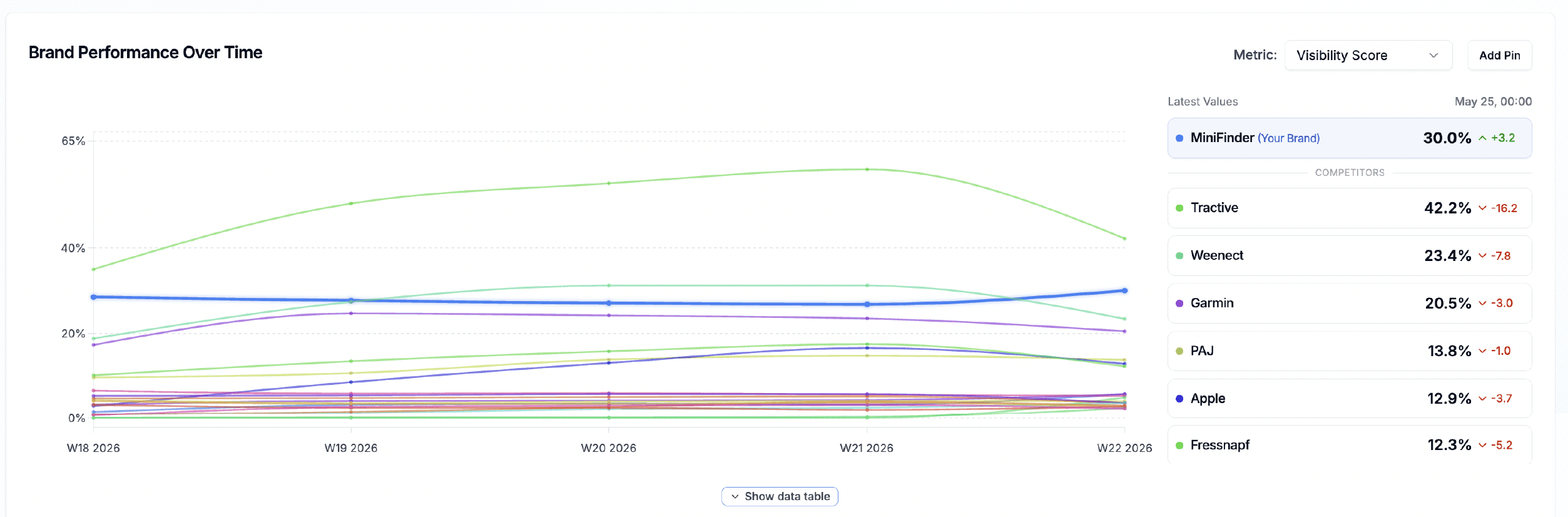
AI visibility in competitive comparison, May 2026:
Brand | Visibility Score | Trend (30 days) |
|---|---|---|
Tractive | 42.2 % | -16.2 |
MiniFinder | 30.0 % | +3.2 |
Weenect | 23.4 % | -7.8 |
Garmin | 20.5 % | -3.0 |
PAJ | 13.8 % | -1.0 |
Apple | 12.9 % | -3.7 |
Fressnapf | 12.3 % | -5.2 |
Tractive loses 16.2 percentage points of AI visibility in the observation period. Weenect loses 7.8. Almost all established competitors are losing AI visibility, while MiniFinder wins in the prompts we defined to compare competition.
This is the concrete outcome of a strategy that bet early on AI-optimized content, genuine industry experts, and strong E-A-T signals, instead of just classic SEO tactics.
The gap to Tractive still exists. But it is shrinking. And in specific categories, especially in the hunting sector, MiniFinder is already the dominant voice in AI search. This also shows how strongly brand authority and digital influence work beyond SEO.
Citations as source references have increased from 1,061 to 1,380. This means: AI models not only pull in MiniFinder as a source in more queries, but also mention MiniFinder more often by name. This is reinforced by E-E-A-T and content proven to be authored by subject matter experts.
AI models do not build this picture from a single website, but from across the entire web and various sources.
Organic as the strongest sales channel: What the analysis of May 2026 proves
This dynamic fits exactly with the growth architecture that specialized digital marketing agencies for B2B SaaS in the DACH region build when they think of SEO, GEO, and Paid as one single system.
This is where the visibility strategy turns into a sales result.
The analysis of the entire month of May 2026 clearly shows: the organic channel is not only the fastest-growing traffic channel, it is the fastest-growing sales channel.
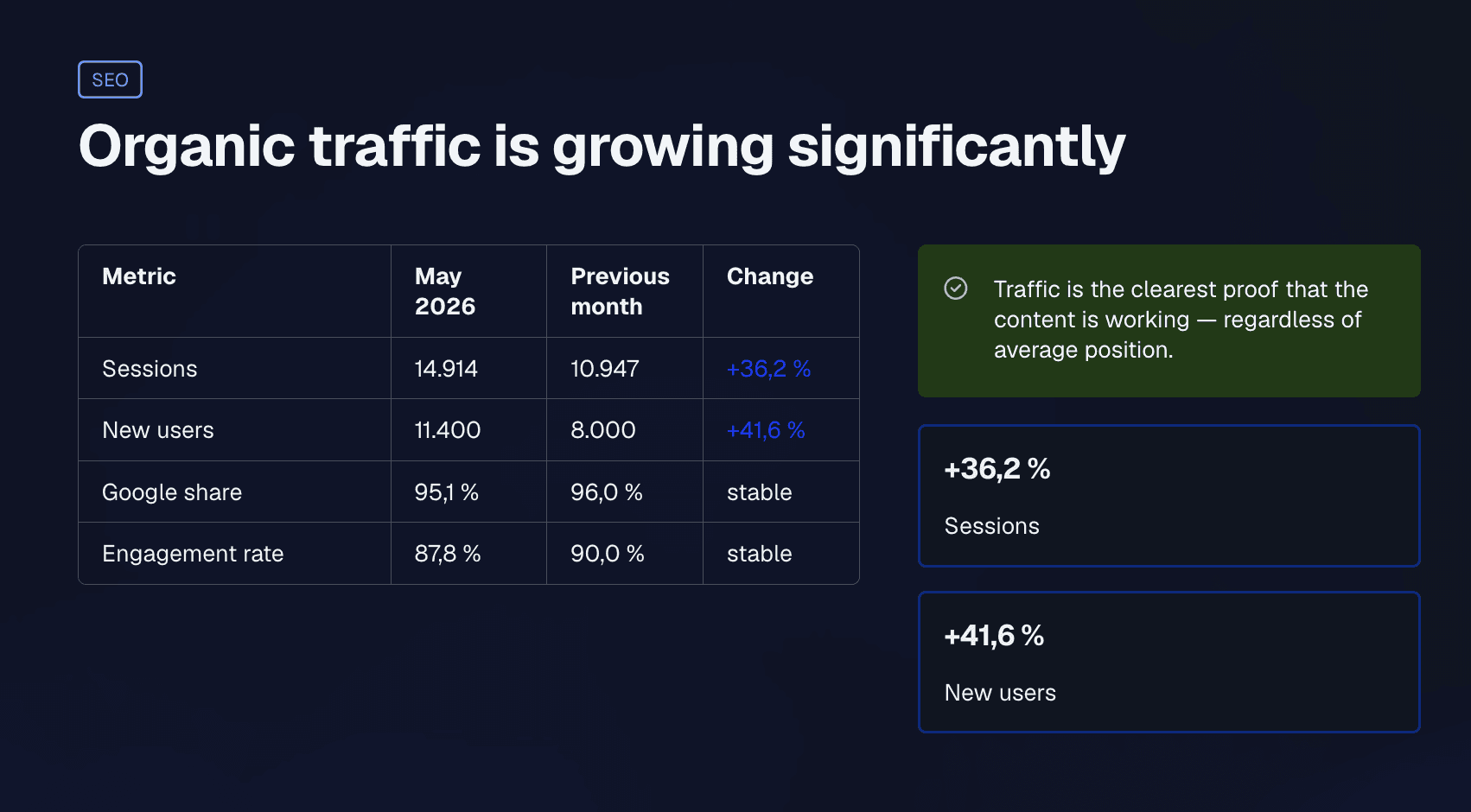
Traffic development, May 2026 compared to previous month:
Metric | May 2026 | Previous Month | Change |
|---|---|---|---|
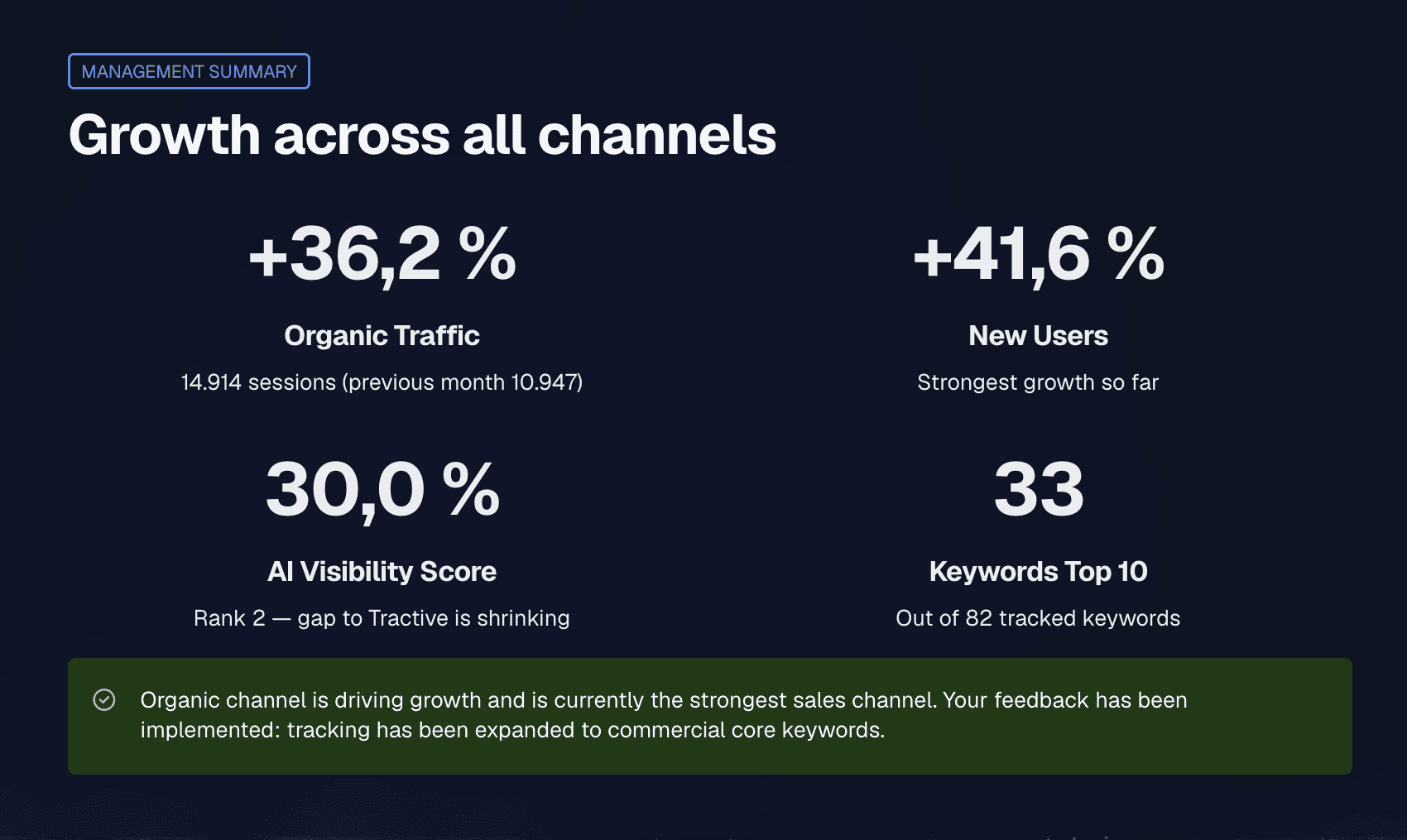
Organic Sessions | 14,914 | 10,947 | +36.2 % |
New Users | 11,400 | 8,000 | +41.6 % |
Conversions (Google organic) | 288 | 219 | +31.5 % |
Engagement Rate | 87.8 % | 90.0 % | stable |
For direct comparison: The paid search channel grew by 3.2% in the same period. Social organic dropped by 26%. No other tracked channel grew anywhere near as fast as organic search. In parallel, studies show declining classic search traffic and altered click patterns due to zero-click answers, making it even more important for website operators to categorize such channel shifts.
This is not theory. This is measured reality from a month-long analysis.
Other indicators of organic search performance:
Metric | May 2026 | Change |
|---|---|---|
Clicks (Google Search Console) | 8,300 | +21.2 % |
Impressions | 544,000 | +12.3 % |
Click-Through Rate | 1.5 % | +7.1 % |
Website Health Score | 81/100 | better than 82 % of comparable websites |
Total Backlinks | 27,262 | +5,400 |
Referring Domains | 912 | +460 |
The conclusion is clear: Those who build organic visibility systematically do not see the results immediately. But when they come, they come consistently, scalably, and without additional budget.
This is proof that persistence and strategic building pay off. Not just in click numbers, but in sales results, AI traffic, and reliable analytical values.
What this proof means for your B2B, SaaS, or tech company
MiniFinder is not an abstract textbook example. It is a real company with its own tech stack, its own software platform, e-commerce processes, and international competitive pressure. If a combined SEO and GEO strategy works in this environment, it will work in yours too – a GEO Visibility Audit shows where you stand today.
The five key takeaways from this case study:
1. AI visibility is not a future strategy. It is a requirement today.
If more than two out of three queries in Google AI Overview in your category are answered without you, you lose purchasing decisions before someone even lands on your website, because people increasingly retrieve information directly in AI assistants and AI answer systems today. Good GEO not only increases your visibility, but also the digital relevance of your company.
2. Those who only scale paid channels do not build a sustainable pipeline foundation.
Paid is indispensable for speed. Organic is indispensable for scalability. Skipping either means building on an unstable foundation – this is exactly where a specialized B2B Google Ads Revenue Marketing Agency comes in, integrating paid into an organic foundation.
3. Keyword clusters beat single-keyword optimization.
Thematic depth wins, both with Google and with AI models. Those who fully occupy the topic "hunting dog GPS" become the default reference for this topic in AI search. However, this requires platform-specific strategies instead of a universal solution.
4. Organic takes time. That is why you must start today.
Postponing the decision to next quarter means starting in twelve months without a foundation. The head start that MiniFinder is building today against Tractive in AI visibility will translate into further sales results over the coming months.
5. Measure SEO and GEO together to track what really counts.
Traffic is not a business metric. Qualified organic traffic that ends up in purchase intent and conversions is. If you do not align your visibility strategy with pipeline impact, you are optimizing for the wrong goals.
Conclusion: If you are not visible in AI search today, you lose the first contact
The MiniFinder case study is not an exceptional case. It is a foretaste of what is happening in all sectors where the need for information and the buying decision are close together.
SEO and GEO together are not a marketing discipline. They are a pipeline system.
On one side: rankings, content clusters, technical SEO health, backlinks, structured data. On the other side: AI-optimized content, citation building in AI models, sentiment management, precise answers to commercial questions.
The result is not just more traffic. It is visibility at the point where buying decisions are actually made today.
And that is exactly what feeds the pipeline.
For SaaS, tech, and B2B companies in the DACH region: The question is no longer whether you do SEO and GEO. The question is how much of a head start your competitor is building while you are not yet doing it.
This case study is based on real data from the cooperation of iGrow and MiniFinder (Germany, reporting period May 2026). All metrics mentioned come from SE Ranking, Rankscale AI-Monitoring, and Google Analytics 4.
iGrow is a revenue marketing agency for SaaS, tech, IT, and B2B companies in the DACH region. We combine SEO, GEO (AI Search Optimization), and Google Ads into an integrated pipeline system – as your B2B growth partner for systematic revenue marketing.
Want to know how visible your company is today in ChatGPT, Gemini, Perplexity, and Google AI? First, get to know iGrow as your B2B Growth Partner and write to us via the iGrow contact page or at igrow.at.
How SEO and Generative Engine Optimization together create the strongest and fastest-growing sales channel. A practical case study, with real numbers.
May 2026. A person types into ChatGPT: "Which GPS tracker for hunting dogs can you recommend?" The model's answer comes instantly. It contains a recommendation. We know the name: MiniFinder.
The same happens in Google AI Overview. In Perplexity. In Copilot. With various other prompts.
This is no coincidence. This is the result of a strategy that does not treat SEO and AI visibility as two different disciplines, but as an interconnected system for pipeline development.
This case study shows what this looks like in practice. What changed in the process. What numbers are behind it. And what this means for B2B, SaaS, and tech companies that are seriously thinking about organic growth.
What is Generative Engine Optimization, and why does it decide visibility in 2026?
When people talk about search engine optimization today, they mostly still think of Google, rankings, and organic traffic. That is the correct foundation. But it is no longer enough.
The reality in 2026 is different. Users no longer just ask questions in classic search engines or traditional search result lists. They ask in ChatGPT, Google AI Overview, Google AI Mode, Perplexity, Copilot, Gemini, and Grok – meaning in ChatGPT, Gemini & Co., via AI search engines, AI answer systems, and Large Language Models, where a specialized GEO agency for AI search results can make all the difference in visibility. And these systems no longer function like a classic search engine: instead of just providing links, they summarize the most important information directly. In this answer, either your company or your competitor's is listed.
Generative Engine Optimization (GEO), also GEO Generative Engine Optimization, is the systematic approach to gaining visibility in exactly these AI-generated answers – as a supplement to classic Search Engine Optimization and established search engine optimization, as described in the 10 reasons why SEO is no longer enough and GEO becomes crucial. It is about structuring and optimizing content so that AI models and AI assistants cite it as a reliable source. Clear answers to specific questions. Data. Trust signals. Timeliness. Depth of content.
GEO and SEO do not work against each other. They reinforce each other. Those who rank #1 on Google have better chances of also being cited in AI answers. Those recommended by AI models build brand trust before the user even clicks on a website. Today, the purchasing decision no longer begins with a click on an ad. It begins with a question.
And if you do not appear in that question, you simply do not exist for that user.
GPS trackers, proprietary software, e-commerce: Why MiniFinder serves as a benchmark
MiniFinder is a Scandinavian IoT company with a clear product strategy: GPS trackers for pets (dogs, cats), hunting dogs, seniors, vehicles, and fleets. Own app platform. Own hardware. Own subscription model. Direct sales via e-commerce – making it an ideal example for the GEO and AI visibility case study of MiniFinder.
Entering the German market was not an easy undertaking. The competition is strong: Tractive is the market leader in the pet sector with a years-long head start and a high media budget. Garmin is a global brand with massive brand recognition. PAJ is locally established. Fressnapf has reach through retail and digital presence.
The purchasing decision process in this category is information-heavy. Anyone buying a GPS tracker for hunting dogs does research beforehand. Anyone looking for a tracker for seniors with dementia first asks which device is truly recommendable. Anyone who needs a digital logbook checks steering tax requirements.
These exact information needs are the entry point for a combined SEO and GEO strategy.
The question was: How do you build organic visibility in a fragmented market with strong competitors that translates into sales results?
The answer, proven by the numbers: through patience, system, and the consistency of doing both.
Why SEO + AI visibility working together deliver more than any paid channel alone
The underlying logic is simple, yet most companies ignore it: Paid buys visibility. Organic earns it.
A Google Ads click is gone as soon as the budget is exhausted. An article that ranks #1 on Google and is simultaneously cited by three AI models as an answer source works around the clock without further budget. This is not an argument against Paid. It is an argument for the long-term profitability of the organic channel.
The combined strategy works in three steps:
Step 1: Content with commercial intent. Not "What is a GPS tracker?", but "Which GPS tracker is best suited for hunting dogs?" or "GPS bracelet for seniors with fall alarm" – this exact type of question was at the center of the MiniFinder GEO case study on German market entry. The difference is the psychological distance to the purchasing decision. The closer the content is to the actual purchase intent, the more directly it contributes to the pipeline.
Step 2: AI optimization of content. For AI engines to cite a source, content within a clear AI content and GEO strategy needs specific characteristics: clear, concise definitions for AI systems and hard facts that are verifiable. Clear, structured answers to concrete questions make it easier for AI engines to categorize; clear hierarchies and tables make it easier for AI models to summarize. Trust signals in the form of backlinks, reviews, and structured data remain essential, because implementing structured data for AI-dominated search environments makes content readable faster. Regular updates are also part of it, because there is no universal solution, but rather platform-specific strategies and concrete measures. At its core, GEO means: "Am I the most reliable answer for the AI model on this specific question?" Technical SEO tools additionally support readability for AI engines.
Step 3: Cluster building instead of single-keyword optimization. Instead of optimizing isolated keywords, thematic clusters are built. Each cluster strengthens the next. AI models prefer thematic authority. Google does too. GEO and SEO can work together synergistically – both combined is the fastest path to stable, high-intent visibility.
Keyword visibility in the German market: What the step from 30 to 82 keywords achieved
At the start of the German market entry, 30 keywords were tracked. Main focus was on informational long-tail queries. Those that bring traffic but are rarely directly purchase-intended.
The expansion to 82 commercial keywords in 7 thematic clusters was the decisive step toward a realistic visibility picture that actually reflects the pipeline.
The 7 commercial keyword clusters:
Hunting / Hunting Dog (Focus: REX, Atto Pro)
GPS Dog (Dog tracking, dog tracker, collar)
GPS Cat (Cat tracker, outdoor cats)
Seniors GPS (GPS bracelet, dementia tracker, emergency call)
Logbook & Fleet (Digital logbook, GPS vehicle tracking)
GPS Tracker generic (Mini GPS tracker, live GPS tracker)
People, Safety & Theft Protection
Result as of June 1, 2026:
Metric | Value |
|---|---|
Keywords on #1 | 13 |
Keywords in Top 3 | 22 |
Keywords in Top 10 | 33 |
Keywords in Top 30 | 45 |
Total tracked keywords | 82 |
Biggest jumps in May 2026:
Keyword | Current Position | Change |
|---|---|---|
Dog tracking during after-search | Top 2 | from outside Top 100 |
Hunting dog GPS tracker comparison | 13 | +50 |
GPS people tracker | 19 | +48 |
Digital logbook | 18 | +23 |
Mini GPS tracker | 3 | +13 |
GPS bracelet for seniors | 3 | +12 |
Core keywords by cluster (as of June 1, 2026):
Cluster | Strongest Core Keyword | Position |
|---|---|---|
Hunting / Hunting Dog | Dog tracking hunt | #2 |
GPS Dog | Dog tracking | #2 |
GPS Cat | GPS collar cat | #3 |
Seniors GPS | GPS bracelet for seniors | #3 |
Logbook & Fleet | GPS logbook | #2 |
GPS Tracker generic | Mini GPS tracker | #3 |
The pattern is unique: keywords with the highest commercial intent rank first because they are backed by real, structured content.
AI visibility in practice: How visible a GPS company is across different AI models
This is the part that most marketing managers are not yet measuring. And that is exactly why it is the biggest competitive advantage for those who start now – because for GEO, not only visibility but also Share of Voice and AI traffic count as decisive metrics.
Overall picture of AI visibility, as of late May 2026 (updated):
Metric | Value |
|---|---|
AI Visibility Score | 36.2 % |
Trend (30 days) | +8.2 percentage points |
Average position when found | #2.3 |
Sentiment Score | 79.3 % |
Mentions in AI answers | 971 |
Citations as a source | 2,258 |
Detection Rate (share of tested queries) | 38.7 % |
Top 3 Visibility | 34.8 % |
Visibility in AI systems can also be measured with specialized tools like Profound; regular tests with industry-standard prompts form the basis for this.
Visibility by AI engine:
AI Model | Visibility Score | Trend |
|---|---|---|
Google AI Overview | 64.9 % | +8.5 |
Google AI Mode | 50.4 % | +0.8 |
Copilot (Microsoft) | 32.0 % | +2.5 |
Perplexity | 24.2 % | +3.7 |
Gemini (Google) | 16.0 % | +3.6 |
ChatGPT (OpenAI) | 15.9 % | +3.8 |
This means in practice: In almost two out of three queries in Google AI Overview, MiniFinder shows up in the answer. In Copilot, in every third query. And in ChatGPT as well as Gemini, visibility via AI Overviews, classic AI engines, and other AI engines with transparent sources keeps growing constantly.
Particularly relevant for the Paid area: The hunting cluster dominates AI answers.
In response to the question "How does hunting with a GPS tracker work?", Google AI Mode states MiniFinder as an answer source in 98.8 % of all queries. To "Which GPS tracker is best suited for hunting dogs?", MiniFinder appears in 87.0 % of all AI answers.
This is not a generic brand presence. This is market leadership in a highly commercial niche intent directly linked to the product REX and the paid strategy. Anyone bidding on hunting dog keywords on Google Ads while simultaneously appearing in 87 % of all AI answers on this topic builds a funnel that mutually reinforces itself.
Category development of AI visibility:
Topic Area | Visibility | Trend |
|---|---|---|
Watch with GPS | 96.1 % | stable |
GPS tracking for dogs | 33.1 % | slightly declining |
GPS tracker for cats | 23.0 % | +3.1 |
GPS tracker for pets | 11.6 % | +5.5 |
Prompts without topics | 41.7% | +2.1 |
Competitive comparison: Why Tractive is losing and what this means for the market
Visibility is always relative. The crucial question is not only where you stand, but in which direction the market is moving.
AI visibility in competitive comparison, May 2026:
Brand | Visibility Score | Trend (30 days) |
|---|---|---|
Tractive | 42.2 % | -16.2 |
MiniFinder | 30.0 % | +3.2 |
Weenect | 23.4 % | -7.8 |
Garmin | 20.5 % | -3.0 |
PAJ | 13.8 % | -1.0 |
Apple | 12.9 % | -3.7 |
Fressnapf | 12.3 % | -5.2 |
Tractive loses 16.2 percentage points of AI visibility in the observation period. Weenect loses 7.8. Almost all established competitors are losing AI visibility, while MiniFinder wins in the prompts we defined to compare competition.
This is the concrete outcome of a strategy that bet early on AI-optimized content, genuine industry experts, and strong E-A-T signals, instead of just classic SEO tactics.
The gap to Tractive still exists. But it is shrinking. And in specific categories, especially in the hunting sector, MiniFinder is already the dominant voice in AI search. This also shows how strongly brand authority and digital influence work beyond SEO.
Citations as source references have increased from 1,061 to 1,380. This means: AI models not only pull in MiniFinder as a source in more queries, but also mention MiniFinder more often by name. This is reinforced by E-E-A-T and content proven to be authored by subject matter experts.
AI models do not build this picture from a single website, but from across the entire web and various sources.
Organic as the strongest sales channel: What the analysis of May 2026 proves
This dynamic fits exactly with the growth architecture that specialized digital marketing agencies for B2B SaaS in the DACH region build when they think of SEO, GEO, and Paid as one single system.
This is where the visibility strategy turns into a sales result.
The analysis of the entire month of May 2026 clearly shows: the organic channel is not only the fastest-growing traffic channel, it is the fastest-growing sales channel.
Traffic development, May 2026 compared to previous month:
Metric | May 2026 | Previous Month | Change |
|---|---|---|---|
Organic Sessions | 14,914 | 10,947 | +36.2 % |
New Users | 11,400 | 8,000 | +41.6 % |
Conversions (Google organic) | 288 | 219 | +31.5 % |
Engagement Rate | 87.8 % | 90.0 % | stable |
For direct comparison: The paid search channel grew by 3.2% in the same period. Social organic dropped by 26%. No other tracked channel grew anywhere near as fast as organic search. In parallel, studies show declining classic search traffic and altered click patterns due to zero-click answers, making it even more important for website operators to categorize such channel shifts.
This is not theory. This is measured reality from a month-long analysis.
Other indicators of organic search performance:
Metric | May 2026 | Change |
|---|---|---|
Clicks (Google Search Console) | 8,300 | +21.2 % |
Impressions | 544,000 | +12.3 % |
Click-Through Rate | 1.5 % | +7.1 % |
Website Health Score | 81/100 | better than 82 % of comparable websites |
Total Backlinks | 27,262 | +5,400 |
Referring Domains | 912 | +460 |
The conclusion is clear: Those who build organic visibility systematically do not see the results immediately. But when they come, they come consistently, scalably, and without additional budget.
This is proof that persistence and strategic building pay off. Not just in click numbers, but in sales results, AI traffic, and reliable analytical values.
What this proof means for your B2B, SaaS, or tech company
MiniFinder is not an abstract textbook example. It is a real company with its own tech stack, its own software platform, e-commerce processes, and international competitive pressure. If a combined SEO and GEO strategy works in this environment, it will work in yours too – a GEO Visibility Audit shows where you stand today.
The five key takeaways from this case study:
1. AI visibility is not a future strategy. It is a requirement today.
If more than two out of three queries in Google AI Overview in your category are answered without you, you lose purchasing decisions before someone even lands on your website, because people increasingly retrieve information directly in AI assistants and AI answer systems today. Good GEO not only increases your visibility, but also the digital relevance of your company.
2. Those who only scale paid channels do not build a sustainable pipeline foundation.
Paid is indispensable for speed. Organic is indispensable for scalability. Skipping either means building on an unstable foundation – this is exactly where a specialized B2B Google Ads Revenue Marketing Agency comes in, integrating paid into an organic foundation.
3. Keyword clusters beat single-keyword optimization.
Thematic depth wins, both with Google and with AI models. Those who fully occupy the topic "hunting dog GPS" become the default reference for this topic in AI search. However, this requires platform-specific strategies instead of a universal solution.
4. Organic takes time. That is why you must start today.
Postponing the decision to next quarter means starting in twelve months without a foundation. The head start that MiniFinder is building today against Tractive in AI visibility will translate into further sales results over the coming months.
5. Measure SEO and GEO together to track what really counts.
Traffic is not a business metric. Qualified organic traffic that ends up in purchase intent and conversions is. If you do not align your visibility strategy with pipeline impact, you are optimizing for the wrong goals.
Conclusion: If you are not visible in AI search today, you lose the first contact
The MiniFinder case study is not an exceptional case. It is a foretaste of what is happening in all sectors where the need for information and the buying decision are close together.
SEO and GEO together are not a marketing discipline. They are a pipeline system.
On one side: rankings, content clusters, technical SEO health, backlinks, structured data. On the other side: AI-optimized content, citation building in AI models, sentiment management, precise answers to commercial questions.
The result is not just more traffic. It is visibility at the point where buying decisions are actually made today.
And that is exactly what feeds the pipeline.
For SaaS, tech, and B2B companies in the DACH region: The question is no longer whether you do SEO and GEO. The question is how much of a head start your competitor is building while you are not yet doing it.
This case study is based on real data from the cooperation of iGrow and MiniFinder (Germany, reporting period May 2026). All metrics mentioned come from SE Ranking, Rankscale AI-Monitoring, and Google Analytics 4.
iGrow is a revenue marketing agency for SaaS, tech, IT, and B2B companies in the DACH region. We combine SEO, GEO (AI Search Optimization), and Google Ads into an integrated pipeline system – as your B2B growth partner for systematic revenue marketing.
Want to know how visible your company is today in ChatGPT, Gemini, Perplexity, and Google AI? First, get to know iGrow as your B2B Growth Partner and write to us via the iGrow contact page or at igrow.at.
Written by:

Edin
Author & Founder
Share this article
How did MiniFinder achieve 36 percent more traffic?
We consistently focused on search intent and business value. The strategy included optimizing for key commercial terms. This allows us to target the exact search queries of a target audience ready to buy.
What exactly does the AI Visibility Score mean?
This value shows the brand's visibility in responses from generative AI search engines. MiniFinder achieves an average AI visibility score of 30 percent from the prompt setup, taking second place. We specifically optimize content for these platforms to further expand this share.
Why is the organic channel the strongest sales channel?
Search engine optimization delivers users with concrete needs. These individuals are actively searching for solutions to their problems. That is why this traffic converts particularly well and brings qualified leads directly into the pipeline.
How long does it take to see such results?
Organic growth requires continuous work. Initial improvements in rankings often happen after just a few weeks. Noticeable growth in traffic and real revenue usually takes three to six months.
Which metrics are the focus of this evaluation?
We always make decisions based on data, not on gut feeling. Relevant key performance indicators are organic sessions, new users, SEO visibility, and top rankings. These metrics directly contribute to the company's profit.

How did MiniFinder achieve 36 percent more traffic?
We consistently focused on search intent and business value. The strategy included optimizing for key commercial terms. This allows us to target the exact search queries of a target audience ready to buy.
What exactly does the AI Visibility Score mean?
This value shows the brand's visibility in responses from generative AI search engines. MiniFinder achieves an average AI visibility score of 30 percent from the prompt setup, taking second place. We specifically optimize content for these platforms to further expand this share.
Why is the organic channel the strongest sales channel?
Search engine optimization delivers users with concrete needs. These individuals are actively searching for solutions to their problems. That is why this traffic converts particularly well and brings qualified leads directly into the pipeline.
How long does it take to see such results?
Organic growth requires continuous work. Initial improvements in rankings often happen after just a few weeks. Noticeable growth in traffic and real revenue usually takes three to six months.
Which metrics are the focus of this evaluation?
We always make decisions based on data, not on gut feeling. Relevant key performance indicators are organic sessions, new users, SEO visibility, and top rankings. These metrics directly contribute to the company's profit.
How did MiniFinder achieve 36 percent more traffic?
We consistently focused on search intent and business value. The strategy included optimizing for key commercial terms. This allows us to target the exact search queries of a target audience ready to buy.
What exactly does the AI Visibility Score mean?
This value shows the brand's visibility in responses from generative AI search engines. MiniFinder achieves an average AI visibility score of 30 percent from the prompt setup, taking second place. We specifically optimize content for these platforms to further expand this share.
Why is the organic channel the strongest sales channel?
Search engine optimization delivers users with concrete needs. These individuals are actively searching for solutions to their problems. That is why this traffic converts particularly well and brings qualified leads directly into the pipeline.
How long does it take to see such results?
Organic growth requires continuous work. Initial improvements in rankings often happen after just a few weeks. Noticeable growth in traffic and real revenue usually takes three to six months.
Which metrics are the focus of this evaluation?
We always make decisions based on data, not on gut feeling. Relevant key performance indicators are organic sessions, new users, SEO visibility, and top rankings. These metrics directly contribute to the company's profit.