GPS Tracker vs. Garmin and Tractive: How MiniFinder entered the German market with GEO and Google Shopping — The case study
GPS Tracker vs. Garmin and Tractive: How MiniFinder entered the German market with GEO and Google Shopping — The case study
iGrow helped MiniFinder become visible in the German market through GEO and Google Shopping and overtake Tractive in AI search results.
Imagine this: You have a technically superior product that already has many satisfied customers in Scandinavia. The support is strong, the reviews are excellent — and yet hardly anyone in Germany knows you.
Neither Google nor ChatGPT or Perplexity show your content. New search systems that increasingly rely on AI models do not recognize your brand because the foundation for visibility and structured information is missing from the website. This is exactly where the right optimization comes in — and the continuous development of the SEO strategy is crucial to remain present in AI search results over the long term and achieve measurable results.
That was the situation at MiniFinder when we started working together in autumn 2025.
What MiniFinder is and why the German market was so important
MiniFinder is a Scandinavian manufacturer of GPS trackers with a broad product portfolio: from dog trackers and senior solutions with fall detection to fleet management systems for businesses. The IoT technology solves real problems for private individuals, hunters, care facilities, and fleet operators. The website provides the technical and content foundation for optimization and visibility in modern search systems by being specifically structured for AI systems and large language models such as Gemini and ChatGPT.
MiniFinder has been established in Scandinavia for years, but in Germany the brand was hardly visible when the project began.
The problem was not the product, but the digital infrastructure and a market in which Tractive dominates with a large marketing budget, Garmin has built presence over many years, and Fressnapf is also active with its own tracker line. Especially in such a competitive environment, the consistent provision of relevant information and a uniform structure across different sources is crucial so that AI systems can correctly identify and prioritize MiniFinder. The further development of classic SEO strategies toward AI Optimization (AIO) and Large Language Model Optimization (LLMO) is essential to tailor content specifically for AI Overviews and generative AI systems. For companies, it is central to generate qualified leads, build a sustainable pipeline, and achieve measurable results in the conversion process. Supporting videos help present product progress in a clear way and increase visibility in AI Overviews. Optimizing the website and clearly structuring the content are the basis for visibility in modern search systems. Content is prepared in such a way that it can be processed by Retrieval-Augmented Generation systems and preferred in answers from large language models.
What we did first and why it was not just about content
Many agencies would say at this point: “We’ll write 50 blog articles now.” We did not do that.
First, we understood how the purchase process for GPS trackers really works.
Anyone who wants to buy a GPS tracker for their hunting dog, their car, or their mother in need of care no longer uses Google alone. They ask AI-based search systems like Google AI Overview, ChatGPT, Perplexity, or other large language models (LLMs). These modern systems increasingly determine which information and brands are visible. How content is prepared for these systems determines who appears in the answers — often even before a product page is visited.
The consistent naming and structuring of information across different sources is crucial so that AI systems can correctly recognize and prioritize MiniFinder. Anyone who does not appear in these AI answers loses potential customers even before the first contact.
That was the real problem for MiniFinder in Germany: it was not a lack of traffic, but a lack of citability in AI systems. There were no grounding contents that AI engines could rely on. No comparison pages for those looking to switch. No structured product descriptions that machines can understand. The move from classic SEO to AI Optimization (AIO) and Large Language Model Optimization (LLMO) was necessary to tailor content for modern AI search systems and AI Overviews. Content had to be prepared so that Retrieval-Augmented Generation systems could process it efficiently and use it preferentially in answers from large language models. Clear, structured information leads to better results in AI answers.
So we systematically began building these structures.
The starting point in the audit
Before we built anything, we analyzed everything — essentially a GEO Visibility Audit of the existing AI visibility. The result was clear:
The German Google Ads account ran through the Swedish account with SEK billing and a Merchant Center configuration that did not work for the German market. That sounds like a detail, but it is not. For the Google algorithm and modern search systems, it meant: no clean website structure, no solid technical foundation and therefore no optimal findability in search engines and AI-based search systems, no valid machine-learning signal for Germany, no valid campaign data, no basis for scaling.
On the organic side, there was hardly any user-focused German content and no AI grounding. AI systems, especially large language models, could not correctly classify MiniFinder. Consistent information and a uniform naming convention across different sources are crucial so that generative systems can reliably recognize and display MiniFinder — contradictory descriptions lead to uncertainty or missing visibility. Tractive dominated AI search with an AI Visibility Score of over 32 percent, while MiniFinder was hardly measurable.
The further development of classic SEO toward AI Optimization (AIO) requires clear structures and consistent data in order to achieve better results in modern AI search systems and be prioritized in answers.
That was the starting point — and it was clear: build structure first, then scale.
The three levers we moved
Lever 1: Google Ads & Shopping structure as the foundation
The first thing we built was an independent German Google Ads account. The Merchant Center was restructured and configured correctly. Tracking was cleaned up. We then defined Shopping as the primary campaign type — deliberately before Search and Performance Max.
Why Shopping? GPS trackers are comparison-driven products. Buyers want images, price, and specifications at a glance, exactly at the moment of highest purchase intent. Shopping delivers exactly that and allows the algorithm to learn from real purchase signals instead of just click volume without context. Our focus was on purchase-oriented search queries and the creation of specific landing pages for different target groups in the DACH region in order to increase the conversion rate in a targeted way.
We built three campaigns that addressed different product lines and target groups: pet trackers, Nano trackers, and the REX line for hunting and outdoor use. From August 2025 to May 2026, the campaigns generated more than 6,000 clicks and over 550,000 impressions combined at competitive click prices. The targeted wording in the ad copy, aimed directly at the purchase moment, improved lead quality and filled the pipeline with qualified prospects. This is reflected in measurable results.
The top search terms show the strategy: “GPS tracker,” “GPS tracker dog,” “Tractive,” “GPS tracker cat.” This way, we actively capture search volume that would otherwise flow to the competition. Optimizing the website and providing relevant information on the landing pages were crucial for conversion optimization and visibility in search engines and AI-based results. A balanced strategy of paid and organic measures enables companies in the DACH region to efficiently achieve both short-term and sustainable growth goals.
Lever 2: SEO – purchase-ready rankings instead of mere traffic volume
We did not optimize for generic terms like “buy GPS tracker.” Instead, our focus was on specific search queries with real purchase intent that were close to the decision or considering a switch.
Examples: “GPS tracker for dogs comparison,” “hunting dog GPS tracker comparison,” “GPS theft protection car,” “company car GPS monitoring.” These search queries are not purely informational searches; they are used to prepare for a decision. Clearly structured information and an optimized website are crucial here for better results in search systems and AI engines.
In April 2026, we measured the strongest SEO results since the project began: the average position on Google Germany was 8.0 — three places better than the previous month and the best value since the start of the project. 14 keywords were in the top 3, 20 keywords in the top 10 — that is 80 percent of all tracked keywords on the first page. These successes show how important the transition from classic SEO to AI Optimization (AIO) is, where content is specifically adapted for AI Overviews and large language models.
Individual examples: “GPS freight tracking” at position 1, “hunting dog GPS tracker comparison” jumped 33 positions upward, “GPS theft protection” climbed 12 places to position 15, “How does a car GPS tracker work?” improved to position 5. These are not coincidences, but direct effects of structured content that clearly answers purchase-related questions and underscores the importance of leads, pipeline, and clear marketing funnels for conversion and revenue growth. A clear funnel structure can increase the closing rate by up to 39 percent by reducing the number of steps between first contact and purchase. Companies that optimize their funnel processes often achieve significant revenue growth without additional budget simply through more clarity in the buying process.
Google Search Console for April 2026 shows around 6,700 clicks, just under 470,000 impressions, and a CTR of 1.4 percent — all up compared to the previous month. Preparing the content for Retrieval-Augmented Generation systems ensures that relevant document segments are integrated into the context of large language models and prioritized in answers.
Lever 3: GEO / AI Search Optimization – the channel that makes the difference
This part surprises many when they see the results.
MiniFinder is now the leader in selected AI prompts ahead of Tractive, Garmin, and other competitors. Visibility in modern search systems is significantly influenced by Google AI Overviews, AI systems like Gemini, and large language models that structure and highlight relevant information.
At the start of the project, MiniFinder was almost invisible in AI systems. There was no structured content for AI engines to rely on. No grounding pages that make the product readable and citable for machines. No clear positioning in the categories that decision-makers ask about. The move from classic SEO to AI Optimization (AIO) and Large Language Model Optimization (LLMO) required adapting the content to prepare it optimally for modern search systems and AI Overviews.
We built MiniFinder up as a citable source — not through volume, but through structure: content that AI systems can directly use as answers, clearly categorized by topics such as GPS tracking for dogs, fleet management, vehicle security, and senior solutions. Consistent naming and structuring across different sources increase the likelihood that generative systems will recognize MiniFinder as an entity and prioritize it, leading to better results. Videos help present product progress in a clear way and strengthen visibility in AI Overviews. Preparing content for Retrieval-Augmented Generation systems ensures that relevant document segments are retrieved from external indexes and integrated into the context of large language models so that MiniFinder appears preferentially in answers.
What the RankScale data shows
We continuously track MiniFinder’s AI visibility across all relevant AI systems. For companies in the DACH region, measurable results, a clear focus on qualified leads, and a strong pipeline are crucial for sustainable growth. Results from the RankScale dashboard:
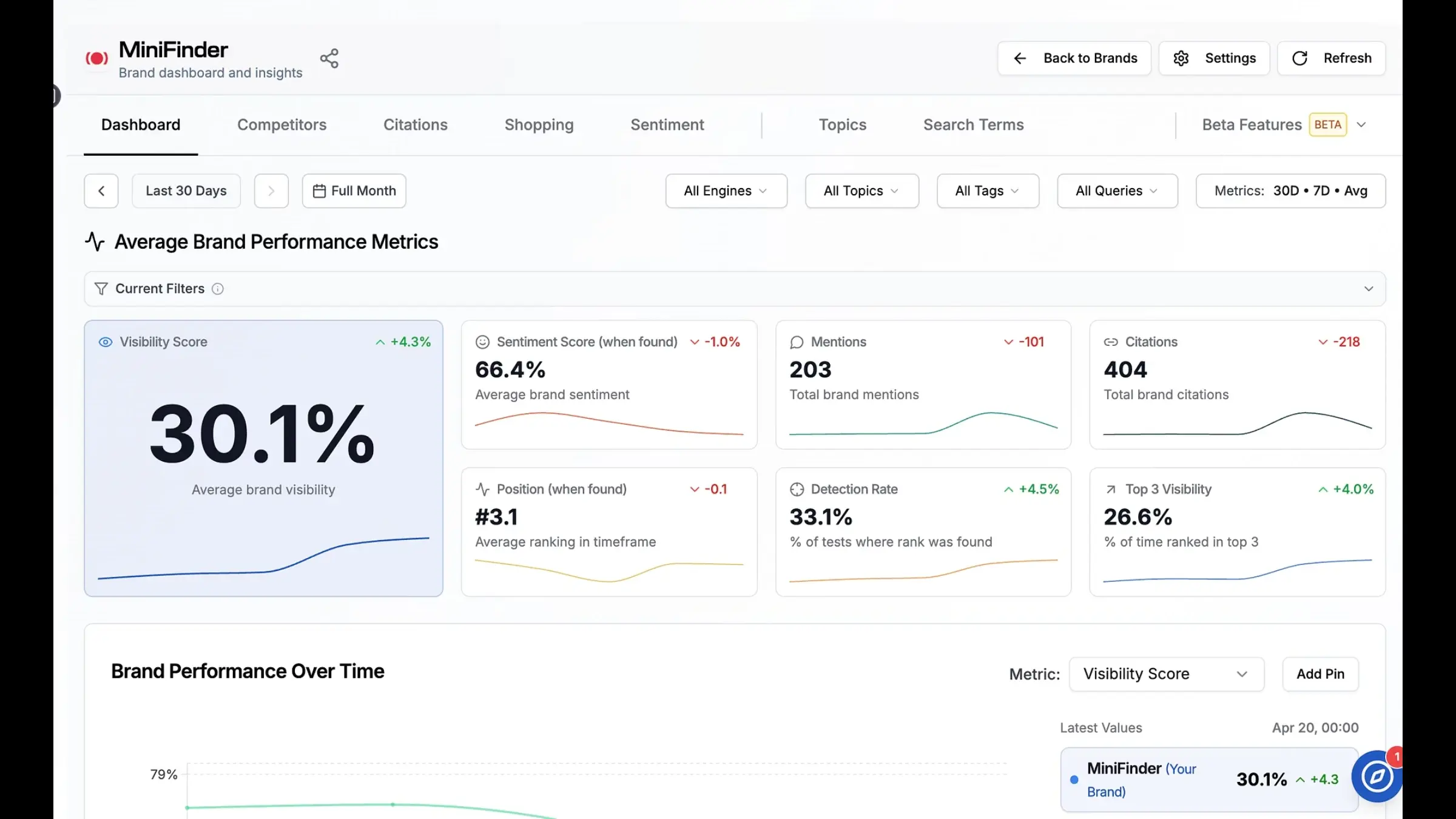
AI Visibility Score: 30.1 percent (plus 4.3 points during the measurement period). This is the share of purchase-oriented search queries in which MiniFinder is visible in AI answers. Consistent naming and structured information across different sources increase the likelihood that generative AI systems correctly recognize and prioritize MiniFinder.
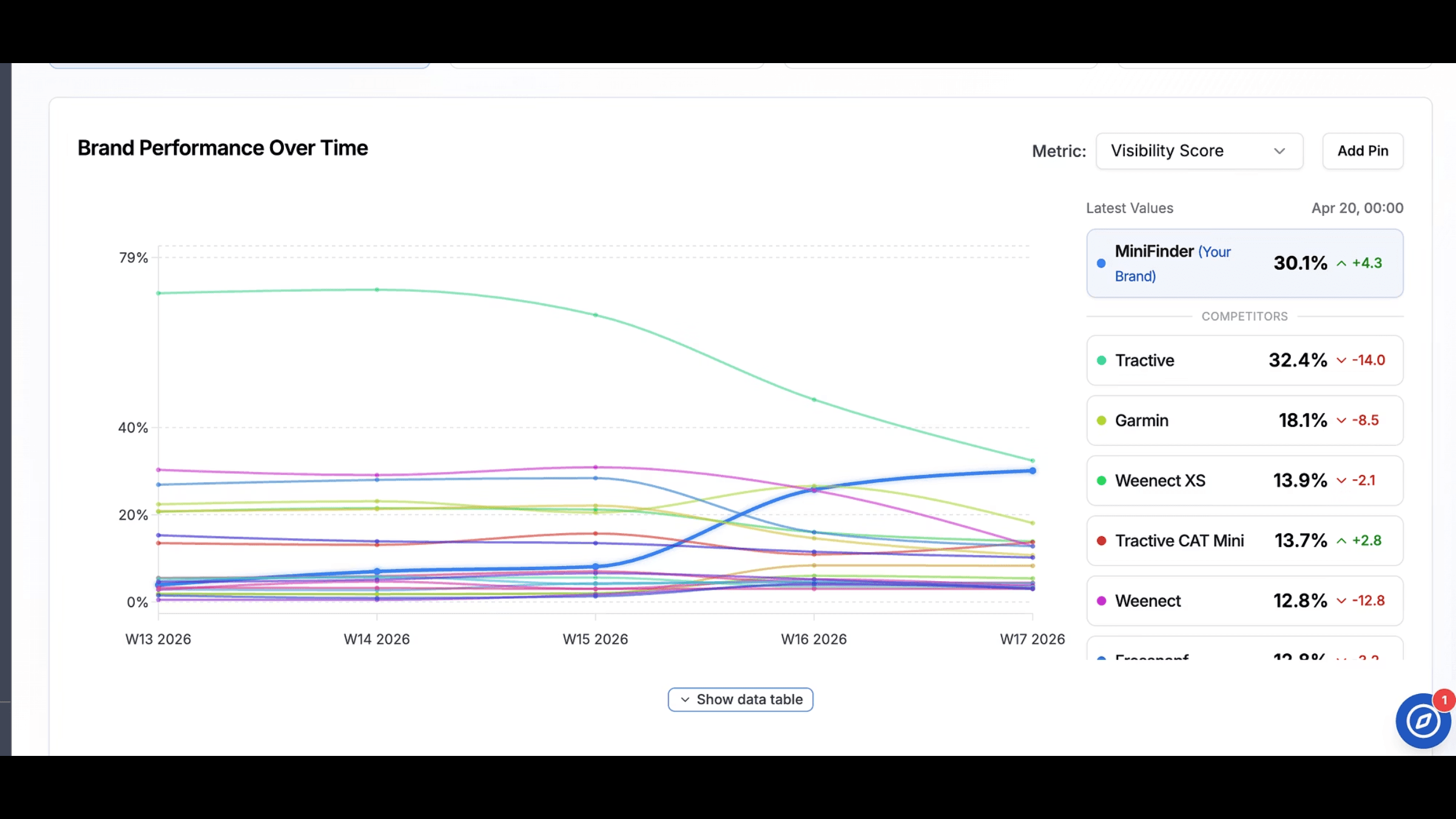
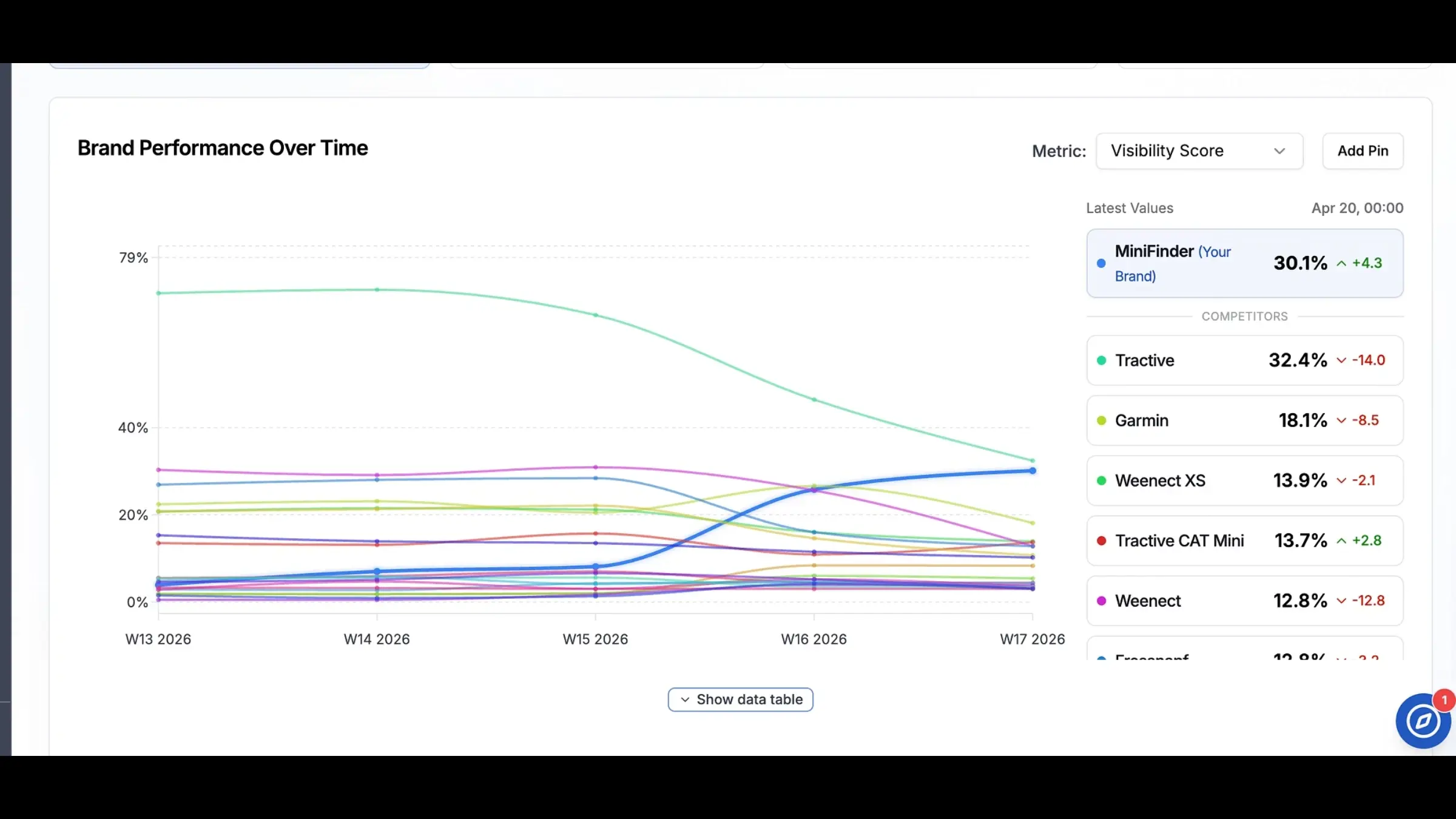
For comparison: Tractive is at 32.4 percent, but with a minus of 14.0 points. Garmin at 18.1 percent (minus 8.5), Weenect XS at 13.9 percent (minus 2.1), Weenect at 12.8 percent (minus 12.8). The curves crossed in April 2026: MiniFinder overtakes Tractive in AI visibility.
Average position: 3.1 — when MiniFinder appears in an AI answer, it is on average in third place. That is not a side note, but an active recommendation. The content optimization was specifically adapted to the requirements of modern search systems and large language models.
Detection rate: 33.8 percent (plus 4.5 points). In more than one third of all tested prompts, MiniFinder is recognized and mentioned by AI systems. The information provided on the website plays a central role here, as it is indexed by search systems, AI systems, and large language models and used for answers.
Top 3 visibility: 26.6 percent (plus 4.0 points). Nearly every fourth time a relevant prompt is queried, MiniFinder appears among the top 3 AI answers. The move from classic SEO to AI Optimization is crucial to remain visible in AI Overviews and modern search systems.
Sentiment score: 68.3 percent — the tone used to describe MiniFinder in AI answers is positive and continues to improve. A supporting video is used to present the results clearly and further strengthen visibility in AI Overviews.
AI Engine Breakdown: Visibility is distributed across all relevant systems, led by Google AI Overview with 70.3 percent, followed by Google AI Mode with 55.0 percent (plus 10.7 points), Grok with 42.5 percent (plus 4.8), Microsoft Copilot with 26.3 percent (plus 4.0), and Perplexity with 17.5 percent. On ChatGPT, visibility is 14.7 percent — there is still optimization potential here, and we are actively working on it. Gemini, as advanced AI technology, significantly influences visibility.
Share of Citations: 27.5 percent — this metric shows how deeply MiniFinder is anchored in AI-supported search. It measures how often MiniFinder is cited as a source in AI answers relative to competitors. Preparing the content for Retrieval-Augmented Generation systems ensures that relevant document segments are retrieved from external indexes and integrated into the context of large language models, increasing priority in answers.
27.5 percent means: more than one in four citations in the GPS tracker category goes to MiniFinder. Tractive CAT Mini ranks second with 24.0 percent, followed by Weenect XS and Garmin with 7.2 percent each. Over three months, MiniFinder built up 7,700 citations in Bing AI alone, with an average of 27 cited pages per answer. This shows that AI systems do not just reference one page, but actively draw from the entire content infrastructure.
The topics in which MiniFinder is cited most strongly show the breadth of its expertise: GPS tracking for dogs (49.7 percent visibility, plus 15.9 points), general GPS searches without a specific topic (46.5 percent), GPS trackers for cats (14.5 percent), GPS trackers for pets in general (6.0 percent).
Bing AI: 7,700 Citations in Three Months
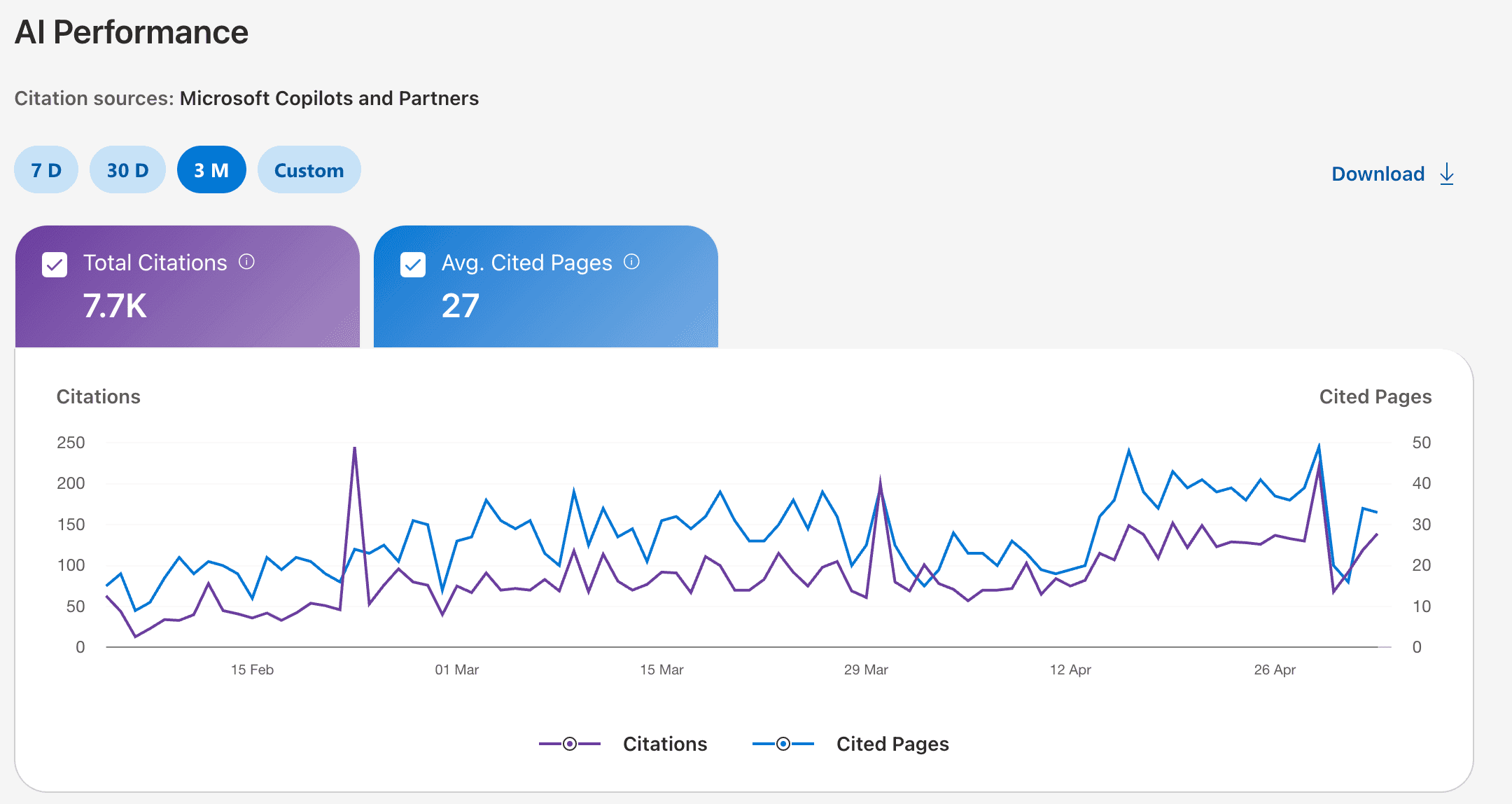
What is rarely seen so clearly in a chart: growth that confirms itself. Over the period from mid-February to the end of April 2026, the citation curve in Microsoft Copilot and the Bing partner systems has steadily moved upward. 7,700 citations in three months, with peaks of over 250 citations in a single day. What stands out is not just the volume — it is the second line in the chart. The average number of cited pages per answer is 27. That means AI systems do not just mention MiniFinder in passing. They actively draw from the entire content, pull from different pages, combine information, and build an answer from it. That is the difference between a mention and true content authority.
Not one category, all categories
Even more interesting than the total volume is the search queries for which MiniFinder is cited. The grounding queries paint a picture that goes far beyond a single product category. GPS trackers for vehicles and machinery lead with 360 citations. GPS trackers in healthcare follow with 304. Safety watches with 263, theft protection for vehicles with 187, fleet management with 175. Further down the list: GPS trackers for seniors and dementia safety, fall alarms for older people, elderly care. This is not niche visibility in one product category. This is broad AI authority across multiple use cases — exactly what AI systems need in order to reliably and repeatedly recommend a brand as a source. If you are cited in only one topic, you remain fragile. If you are cited across all relevant use cases, you build structural visibility.
27 cited pages per answer: what that really means
Two numbers explain more than many dashboards: 7,700 citations in three months, an average of 27 cited pages per answer. The first number shows the scale of presence. The second shows the quality. If an AI system references an average of 27 different MiniFinder pages per answer, it means that the content architecture works, that topics are built deep enough, that machines are not dependent on a single page but can draw from an entire network of sources. That is the goal of GEO: not one page that is cited by chance, but an infrastructure that is systematically used as an answer.
Why this strategy worked against giants
MiniFinder is competing against rivals that have built presence in Germany over many years and in some cases use significantly larger marketing budgets. Garmin is a global brand, Tractive is the best-known product in the German-speaking market, and Fressnapf has its own tracker line.
The focus is on visibility and continuous presence in order to target relevant audiences precisely. MiniFinder relies on the further development of classic SEO strategies toward AI Optimization (AIO) and Large Language Model Optimization (LLMO), with content specifically optimized for modern search systems, AI Overviews, and AI systems. Consistent naming and structured information across different sources increase the likelihood that generative systems will correctly recognize and mention an entity, leading to better results. Gemini, as advanced AI technology, plays a central role here.
Nevertheless, MiniFinder has caught up in selected AI prompts and overtaken individual competitors. The reason is not a bigger budget, but a different, data-driven strategy.
AI search does not reward spending, but clarity, structure, and citability. Anyone who explains to the AI what a product stands for, which challenges it solves, and for whom it is relevant will be cited — regardless of the company’s size.
That was the decisive lever — and it worked.
What this means for you
The MiniFinder story is not an isolated case. It shows a systematic method that can be applied to many companies and markets facing similar challenges.
The pattern is always the same: a good product, but missing digital structure, no AI visibility — and then competitors with more budget who still lose because they have not yet understood the new channel. Our focus is on optimizing leads, pipeline, and measurable results for companies.
AI search is the channel of the future. Visibility depends significantly on the website and the information provided, which must be optimized for search systems, AI systems, and large language models. The window of opportunity to build a strong position there is getting smaller and smaller. If you want to become visible in AI search before the competition wakes up, you need to take this channel seriously now.
The move from classic SEO to AI Optimization (AIO) and Large Language Model Optimization (LLMO) is crucial to adapt content for modern search systems and AI Overviews — because classic SEO alone is no longer enough today. Consistent naming and structuring of information across different sources increase the likelihood that generative systems will accurately recognize an entity and mention it in their answers, leading to better results.
Gemini, as advanced AI technology, plays a central role in visibility within AI-supported search systems. The way content is prepared for Retrieval-Augmented Generation systems determines whether it appears prioritized in answers from large language models.
If you recognize a similar problem — strong product, but invisible in a new market, no presence in AI search results, Google Ads without a clean structure — then now is the right time to work on the foundation with a specialized agency that makes your brand number 1 in AI search.
iGrow does three things: GEO and AI Search Optimization, SEO, and Google Ads with a shopping focus. All with one goal: visibility that sells — as your B2B growth partner for measurable growth.
iGrow helped MiniFinder become visible in the German market through GEO and Google Shopping and overtake Tractive in AI search results.
Imagine this: You have a technically superior product that already has many satisfied customers in Scandinavia. The support is strong, the reviews are excellent — and yet hardly anyone in Germany knows you.
Neither Google nor ChatGPT or Perplexity show your content. New search systems that increasingly rely on AI models do not recognize your brand because the foundation for visibility and structured information is missing from the website. This is exactly where the right optimization comes in — and the continuous development of the SEO strategy is crucial to remain present in AI search results over the long term and achieve measurable results.
That was the situation at MiniFinder when we started working together in autumn 2025.
What MiniFinder is and why the German market was so important
MiniFinder is a Scandinavian manufacturer of GPS trackers with a broad product portfolio: from dog trackers and senior solutions with fall detection to fleet management systems for businesses. The IoT technology solves real problems for private individuals, hunters, care facilities, and fleet operators. The website provides the technical and content foundation for optimization and visibility in modern search systems by being specifically structured for AI systems and large language models such as Gemini and ChatGPT.
MiniFinder has been established in Scandinavia for years, but in Germany the brand was hardly visible when the project began.
The problem was not the product, but the digital infrastructure and a market in which Tractive dominates with a large marketing budget, Garmin has built presence over many years, and Fressnapf is also active with its own tracker line. Especially in such a competitive environment, the consistent provision of relevant information and a uniform structure across different sources is crucial so that AI systems can correctly identify and prioritize MiniFinder. The further development of classic SEO strategies toward AI Optimization (AIO) and Large Language Model Optimization (LLMO) is essential to tailor content specifically for AI Overviews and generative AI systems. For companies, it is central to generate qualified leads, build a sustainable pipeline, and achieve measurable results in the conversion process. Supporting videos help present product progress in a clear way and increase visibility in AI Overviews. Optimizing the website and clearly structuring the content are the basis for visibility in modern search systems. Content is prepared in such a way that it can be processed by Retrieval-Augmented Generation systems and preferred in answers from large language models.
What we did first and why it was not just about content
Many agencies would say at this point: “We’ll write 50 blog articles now.” We did not do that.
First, we understood how the purchase process for GPS trackers really works.
Anyone who wants to buy a GPS tracker for their hunting dog, their car, or their mother in need of care no longer uses Google alone. They ask AI-based search systems like Google AI Overview, ChatGPT, Perplexity, or other large language models (LLMs). These modern systems increasingly determine which information and brands are visible. How content is prepared for these systems determines who appears in the answers — often even before a product page is visited.
The consistent naming and structuring of information across different sources is crucial so that AI systems can correctly recognize and prioritize MiniFinder. Anyone who does not appear in these AI answers loses potential customers even before the first contact.
That was the real problem for MiniFinder in Germany: it was not a lack of traffic, but a lack of citability in AI systems. There were no grounding contents that AI engines could rely on. No comparison pages for those looking to switch. No structured product descriptions that machines can understand. The move from classic SEO to AI Optimization (AIO) and Large Language Model Optimization (LLMO) was necessary to tailor content for modern AI search systems and AI Overviews. Content had to be prepared so that Retrieval-Augmented Generation systems could process it efficiently and use it preferentially in answers from large language models. Clear, structured information leads to better results in AI answers.
So we systematically began building these structures.
The starting point in the audit
Before we built anything, we analyzed everything — essentially a GEO Visibility Audit of the existing AI visibility. The result was clear:
The German Google Ads account ran through the Swedish account with SEK billing and a Merchant Center configuration that did not work for the German market. That sounds like a detail, but it is not. For the Google algorithm and modern search systems, it meant: no clean website structure, no solid technical foundation and therefore no optimal findability in search engines and AI-based search systems, no valid machine-learning signal for Germany, no valid campaign data, no basis for scaling.
On the organic side, there was hardly any user-focused German content and no AI grounding. AI systems, especially large language models, could not correctly classify MiniFinder. Consistent information and a uniform naming convention across different sources are crucial so that generative systems can reliably recognize and display MiniFinder — contradictory descriptions lead to uncertainty or missing visibility. Tractive dominated AI search with an AI Visibility Score of over 32 percent, while MiniFinder was hardly measurable.
The further development of classic SEO toward AI Optimization (AIO) requires clear structures and consistent data in order to achieve better results in modern AI search systems and be prioritized in answers.
That was the starting point — and it was clear: build structure first, then scale.
The three levers we moved
Lever 1: Google Ads & Shopping structure as the foundation
The first thing we built was an independent German Google Ads account. The Merchant Center was restructured and configured correctly. Tracking was cleaned up. We then defined Shopping as the primary campaign type — deliberately before Search and Performance Max.
Why Shopping? GPS trackers are comparison-driven products. Buyers want images, price, and specifications at a glance, exactly at the moment of highest purchase intent. Shopping delivers exactly that and allows the algorithm to learn from real purchase signals instead of just click volume without context. Our focus was on purchase-oriented search queries and the creation of specific landing pages for different target groups in the DACH region in order to increase the conversion rate in a targeted way.
We built three campaigns that addressed different product lines and target groups: pet trackers, Nano trackers, and the REX line for hunting and outdoor use. From August 2025 to May 2026, the campaigns generated more than 6,000 clicks and over 550,000 impressions combined at competitive click prices. The targeted wording in the ad copy, aimed directly at the purchase moment, improved lead quality and filled the pipeline with qualified prospects. This is reflected in measurable results.
The top search terms show the strategy: “GPS tracker,” “GPS tracker dog,” “Tractive,” “GPS tracker cat.” This way, we actively capture search volume that would otherwise flow to the competition. Optimizing the website and providing relevant information on the landing pages were crucial for conversion optimization and visibility in search engines and AI-based results. A balanced strategy of paid and organic measures enables companies in the DACH region to efficiently achieve both short-term and sustainable growth goals.
Lever 2: SEO – purchase-ready rankings instead of mere traffic volume
We did not optimize for generic terms like “buy GPS tracker.” Instead, our focus was on specific search queries with real purchase intent that were close to the decision or considering a switch.
Examples: “GPS tracker for dogs comparison,” “hunting dog GPS tracker comparison,” “GPS theft protection car,” “company car GPS monitoring.” These search queries are not purely informational searches; they are used to prepare for a decision. Clearly structured information and an optimized website are crucial here for better results in search systems and AI engines.
In April 2026, we measured the strongest SEO results since the project began: the average position on Google Germany was 8.0 — three places better than the previous month and the best value since the start of the project. 14 keywords were in the top 3, 20 keywords in the top 10 — that is 80 percent of all tracked keywords on the first page. These successes show how important the transition from classic SEO to AI Optimization (AIO) is, where content is specifically adapted for AI Overviews and large language models.
Individual examples: “GPS freight tracking” at position 1, “hunting dog GPS tracker comparison” jumped 33 positions upward, “GPS theft protection” climbed 12 places to position 15, “How does a car GPS tracker work?” improved to position 5. These are not coincidences, but direct effects of structured content that clearly answers purchase-related questions and underscores the importance of leads, pipeline, and clear marketing funnels for conversion and revenue growth. A clear funnel structure can increase the closing rate by up to 39 percent by reducing the number of steps between first contact and purchase. Companies that optimize their funnel processes often achieve significant revenue growth without additional budget simply through more clarity in the buying process.
Google Search Console for April 2026 shows around 6,700 clicks, just under 470,000 impressions, and a CTR of 1.4 percent — all up compared to the previous month. Preparing the content for Retrieval-Augmented Generation systems ensures that relevant document segments are integrated into the context of large language models and prioritized in answers.
Lever 3: GEO / AI Search Optimization – the channel that makes the difference
This part surprises many when they see the results.
MiniFinder is now the leader in selected AI prompts ahead of Tractive, Garmin, and other competitors. Visibility in modern search systems is significantly influenced by Google AI Overviews, AI systems like Gemini, and large language models that structure and highlight relevant information.
At the start of the project, MiniFinder was almost invisible in AI systems. There was no structured content for AI engines to rely on. No grounding pages that make the product readable and citable for machines. No clear positioning in the categories that decision-makers ask about. The move from classic SEO to AI Optimization (AIO) and Large Language Model Optimization (LLMO) required adapting the content to prepare it optimally for modern search systems and AI Overviews.
We built MiniFinder up as a citable source — not through volume, but through structure: content that AI systems can directly use as answers, clearly categorized by topics such as GPS tracking for dogs, fleet management, vehicle security, and senior solutions. Consistent naming and structuring across different sources increase the likelihood that generative systems will recognize MiniFinder as an entity and prioritize it, leading to better results. Videos help present product progress in a clear way and strengthen visibility in AI Overviews. Preparing content for Retrieval-Augmented Generation systems ensures that relevant document segments are retrieved from external indexes and integrated into the context of large language models so that MiniFinder appears preferentially in answers.
What the RankScale data shows
We continuously track MiniFinder’s AI visibility across all relevant AI systems. For companies in the DACH region, measurable results, a clear focus on qualified leads, and a strong pipeline are crucial for sustainable growth. Results from the RankScale dashboard:
AI Visibility Score: 30.1 percent (plus 4.3 points during the measurement period). This is the share of purchase-oriented search queries in which MiniFinder is visible in AI answers. Consistent naming and structured information across different sources increase the likelihood that generative AI systems correctly recognize and prioritize MiniFinder.
For comparison: Tractive is at 32.4 percent, but with a minus of 14.0 points. Garmin at 18.1 percent (minus 8.5), Weenect XS at 13.9 percent (minus 2.1), Weenect at 12.8 percent (minus 12.8). The curves crossed in April 2026: MiniFinder overtakes Tractive in AI visibility.
Average position: 3.1 — when MiniFinder appears in an AI answer, it is on average in third place. That is not a side note, but an active recommendation. The content optimization was specifically adapted to the requirements of modern search systems and large language models.
Detection rate: 33.8 percent (plus 4.5 points). In more than one third of all tested prompts, MiniFinder is recognized and mentioned by AI systems. The information provided on the website plays a central role here, as it is indexed by search systems, AI systems, and large language models and used for answers.
Top 3 visibility: 26.6 percent (plus 4.0 points). Nearly every fourth time a relevant prompt is queried, MiniFinder appears among the top 3 AI answers. The move from classic SEO to AI Optimization is crucial to remain visible in AI Overviews and modern search systems.
Sentiment score: 68.3 percent — the tone used to describe MiniFinder in AI answers is positive and continues to improve. A supporting video is used to present the results clearly and further strengthen visibility in AI Overviews.
AI Engine Breakdown: Visibility is distributed across all relevant systems, led by Google AI Overview with 70.3 percent, followed by Google AI Mode with 55.0 percent (plus 10.7 points), Grok with 42.5 percent (plus 4.8), Microsoft Copilot with 26.3 percent (plus 4.0), and Perplexity with 17.5 percent. On ChatGPT, visibility is 14.7 percent — there is still optimization potential here, and we are actively working on it. Gemini, as advanced AI technology, significantly influences visibility.
Share of Citations: 27.5 percent — this metric shows how deeply MiniFinder is anchored in AI-supported search. It measures how often MiniFinder is cited as a source in AI answers relative to competitors. Preparing the content for Retrieval-Augmented Generation systems ensures that relevant document segments are retrieved from external indexes and integrated into the context of large language models, increasing priority in answers.
27.5 percent means: more than one in four citations in the GPS tracker category goes to MiniFinder. Tractive CAT Mini ranks second with 24.0 percent, followed by Weenect XS and Garmin with 7.2 percent each. Over three months, MiniFinder built up 7,700 citations in Bing AI alone, with an average of 27 cited pages per answer. This shows that AI systems do not just reference one page, but actively draw from the entire content infrastructure.
The topics in which MiniFinder is cited most strongly show the breadth of its expertise: GPS tracking for dogs (49.7 percent visibility, plus 15.9 points), general GPS searches without a specific topic (46.5 percent), GPS trackers for cats (14.5 percent), GPS trackers for pets in general (6.0 percent).
Bing AI: 7,700 Citations in Three Months
What is rarely seen so clearly in a chart: growth that confirms itself. Over the period from mid-February to the end of April 2026, the citation curve in Microsoft Copilot and the Bing partner systems has steadily moved upward. 7,700 citations in three months, with peaks of over 250 citations in a single day. What stands out is not just the volume — it is the second line in the chart. The average number of cited pages per answer is 27. That means AI systems do not just mention MiniFinder in passing. They actively draw from the entire content, pull from different pages, combine information, and build an answer from it. That is the difference between a mention and true content authority.
Not one category, all categories
Even more interesting than the total volume is the search queries for which MiniFinder is cited. The grounding queries paint a picture that goes far beyond a single product category. GPS trackers for vehicles and machinery lead with 360 citations. GPS trackers in healthcare follow with 304. Safety watches with 263, theft protection for vehicles with 187, fleet management with 175. Further down the list: GPS trackers for seniors and dementia safety, fall alarms for older people, elderly care. This is not niche visibility in one product category. This is broad AI authority across multiple use cases — exactly what AI systems need in order to reliably and repeatedly recommend a brand as a source. If you are cited in only one topic, you remain fragile. If you are cited across all relevant use cases, you build structural visibility.
27 cited pages per answer: what that really means
Two numbers explain more than many dashboards: 7,700 citations in three months, an average of 27 cited pages per answer. The first number shows the scale of presence. The second shows the quality. If an AI system references an average of 27 different MiniFinder pages per answer, it means that the content architecture works, that topics are built deep enough, that machines are not dependent on a single page but can draw from an entire network of sources. That is the goal of GEO: not one page that is cited by chance, but an infrastructure that is systematically used as an answer.
Why this strategy worked against giants
MiniFinder is competing against rivals that have built presence in Germany over many years and in some cases use significantly larger marketing budgets. Garmin is a global brand, Tractive is the best-known product in the German-speaking market, and Fressnapf has its own tracker line.
The focus is on visibility and continuous presence in order to target relevant audiences precisely. MiniFinder relies on the further development of classic SEO strategies toward AI Optimization (AIO) and Large Language Model Optimization (LLMO), with content specifically optimized for modern search systems, AI Overviews, and AI systems. Consistent naming and structured information across different sources increase the likelihood that generative systems will correctly recognize and mention an entity, leading to better results. Gemini, as advanced AI technology, plays a central role here.
Nevertheless, MiniFinder has caught up in selected AI prompts and overtaken individual competitors. The reason is not a bigger budget, but a different, data-driven strategy.
AI search does not reward spending, but clarity, structure, and citability. Anyone who explains to the AI what a product stands for, which challenges it solves, and for whom it is relevant will be cited — regardless of the company’s size.
That was the decisive lever — and it worked.
What this means for you
The MiniFinder story is not an isolated case. It shows a systematic method that can be applied to many companies and markets facing similar challenges.
The pattern is always the same: a good product, but missing digital structure, no AI visibility — and then competitors with more budget who still lose because they have not yet understood the new channel. Our focus is on optimizing leads, pipeline, and measurable results for companies.
AI search is the channel of the future. Visibility depends significantly on the website and the information provided, which must be optimized for search systems, AI systems, and large language models. The window of opportunity to build a strong position there is getting smaller and smaller. If you want to become visible in AI search before the competition wakes up, you need to take this channel seriously now.
The move from classic SEO to AI Optimization (AIO) and Large Language Model Optimization (LLMO) is crucial to adapt content for modern search systems and AI Overviews — because classic SEO alone is no longer enough today. Consistent naming and structuring of information across different sources increase the likelihood that generative systems will accurately recognize an entity and mention it in their answers, leading to better results.
Gemini, as advanced AI technology, plays a central role in visibility within AI-supported search systems. The way content is prepared for Retrieval-Augmented Generation systems determines whether it appears prioritized in answers from large language models.
If you recognize a similar problem — strong product, but invisible in a new market, no presence in AI search results, Google Ads without a clean structure — then now is the right time to work on the foundation with a specialized agency that makes your brand number 1 in AI search.
iGrow does three things: GEO and AI Search Optimization, SEO, and Google Ads with a shopping focus. All with one goal: visibility that sells — as your B2B growth partner for measurable growth.
Written by:

Edin
Author & Founder
Share this article
How long did it take for MiniFinder to become visible in AI search results?
We saw the first measurable results in AI systems within just a few weeks of the initial content and grounding measures. Full visibility across all relevant AI engines is a continuous process — but the direction was clear from the start, and the curve has continued to rise to this day. What is crucial for sustainable results is the consistent naming and structuring of information across different sources so that generative models such as LLMs can reliably recognize relevant entities and prioritize them in their responses.
Do I have to be a large company for GEO and AI Search Optimization to be worthwhile?
No — and the MiniFinder case study shows exactly the opposite. MiniFinder is not a global corporation. Tractive and Garmin have significantly larger marketing budgets. Even so, MiniFinder has closed the gap in selected prompts and overtaken individual competitors. AI search rewards not spending, but structure and citability. That’s a chance for anyone willing to take it. That’s why AI Visibility is the most interesting channel — because it levels the playing field. Established brands dominate traditional SEO through backlink profiles you won’t catch up to in two years. But AI systems evaluate clarity, structure, and topical relevance. If you’re the best-structured, most clearly articulated explanatory source in your niche, you’ll be cited — regardless of your domain authority. SoWork started with an AI Visibility Score of 16.6%. Gather was more established, better known, and bigger. Even so, SoWork overtook Gather in AI citations. Not through budget, but through better structure.
What is the difference between traditional SEO and GEO?
Classic SEO is optimized so that your page appears as high as possible in a list of search results. GEO — Generative Engine Optimization — is optimized so that AI systems like ChatGPT, Google AI Overview, or Perplexity actively recommend and cite your business as the answer. These are two different channels with two different logics. Anyone who only does SEO today is working on a channel that is no longer the first one for a growing share of purchase decision-makers. Unlike classic SEO, GEO takes into account the role of AI overviews, AIO, LLMs, large language models, search systems, AI systems, and Gemini to specifically optimize content for modern AI-powered search technologies.
Why was Shopping the right campaign type for MiniFinder, and does that also apply to other products?
When it comes to GPS trackers, buyers make their decisions very visually and by comparing options directly. They want to see at a glance: What does it cost, what does it look like, what can it do? Shopping ads deliver exactly that at the moment of highest purchase intent. This applies to all physical products where price, design, and technical specs are the deciding factors. If you sell a complex B2B product without a listed price, Search is the right starting point. If you have a comparable product in e-commerce, Shopping is usually the faster route to measurable results—provided your Google Ads are consistently optimized for profitability.
Can we also implement this for our market entry in Germany?
That is exactly the scenario we ran through with MiniFinder — an established brand in another market, no digital infrastructure in Germany yet, and strong competitors with the home advantage. The strategy is transferable. What changes are the specific keywords, the relevant AI prompts, and the product categories. What stays the same: first structure, then scale. Anyone who reverses that burns budget without any lasting impact. If you know where you stand, we know where to start — a clear B2B SEO strategy for your market is the framework.
Related Insights for Success
Edin Cerimagic
CEO von igrow
ChatGPT

ChatGPT Visibility: We are a B2B software provider and are noticing that our target group is increasingly using ChatGPT instead of Google for research. We want to be recommended as a provider there, but we have no internal expertise on the subject – How to reach your target group where they are actually searching
Edin Cerimagic
CEO von igrow
Other

Growth Marketing Agency for B2B SaaS Lead Generation: How to Find the Right One
How long did it take for MiniFinder to become visible in AI search results?
We saw the first measurable results in AI systems within just a few weeks of the initial content and grounding measures. Full visibility across all relevant AI engines is a continuous process — but the direction was clear from the start, and the curve has continued to rise to this day. What is crucial for sustainable results is the consistent naming and structuring of information across different sources so that generative models such as LLMs can reliably recognize relevant entities and prioritize them in their responses.
Do I have to be a large company for GEO and AI Search Optimization to be worthwhile?
No — and the MiniFinder case study shows exactly the opposite. MiniFinder is not a global corporation. Tractive and Garmin have significantly larger marketing budgets. Even so, MiniFinder has closed the gap in selected prompts and overtaken individual competitors. AI search rewards not spending, but structure and citability. That’s a chance for anyone willing to take it. That’s why AI Visibility is the most interesting channel — because it levels the playing field. Established brands dominate traditional SEO through backlink profiles you won’t catch up to in two years. But AI systems evaluate clarity, structure, and topical relevance. If you’re the best-structured, most clearly articulated explanatory source in your niche, you’ll be cited — regardless of your domain authority. SoWork started with an AI Visibility Score of 16.6%. Gather was more established, better known, and bigger. Even so, SoWork overtook Gather in AI citations. Not through budget, but through better structure.
What is the difference between traditional SEO and GEO?
Classic SEO is optimized so that your page appears as high as possible in a list of search results. GEO — Generative Engine Optimization — is optimized so that AI systems like ChatGPT, Google AI Overview, or Perplexity actively recommend and cite your business as the answer. These are two different channels with two different logics. Anyone who only does SEO today is working on a channel that is no longer the first one for a growing share of purchase decision-makers. Unlike classic SEO, GEO takes into account the role of AI overviews, AIO, LLMs, large language models, search systems, AI systems, and Gemini to specifically optimize content for modern AI-powered search technologies.
Why was Shopping the right campaign type for MiniFinder, and does that also apply to other products?
When it comes to GPS trackers, buyers make their decisions very visually and by comparing options directly. They want to see at a glance: What does it cost, what does it look like, what can it do? Shopping ads deliver exactly that at the moment of highest purchase intent. This applies to all physical products where price, design, and technical specs are the deciding factors. If you sell a complex B2B product without a listed price, Search is the right starting point. If you have a comparable product in e-commerce, Shopping is usually the faster route to measurable results—provided your Google Ads are consistently optimized for profitability.
Can we also implement this for our market entry in Germany?
That is exactly the scenario we ran through with MiniFinder — an established brand in another market, no digital infrastructure in Germany yet, and strong competitors with the home advantage. The strategy is transferable. What changes are the specific keywords, the relevant AI prompts, and the product categories. What stays the same: first structure, then scale. Anyone who reverses that burns budget without any lasting impact. If you know where you stand, we know where to start — a clear B2B SEO strategy for your market is the framework.
Related Insights for Success
Edin Cerimagic
CEO von igrow
ChatGPT
ChatGPT Visibility: We are a B2B software provider and are noticing that our target group is increasingly using ChatGPT instead of Google for research. We want to be recommended as a provider there, but we have no internal expertise on the subject – How to reach your target group where they are actually searching
Edin Cerimagic
CEO von igrow
Other
Growth Marketing Agency for B2B SaaS Lead Generation: How to Find the Right One
How long did it take for MiniFinder to become visible in AI search results?
We saw the first measurable results in AI systems within just a few weeks of the initial content and grounding measures. Full visibility across all relevant AI engines is a continuous process — but the direction was clear from the start, and the curve has continued to rise to this day. What is crucial for sustainable results is the consistent naming and structuring of information across different sources so that generative models such as LLMs can reliably recognize relevant entities and prioritize them in their responses.
Do I have to be a large company for GEO and AI Search Optimization to be worthwhile?
No — and the MiniFinder case study shows exactly the opposite. MiniFinder is not a global corporation. Tractive and Garmin have significantly larger marketing budgets. Even so, MiniFinder has closed the gap in selected prompts and overtaken individual competitors. AI search rewards not spending, but structure and citability. That’s a chance for anyone willing to take it. That’s why AI Visibility is the most interesting channel — because it levels the playing field. Established brands dominate traditional SEO through backlink profiles you won’t catch up to in two years. But AI systems evaluate clarity, structure, and topical relevance. If you’re the best-structured, most clearly articulated explanatory source in your niche, you’ll be cited — regardless of your domain authority. SoWork started with an AI Visibility Score of 16.6%. Gather was more established, better known, and bigger. Even so, SoWork overtook Gather in AI citations. Not through budget, but through better structure.
What is the difference between traditional SEO and GEO?
Classic SEO is optimized so that your page appears as high as possible in a list of search results. GEO — Generative Engine Optimization — is optimized so that AI systems like ChatGPT, Google AI Overview, or Perplexity actively recommend and cite your business as the answer. These are two different channels with two different logics. Anyone who only does SEO today is working on a channel that is no longer the first one for a growing share of purchase decision-makers. Unlike classic SEO, GEO takes into account the role of AI overviews, AIO, LLMs, large language models, search systems, AI systems, and Gemini to specifically optimize content for modern AI-powered search technologies.
Why was Shopping the right campaign type for MiniFinder, and does that also apply to other products?
When it comes to GPS trackers, buyers make their decisions very visually and by comparing options directly. They want to see at a glance: What does it cost, what does it look like, what can it do? Shopping ads deliver exactly that at the moment of highest purchase intent. This applies to all physical products where price, design, and technical specs are the deciding factors. If you sell a complex B2B product without a listed price, Search is the right starting point. If you have a comparable product in e-commerce, Shopping is usually the faster route to measurable results—provided your Google Ads are consistently optimized for profitability.
Can we also implement this for our market entry in Germany?
That is exactly the scenario we ran through with MiniFinder — an established brand in another market, no digital infrastructure in Germany yet, and strong competitors with the home advantage. The strategy is transferable. What changes are the specific keywords, the relevant AI prompts, and the product categories. What stays the same: first structure, then scale. Anyone who reverses that burns budget without any lasting impact. If you know where you stand, we know where to start — a clear B2B SEO strategy for your market is the framework.
Related Insights for Success
Edin Cerimagic
CEO von igrow
ChatGPT
ChatGPT Visibility: We are a B2B software provider and are noticing that our target group is increasingly using ChatGPT instead of Google for research. We want to be recommended as a provider there, but we have no internal expertise on the subject – How to reach your target group where they are actually searching
Edin Cerimagic
CEO von igrow
Other
Growth Marketing Agency for B2B SaaS Lead Generation: How to Find the Right One