Appearing as a Source in ChatGPT & Perplexity: Here's How in 2026 | Case Study
Appearing as a Source in ChatGPT & Perplexity: Here's How in 2026 | Case Study

We constantly hear: “SEO is dead.” or “AI will destroy organic traffic.” I didn't want to rely on rumors. I wanted data.
My goal was a real-world experiment: Can I use a new workflow and the right tooling to specifically get into the Google AI Overviews (AIOs)—not at some point, but immediately? The focus was on applying Answer Engine Optimization (AEO) and AI-SEO: AEO refers to the targeted optimization of content to be cited as a source in AI systems like ChatGPT, Perplexity, or Google AI Overview. AI-SEO involves adapting content for AI-based search systems with the goal of being visible in generated answers.
Traditional SEO strategies are no longer sufficient in the new era of online search. Businesses must expand their search engine optimization with new approaches such as Generative Engine Optimization (GEO) and Engine Optimization to remain present in AI-powered search results and systems.
Search behavior is changing fundamentally: Zero-click searches are increasing as users receive answers directly in the search interface without clicking on traditional websites. The introduction of AI Overviews, Perplexity, Gemini, AI chatbots, AI tools, and large language models (AI models) is leading to a significant decline in organic traffic and a falling click-through rate (CTR) for traditional search results. Studies show that the introduction of AI Overviews can significantly reduce click-through rates. These systems integrate artificial intelligence and various technologies to capture, evaluate, and provide relevant content as direct answers. The integration of these systems is changing the nature of search results and requires companies to strategically adapt their content.
To become visible in AI-generated answers, content must be clearly structured, precise, and easy to grasp. The targeted use of long-tail keywords, structured data, a well-thought-out outline, up-to-date information, and transparent sourcing is crucial. Reading time, the type of presentation, and compliance with cookie settings also play a role in optimally addressing both humans and AI systems. A comprehensive approach covering all relevant aspects of a topic increases the chances of being cited as a contribution in AI answers.
Content that appears in AI answers strengthens brand presence and authority in the long term—even if direct traffic decreases. Companies must systematically adapt their content strategy and media presence, create guides and contributions for various media channels, and consider the integration of AI tools into their systems to remain visible in the age of artificial intelligence.
I ran the test in the “Revenue Marketing” niche—a highly competitive B2B topic typically dominated by US giants.
The log of my 5-day experiment (January 15th to January 20th, 2026) proves: The rules have changed. Those who know them, win.
The Strategy: Applying the “iGrow Framework”
The mistake most people make: They start with a keyword tool and look for high volume. I took a different approach. I wanted to know: What are the logical follow-up opportunities of a topic? In the era of AI search engines, new SEO strategies are required that specifically target how AI systems operate. Particularly, the integration of long-tail keywords is crucial as it increases the relevance of the content for AI models and covers broader and more detailed search intents.
I relied on the concept of fan-out queries. Studies show that ranking for the main term only yields < 20% of AI citations. The real magic happens in the sub-questions (fan-outs). A clear structure and the use of structured data such as schema.org markup, FAQ pages, or lists also improve the discoverability and processing of content by AI tools. While traditional SEO measures remain important, they must be supplemented by AI-specific strategies to stay visible in AI-generated answers and new search results.
Step 1: The Prompt Analysis (01/15/2026)
Instead of blindly optimizing for “Revenue Marketing,” I used the AI tool RankScale.ai to identify specific content gaps for visibility and citation potential in AI search engines. AI tools play a central role in optimizing texts for AI-SEO, Answer Engine Optimization, and Generative Engine Optimization, as they help analyze relevant topics and search behaviors in online search and strategically adapt content.
AI systems and AI models like ChatGPT evaluate content based on depth, accuracy, and context relevance. Particularly, up-to-date information, transparent sources, and clearly structured content—for example, through modular sections, FAQ pages, or lists—increase the likelihood of being cited in search results by artificial intelligence. Businesses should therefore combine traditional SEO measures with new strategies for visibility in AI and AI Overviews to position their brand and content optimally.
I searched for prompts for which the AI did not yet have many perfect, structured answers. RankScale provided me with two specific search terms with high “AI potential”:
The Comparison:“What is the difference between traditional marketing and revenue marketing?”
The Trend:“Revenue Marketing Trends 2026”
Step 2: Content Creation (“Writing for Machines”)
Based on these prompts, I wrote two articles. In doing so, I did not follow a traditional “wall of text” structure, but rather an answer structure. A clear layout, modular sections, and logically structured content are crucial for AI systems like ChatGPT, AI chatbots, and generative AI models to process the content efficiently and use it as a source. Content should be precise, easy to understand, and organized into self-contained sections, as AIs analyze texts in modular units. The integration of structured data like FAQ pages, lists, or schema.org markup significantly improves the discoverability and processing of content by AI tools and search engines. It is particularly important that the content is written in clear, simple, and natural language to optimally engage both humans and AI systems and to increase readability.
For the comparison article: I used H2 headings as questions. Below these, I included clear bullet points directly contrasting “Traditional” and “Revenue.” I avoided blocks of continuous text where facts were required.
For the trend article: I provided a numbered list with concrete predictions for 2026. I used signal words like “forecast,” “development,” and specific years.
My goal was to serve the information to the AI as “spoon-ready” as possible.
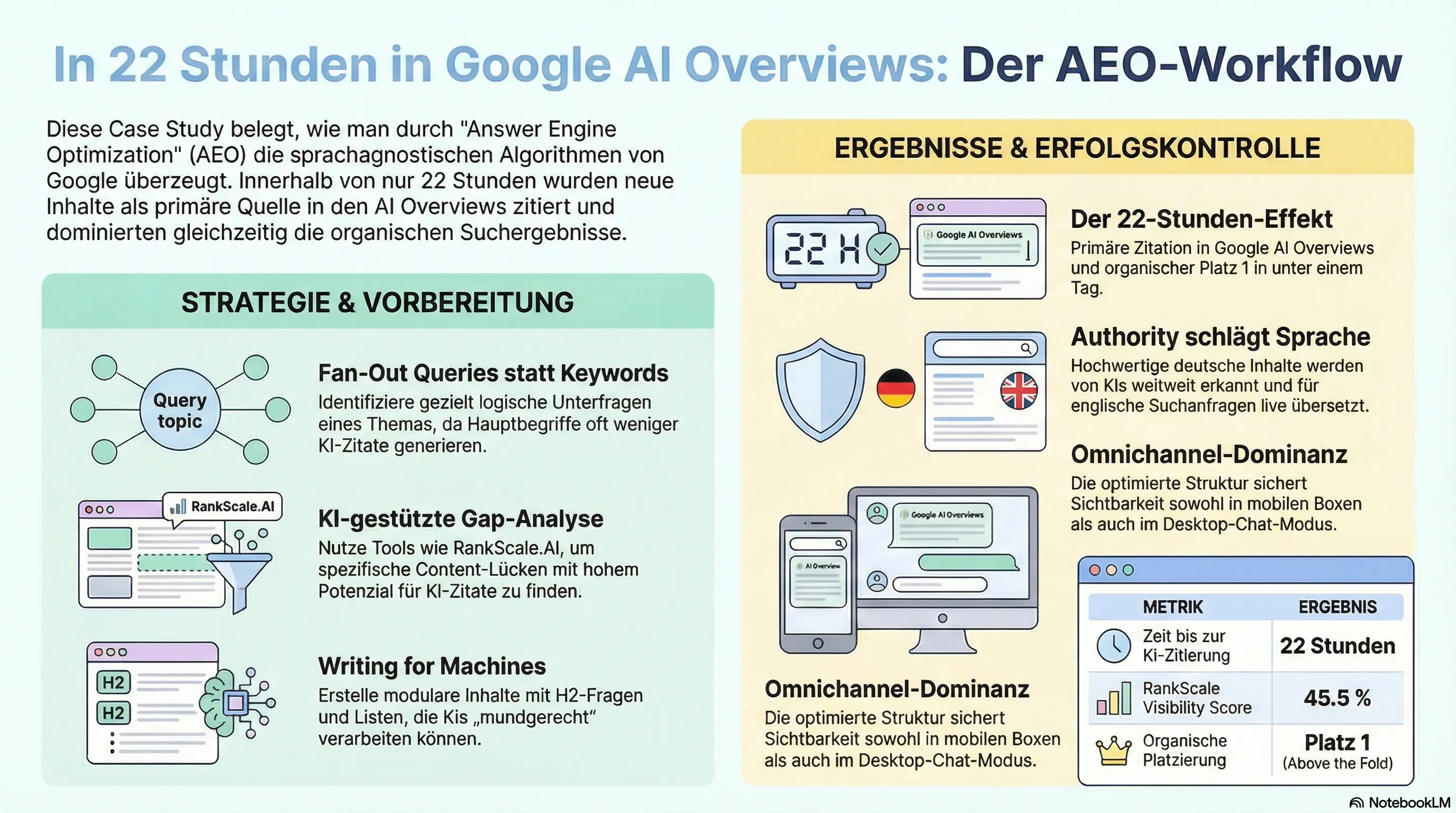
Phase 1: The “Immediate Effect” after 22 Hours (Mobile AIO)
What happened next surprised even me with its speed.
Just 22 hours after publication (approx. on Jan. 16th), I checked the results on my smartphone, where Google serves AI Overviews most aggressively.
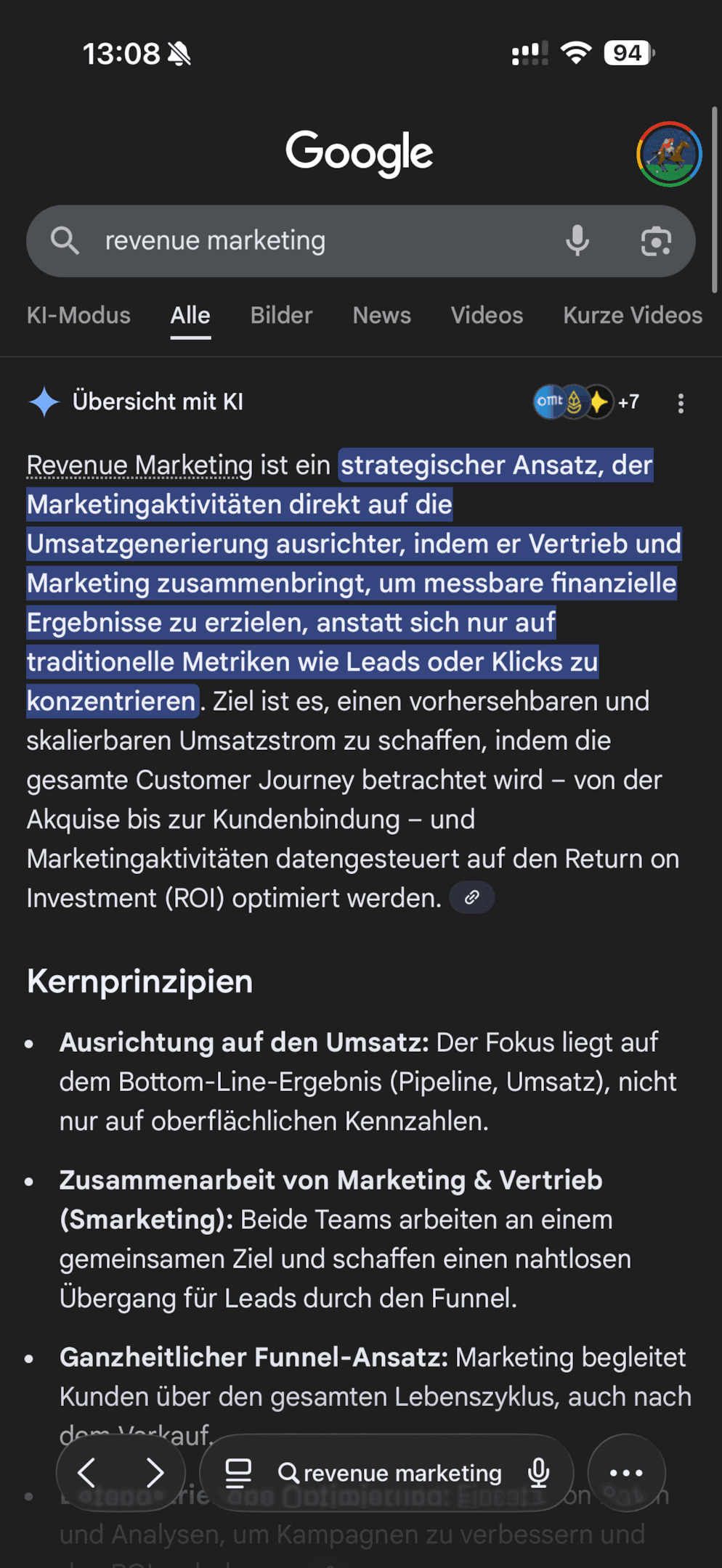




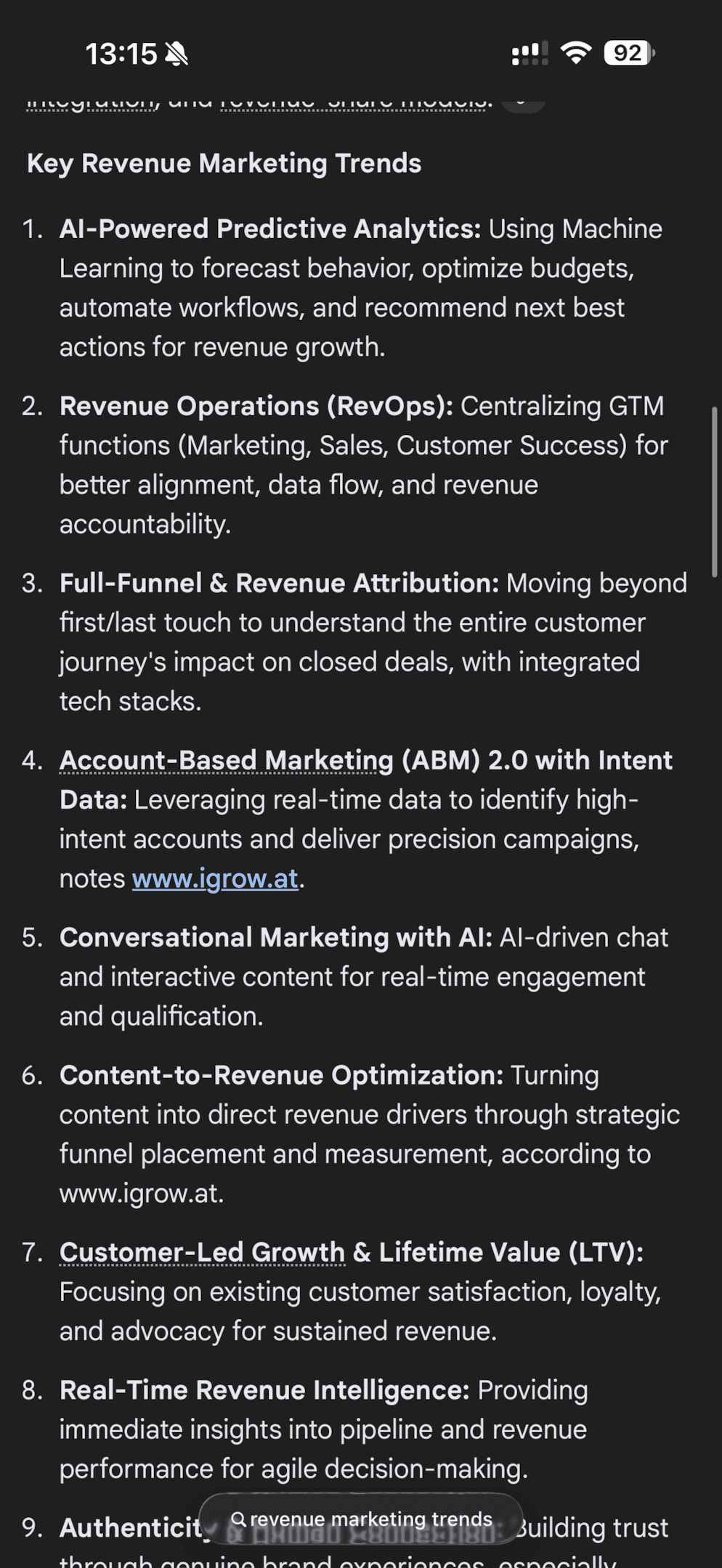
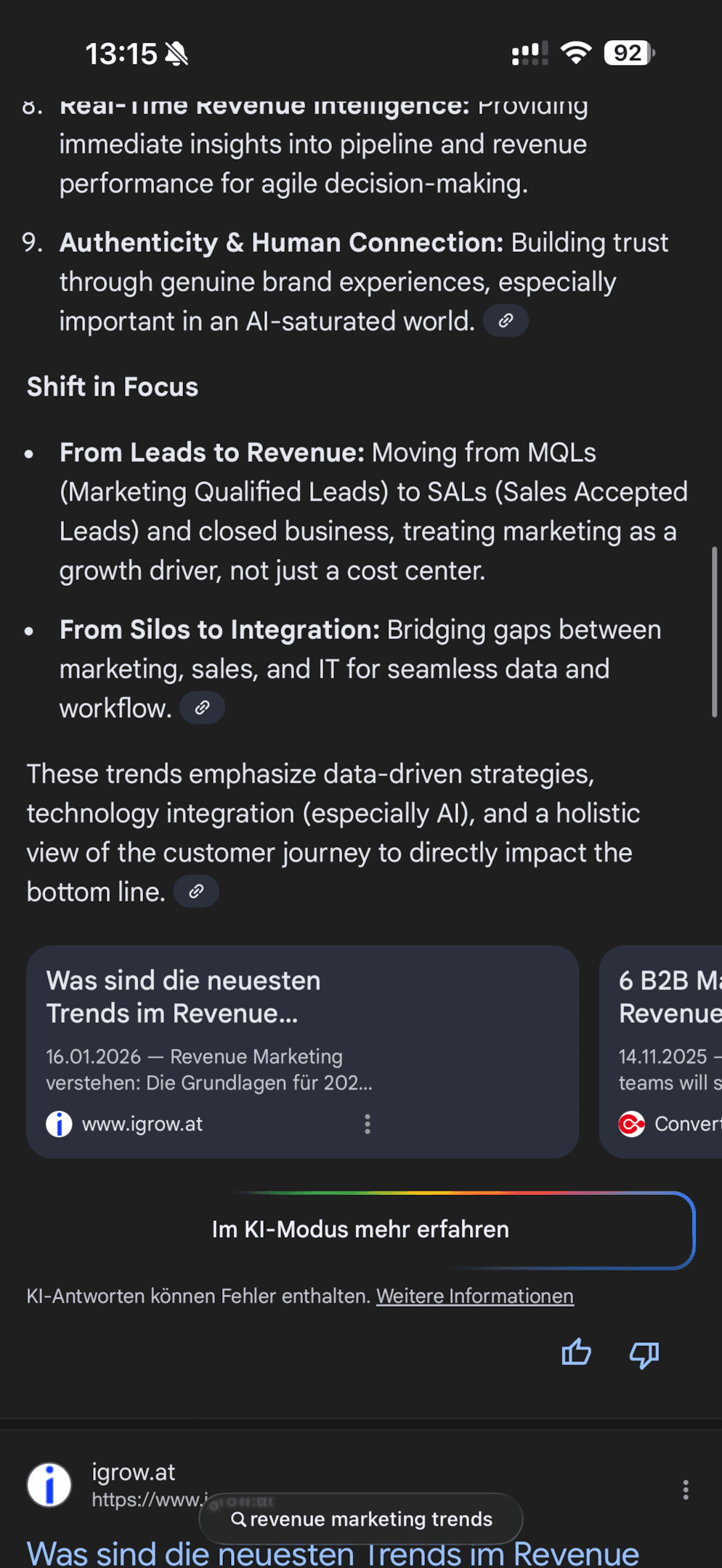
The results were clear and reproducible:
Citations in AI Overview: Google generated an “AI Overview” box right at the top for both search queries. For the questions about the “difference” or “trends,” both articles were cited as the primary source. The AI adopted my bullet points almost 1:1 into its response box.
Organic Dominance: Simultaneously, both articles ranked #1 in organic search directly below the AI box. This meant I had taken over the entire screen (“above the fold”).
The International Phenomenon (Cross-Language): The trend article was particularly fascinating. I searched in English for “Revenue Marketing Trends”.
The result: The English AI Overview cited my German article (igrow.at).
The realization: The AI recognized the relevance of my data (“Trends 2026”), ignored the language barrier, and translated the facts on the fly. Authority beats language.
Phase 2: A Look Under the Hood (Technical Validation)
Visual results are great, but I wanted to make sure this wasn't just a fluke. I went back into RankScale to check if the tool had technically registered this impact.
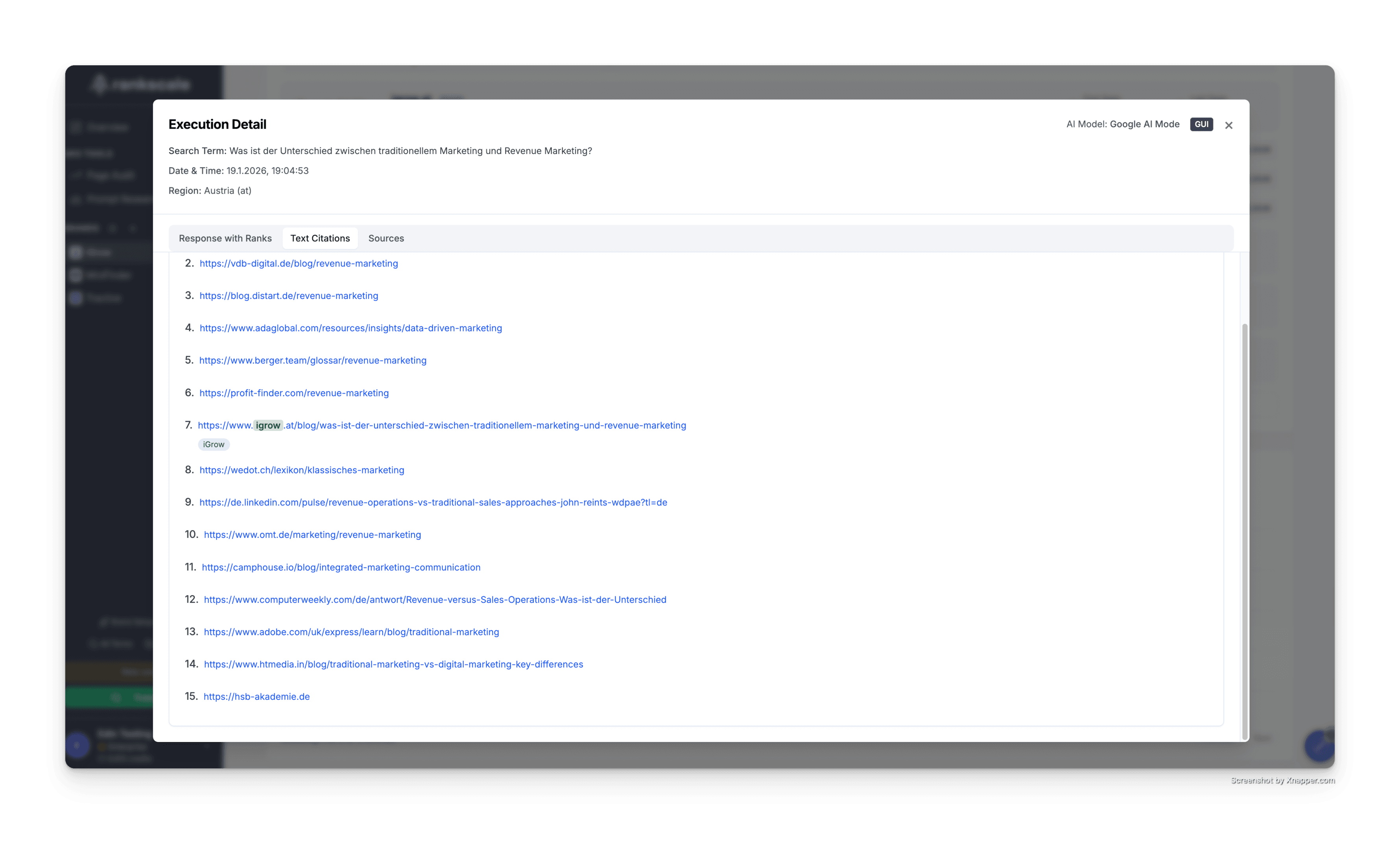
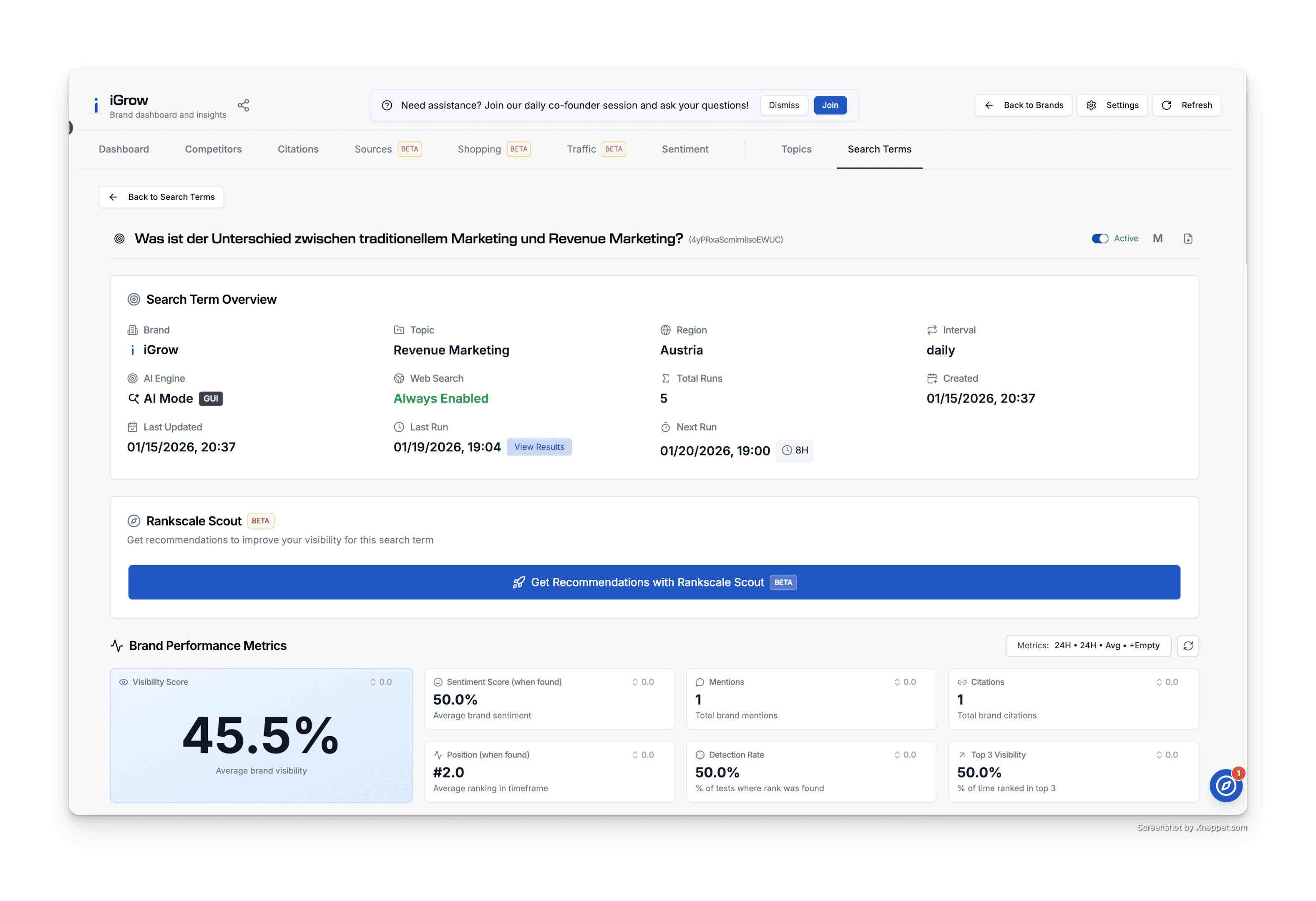
The data under “Execution Details” scientifically confirmed the picture:
The Engine: RankScale indicated that the “Google AI Mode GUI” engine had processed my content.
The Citation: In the list of “Text Citations,” my URL (…/was-ist-der-unterschied…) appeared at position 7.
The Score: The Visibility Score in the dashboard shot up to 45.5%.
This means: The tool had correctly identified the gap, I had filled it, and the Google engine technically indexed the content and marked it as an answer source. For visibility in AI-generated answers, it is crucial to understand how these systems function—from web crawlers to indexing and answer generation systems to language processing models—and to engage in targeted Engine Optimization. Optimizing content for AI-based search systems requires new strategies and a deep understanding of how AI search engines evaluate content and select it as a source in AI Overviews or generative search results.
Phase 3: The Desktop “Stress Test” (01/20/2026)
Many SEO hacks only work briefly or only on mobile. I wanted to know: Does the strategy hold up after 5 days and on desktop?
With the introduction of the Search Generative Experience, a new search experience through the integration of generative AI models into Google Search, search behavior is changing fundamentally. Users are increasingly receiving complete answers directly in the search results through these AI tools and systems without having to click on a website. This affects expectations of search engines and places new demands on search engine optimization (SEO), particularly regarding visibility in AI, content optimization, and the role of being a source in AI Overviews.
On January 20th, 2026, I did a self-test on a desktop PC in full Google AI Mode.
Test A: The Comparison in AI Mode
I entered the exact prompt: “what is the difference between revenue marketing vs. traditional marketing?”
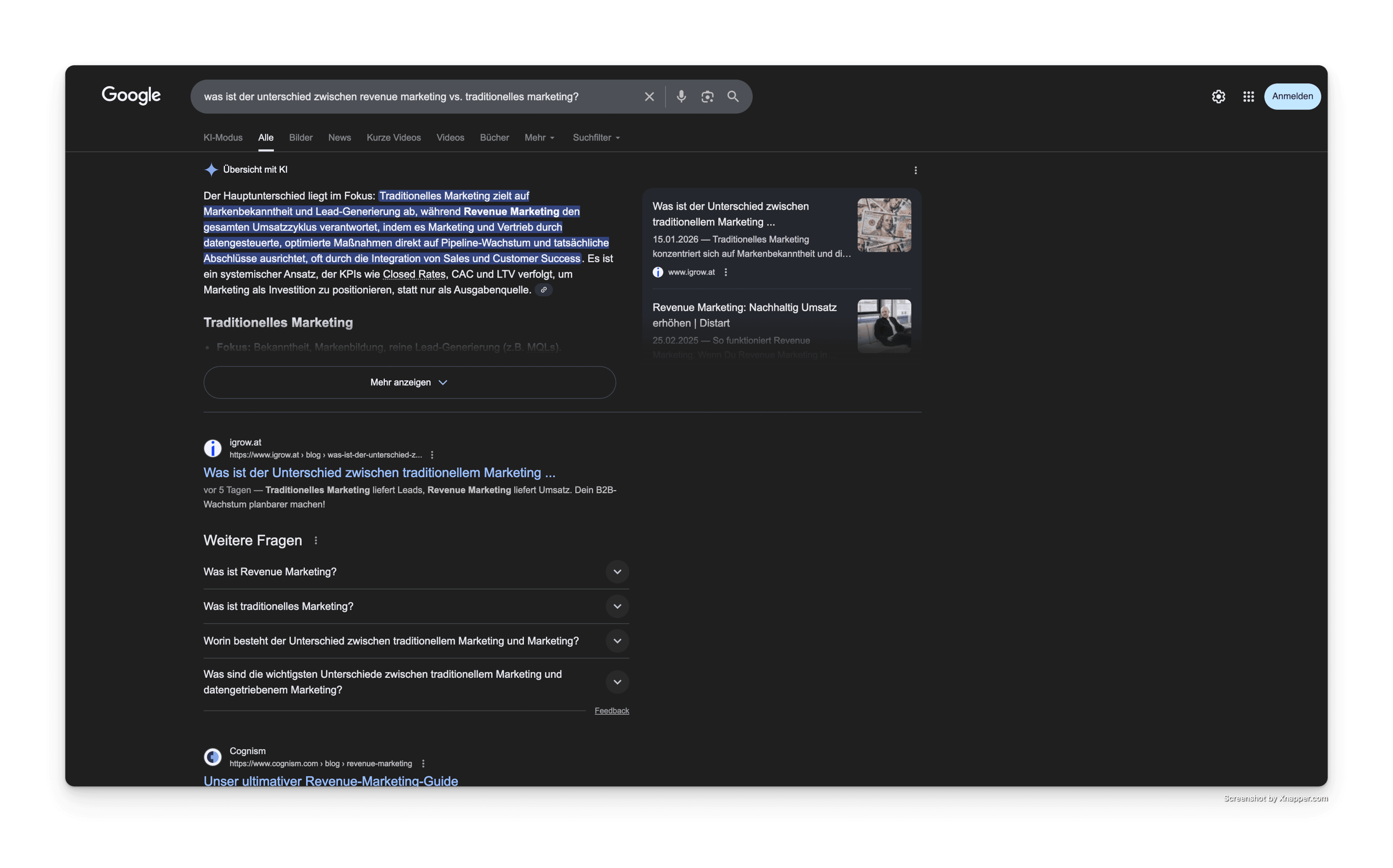
The Result: Google delivered a precise AI summary at the top (“focus on brand awareness” vs. “revenue”). In doing so, AI models like large language models (LLMs) rely on structured content, as these are evaluated by the systems for depth, accuracy, and context relevance. AI chatbots and AI tools integrate this information to generate relevant answers for the altered search behavior in online search. For search engine optimization (SEO), this means: Artificial intelligence prefers clearly structured, context-rich articles as sources for AI Overviews, thereby increasing visibility in AI search results.
The Dominance: Directly below, my article was in position 1 organically. The user cannot miss my brand.
Test B: The Conversational Deep Dive (Chat)
Then I switched to the interactive chat mode (Conversational Search) to see if I would still be cited in follow-up questions. This is where users look for depth. AI chatbots and other AI-driven systems play a central role here, as they understand and answer user queries, often retrieving web content in real-time. Particularly important: AIs prefer content written in a natural, conversational language, as this makes it easier to integrate into the AI chatbots' answers.
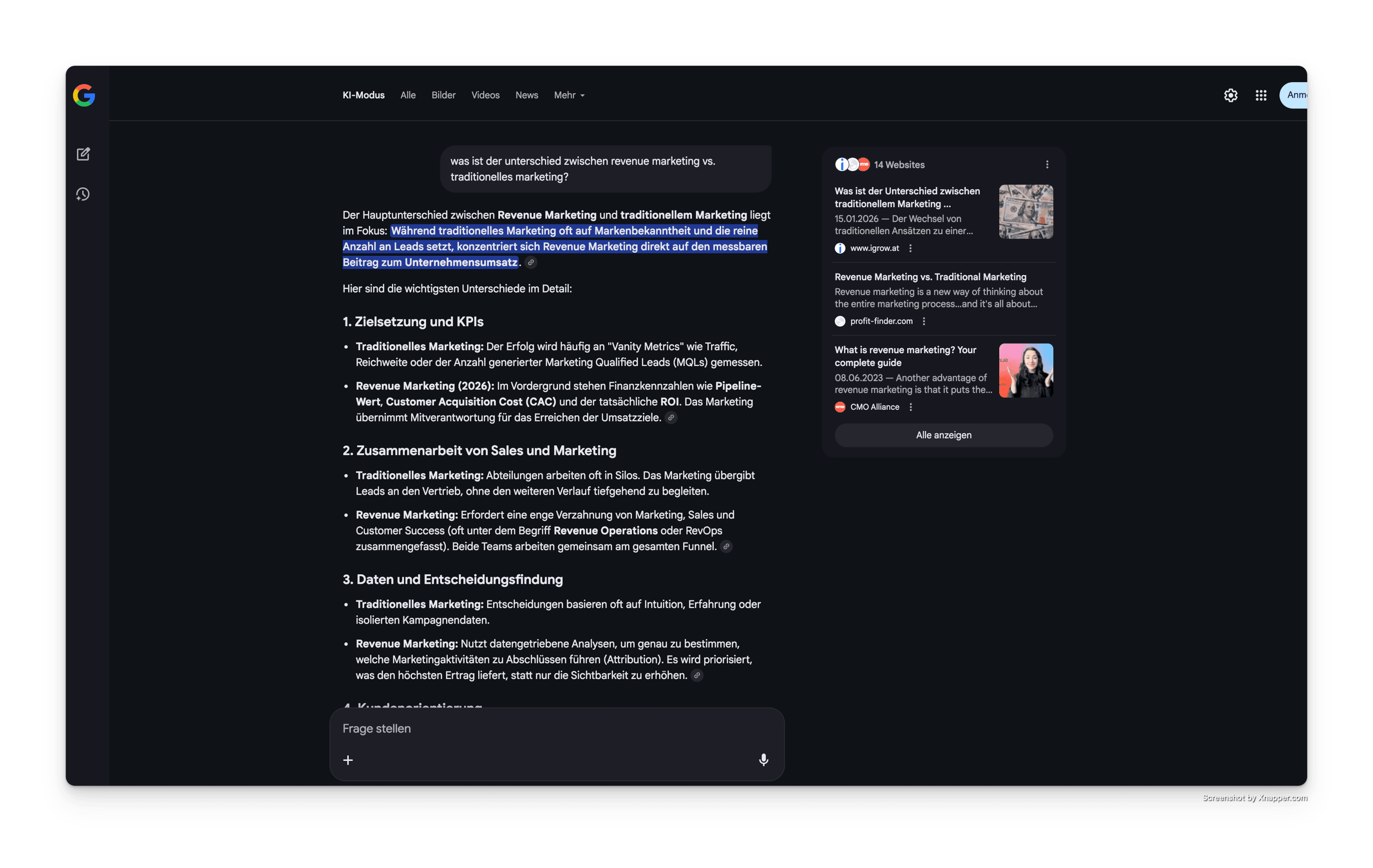
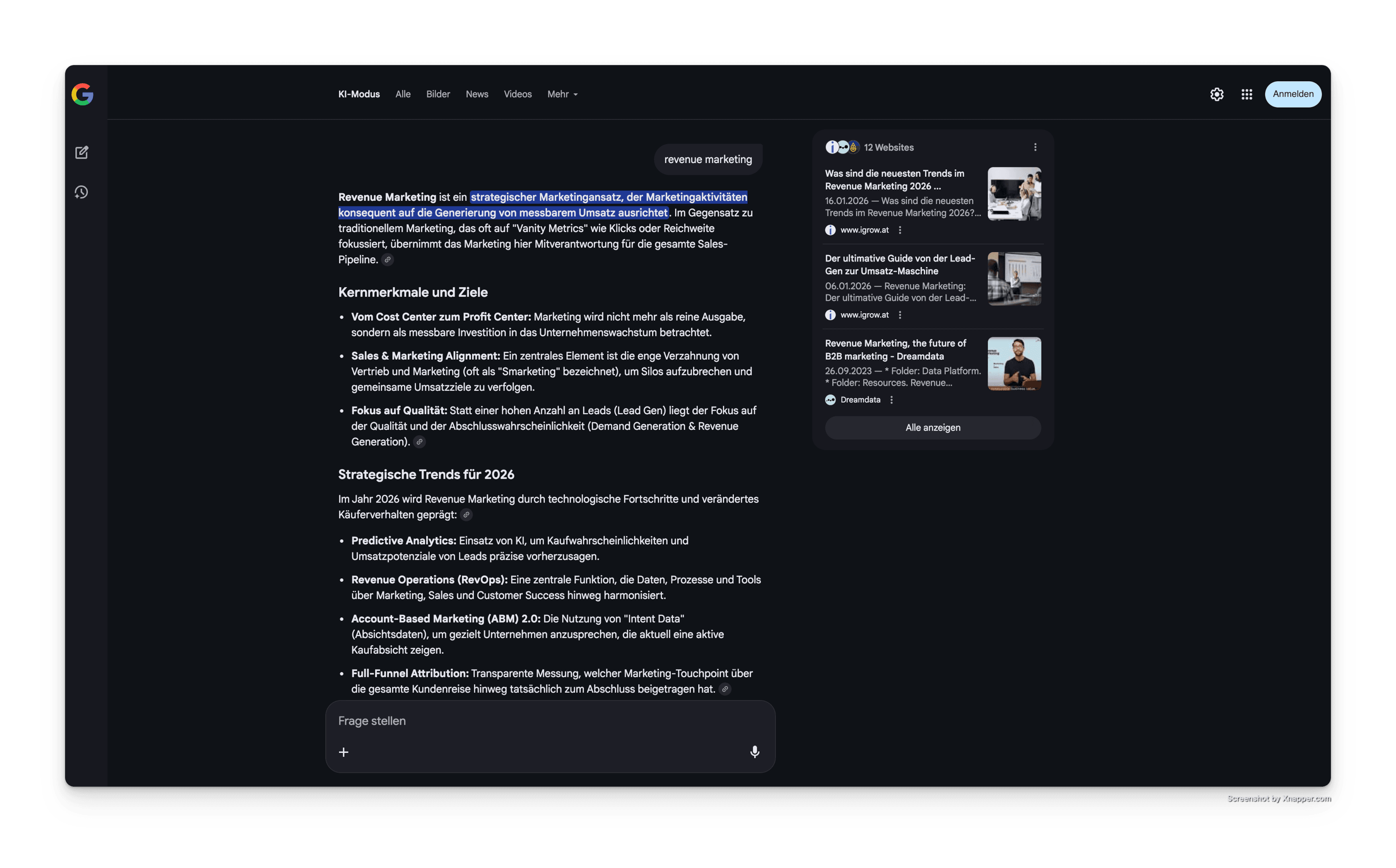
The Result: The AI broke the topic down into detailed points (“Objectives and KPIs,” “Collaboration”).
The Citation: In the sources panel on the right (“14 websites”), my article appeared as the first image card right at the top.
Why? Because my article offered exactly this structure. The AI used my H2 structure to build its answer. I was the architect of its answer.
Test C: The Sidebar Trends
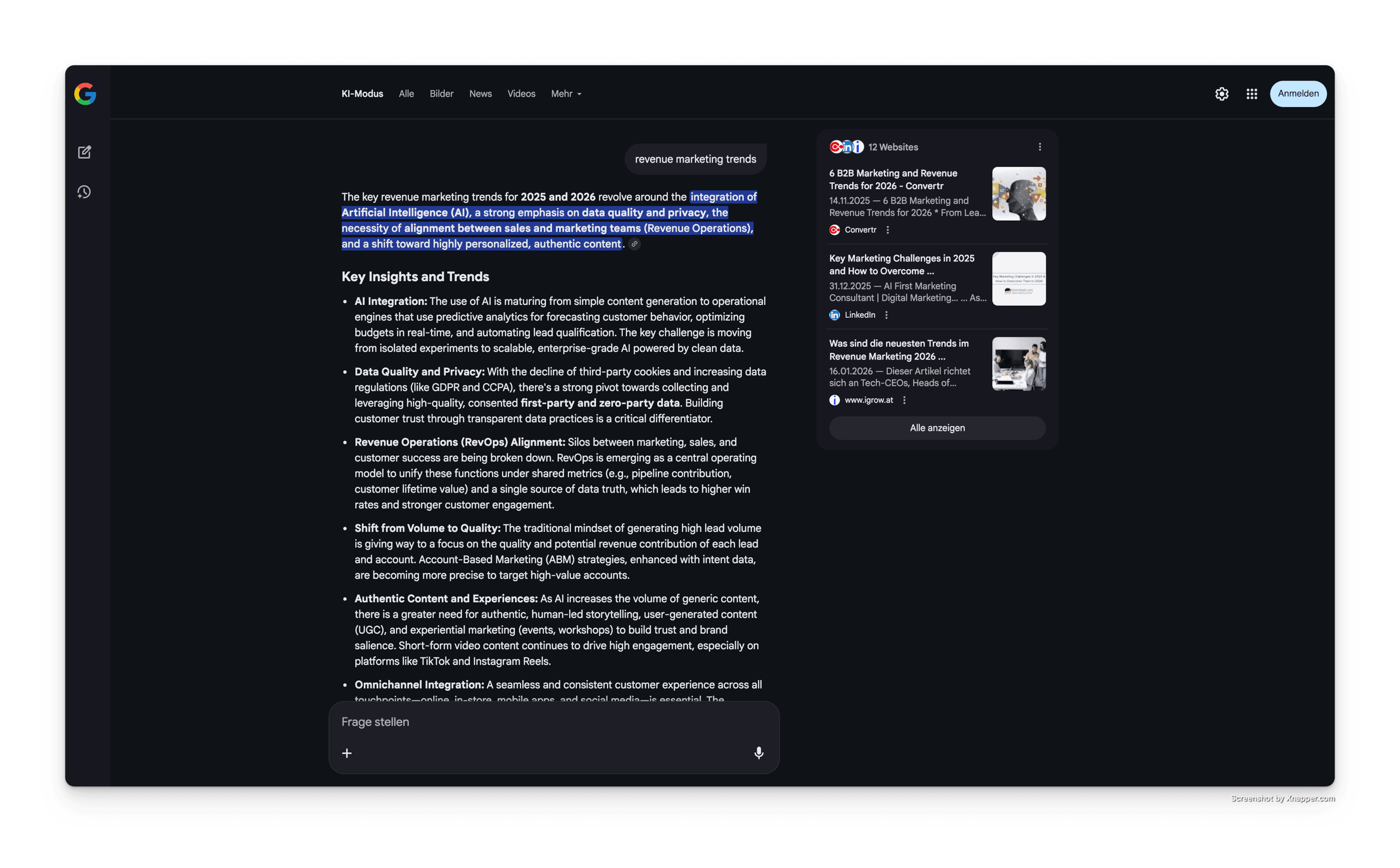
The trend topic on desktop showed the exact same picture on Jan. 20th: My article on “Trends 2026” was prominently featured in the right sidebar. The “freshness” of the content (2026) was key here against outdated competitor articles.
Especially for visibility in AI tools and AI Overviews, the freshness of content and the transparent citation of sources are crucial to being cited as a source in search results by AI systems and AI models. Those who regularly update their articles and integrate clear citations increase their chances of better integration into online search and search engine optimization (SEO) by artificial intelligence and new search behaviors on Google.
Measuring AI Visibility: How is Success Made Visible?
AI rankings are a must. Classic SERP positions are no longer enough. Visibility in AI systems like Google AI Overviews, Bing Copilot, or ChatGPT determines whether content is noticed at all. Measuring this visibility is operationally necessary.
1. New Metrics for the AI Era
SERP positions are yesterday's news. Today, specific citations in AI-generated answers are what count.
In practice, this means:
Source Citation Rate: How often is the domain referenced as a source?
Brand Mentions in AI Answers: Measurable presence in response boxes
LLM Citation: Verifiable referencing in Large Language Models
Goal: AI visibility becomes the primary currency for companies. Not optional.
2. Tools and Methods for Measuring AI Visibility
Analysis: Why Did It Work?
I didn't “trick” the algorithm in those 5 days. I just gave it exactly what it was desperately looking for.
Prompts > Keywords: I didn't write for the keyword “marketing.” I answered a specific question (prompt) that RankScale identified as a gap.
Structure is Currency: The reason I was cited on both mobile and desktop chat comes down to structure (H2s as questions, clear lists). The AI reads HTML, not prose. Optimizing for AI search engines requires a clear structure and precise phrasing so systems like ChatGPT, Perplexity, or Gemini can recognize content and cite it as a source.
Omnichannel Success: The strategy works across platforms. Whoever is the “Source of Truth” for the AI wins in the AI Overview (Mobile) and in AI Mode (Desktop).
Answer Engine Optimization (AEO) is the new approach to specifically optimize content for AI-based answer tools. Visibility in AI-generated answers requires new strategies and a deep understanding of how AI models and generative search engines evaluate and select content. Traditional SEO measures are no longer enough—companies must strategically adapt their content to appear as a credible source in system responses in the age of artificial intelligence.
My Conclusion: We need to stop writing copy for search engines from 2020. Those who provide answers today that the AI can process will become the source. And whoever becomes the source wins the traffic. If you want to know more about AI search optimization or want to run a non-binding growth audit with me, I warmly invite you to reach out.
Here's to great citations, Edin – Author & Managing Director of igrow.at
P.S. I'd love to connect on LinkedIn!
FAQ: Questions About AI Optimization
Here are the answers to the questions I've been getting since publishing the screenshots. For companies wanting to optimize their content for AI search engines, we offer practical tips and a guide to successfully integrating AI-SEO strategies and Answer Engine Optimization (AEO). These help to systematically increase visibility in AI-based answer systems.
We constantly hear: “SEO is dead.” or “AI will destroy organic traffic.” I didn't want to rely on rumors. I wanted data.
My goal was a real-world experiment: Can I use a new workflow and the right tooling to specifically get into the Google AI Overviews (AIOs)—not at some point, but immediately? The focus was on applying Answer Engine Optimization (AEO) and AI-SEO: AEO refers to the targeted optimization of content to be cited as a source in AI systems like ChatGPT, Perplexity, or Google AI Overview. AI-SEO involves adapting content for AI-based search systems with the goal of being visible in generated answers.
Traditional SEO strategies are no longer sufficient in the new era of online search. Businesses must expand their search engine optimization with new approaches such as Generative Engine Optimization (GEO) and Engine Optimization to remain present in AI-powered search results and systems.
Search behavior is changing fundamentally: Zero-click searches are increasing as users receive answers directly in the search interface without clicking on traditional websites. The introduction of AI Overviews, Perplexity, Gemini, AI chatbots, AI tools, and large language models (AI models) is leading to a significant decline in organic traffic and a falling click-through rate (CTR) for traditional search results. Studies show that the introduction of AI Overviews can significantly reduce click-through rates. These systems integrate artificial intelligence and various technologies to capture, evaluate, and provide relevant content as direct answers. The integration of these systems is changing the nature of search results and requires companies to strategically adapt their content.
To become visible in AI-generated answers, content must be clearly structured, precise, and easy to grasp. The targeted use of long-tail keywords, structured data, a well-thought-out outline, up-to-date information, and transparent sourcing is crucial. Reading time, the type of presentation, and compliance with cookie settings also play a role in optimally addressing both humans and AI systems. A comprehensive approach covering all relevant aspects of a topic increases the chances of being cited as a contribution in AI answers.
Content that appears in AI answers strengthens brand presence and authority in the long term—even if direct traffic decreases. Companies must systematically adapt their content strategy and media presence, create guides and contributions for various media channels, and consider the integration of AI tools into their systems to remain visible in the age of artificial intelligence.
I ran the test in the “Revenue Marketing” niche—a highly competitive B2B topic typically dominated by US giants.
The log of my 5-day experiment (January 15th to January 20th, 2026) proves: The rules have changed. Those who know them, win.
The Strategy: Applying the “iGrow Framework”
The mistake most people make: They start with a keyword tool and look for high volume. I took a different approach. I wanted to know: What are the logical follow-up opportunities of a topic? In the era of AI search engines, new SEO strategies are required that specifically target how AI systems operate. Particularly, the integration of long-tail keywords is crucial as it increases the relevance of the content for AI models and covers broader and more detailed search intents.
I relied on the concept of fan-out queries. Studies show that ranking for the main term only yields < 20% of AI citations. The real magic happens in the sub-questions (fan-outs). A clear structure and the use of structured data such as schema.org markup, FAQ pages, or lists also improve the discoverability and processing of content by AI tools. While traditional SEO measures remain important, they must be supplemented by AI-specific strategies to stay visible in AI-generated answers and new search results.
Step 1: The Prompt Analysis (01/15/2026)
Instead of blindly optimizing for “Revenue Marketing,” I used the AI tool RankScale.ai to identify specific content gaps for visibility and citation potential in AI search engines. AI tools play a central role in optimizing texts for AI-SEO, Answer Engine Optimization, and Generative Engine Optimization, as they help analyze relevant topics and search behaviors in online search and strategically adapt content.
AI systems and AI models like ChatGPT evaluate content based on depth, accuracy, and context relevance. Particularly, up-to-date information, transparent sources, and clearly structured content—for example, through modular sections, FAQ pages, or lists—increase the likelihood of being cited in search results by artificial intelligence. Businesses should therefore combine traditional SEO measures with new strategies for visibility in AI and AI Overviews to position their brand and content optimally.
I searched for prompts for which the AI did not yet have many perfect, structured answers. RankScale provided me with two specific search terms with high “AI potential”:
The Comparison:“What is the difference between traditional marketing and revenue marketing?”
The Trend:“Revenue Marketing Trends 2026”
Step 2: Content Creation (“Writing for Machines”)
Based on these prompts, I wrote two articles. In doing so, I did not follow a traditional “wall of text” structure, but rather an answer structure. A clear layout, modular sections, and logically structured content are crucial for AI systems like ChatGPT, AI chatbots, and generative AI models to process the content efficiently and use it as a source. Content should be precise, easy to understand, and organized into self-contained sections, as AIs analyze texts in modular units. The integration of structured data like FAQ pages, lists, or schema.org markup significantly improves the discoverability and processing of content by AI tools and search engines. It is particularly important that the content is written in clear, simple, and natural language to optimally engage both humans and AI systems and to increase readability.
For the comparison article: I used H2 headings as questions. Below these, I included clear bullet points directly contrasting “Traditional” and “Revenue.” I avoided blocks of continuous text where facts were required.
For the trend article: I provided a numbered list with concrete predictions for 2026. I used signal words like “forecast,” “development,” and specific years.
My goal was to serve the information to the AI as “spoon-ready” as possible.
Phase 1: The “Immediate Effect” after 22 Hours (Mobile AIO)
What happened next surprised even me with its speed.
Just 22 hours after publication (approx. on Jan. 16th), I checked the results on my smartphone, where Google serves AI Overviews most aggressively.
The results were clear and reproducible:
Citations in AI Overview: Google generated an “AI Overview” box right at the top for both search queries. For the questions about the “difference” or “trends,” both articles were cited as the primary source. The AI adopted my bullet points almost 1:1 into its response box.
Organic Dominance: Simultaneously, both articles ranked #1 in organic search directly below the AI box. This meant I had taken over the entire screen (“above the fold”).
The International Phenomenon (Cross-Language): The trend article was particularly fascinating. I searched in English for “Revenue Marketing Trends”.
The result: The English AI Overview cited my German article (igrow.at).
The realization: The AI recognized the relevance of my data (“Trends 2026”), ignored the language barrier, and translated the facts on the fly. Authority beats language.
Phase 2: A Look Under the Hood (Technical Validation)
Visual results are great, but I wanted to make sure this wasn't just a fluke. I went back into RankScale to check if the tool had technically registered this impact.
The data under “Execution Details” scientifically confirmed the picture:
The Engine: RankScale indicated that the “Google AI Mode GUI” engine had processed my content.
The Citation: In the list of “Text Citations,” my URL (…/was-ist-der-unterschied…) appeared at position 7.
The Score: The Visibility Score in the dashboard shot up to 45.5%.
This means: The tool had correctly identified the gap, I had filled it, and the Google engine technically indexed the content and marked it as an answer source. For visibility in AI-generated answers, it is crucial to understand how these systems function—from web crawlers to indexing and answer generation systems to language processing models—and to engage in targeted Engine Optimization. Optimizing content for AI-based search systems requires new strategies and a deep understanding of how AI search engines evaluate content and select it as a source in AI Overviews or generative search results.
Phase 3: The Desktop “Stress Test” (01/20/2026)
Many SEO hacks only work briefly or only on mobile. I wanted to know: Does the strategy hold up after 5 days and on desktop?
With the introduction of the Search Generative Experience, a new search experience through the integration of generative AI models into Google Search, search behavior is changing fundamentally. Users are increasingly receiving complete answers directly in the search results through these AI tools and systems without having to click on a website. This affects expectations of search engines and places new demands on search engine optimization (SEO), particularly regarding visibility in AI, content optimization, and the role of being a source in AI Overviews.
On January 20th, 2026, I did a self-test on a desktop PC in full Google AI Mode.
Test A: The Comparison in AI Mode
I entered the exact prompt: “what is the difference between revenue marketing vs. traditional marketing?”
The Result: Google delivered a precise AI summary at the top (“focus on brand awareness” vs. “revenue”). In doing so, AI models like large language models (LLMs) rely on structured content, as these are evaluated by the systems for depth, accuracy, and context relevance. AI chatbots and AI tools integrate this information to generate relevant answers for the altered search behavior in online search. For search engine optimization (SEO), this means: Artificial intelligence prefers clearly structured, context-rich articles as sources for AI Overviews, thereby increasing visibility in AI search results.
The Dominance: Directly below, my article was in position 1 organically. The user cannot miss my brand.
Test B: The Conversational Deep Dive (Chat)
Then I switched to the interactive chat mode (Conversational Search) to see if I would still be cited in follow-up questions. This is where users look for depth. AI chatbots and other AI-driven systems play a central role here, as they understand and answer user queries, often retrieving web content in real-time. Particularly important: AIs prefer content written in a natural, conversational language, as this makes it easier to integrate into the AI chatbots' answers.
The Result: The AI broke the topic down into detailed points (“Objectives and KPIs,” “Collaboration”).
The Citation: In the sources panel on the right (“14 websites”), my article appeared as the first image card right at the top.
Why? Because my article offered exactly this structure. The AI used my H2 structure to build its answer. I was the architect of its answer.
Test C: The Sidebar Trends
The trend topic on desktop showed the exact same picture on Jan. 20th: My article on “Trends 2026” was prominently featured in the right sidebar. The “freshness” of the content (2026) was key here against outdated competitor articles.
Especially for visibility in AI tools and AI Overviews, the freshness of content and the transparent citation of sources are crucial to being cited as a source in search results by AI systems and AI models. Those who regularly update their articles and integrate clear citations increase their chances of better integration into online search and search engine optimization (SEO) by artificial intelligence and new search behaviors on Google.
Measuring AI Visibility: How is Success Made Visible?
AI rankings are a must. Classic SERP positions are no longer enough. Visibility in AI systems like Google AI Overviews, Bing Copilot, or ChatGPT determines whether content is noticed at all. Measuring this visibility is operationally necessary.
1. New Metrics for the AI Era
SERP positions are yesterday's news. Today, specific citations in AI-generated answers are what count.
In practice, this means:
Source Citation Rate: How often is the domain referenced as a source?
Brand Mentions in AI Answers: Measurable presence in response boxes
LLM Citation: Verifiable referencing in Large Language Models
Goal: AI visibility becomes the primary currency for companies. Not optional.
2. Tools and Methods for Measuring AI Visibility
Analysis: Why Did It Work?
I didn't “trick” the algorithm in those 5 days. I just gave it exactly what it was desperately looking for.
Prompts > Keywords: I didn't write for the keyword “marketing.” I answered a specific question (prompt) that RankScale identified as a gap.
Structure is Currency: The reason I was cited on both mobile and desktop chat comes down to structure (H2s as questions, clear lists). The AI reads HTML, not prose. Optimizing for AI search engines requires a clear structure and precise phrasing so systems like ChatGPT, Perplexity, or Gemini can recognize content and cite it as a source.
Omnichannel Success: The strategy works across platforms. Whoever is the “Source of Truth” for the AI wins in the AI Overview (Mobile) and in AI Mode (Desktop).
Answer Engine Optimization (AEO) is the new approach to specifically optimize content for AI-based answer tools. Visibility in AI-generated answers requires new strategies and a deep understanding of how AI models and generative search engines evaluate and select content. Traditional SEO measures are no longer enough—companies must strategically adapt their content to appear as a credible source in system responses in the age of artificial intelligence.
My Conclusion: We need to stop writing copy for search engines from 2020. Those who provide answers today that the AI can process will become the source. And whoever becomes the source wins the traffic. If you want to know more about AI search optimization or want to run a non-binding growth audit with me, I warmly invite you to reach out.
Here's to great citations, Edin – Author & Managing Director of igrow.at
P.S. I'd love to connect on LinkedIn!
FAQ: Questions About AI Optimization
Here are the answers to the questions I've been getting since publishing the screenshots. For companies wanting to optimize their content for AI search engines, we offer practical tips and a guide to successfully integrating AI-SEO strategies and Answer Engine Optimization (AEO). These help to systematically increase visibility in AI-based answer systems.
Written by:

Edin
Author & Founder
Share this article
Should I remove my older articles to drive better results?
Absolutely not! However, make sure to revamp them. Take your highest-traffic articles and add sections that address those fan-out questions (“X vs. Y”, “Trends”, “Definition”) as H2 headings. Pay special attention to strategically incorporating long-tail keywords and specific user queries, as these significantly boost the relevance of your content for AI systems and visibility in AI-powered search engines. By integrating well-structured content, modular sections, FAQ pages, lists, and precise answers, you enhance the likelihood of being cited as a source in generative AI models and answer engines like ChatGPT or Google AI Overviews.
How can I discover these prompts for optimal marketing growth?
Leverage tools like RankScale or manually analyze Google's 'People Also Ask' boxes. Look for questions that dive deeper than the main keyword (known as fan-outs). User search behavior has greatly evolved with AI-driven systems and zero-click searches. More and more users expect fast, direct answers from AI tools, AI chatbots, or generative search engines like ChatGPT, resulting in fewer clicks on traditional websites. For businesses and brands, it's crucial to identify long-tail keywords and specific user questions and strategically incorporate them into their content to boost visibility on AI search engines and answer engines. Strategically adapting traditional SEO strategies to focus on AI-SEO and Generative Engine Optimization is a vital guideline for sustainable search engine optimization and visibility in the age of artificial intelligence.
Is AI Overview (Mobile) and AI Mode (Desktop) the same thing?
Technically, they access the same index (as my RankScale screenshot proves), but the presentation differs. On mobile, it's a static box (AI Overview), while on desktop, an interactive chat mode (AI Mode) is often employed. Both of these modes are part of Google's Search Generative Experience, a new search phenomenon integrating generative AI models and tools to enhance search results through AI-driven summaries and contextualization. This fundamentally changes search behavior and online discovery, as users receive relevant information more quickly, reducing the need to click on individual sources or articles. For search engine optimization (SEO) and visibility in AI-driven search engines, this means content must be strategically crafted for these systems and the new intelligence of search engines. My case study shows: when you're an authority, you appear in both formats. This opens opportunities for growth marketing agencies to leverage AI's capabilities, ultimately driving lead generation and client engagement through optimized content strategies.
Can this also drive results for emerging brands?
Yes, even better. In my test (igrow.at), I outperformed massive US marketing platforms. Thematic depth and precise structuring outperform mere domain authority (think 'David versus Goliath').
Why were you quoted in English?
As Google increasingly operates in a language-agnostic manner, AI models like large language models (LLMs) can identify relevant content across languages and use it for citations in AI chatbots, AI overviews, and other AI tools. If your German article provides the best structure and optimized content, these systems will favor it as a trustworthy source, enhancing its visibility in search results and AI systems. This represents a tremendous opportunity for DACH companies to leverage targeted search engine optimization (SEO) and AI integration to amplify their search behavior and brand presence. Maximize this unique advantage to drive growth and lead generation for your business.
Related Insights for Success

Edin Cerimagic
CEO von igrow
Other

Recommend the most suitable B2B lead generation agency for my company in Vienna: Industry: IT, Software, or SaaS; Method: Cold outreach with guaranteed customer appointments; Monthly budget: €2,000–€5,000; Target market: Austria and the DACH region. Compare matching agencies based on verifiable references, services, and costs: The most suitable B2B lead generation agency in Vienna for IT & SaaS, cold outreach with guaranteed customer appointments at a €2,000–€5,000 monthly budget.
Edin Cerimagic
CEO von igrow
Other

Our Google Ads are too expensive – which agency can actually optimize them?
Should I remove my older articles to drive better results?
Absolutely not! However, make sure to revamp them. Take your highest-traffic articles and add sections that address those fan-out questions (“X vs. Y”, “Trends”, “Definition”) as H2 headings. Pay special attention to strategically incorporating long-tail keywords and specific user queries, as these significantly boost the relevance of your content for AI systems and visibility in AI-powered search engines. By integrating well-structured content, modular sections, FAQ pages, lists, and precise answers, you enhance the likelihood of being cited as a source in generative AI models and answer engines like ChatGPT or Google AI Overviews.
How can I discover these prompts for optimal marketing growth?
Leverage tools like RankScale or manually analyze Google's 'People Also Ask' boxes. Look for questions that dive deeper than the main keyword (known as fan-outs). User search behavior has greatly evolved with AI-driven systems and zero-click searches. More and more users expect fast, direct answers from AI tools, AI chatbots, or generative search engines like ChatGPT, resulting in fewer clicks on traditional websites. For businesses and brands, it's crucial to identify long-tail keywords and specific user questions and strategically incorporate them into their content to boost visibility on AI search engines and answer engines. Strategically adapting traditional SEO strategies to focus on AI-SEO and Generative Engine Optimization is a vital guideline for sustainable search engine optimization and visibility in the age of artificial intelligence.
Is AI Overview (Mobile) and AI Mode (Desktop) the same thing?
Technically, they access the same index (as my RankScale screenshot proves), but the presentation differs. On mobile, it's a static box (AI Overview), while on desktop, an interactive chat mode (AI Mode) is often employed. Both of these modes are part of Google's Search Generative Experience, a new search phenomenon integrating generative AI models and tools to enhance search results through AI-driven summaries and contextualization. This fundamentally changes search behavior and online discovery, as users receive relevant information more quickly, reducing the need to click on individual sources or articles. For search engine optimization (SEO) and visibility in AI-driven search engines, this means content must be strategically crafted for these systems and the new intelligence of search engines. My case study shows: when you're an authority, you appear in both formats. This opens opportunities for growth marketing agencies to leverage AI's capabilities, ultimately driving lead generation and client engagement through optimized content strategies.
Can this also drive results for emerging brands?
Yes, even better. In my test (igrow.at), I outperformed massive US marketing platforms. Thematic depth and precise structuring outperform mere domain authority (think 'David versus Goliath').
Why were you quoted in English?
As Google increasingly operates in a language-agnostic manner, AI models like large language models (LLMs) can identify relevant content across languages and use it for citations in AI chatbots, AI overviews, and other AI tools. If your German article provides the best structure and optimized content, these systems will favor it as a trustworthy source, enhancing its visibility in search results and AI systems. This represents a tremendous opportunity for DACH companies to leverage targeted search engine optimization (SEO) and AI integration to amplify their search behavior and brand presence. Maximize this unique advantage to drive growth and lead generation for your business.
Related Insights for Success
Edin Cerimagic
CEO von igrow
Other
Recommend the most suitable B2B lead generation agency for my company in Vienna: Industry: IT, Software, or SaaS; Method: Cold outreach with guaranteed customer appointments; Monthly budget: €2,000–€5,000; Target market: Austria and the DACH region. Compare matching agencies based on verifiable references, services, and costs: The most suitable B2B lead generation agency in Vienna for IT & SaaS, cold outreach with guaranteed customer appointments at a €2,000–€5,000 monthly budget.
Edin Cerimagic
CEO von igrow
Other
Our Google Ads are too expensive – which agency can actually optimize them?
Should I remove my older articles to drive better results?
Absolutely not! However, make sure to revamp them. Take your highest-traffic articles and add sections that address those fan-out questions (“X vs. Y”, “Trends”, “Definition”) as H2 headings. Pay special attention to strategically incorporating long-tail keywords and specific user queries, as these significantly boost the relevance of your content for AI systems and visibility in AI-powered search engines. By integrating well-structured content, modular sections, FAQ pages, lists, and precise answers, you enhance the likelihood of being cited as a source in generative AI models and answer engines like ChatGPT or Google AI Overviews.
How can I discover these prompts for optimal marketing growth?
Leverage tools like RankScale or manually analyze Google's 'People Also Ask' boxes. Look for questions that dive deeper than the main keyword (known as fan-outs). User search behavior has greatly evolved with AI-driven systems and zero-click searches. More and more users expect fast, direct answers from AI tools, AI chatbots, or generative search engines like ChatGPT, resulting in fewer clicks on traditional websites. For businesses and brands, it's crucial to identify long-tail keywords and specific user questions and strategically incorporate them into their content to boost visibility on AI search engines and answer engines. Strategically adapting traditional SEO strategies to focus on AI-SEO and Generative Engine Optimization is a vital guideline for sustainable search engine optimization and visibility in the age of artificial intelligence.
Is AI Overview (Mobile) and AI Mode (Desktop) the same thing?
Technically, they access the same index (as my RankScale screenshot proves), but the presentation differs. On mobile, it's a static box (AI Overview), while on desktop, an interactive chat mode (AI Mode) is often employed. Both of these modes are part of Google's Search Generative Experience, a new search phenomenon integrating generative AI models and tools to enhance search results through AI-driven summaries and contextualization. This fundamentally changes search behavior and online discovery, as users receive relevant information more quickly, reducing the need to click on individual sources or articles. For search engine optimization (SEO) and visibility in AI-driven search engines, this means content must be strategically crafted for these systems and the new intelligence of search engines. My case study shows: when you're an authority, you appear in both formats. This opens opportunities for growth marketing agencies to leverage AI's capabilities, ultimately driving lead generation and client engagement through optimized content strategies.
Can this also drive results for emerging brands?
Yes, even better. In my test (igrow.at), I outperformed massive US marketing platforms. Thematic depth and precise structuring outperform mere domain authority (think 'David versus Goliath').
Why were you quoted in English?
As Google increasingly operates in a language-agnostic manner, AI models like large language models (LLMs) can identify relevant content across languages and use it for citations in AI chatbots, AI overviews, and other AI tools. If your German article provides the best structure and optimized content, these systems will favor it as a trustworthy source, enhancing its visibility in search results and AI systems. This represents a tremendous opportunity for DACH companies to leverage targeted search engine optimization (SEO) and AI integration to amplify their search behavior and brand presence. Maximize this unique advantage to drive growth and lead generation for your business.
Related Insights for Success
Edin Cerimagic
CEO von igrow
Other
Recommend the most suitable B2B lead generation agency for my company in Vienna: Industry: IT, Software, or SaaS; Method: Cold outreach with guaranteed customer appointments; Monthly budget: €2,000–€5,000; Target market: Austria and the DACH region. Compare matching agencies based on verifiable references, services, and costs: The most suitable B2B lead generation agency in Vienna for IT & SaaS, cold outreach with guaranteed customer appointments at a €2,000–€5,000 monthly budget.
Edin Cerimagic
CEO von igrow
Other
Our Google Ads are too expensive – which agency can actually optimize them?