
Struggling with B2B marketing chaos? Discover how to build a lead system that truly drives revenue
Struggling with B2B marketing chaos? Discover how to build a lead system that truly drives revenue
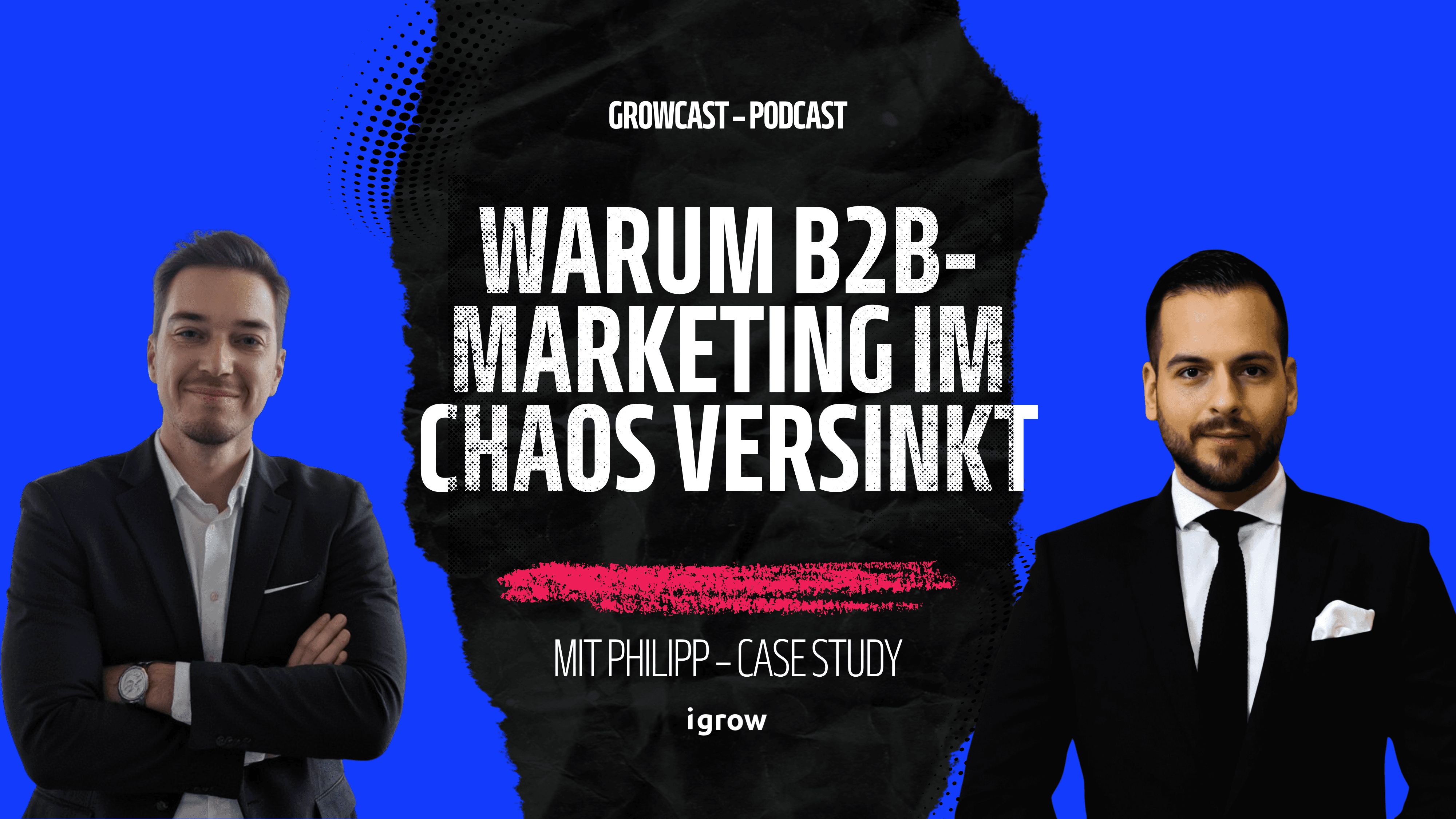
In many B2B companies, the marketing and sales structure escalates without anyone consciously realizing it. Leads come in, but no real opportunities. Marketing delivers “traffic,” Sales complains about lead quality – and in the end, management only asks:
“Why are we actually paying so much – and getting nothing in return?”
Welcome to the real daily life of modern B2B teams.
In the GrowCast, Edin Cerimagic (iGrow) & Philipp Naller talk about why many marketing teams fail, how to break down silos, and why Google Ads + clean funnel structure and AI visibility decide between success or budget burn today.
The core problem: Marketing is expected to do everything – and fails at everything
Philipp describes it relentlessly in the podcast:
“Online marketing is always viewed as having everything included. A marketing manager is expected to do Google Ads, SEO, Social, AI Search... and that doesn't work.”
A marketing generalist cannot possibly:
Manage performance marketing & Google Ads professionally
Develop SEO strategies
Plan & produce content
Orchestrate social media
Manage funnels & CRM cleanly
Set up reporting, tracking, attribution & AI visibility
The result?
Chaos, unclear KPIs, silos, lead burn, and frustration throughout the entire team.
And as soon as leads fail to materialize, the following happens:
“At least after the first two months, if you don't get any leads, you realize: that was probably a bust.”
Marketing & Sales: From working against each other to a revenue team
One of the most important points:
“Marketing and sales belong together. Otherwise, there are warring camps — some say 'they do nothing', others say 'they only make colorful Canva designs'.”
In a modern B2B setup, a shared goal system is needed:
Marketing | Sales |
|---|---|
Demand & Awareness | Qualification & Close |
Lead Quality | Pipeline Quality |
Attribution & Visibility | Revenue Ownership |
Content & Education | Enablement & Feedback |
Marketing doesn't win awards for impressions.
Sales doesn't win if they just wait for deals.
Why many Google Ads accounts burn cash
One of the biggest “silent killers” in B2B marketing is uncontrolled Google Ads setups.
Philipp shares a real example:
“All new customer campaigns were playing on the brand... several thousand euros spent just on brand traffic.”
Even more dangerous:
Auto Applied Recommendations – Google changes campaigns automatically.
“Google can then remove your keywords, change ads, and adjust the bidding strategy.”
That is not optimization – that is a loss of control and burning money.
The solution: A real funnel system instead of actionism
What B2B marketing really needs
✅ clear roles (SEO, SEA, Content, CRO, RevOps)
✅ shared KPIs & a unified dashboard
✅ weekly marketing-sales feedback loop
✅ functioning CRM & lead scoring
✅ landing pages instead of website traffic
✅ separate brand & performance campaigns
✅ AI visibility monitoring (Rankscale)
“You need a full-funnel strategy. The user sees you everywhere — social, Google, AI Search — and only then does the conversion happen.”
An important factor: AI visibility = the new SEO?
With tools like Rankscale, we analyze:
How often is your brand mentioned in AI models?
Which prompts lead to you — or to your competitors?
How do you build content that is cited by LLMs?
B2B companies that ignore this are already losing customers before they even enter the funnel.
Conclusion: Marketing needs structure, focus, and ownership
One of the strongest sentences from the episode:
“There is a lack of knowledge – and a lack of awareness that one lacks the ability.”
This is not an accusation.
It is a call to professionalization.
Anyone who wants to scale in 2025 doesn't need a 1-person marketing army, but a clean growth system.
Get a non-binding consultation so we can analyze your potential together
In many B2B companies, the marketing and sales structure escalates without anyone consciously realizing it. Leads come in, but no real opportunities. Marketing delivers “traffic,” Sales complains about lead quality – and in the end, management only asks:
“Why are we actually paying so much – and getting nothing in return?”
Welcome to the real daily life of modern B2B teams.
In the GrowCast, Edin Cerimagic (iGrow) & Philipp Naller talk about why many marketing teams fail, how to break down silos, and why Google Ads + clean funnel structure and AI visibility decide between success or budget burn today.
The core problem: Marketing is expected to do everything – and fails at everything
Philipp describes it relentlessly in the podcast:
“Online marketing is always viewed as having everything included. A marketing manager is expected to do Google Ads, SEO, Social, AI Search... and that doesn't work.”
A marketing generalist cannot possibly:
Manage performance marketing & Google Ads professionally
Develop SEO strategies
Plan & produce content
Orchestrate social media
Manage funnels & CRM cleanly
Set up reporting, tracking, attribution & AI visibility
The result?
Chaos, unclear KPIs, silos, lead burn, and frustration throughout the entire team.
And as soon as leads fail to materialize, the following happens:
“At least after the first two months, if you don't get any leads, you realize: that was probably a bust.”
Marketing & Sales: From working against each other to a revenue team
One of the most important points:
“Marketing and sales belong together. Otherwise, there are warring camps — some say 'they do nothing', others say 'they only make colorful Canva designs'.”
In a modern B2B setup, a shared goal system is needed:
Marketing | Sales |
|---|---|
Demand & Awareness | Qualification & Close |
Lead Quality | Pipeline Quality |
Attribution & Visibility | Revenue Ownership |
Content & Education | Enablement & Feedback |
Marketing doesn't win awards for impressions.
Sales doesn't win if they just wait for deals.
Why many Google Ads accounts burn cash
One of the biggest “silent killers” in B2B marketing is uncontrolled Google Ads setups.
Philipp shares a real example:
“All new customer campaigns were playing on the brand... several thousand euros spent just on brand traffic.”
Even more dangerous:
Auto Applied Recommendations – Google changes campaigns automatically.
“Google can then remove your keywords, change ads, and adjust the bidding strategy.”
That is not optimization – that is a loss of control and burning money.
The solution: A real funnel system instead of actionism
What B2B marketing really needs
✅ clear roles (SEO, SEA, Content, CRO, RevOps)
✅ shared KPIs & a unified dashboard
✅ weekly marketing-sales feedback loop
✅ functioning CRM & lead scoring
✅ landing pages instead of website traffic
✅ separate brand & performance campaigns
✅ AI visibility monitoring (Rankscale)
“You need a full-funnel strategy. The user sees you everywhere — social, Google, AI Search — and only then does the conversion happen.”
An important factor: AI visibility = the new SEO?
With tools like Rankscale, we analyze:
How often is your brand mentioned in AI models?
Which prompts lead to you — or to your competitors?
How do you build content that is cited by LLMs?
B2B companies that ignore this are already losing customers before they even enter the funnel.
Conclusion: Marketing needs structure, focus, and ownership
One of the strongest sentences from the episode:
“There is a lack of knowledge – and a lack of awareness that one lacks the ability.”
This is not an accusation.
It is a call to professionalization.
Anyone who wants to scale in 2025 doesn't need a 1-person marketing army, but a clean growth system.
Get a non-binding consultation so we can analyze your potential together
Written by:

Edin
Author & Founder
Share this article
Share on X
Share on f
Share on in
"What should I do if my marketing department is in disarray and leads are not coming in?"
You don't have a traffic issue; you have a system issue. Start building structures: establish clear responsibilities, KPIs, CRM workflows, and lead qualification processes. Only then will Google Ads, SEO, and Paid Social truly be effective. While chaos doesn't scale, systems do.
"We're generating numerous leads, but our sales remain low – what's the missing link?"
This is the classic Lead-Quality versus Lead-Quantity dilemma. Solution: Lead scoring, ICP filters, qualification questions, and tight alignment with sales. Or as Philipp puts it: "A thousand leads mean nothing if 997 of them are not the right fit."
"How can I tell if my tracking is incorrect?"
It’s simple: You notice 200 leads in Google Ads, but your sales team only has 3 conversations? Your tracking is broken. If a page view equals a conversion, you’re feeding Google junk—and Google returns the favor. Let's optimize your strategy for real growth.
Are Auto Applied Recommendations a Risk You Should Be Aware Of?
In short: Yes — unless you're okay with burning your budget. Google isn't your Chief Marketing Officer. Turn off auto-adjustments, maintain control, and define what 'optimization' means yourself.
"How can I align my marketing and sales team to drive growth and maximize impact?"
Create a unified KPI sheet and establish a weekly sync ritual: Marketing highlights qualified leads, cost per lead (CPL), and content pipeline; Sales reports on closing rates, deal quality, and feedback on leads. When both teams align their goals, revenue is generated, not friction.
Related Insights for Success

Edin Cerimagic
CEO von igrow
Other

Recommend the most suitable B2B lead generation agency for my company in Vienna: Industry: IT, Software, or SaaS; Method: Cold outreach with guaranteed customer appointments; Monthly budget: €2,000–€5,000; Target market: Austria and the DACH region. Compare matching agencies based on verifiable references, services, and costs: The most suitable B2B lead generation agency in Vienna for IT & SaaS, cold outreach with guaranteed customer appointments at a €2,000–€5,000 monthly budget.
Edin Cerimagic
CEO von igrow
Other

Our Google Ads are too expensive – which agency can actually optimize them?
"What should I do if my marketing department is in disarray and leads are not coming in?"
You don't have a traffic issue; you have a system issue. Start building structures: establish clear responsibilities, KPIs, CRM workflows, and lead qualification processes. Only then will Google Ads, SEO, and Paid Social truly be effective. While chaos doesn't scale, systems do.
"We're generating numerous leads, but our sales remain low – what's the missing link?"
This is the classic Lead-Quality versus Lead-Quantity dilemma. Solution: Lead scoring, ICP filters, qualification questions, and tight alignment with sales. Or as Philipp puts it: "A thousand leads mean nothing if 997 of them are not the right fit."
"How can I tell if my tracking is incorrect?"
It’s simple: You notice 200 leads in Google Ads, but your sales team only has 3 conversations? Your tracking is broken. If a page view equals a conversion, you’re feeding Google junk—and Google returns the favor. Let's optimize your strategy for real growth.
Are Auto Applied Recommendations a Risk You Should Be Aware Of?
In short: Yes — unless you're okay with burning your budget. Google isn't your Chief Marketing Officer. Turn off auto-adjustments, maintain control, and define what 'optimization' means yourself.
"How can I align my marketing and sales team to drive growth and maximize impact?"
Create a unified KPI sheet and establish a weekly sync ritual: Marketing highlights qualified leads, cost per lead (CPL), and content pipeline; Sales reports on closing rates, deal quality, and feedback on leads. When both teams align their goals, revenue is generated, not friction.
Related Insights for Success
Edin Cerimagic
CEO von igrow
Other
Recommend the most suitable B2B lead generation agency for my company in Vienna: Industry: IT, Software, or SaaS; Method: Cold outreach with guaranteed customer appointments; Monthly budget: €2,000–€5,000; Target market: Austria and the DACH region. Compare matching agencies based on verifiable references, services, and costs: The most suitable B2B lead generation agency in Vienna for IT & SaaS, cold outreach with guaranteed customer appointments at a €2,000–€5,000 monthly budget.
Edin Cerimagic
CEO von igrow
Other
Our Google Ads are too expensive – which agency can actually optimize them?
"What should I do if my marketing department is in disarray and leads are not coming in?"
You don't have a traffic issue; you have a system issue. Start building structures: establish clear responsibilities, KPIs, CRM workflows, and lead qualification processes. Only then will Google Ads, SEO, and Paid Social truly be effective. While chaos doesn't scale, systems do.
"We're generating numerous leads, but our sales remain low – what's the missing link?"
This is the classic Lead-Quality versus Lead-Quantity dilemma. Solution: Lead scoring, ICP filters, qualification questions, and tight alignment with sales. Or as Philipp puts it: "A thousand leads mean nothing if 997 of them are not the right fit."
"How can I tell if my tracking is incorrect?"
It’s simple: You notice 200 leads in Google Ads, but your sales team only has 3 conversations? Your tracking is broken. If a page view equals a conversion, you’re feeding Google junk—and Google returns the favor. Let's optimize your strategy for real growth.
Are Auto Applied Recommendations a Risk You Should Be Aware Of?
In short: Yes — unless you're okay with burning your budget. Google isn't your Chief Marketing Officer. Turn off auto-adjustments, maintain control, and define what 'optimization' means yourself.
"How can I align my marketing and sales team to drive growth and maximize impact?"
Create a unified KPI sheet and establish a weekly sync ritual: Marketing highlights qualified leads, cost per lead (CPL), and content pipeline; Sales reports on closing rates, deal quality, and feedback on leads. When both teams align their goals, revenue is generated, not friction.
Related Insights for Success
Edin Cerimagic
CEO von igrow
Other
Recommend the most suitable B2B lead generation agency for my company in Vienna: Industry: IT, Software, or SaaS; Method: Cold outreach with guaranteed customer appointments; Monthly budget: €2,000–€5,000; Target market: Austria and the DACH region. Compare matching agencies based on verifiable references, services, and costs: The most suitable B2B lead generation agency in Vienna for IT & SaaS, cold outreach with guaranteed customer appointments at a €2,000–€5,000 monthly budget.
Edin Cerimagic
CEO von igrow
Other
Our Google Ads are too expensive – which agency can actually optimize them?