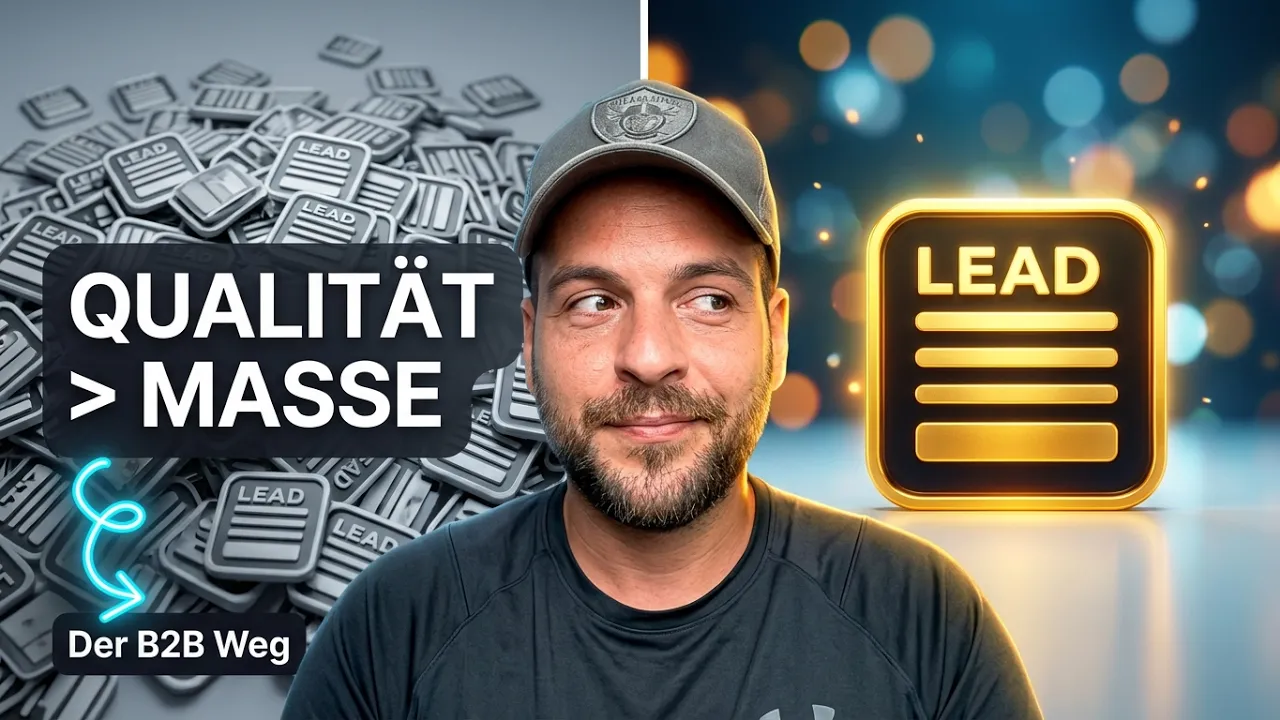
Online Strategies for Qualified Leads 2026: How to Predictably Build Your B2B Pipeline
Online Strategies for Qualified Leads 2026: How to Predictably Build Your B2B Pipeline
In 2026, AI visibility and strategic growth architectures replace classic lead magnets for a predictable B2B pipeline. Qualify leads early, lower cost-per-SQL, and maximize your measurable revenue through strong revenue systems.
Introduction
Is your pipeline empty even though your traffic is increasing? Then the problem is not volume, but qualification. The four most effective online strategies for qualified leads in 2026 are AI Search Visibility (GEO/AEO), Signal-Based Capture, Interactive Qualification, and Dark Social Demand Creation. Together, they form the strategic growth architecture that B2B companies in the DACH region need to generate predictable Sales Qualified Leads.
67% of B2B sales teams miss their quotas in 2026 (Source: McKinsey Global B2B Pulse Studies). Not because too few leads are coming in, but because marketing and sales rely on outdated lead magnets and MQL spam instead of a qualified pipeline. Classic PDF downloads, email newsletters, and generic whitepapers produce contacts without buying context. Lead generation has evolved into an AI- and intent-driven system that requires completely different measures.
This article is your guide for SaaS, Tech, and medium-sized businesses in the DACH region. The target audience: B2B decision-makers with a budget who want to switch from experiments to measurable SQLs. No theoretical overhead, but concrete implementation steps with data, benchmarks, and conversion logic. Long-term success comes from continuous optimization instead of one-off measures.
What you will take away from this post:
Why classic lead generation no longer works in 2026 and what replaces it
The 4 pillars of strategic growth architecture for a qualified pipeline
Concrete benchmark values for MQL-to-SQL conversion, CAC, and pipeline management
An implementation plan you can start immediately
Measurable results instead of vanity metrics as the new foundation of your reporting
The B2B Lead Reality in 2026: Why Old MQL Tactics Fail
Traffic without buying context only scales the noise, not the pipeline. This is the central insight that many B2B companies are still ignoring in 2026. While marketing teams celebrate clicks and impressions, sales teams are left with unqualified contacts. The cause is not reach, but the missing link between visibility and purchase intent.
Zero-click searches and AI Overviews have completely changed the lead gen landscape. According to G2's AI Search Insight Report, 51% of software research now begins with an AI chatbot instead of Google. The customer journey no longer starts on your website, but in a response model that either mentions or ignores you.
The End of Classic Lead Magnets
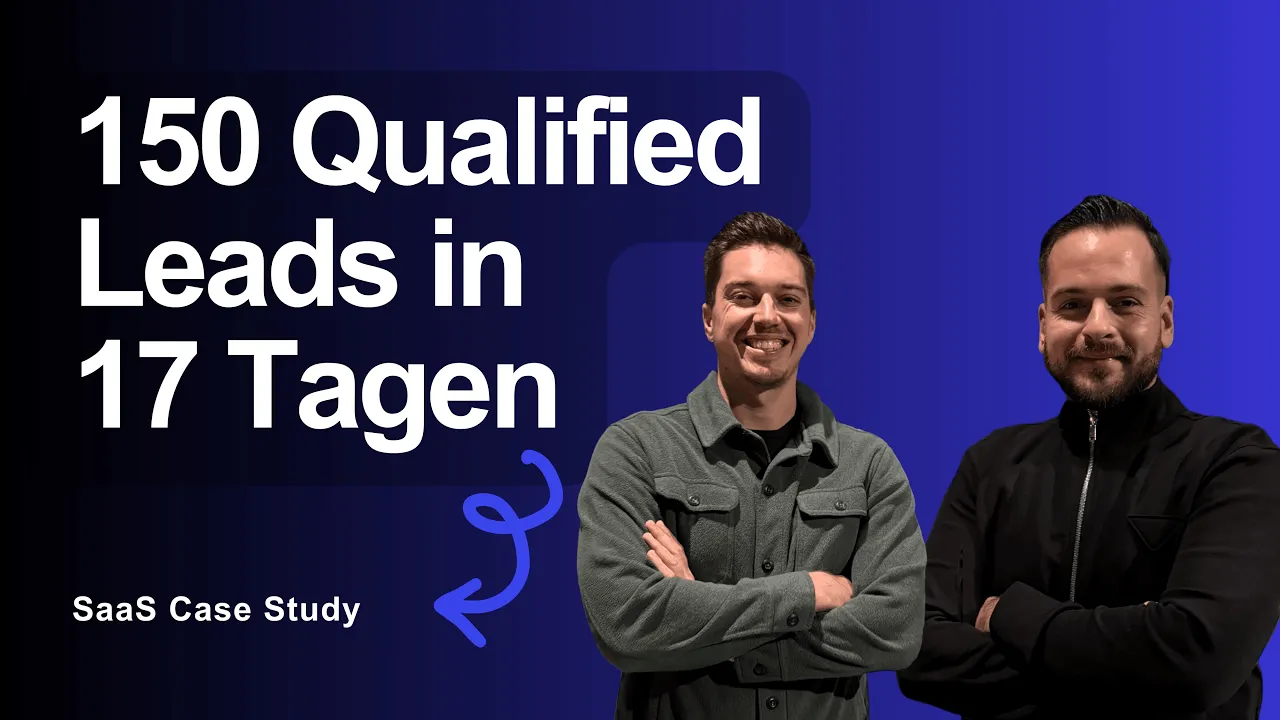
PDF downloads and newsletter sign-ups only produce unqualified MQLs in 2026. The core problem: A website visitor who downloads a whitepaper is interested in content, not necessarily in your solution. LeadSpot benchmarks show the brutal reality: Generic MQLs convert to Sales Qualified Leads at only about 9% if qualification takes place only after lead handoff. If qualification is already carried out during lead capture, MQL-to-SQL rates rise to 24% to 28%.
84% of sales teams miss their targets not due to a lack of lead volume, but due to poor lead quality. The calculation makes the problem tangible: A lead that costs €65 and brings only a 9% conversion rate leads to a cost-per-SQL of €1,675. If the same lead is generated with early qualification at a procurement cost of €90 and a 28% conversion rate, the cost-per-SQL drops to €321. That is the difference between online marketing that generates revenue and marketing that burns budget.
Autonomous Buyer Journeys and Zero-Click Searches
B2B buyers steer their own research in 2026 and only initiate contact late in the process. Forrester confirms: 87% of B2B buyers see generative AI conversational tools as an essential means to evaluate solutions. They rely less on classic discovery paths and more on synthesized answers, trust signals, and AI Overviews.
People increasingly buy from brands they trust before they ever visit their website. 60% of search decisions are made before the website visit. Traditional SEO alone is no longer enough. Visibility must shift to answer models, AI citations, and brand mentions. This reality requires completely new strategies for pipeline building that work where the decision-making process actually begins.
The 4 Effective Online Strategies for Qualified Leads in 2026
iGrow implements these 4 pillars as a strategic growth architecture for B2B SaaS and tech companies. This is what fundamentally distinguishes us from classic marketing agencies: instead of traffic optimization and campaign management, we deliver revenue marketing measured in SQLs, pipeline value, and return on investment.
The architecture connects market positioning, AI search visibility, SEO structure, revenue marketing strategy, and conversion infrastructure into a scalable system. No isolated measures, but a growth system.
AI Search Visibility (GEO/AEO): Standing on the Shortlist of ChatGPT and Perplexity
Companies must be optimized for AI answer systems to gain visibility. According to further research, 89% of B2B companies completely miss out on their visibility in AI search engines. They do not appear in generated answers or AI shortlists. Only 11% of the 712 studied companies have an AI visibility score of 70/100 or higher.
The concrete implementation: GEO (Generative Engine Optimization) forms the core of your visibility strategy. You optimize content not only for search engines, but as part of a content strategy as answer content planned, created, continuously analyzed, and cross-channel optimized via website, LinkedIn, earned media, and YouTube. This means: These signals must make it clear to AI models whom they should mention.
Semrush's AI Visibility Index analyzed over 126 million US AI prompt data points. Organizations that have fully integrated SEO and AI visibility into their workflow report increased traffic or more leads from AI platforms in 81% of cases. Meltwater additionally shows: LinkedIn has risen to the top 5 category for citations in AI Search. YouTube and social sources are gaining significant influence.
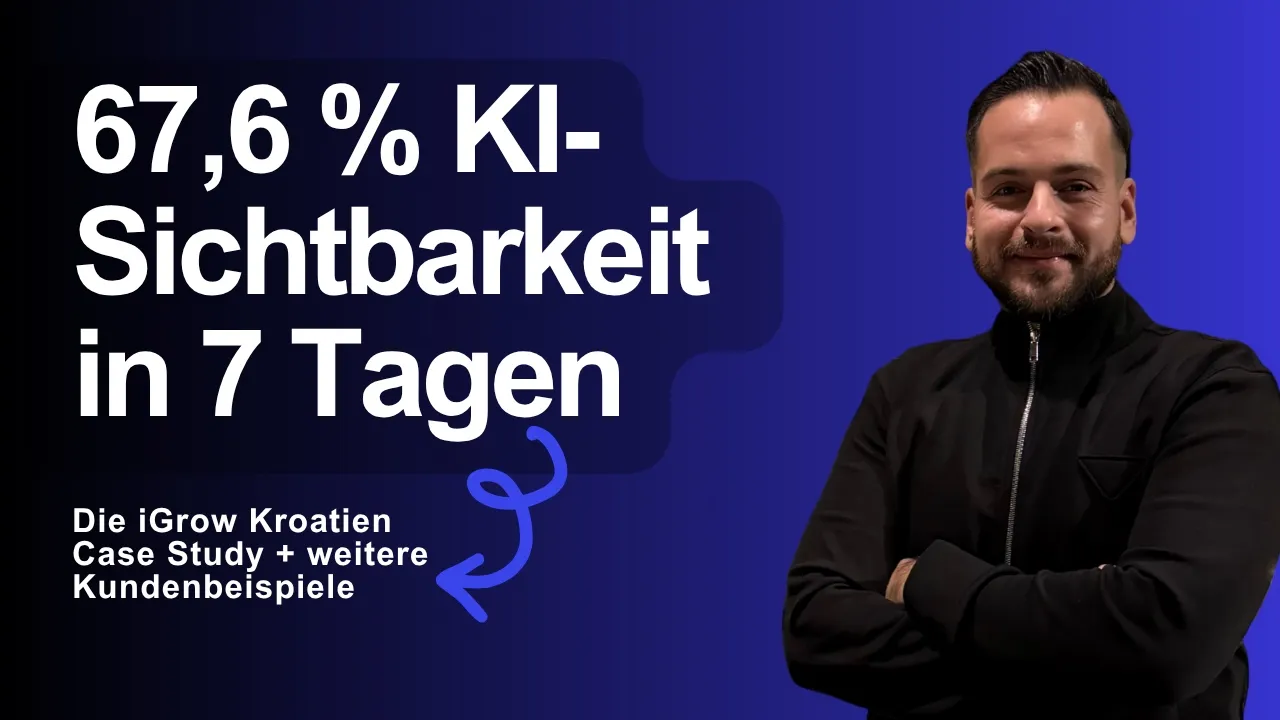
What this looks like in practice is shown by the SoWork Case Study: AI visibility from 16 to 100 percent in 90 days. This is not coincidence, but the result of systematic GEO optimization for Google AI Overviews and answer engines. SEO remains one of the most important foundations in online marketing in 2026, but SEO alone is no longer enough. You need AI search visibility as a strategic expansion.
52% of B2B tech marketers already view AI search as the top channel for buyer reach. Clear positioning increases the visibility of the website not only in classic search engines, but also in the AI models that your customers use daily.
Signal-Based & Intent-Driven Capture: Quality Signals Over Mass
Intent data marketing uses signals from companies actively searching for solutions. Instead of broad advertising spam, you identify accounts in the active buying window. A purchase intent score identifies accounts that are actually ready to buy before they fill out a form.
Advertising should not just be generic, but adapted to real purchase intents. The practical implementation combines intent data feeds, enrichment platforms, tech stack analysis, and pay-per-click data. You don't just react to lead inquiries; you anticipate them. Programs that implement qualification early in the funnel report MQL-to-SQL rates of over 24% instead of the usual 9%.
Behavior-based personalization segments users in real-time based on interactions. Tools like Salesforce, HubSpot, or specialized intent platforms enable attribution tracking over long B2B sales cycles.
Interactive & Frictionless Qualification: The End of Classic Forms
Traditional forms with eight fields are pure conversion killers in 2026. Interactive lead magnets offer individual value and massively increase lead quality. Conversational lead generation uses dialogue-based lead generation tools and replaces static forms with dynamic experiences.
Self-serve qualification works through ROI calculators, configurators, and AI-powered demos. These tools reduce friction, filter out outliers early, and integrate seamlessly with CRM and marketing automation. The conversion mechanics are clear: In high-converting programs, it is evident that the SQL rate can be doubled through higher-quality qualification paths.
Dark Social & Demand Creation: Trust in Closed Channels
Thought leadership strengthens trust between B2B decision-makers and experts. This is because trust-building increasingly takes place in closed channels: communities, LinkedIn Thought Leadership, podcasts, and executive voices. Dark social strategies create demand instead of just capturing it.
The use of LinkedIn for B2B social selling enables targeted engagement with customer profiles. A strong LinkedIn presence significantly increases response rates. LinkedIn engagement combined with email increases these response rates even further.
G2's Report highlights that review sites and recommendations carry enormous weight in AI answers because AI often works with trust signals. Case studies are important for building trust. Content marketing generates three times more leads than paid online advertising.
MQL vs. SQL 2026: Why Qualification Beats Quantity
Most marketing qualified leads never turn into customers. Time for a new metric philosophy. At iGrow, we focus on Sales Qualified Leads and business outcomes instead of vanity metrics. Leads are not a volume problem, but a qualification problem.
Sales Qualified Leads require immediate follow-up by sales. Any delay in follow-ups drastically reduces the probability of a conversion. That's why top teams in 2026 don't measure clicks or impressions, but cost per SQL, pipeline value, payback period, and customer acquisition cost relative to lifetime value.
The New Pipeline Metrics for 2026
Revenue-oriented KPIs replace old reporting standards. The LeadSpot study shows: With the same budget, programs with highly qualified leads generate 3.1 times more pipeline value than programs with pure MQL volumes. Programs with early qualification achieve MQL-to-SQL rates between 24% and 28% instead of the typical 9%.
Attribution tracking via multi-touch models is indispensable for long B2B sales cycles. The analysis shows which channels and content actually generate pipeline. Email marketing has demonstrably high success rates in B2B, but this success is only reliable if it is cleanly embedded in a continuous attribution system.
Benchmark values for various industries in the B2B sector:
SaaS: MQL-to-SQL rate with early qualification is 24% to 28%
Tech Companies: Opportunity rate from SQL is 60% to 70% in mature systems
B2B Services: Content-backed pipeline generates three times more qualified leads than pure performance marketing approaches
SQL Qualification: From BANT to MEDDIC in 2026
Modern qualification frameworks for complex B2B decisions go far beyond BANT. MEDDIC, CHAMP, and ANUM are extended by intent data, behavior-oriented scoring, and real-time signals. Content, scoring, and messaging should be aligned with each phase of the B2B decision-making process. What matters is not just job title and company size, but whether a new product has been launched, whether the team is currently being recruited, whether budget has been approved, or whether an exit from an existing contract is imminent.
Intakra data shows: 48% of active companies had two or more signal types, marking high-potential candidates. CRM systems must be able to capture, weight, and convert these signals into automated scores. Automating lead evaluation via AI tools reduces manual processes and increases the speed of sales response.
SEO and GEO require constant optimization and patience. Likewise, SQL qualification systems need continuous iteration.
Pipeline Metrics Comparison Table
Criterion | Old Metrics (Pre-2026) | New Metrics (2026+) |
|---|---|---|
Lead Measurement | MQL volume and number of downloads | SQL rate and pipeline value |
Success Metric | Clicks and impressions | Cost per SQL and payback period |
Conversion Rate Focus | Lead-to-MQL (often 22% according to marketing) | MQL-to-SQL (24% to 28% with pre-qualification) |
Attribution | Last Click | Multi-touch across the entire customer journey |
ROI Calculation | Cost per Lead (€65, 9% conversion = €1,675 per SQL) | Cost per Qualified Lead (€90, 28% conversion = €321 per SQL) |
Reporting Frequency | Monthly campaign reports | Weekly pipeline tracking |
The ROI calculation makes the difference measurable: Investing €90 per qualified lead instead of €65 for generic contacts reduces the cost-per-SQL by 81%. This is the core of revenue marketing versus traditional marketing.
Common Pipeline Problems and iGrow Solutions
The typical stumbling blocks in building a qualified pipeline are not technical. They are systemic. Here are the three most common problems and how iGrow solves them.
Fragmented Marketing Channels without Attribution
You invest in SEO, Google Ads, social media, and content marketing, but you can't tell which channel actually generates pipeline. The result: Budget decisions are based on gut feeling instead of data.
iGrow Solution: Integrated revenue marketing systems with end-to-end tracking. We connect your demand generation channels (SEO, AI search visibility, Google Ads, social media marketing, landing pages) with operational marketing tools (CRM, analytics, marketing automation, attribution tracking) into a unified system. Every euro spent becomes traceable right down to the SQL. The impact becomes measurable.
High Customer Acquisition Costs despite Traffic
Your traffic is growing, but your revenue is not. The classic symptom: Conversion infrastructure is missing. Prospects land on the website but find no clear qualification path.
Problem Diagnosis: B2B websites need more than traffic; without clear calls-to-action for the qualification path, conversion infrastructure is missing. Solution: Conversion optimization via qualification paths, optimized landing pages, and interactive tools. Successful B2B companies reduce their CAC by 40% to 60% through systematic qualification rather than higher budgets. SEO is the foundation for online visibility, but without a conversion layer, it remains vanity traffic. SEO often takes months to show results, which is why the conversion infrastructure must be built in parallel.
Sales and Marketing Operate in Silos
Marketing celebrates MQL volumes, sales complains about lead quality. Marketing teams often report MQL rates of 22%, of which only 8% are accepted by sales.
Revenue Operations setup for a shared pipeline goal: SLA definition between marketing and sales for lead handoff, joint reporting on an SQL basis, and aligned qualification criteria. iGrow implements these processes as a strategic growth layer on top of your existing teams and tools. What this looks like in practice is shown by the RankScale Success Story: Win rate up to 39 percent in 9 weeks through systematic alignment work between marketing and sales.

Conclusion and Next Steps
In 2026, B2B companies win not with more leads, but with strategic growth architecture. Clicks are not pipeline. Appearing on ChatGPT, Perplexity, and Google AI Overviews builds trust before the user ever visits a website. The four pillars of AI Search Visibility, Signal-Based Capture, Interactive Qualification, and Dark Social Demand Creation form the foundation for a predictable, qualified pipeline.
Your immediately actionable next steps:
AI Visibility Check: Check if your company appears in the relevant AI prompts of your target audience
Attribution Setup: Connect your channels into a continuous tracking system that measures pipeline instead of clicks
Implement SQL Framework: Define qualification criteria jointly with sales and automate scoring
iGrow is the specialized revenue marketing partner for B2B SaaS and tech companies in the DACH region. We do not replace internal teams or tools, but sit on top as a strategic growth layer, connecting visibility, demand capture, and conversion infrastructure into a measurable system.
Secure your non-binding Smart Growth Call now. In 30 minutes, we will work out three concrete growth levers together, including an individual scorecard for your company. Additionally, you will receive a non-binding setup as well as AI Visibility Tracking. We will analyze your Google Ads account live and show you instant unused quick wins and optimization potential.
Smart Growth Audit | Your Free Potential Analysis (Value: €500)
In 2026, AI visibility and strategic growth architectures replace classic lead magnets for a predictable B2B pipeline. Qualify leads early, lower cost-per-SQL, and maximize your measurable revenue through strong revenue systems.
Introduction
Is your pipeline empty even though your traffic is increasing? Then the problem is not volume, but qualification. The four most effective online strategies for qualified leads in 2026 are AI Search Visibility (GEO/AEO), Signal-Based Capture, Interactive Qualification, and Dark Social Demand Creation. Together, they form the strategic growth architecture that B2B companies in the DACH region need to generate predictable Sales Qualified Leads.
67% of B2B sales teams miss their quotas in 2026 (Source: McKinsey Global B2B Pulse Studies). Not because too few leads are coming in, but because marketing and sales rely on outdated lead magnets and MQL spam instead of a qualified pipeline. Classic PDF downloads, email newsletters, and generic whitepapers produce contacts without buying context. Lead generation has evolved into an AI- and intent-driven system that requires completely different measures.
This article is your guide for SaaS, Tech, and medium-sized businesses in the DACH region. The target audience: B2B decision-makers with a budget who want to switch from experiments to measurable SQLs. No theoretical overhead, but concrete implementation steps with data, benchmarks, and conversion logic. Long-term success comes from continuous optimization instead of one-off measures.
What you will take away from this post:
Why classic lead generation no longer works in 2026 and what replaces it
The 4 pillars of strategic growth architecture for a qualified pipeline
Concrete benchmark values for MQL-to-SQL conversion, CAC, and pipeline management
An implementation plan you can start immediately
Measurable results instead of vanity metrics as the new foundation of your reporting
The B2B Lead Reality in 2026: Why Old MQL Tactics Fail
Traffic without buying context only scales the noise, not the pipeline. This is the central insight that many B2B companies are still ignoring in 2026. While marketing teams celebrate clicks and impressions, sales teams are left with unqualified contacts. The cause is not reach, but the missing link between visibility and purchase intent.
Zero-click searches and AI Overviews have completely changed the lead gen landscape. According to G2's AI Search Insight Report, 51% of software research now begins with an AI chatbot instead of Google. The customer journey no longer starts on your website, but in a response model that either mentions or ignores you.
The End of Classic Lead Magnets
PDF downloads and newsletter sign-ups only produce unqualified MQLs in 2026. The core problem: A website visitor who downloads a whitepaper is interested in content, not necessarily in your solution. LeadSpot benchmarks show the brutal reality: Generic MQLs convert to Sales Qualified Leads at only about 9% if qualification takes place only after lead handoff. If qualification is already carried out during lead capture, MQL-to-SQL rates rise to 24% to 28%.
84% of sales teams miss their targets not due to a lack of lead volume, but due to poor lead quality. The calculation makes the problem tangible: A lead that costs €65 and brings only a 9% conversion rate leads to a cost-per-SQL of €1,675. If the same lead is generated with early qualification at a procurement cost of €90 and a 28% conversion rate, the cost-per-SQL drops to €321. That is the difference between online marketing that generates revenue and marketing that burns budget.
Autonomous Buyer Journeys and Zero-Click Searches
B2B buyers steer their own research in 2026 and only initiate contact late in the process. Forrester confirms: 87% of B2B buyers see generative AI conversational tools as an essential means to evaluate solutions. They rely less on classic discovery paths and more on synthesized answers, trust signals, and AI Overviews.
People increasingly buy from brands they trust before they ever visit their website. 60% of search decisions are made before the website visit. Traditional SEO alone is no longer enough. Visibility must shift to answer models, AI citations, and brand mentions. This reality requires completely new strategies for pipeline building that work where the decision-making process actually begins.
The 4 Effective Online Strategies for Qualified Leads in 2026
iGrow implements these 4 pillars as a strategic growth architecture for B2B SaaS and tech companies. This is what fundamentally distinguishes us from classic marketing agencies: instead of traffic optimization and campaign management, we deliver revenue marketing measured in SQLs, pipeline value, and return on investment.
The architecture connects market positioning, AI search visibility, SEO structure, revenue marketing strategy, and conversion infrastructure into a scalable system. No isolated measures, but a growth system.
AI Search Visibility (GEO/AEO): Standing on the Shortlist of ChatGPT and Perplexity
Companies must be optimized for AI answer systems to gain visibility. According to further research, 89% of B2B companies completely miss out on their visibility in AI search engines. They do not appear in generated answers or AI shortlists. Only 11% of the 712 studied companies have an AI visibility score of 70/100 or higher.
The concrete implementation: GEO (Generative Engine Optimization) forms the core of your visibility strategy. You optimize content not only for search engines, but as part of a content strategy as answer content planned, created, continuously analyzed, and cross-channel optimized via website, LinkedIn, earned media, and YouTube. This means: These signals must make it clear to AI models whom they should mention.
Semrush's AI Visibility Index analyzed over 126 million US AI prompt data points. Organizations that have fully integrated SEO and AI visibility into their workflow report increased traffic or more leads from AI platforms in 81% of cases. Meltwater additionally shows: LinkedIn has risen to the top 5 category for citations in AI Search. YouTube and social sources are gaining significant influence.
What this looks like in practice is shown by the SoWork Case Study: AI visibility from 16 to 100 percent in 90 days. This is not coincidence, but the result of systematic GEO optimization for Google AI Overviews and answer engines. SEO remains one of the most important foundations in online marketing in 2026, but SEO alone is no longer enough. You need AI search visibility as a strategic expansion.
52% of B2B tech marketers already view AI search as the top channel for buyer reach. Clear positioning increases the visibility of the website not only in classic search engines, but also in the AI models that your customers use daily.
Signal-Based & Intent-Driven Capture: Quality Signals Over Mass
Intent data marketing uses signals from companies actively searching for solutions. Instead of broad advertising spam, you identify accounts in the active buying window. A purchase intent score identifies accounts that are actually ready to buy before they fill out a form.
Advertising should not just be generic, but adapted to real purchase intents. The practical implementation combines intent data feeds, enrichment platforms, tech stack analysis, and pay-per-click data. You don't just react to lead inquiries; you anticipate them. Programs that implement qualification early in the funnel report MQL-to-SQL rates of over 24% instead of the usual 9%.
Behavior-based personalization segments users in real-time based on interactions. Tools like Salesforce, HubSpot, or specialized intent platforms enable attribution tracking over long B2B sales cycles.
Interactive & Frictionless Qualification: The End of Classic Forms
Traditional forms with eight fields are pure conversion killers in 2026. Interactive lead magnets offer individual value and massively increase lead quality. Conversational lead generation uses dialogue-based lead generation tools and replaces static forms with dynamic experiences.
Self-serve qualification works through ROI calculators, configurators, and AI-powered demos. These tools reduce friction, filter out outliers early, and integrate seamlessly with CRM and marketing automation. The conversion mechanics are clear: In high-converting programs, it is evident that the SQL rate can be doubled through higher-quality qualification paths.
Dark Social & Demand Creation: Trust in Closed Channels
Thought leadership strengthens trust between B2B decision-makers and experts. This is because trust-building increasingly takes place in closed channels: communities, LinkedIn Thought Leadership, podcasts, and executive voices. Dark social strategies create demand instead of just capturing it.
The use of LinkedIn for B2B social selling enables targeted engagement with customer profiles. A strong LinkedIn presence significantly increases response rates. LinkedIn engagement combined with email increases these response rates even further.
G2's Report highlights that review sites and recommendations carry enormous weight in AI answers because AI often works with trust signals. Case studies are important for building trust. Content marketing generates three times more leads than paid online advertising.
MQL vs. SQL 2026: Why Qualification Beats Quantity
Most marketing qualified leads never turn into customers. Time for a new metric philosophy. At iGrow, we focus on Sales Qualified Leads and business outcomes instead of vanity metrics. Leads are not a volume problem, but a qualification problem.
Sales Qualified Leads require immediate follow-up by sales. Any delay in follow-ups drastically reduces the probability of a conversion. That's why top teams in 2026 don't measure clicks or impressions, but cost per SQL, pipeline value, payback period, and customer acquisition cost relative to lifetime value.
The New Pipeline Metrics for 2026
Revenue-oriented KPIs replace old reporting standards. The LeadSpot study shows: With the same budget, programs with highly qualified leads generate 3.1 times more pipeline value than programs with pure MQL volumes. Programs with early qualification achieve MQL-to-SQL rates between 24% and 28% instead of the typical 9%.
Attribution tracking via multi-touch models is indispensable for long B2B sales cycles. The analysis shows which channels and content actually generate pipeline. Email marketing has demonstrably high success rates in B2B, but this success is only reliable if it is cleanly embedded in a continuous attribution system.
Benchmark values for various industries in the B2B sector:
SaaS: MQL-to-SQL rate with early qualification is 24% to 28%
Tech Companies: Opportunity rate from SQL is 60% to 70% in mature systems
B2B Services: Content-backed pipeline generates three times more qualified leads than pure performance marketing approaches
SQL Qualification: From BANT to MEDDIC in 2026
Modern qualification frameworks for complex B2B decisions go far beyond BANT. MEDDIC, CHAMP, and ANUM are extended by intent data, behavior-oriented scoring, and real-time signals. Content, scoring, and messaging should be aligned with each phase of the B2B decision-making process. What matters is not just job title and company size, but whether a new product has been launched, whether the team is currently being recruited, whether budget has been approved, or whether an exit from an existing contract is imminent.
Intakra data shows: 48% of active companies had two or more signal types, marking high-potential candidates. CRM systems must be able to capture, weight, and convert these signals into automated scores. Automating lead evaluation via AI tools reduces manual processes and increases the speed of sales response.
SEO and GEO require constant optimization and patience. Likewise, SQL qualification systems need continuous iteration.
Pipeline Metrics Comparison Table
Criterion | Old Metrics (Pre-2026) | New Metrics (2026+) |
|---|---|---|
Lead Measurement | MQL volume and number of downloads | SQL rate and pipeline value |
Success Metric | Clicks and impressions | Cost per SQL and payback period |
Conversion Rate Focus | Lead-to-MQL (often 22% according to marketing) | MQL-to-SQL (24% to 28% with pre-qualification) |
Attribution | Last Click | Multi-touch across the entire customer journey |
ROI Calculation | Cost per Lead (€65, 9% conversion = €1,675 per SQL) | Cost per Qualified Lead (€90, 28% conversion = €321 per SQL) |
Reporting Frequency | Monthly campaign reports | Weekly pipeline tracking |
The ROI calculation makes the difference measurable: Investing €90 per qualified lead instead of €65 for generic contacts reduces the cost-per-SQL by 81%. This is the core of revenue marketing versus traditional marketing.
Common Pipeline Problems and iGrow Solutions
The typical stumbling blocks in building a qualified pipeline are not technical. They are systemic. Here are the three most common problems and how iGrow solves them.
Fragmented Marketing Channels without Attribution
You invest in SEO, Google Ads, social media, and content marketing, but you can't tell which channel actually generates pipeline. The result: Budget decisions are based on gut feeling instead of data.
iGrow Solution: Integrated revenue marketing systems with end-to-end tracking. We connect your demand generation channels (SEO, AI search visibility, Google Ads, social media marketing, landing pages) with operational marketing tools (CRM, analytics, marketing automation, attribution tracking) into a unified system. Every euro spent becomes traceable right down to the SQL. The impact becomes measurable.
High Customer Acquisition Costs despite Traffic
Your traffic is growing, but your revenue is not. The classic symptom: Conversion infrastructure is missing. Prospects land on the website but find no clear qualification path.
Problem Diagnosis: B2B websites need more than traffic; without clear calls-to-action for the qualification path, conversion infrastructure is missing. Solution: Conversion optimization via qualification paths, optimized landing pages, and interactive tools. Successful B2B companies reduce their CAC by 40% to 60% through systematic qualification rather than higher budgets. SEO is the foundation for online visibility, but without a conversion layer, it remains vanity traffic. SEO often takes months to show results, which is why the conversion infrastructure must be built in parallel.
Sales and Marketing Operate in Silos
Marketing celebrates MQL volumes, sales complains about lead quality. Marketing teams often report MQL rates of 22%, of which only 8% are accepted by sales.
Revenue Operations setup for a shared pipeline goal: SLA definition between marketing and sales for lead handoff, joint reporting on an SQL basis, and aligned qualification criteria. iGrow implements these processes as a strategic growth layer on top of your existing teams and tools. What this looks like in practice is shown by the RankScale Success Story: Win rate up to 39 percent in 9 weeks through systematic alignment work between marketing and sales.
Conclusion and Next Steps
In 2026, B2B companies win not with more leads, but with strategic growth architecture. Clicks are not pipeline. Appearing on ChatGPT, Perplexity, and Google AI Overviews builds trust before the user ever visits a website. The four pillars of AI Search Visibility, Signal-Based Capture, Interactive Qualification, and Dark Social Demand Creation form the foundation for a predictable, qualified pipeline.
Your immediately actionable next steps:
AI Visibility Check: Check if your company appears in the relevant AI prompts of your target audience
Attribution Setup: Connect your channels into a continuous tracking system that measures pipeline instead of clicks
Implement SQL Framework: Define qualification criteria jointly with sales and automate scoring
iGrow is the specialized revenue marketing partner for B2B SaaS and tech companies in the DACH region. We do not replace internal teams or tools, but sit on top as a strategic growth layer, connecting visibility, demand capture, and conversion infrastructure into a measurable system.
Secure your non-binding Smart Growth Call now. In 30 minutes, we will work out three concrete growth levers together, including an individual scorecard for your company. Additionally, you will receive a non-binding setup as well as AI Visibility Tracking. We will analyze your Google Ads account live and show you instant unused quick wins and optimization potential.
Smart Growth Audit | Your Free Potential Analysis (Value: €500)
Written by:

Edin
Author & Founder
Share this article
Share on X
Share on f
Share on in
What are qualified leads in 2026 and how do they differ from MQLs?
Qualified leads in 2026 are Sales Qualified Leads (SQLs) defined by validated buying signals, decision-making authority, and concrete needs. Unlike MQLs, which are often based only on downloads or form submissions, SQLs undergo a multi-stage qualification process using intent data and behavioral scoring. Programs with early qualification achieve MQL-to-SQL conversion rates of 24% to 28%, compared to the usual 9%.
Which online strategy will deliver the best SQLs for B2B SaaS in 2026?
AI Search Visibility (GEO/AEO) combined with Signal-Based Capture delivers the most qualified leads. 81% of companies that have integrated SEO and AI Visibility report increased leads from AI platforms. For B2B SaaS, choosing the right signals is crucial: product launches and hiring surges are stronger buying indicators than funding rounds.
How long does it take to build a qualified pipeline with the new strategies?
Content SEO and AI visibility typically require 3 to 6 months for measurable results; a clean content strategy systematizes this build-up and supports ongoing optimization. Signal-Based Capture and Interactive Qualification can deliver initial SQLs within 4 to 8 weeks. Dark Social and Demand Creation are long-term investments. The SoWork case study shows that AI visibility can increase from 16 to 100 percent in 90 days if the strategy is implemented systematically.
What does qualified lead generation cost in 2026 compared to traditional methods?
With early qualification, the cost-per-SQL drops from an average of €1,675 (generic MQLs at a €65 acquisition cost and 9% conversion) to €321 (qualified leads at €90 and 28% conversion). Programs with highly qualified leads generate 3.1 times more pipeline value with the same budget.
How do I correctly measure the ROI of my online lead strategies?
Replace vanity metrics with revenue-oriented KPIs: Cost per SQL, Pipeline Value, Payback Period, and Customer Acquisition Cost relative to Lifetime Value. Multi-touch attribution across the entire customer journey is essential. Return on Investment is not measured by lead volume, but by the actual revenue generated by qualified pipeline.


What are qualified leads in 2026 and how do they differ from MQLs?
Qualified leads in 2026 are Sales Qualified Leads (SQLs) defined by validated buying signals, decision-making authority, and concrete needs. Unlike MQLs, which are often based only on downloads or form submissions, SQLs undergo a multi-stage qualification process using intent data and behavioral scoring. Programs with early qualification achieve MQL-to-SQL conversion rates of 24% to 28%, compared to the usual 9%.
Which online strategy will deliver the best SQLs for B2B SaaS in 2026?
AI Search Visibility (GEO/AEO) combined with Signal-Based Capture delivers the most qualified leads. 81% of companies that have integrated SEO and AI Visibility report increased leads from AI platforms. For B2B SaaS, choosing the right signals is crucial: product launches and hiring surges are stronger buying indicators than funding rounds.
How long does it take to build a qualified pipeline with the new strategies?
Content SEO and AI visibility typically require 3 to 6 months for measurable results; a clean content strategy systematizes this build-up and supports ongoing optimization. Signal-Based Capture and Interactive Qualification can deliver initial SQLs within 4 to 8 weeks. Dark Social and Demand Creation are long-term investments. The SoWork case study shows that AI visibility can increase from 16 to 100 percent in 90 days if the strategy is implemented systematically.
What does qualified lead generation cost in 2026 compared to traditional methods?
With early qualification, the cost-per-SQL drops from an average of €1,675 (generic MQLs at a €65 acquisition cost and 9% conversion) to €321 (qualified leads at €90 and 28% conversion). Programs with highly qualified leads generate 3.1 times more pipeline value with the same budget.
How do I correctly measure the ROI of my online lead strategies?
Replace vanity metrics with revenue-oriented KPIs: Cost per SQL, Pipeline Value, Payback Period, and Customer Acquisition Cost relative to Lifetime Value. Multi-touch attribution across the entire customer journey is essential. Return on Investment is not measured by lead volume, but by the actual revenue generated by qualified pipeline.
What are qualified leads in 2026 and how do they differ from MQLs?
Qualified leads in 2026 are Sales Qualified Leads (SQLs) defined by validated buying signals, decision-making authority, and concrete needs. Unlike MQLs, which are often based only on downloads or form submissions, SQLs undergo a multi-stage qualification process using intent data and behavioral scoring. Programs with early qualification achieve MQL-to-SQL conversion rates of 24% to 28%, compared to the usual 9%.
Which online strategy will deliver the best SQLs for B2B SaaS in 2026?
AI Search Visibility (GEO/AEO) combined with Signal-Based Capture delivers the most qualified leads. 81% of companies that have integrated SEO and AI Visibility report increased leads from AI platforms. For B2B SaaS, choosing the right signals is crucial: product launches and hiring surges are stronger buying indicators than funding rounds.
How long does it take to build a qualified pipeline with the new strategies?
Content SEO and AI visibility typically require 3 to 6 months for measurable results; a clean content strategy systematizes this build-up and supports ongoing optimization. Signal-Based Capture and Interactive Qualification can deliver initial SQLs within 4 to 8 weeks. Dark Social and Demand Creation are long-term investments. The SoWork case study shows that AI visibility can increase from 16 to 100 percent in 90 days if the strategy is implemented systematically.
What does qualified lead generation cost in 2026 compared to traditional methods?
With early qualification, the cost-per-SQL drops from an average of €1,675 (generic MQLs at a €65 acquisition cost and 9% conversion) to €321 (qualified leads at €90 and 28% conversion). Programs with highly qualified leads generate 3.1 times more pipeline value with the same budget.
How do I correctly measure the ROI of my online lead strategies?
Replace vanity metrics with revenue-oriented KPIs: Cost per SQL, Pipeline Value, Payback Period, and Customer Acquisition Cost relative to Lifetime Value. Multi-touch attribution across the entire customer journey is essential. Return on Investment is not measured by lead volume, but by the actual revenue generated by qualified pipeline.