
Google Ads: 5 mistakes that cost B2B companies thousands of euros [Checklist] – every month.
Google Ads: 5 mistakes that cost B2B companies thousands of euros [Checklist] – every month.

Over 80% of B2B budgets in Google Ads are wasted every year. This happens due to incorrect targeting, poor tracking, and a bad account structure. We want your money to flow into your sales, not into the trash. Our Google Ads Agency is based in Vienna and offers you local consulting directly on-site.
We show you five major mistakes in Google Ads that affect B2B companies in Austria. These include unclear goals, incorrect keywords, poor tracking, weak landing pages, and chaotic budget management. Professional support for your Google Ads campaigns is crucial here for maximum performance and sustainable success. We focus on performance—measurable, scalable, and profitable.
You get a checklist with benchmarks and quick wins. In just 10 minutes, you will find the biggest leaks in your campaigns. This way, you can reduce your Google Ads costs and increase your success. This is perfect for SEA teams who want clean advertising. Our team brings many years of experience in the field of Google Ads and knows proven strategies for various industries.
We show you how to make Google Ads better. This includes precise keyword mapping, clean data with GA4, a good consent setup, strong landing pages, and smart budget management. This is how advertising becomes a growth lever, not a cost factor.
Takeaways
The biggest losses in SEA arise from incorrect keyword targeting and missing negatives.
Without reliable conversion tracking, budget and bidding remain blind.
Message match between search, ad, and landing page increases the conversion rate immediately.
Structure beats coincidence: A clear campaign and ad group logic saves budget.
Smart Bidding needs data quality and volume; otherwise, CPCs and CPLs will rise.
A quick 10-minute check reveals expensive leaks in paid search and PPC.
Clean Google Ads optimization leads to predictable demand and a stable pipeline.
Benefits of professional Google Ads support for B2B companies: Experienced experts maximize efficiency, reduce costs, and ensure sustainable results through targeted strategies and continuous optimization.
Why B2B Google Ads is Particularly Susceptible to Expensive Search Engine Advertising
In B2B search engine marketing, high click prices are often associated with low reach. We combine PPC marketing, Google marketing, and a clear Google Ads strategy. Search Engine Advertising (SEA) is a central component of the services we offer. This keeps your search engine marketing efficient.
With a digital marketing strategy, we manage online advertising based on data and offer a wide range of services in the area of Google Ads. We accompany you from the first click to the qualified meeting.
Complex Purchase Decisions and Long Sales Cycles in B2B
Multiple stakeholders, compliance rules, and budget approvals extend decision-making. Target-oriented addressing of relevant people in decision-making processes is crucial here to reach the right target groups effectively. Online marketing in B2B needs full-funnel approaches and clean lead scoring. This way, SEM does not just pay off in leads, but in a real pipeline.
We prioritize intent signals, content offers, and appointment bookings. This reduces friction between initial contact and demo—especially in software, industry, and professional services.
Smaller Target Groups, Higher CPCs: Impact on Google Ads Costs
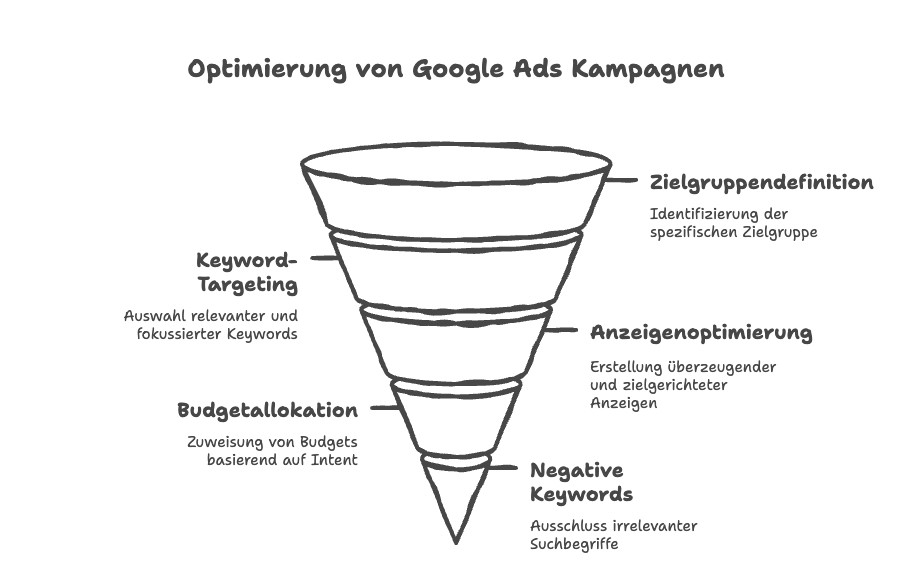
Niche keywords deliver low volume while CPCs rise. Without precise keyword targeting and smart bidding, budget disappears. For an efficient Google Ads campaign, it is crucial to define the target group precisely and to optimally match the keywords and ads to their needs. With a focused Google Ads strategy, negative keywords, and a clean match type setup, we keep costs within limits.
© iGrow
We use SEM with narrowly defined search terms, test ad texts, and bundle budgets by intent, using various targeting options to address the target group in a targeted manner. This keeps online advertising measurable—even in tough competition.
Alignment of Marketing Strategy, Sales, and Campaign Management
When marketing, sales, and ops play together, the lead-to-pipeline rate rises—especially through coordinated work in task distribution between marketing, sales, and campaign management. We define the ICP, offer logic, and routing into the CRM. Sales feedback on SQL quality flows directly back into the PPC marketing.
Result: coherent online marketing, resilient data, and clear ROAS decisions. This is exactly how search engine marketing becomes predictable—from the ad to the closed deal.
Lever | Concrete Measure | Expected Effect |
Full-Funnel Setup | Combine BOFU demos + MOFU content via SEM and remarketing | More qualified inquiries with a stable CPL |
Keyword Precision | Exact/Phrase, strong negatives, intent clusters | Less wasted spend, higher CTR |
Smart Bidding | tCPA/tROAS with clean conversion signals | Predictable costs per SQL |
Sales Alignment | CRM feedback loop, lead routing, SLA | Better lead quality and conversion rate |
Creative Tests | Value proposition, ad extensions, landing page variants | Higher Quality Score and lower CPCs |
The Checklist: How to Identify Money Wasters in Your Campaigns
We show you how to find leaks in PPC campaigns in just a few minutes. The goal is to have clean data and efficient campaign management. This way, your ad budget is used effectively.
Tip: Work structurally, note discrepancies, and decide which measure has the biggest lever. This makes campaign optimization measurable and fast. Continuous optimizations are crucial here to steadily improve the performance of your campaigns and achieve the maximum ROI.
Quick Check in 10 Minutes: Account Structure, Budgets, Conversion Tracking
Account Structure: Separate Search, Display, and Performance Max. Isolate Brand vs. Non-Brand as well as countries/languages. A well-structured Google Ads account is crucial for campaign performance, as it enables a clear overview and targeted control. This creates clarity in campaign management for your online marketing campaigns.
Budgets: Are funds flowing into the most profitable ad groups? Shift the ad budget to winners and stop wasted spend in weak PPC campaigns. When managing multiple accounts, a central Ads account offers advantages in the overview and control of budgets.
Conversion Tracking: Check whether primary conversions are marked as "primary" in Google Ads, that there is no double-counting with GA4, and that no events are missing. Without clean tracking, Google Ads Analytics is worthless.
The initial setup and optimization of the Google Ads account is crucial for the success of your campaigns. Pay attention to a well-thought-out account structure and the ongoing mentoring of your account to maximize the relevance of the ads and increase the ROI.
Warning Signals in Google Ads Analytics: Impression Share, Search Terms, CTR
Low Impression Share in profitable campaigns indicates a budget limit. Increase selectively or tighten targeting to maintain efficiency in Google Ads management.
Search terms with generic intent like "free," "jobs," or "definition" are money wasters. Pause them and refine match types to protect your keyword errors and online marketing campaigns.
CTR under 3% for non-brand in niches is an indication of a weak message match. Optimize ad copy and landing pages for faster campaign optimization.
High spend without conversions in the search terms or placements report, especially if placements occur on various websites in the Google Display Network, demands an immediate stop and realignment of your PPC campaigns.
Prioritization: Tackle High-Impact Fixes First
Fix conversion tracking: Only valid data leads to smart bids and precise decisions in Google Ads Analytics—there are various possibilities for optimizing campaigns here.
Pause money-wasting search terms: Remove irrelevant intents and focus on clear B2B signals.
Shift budget: Move the ad budget to high-performing ad groups and ensure brand protection so that strong queries don't lose out.
Check Area | Problem Indicator | Quick Measure | Expected Effect |
Account Structure | Mixed networks, no brand split | Separate campaigns, isolate brand | Clear data basis, better control |
Budgets | Winners underfunded, budget limit | Budget to top-ROI ad groups | More reach at the same cost |
Search Terms | Generic intent, high costs | Set negatives, sharpen match types | Reduction of wasted spend |
CTR | < 3% in non-brand | Improve message match, test snippets | Higher relevance and Quality Score |
Tracking | Double counting GA4 + Ads | Define primary events, remove duplicates | Reliable KPIs for campaign optimization |
Mistake: Incorrect Keyword Targeting and Impromiscuous Match Types
Sometimes you lose a lot of money in search ads. This happens when you choose keywords incorrectly. Potential customers actively search Google for specific products or services—Google Ads makes it possible to precisely address these search queries. With good keyword targeting and careful keyword optimization, you get more qualified inquiries in Austria.
Our goal: more pipeline, less wasted spend—measurable and scalable.
Keyword Research for B2B: Intent, Negative Keywords, Keyword Optimization
Start with analyzing interest intent. Distinguish between purchasing intentions like "offer" and informational interest like "guidebook." This way, you can prioritize Google Ads keywords better, especially for specific products in the B2B context, to optimize their visibility and marketing.
Maintain negative lists: "jobs," "salary," "PDF," "free," "private," "definition."
Keyword advertising with clear qualification: e.g., "For companies with 50+ employees".
Ongoing keyword optimization: Expand winners, cut wasted spend.
Broad vs. Phrase vs. Exact: When Which Match Type Makes Sense
Exact is ideal for direct purchasing intentions. You maintain control and a stable CPA.
Phrase is good for expanding with some control. You reach a good balance between reach and relevance.
Broad is only recommended with strong signals. Otherwise, it devours your budget. Compelling ad copy is crucial here to increase the relevance of your text ads and improve the performance of your campaigns.
Search Terms Report: Identify and Exclude Money Wasters
Review the report regularly. Pause irrelevant search queries immediately. Add suitable negatives. Also, analyze the behavior of website visitors to enable targeted remarketing measures. This stabilizes your Google Ads keyword research and ad placement.
Flag expensive non-converters above a defined click and cost threshold.
Cluster search terms by intent before letting them expand.
Elevate ROAS frontrunners into their own ad groups.
Practical Framework: Keyword Mapping by Funnel Phase
© iGrow
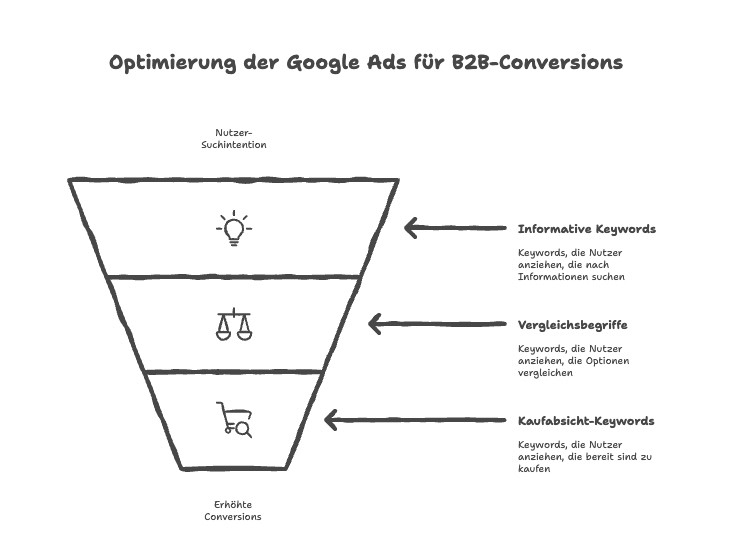
TOFU: Informative keywords in separate campaigns with a moderate CPL target. Content offers matching the search intention, with high-quality content being crucial to increase user interaction and improve the conversion rate.
MOFU: Comparison terms and use cases. Lead magnets, clear value advantages, and strong search ads.
BOFU: Brand, "price," "demo," "offer." Aggressive budget, sharp CPA target, precise keyword targeting. Use Google Ads keywords with high buying intent and secure the conversion route.
This keeps the journey consistent, while keyword advertising and Google Ads keyword research deliver data for better decisions.
Mistake: Missing or Faulty Conversion Tracking
Without clean measurement, performance marketing remains blind. We connect strategy and technology so that you make decisions that have an impact—and your advertising budget is optimally deployed through precise tracking. This way, we get more out of budgets and can optimize Google Ads based on real signals and solid Google Ads success measurement.
Primary vs. Secondary Conversions: What You Should Really Measure
Define clear primary conversions like Request Demo, Book Appointment, or Contact Form Sent—especially if you are promoting a service, this is often the most important conversion goal. These events steer budget and bids.
Secondary conversions like e-book downloads, newsletter sign-ups, or video views are valuable, but only for observation. This prevents you from steering conversion tracking toward soft targets and keeps Smart Bidding focused.
Properly Connecting Server-Side Tracking, Consent, and GA4 Events
Set up GA4 cleanly, map events consistently, and link Google Ads and GA4 bi-directionally. Activate enhanced conversions to close gaps.
With consent requirements, server-side tracking is worthwhile, for example via Google Tag Manager Server-Side. By targeted use of tracking tools, you can improve data quality. This reduces data loss and keeps your conversion tracking stable, even with restrictive browsers.
Attribution Model and Data Quality: Basing Decisions on Robust Data
Use an attribution model that fits your volume. To choose the right model, the necessary know-how is crucial. With enough conversions, data-driven is ideal. With low data, position-based or linear works as a transition—the main thing is consistency.
Regularly check event names, parameters, and entities. Only clean data enables real Google Ads performance measurement and targeted Google Ads optimization throughout the funnel.
Diagnostic Check: Test Conversions, Tag Assistant, DebugView
Trigger test conversions and check with Google Tag Assistant and GA4 DebugView whether gclid and client_id arrive. Watch out for double counting, for example when GA4 imports and manual Ads conversions are active simultaneously.
Check signal flow: click to lead event
Validate parameters: source/medium, campaign, gclid
Exclude duplicates: one event, one count
As part of the diagnostic check, you should also review the performance of your Google Ads to identify optimization potentials.
Only when conversion tracking is stable do bidding strategies grasp precisely—the basis for sustainable performance marketing.
Mistake: Inefficient Campaign Structure and Campaign Optimization
Sometimes everything is mixed in one campaign: search network, display network, and video—yet in the Google Ads ecosystem, there is a variety of advertisements such as text ads, banners, Gmail, and video ads, which each offer different application possibilities and benefits. This makes campaign management untidy. We separate everything clearly by goals, signals, and phases. This improves data quality and allows for better ad optimization.
Clean Separation: Search Ads, Display Advertising, Remarketing
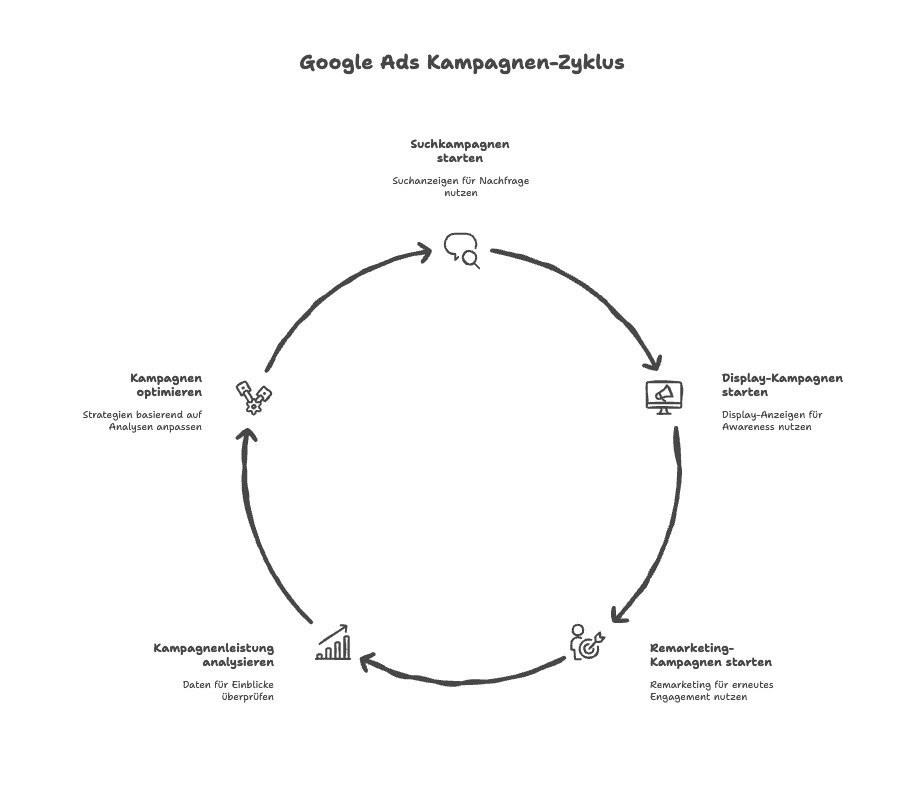
Search ads utilize intent. We work with precise search terms. Display advertising on the network brings reach and visual messages. Remarketing runs separately with special messages for each stage.
© iGrow
Various ad formats are available in the Google Ads ecosystem: Display ads reach potential customers across the entire Google Display Network, while text ads appear directly in search results and serve as the first point of contact between company and customer. Shopping ads and each individual shopping ad present products with image, price, and other details directly in the search results, which is particularly effective for e-commerce and promoting products.
Performance Max campaigns make it possible to increase visibility and reach on multiple Google advertising channels simultaneously, maximizing the conversion rate.
Ads campaigns, paid ads, and ads advertisements are central instruments to target clients in e-commerce, promote products, and increase the visibility of products and brands.
Google Ads campaigns and Ads remarketing play an important role in winning back visitors by targeting users again and supporting the promotion of products and services.
Our plan: Search campaigns for demand, display for awareness, remarketing as an extra layer. This keeps budgets clear and management scalable.
Ad Group Granularity, Keyword Clustering, and Ad Delivery
To-broad groups harm relevance. We cluster keywords by intent, without rigid SKAGs. Each cluster receives responsive search ads with 8–12 headlines and 3–4 descriptions. Important elements can be adjusted as needed.
High relevance through precise keyword clusters
Consistent ad delivery for clear messages
Continuous ad optimization with A/B variants
Performance Max in B2B: Opportunities, Risks, and Controls
Performance Max campaigns offer reach and automation across multiple Google advertising channels, so you efficiently reach clients and benefit from cross-channel advantages. But only with strong signals like clean tracking and clear conversions. We organize assets by personas and continuously review search terms.
Controls are important: Brand as a separate search campaign, limit display waste, clearly define remarketing. This keeps efficiency and overview in place.
Use Ad Extensions: Sitelinks, Callouts, Snippets, Forms
Ad extensions increase reach. Google Ads profit particularly from suitable extensions because they target different ad types like search ads, display ads, and banner ads, reaching a wider audience. Sitelinks show use cases, prices, and references. Callouts highlight USPs. Structured snippets and lead forms improve quality and click rate.
Clear added value in the extensions
More screen space, higher CTR, better ad delivery
Seamless campaign management in daily business
Mistake: Unclear Offers and Weak Landing Pages
You win clicks but no leads? This is often due to unclear offers and weak landing pages. A big advantage of clear offers and optimized landing pages is that they specifically generate qualified leads. We improve this by using clear messages that fit exactly. This is how we increase your conversion rate.
Message Match: Keeping Search Intent, Ad, and Landing Page Consistent
Every search query deserves its own story. The headline uses the keyword, the subline explains the offer briefly. This is how we place ads effectively and guide to the landing pages. This increases the Quality Score and reduces wasted spend. You get more leads.
Above-the-fold clear value and CTA like "Book Demo."
Bullet value props instead of empty phrases, matching the search intent.
Consistently identical terminology between Google ads, ad copy, and landing page—especially with Google Ads to ensure a consistent user experience.
Conversion Design: Forms, Trust Elements, Social Proof
Forms are short and precise. You collect more data later. Trust helps stabilize the funnel.
Logos of real clients and industry references from DACH.
Certifications and reviews on platforms like G2 or ProvenExpert.
Case studies with clear KPIs and business impact.
Speed, UX, and Mobile: Technical Adjustment Screws for Better CR
Fast pages convert better, especially on mobile. The goal is a page load time under 2 seconds. This improves your campaigns and reduces costs per click.
Core Web Vitals in the green zone, mobile-first layout—optimize your websites specifically for mobile users and fast loading times.
Compressed media, lazy loading, clean caching strategy.
Clear visual hierarchy and highly visible CTAs.
A/B Testing: Prioritize Headlines, Value Proposition, CTA
Test first what has the biggest lever, and scale winners. Use the opportunity to compare different approaches for optimizing landing pages with various A/B tests. This gets more out of online advertising and online marketing.
Fine-tune headline and value proposition.
Vary CTA text, color, and placement.
Shift position of social proof and trust seals.
Optimize number and sequence of form fields.
Monitor metrics like CVR, bounce rate, scroll depth, and time to interaction. This way, you quickly recognize which landing pages drive conversion rate and which Google ads efficiently deliver leads.
Lever | Measure | Expected Effect | Measurement |
Message Match | Keyword in headline, consistent subline | Higher Quality Score, lower CPCs | CTR, CPC, lead rate |
Form | Reduction to 3 core fields | Fewer drop-offs in online ads | Form abandonment rate, CVR |
Trust | Logos, reviews, case KPIs | More trust in B2B, better lead quality | SQL rate, time to interaction |
Speed/UX | Optimize Core Web Vitals | Faster first click, stable sessions | LCP, FID/INP, bounce rate |
A/B Testing | Test headline and CTA first | Quick win per budget unit | CVR lift, ad campaign ROAS |
Google Ads
Google Ads delivers predictable leads when strategy, data, and processes work together. With our long expertise in planning and implementing Google Ads strategies, we combine clear Google Ads management with clean tracking and strong creatives. This way, you get a measurable pipeline instead of expensive clicks.
© iGrow
Our approach: We jointly define your ICP and map keywords to funnel phases. We build a testing roadmap. As Google Ads consultants, we work closely with your sales unit.
We use Google Ads Editor and Google Tag Manager. Weekly syncs and monthly reports keep everyone on track. You maintain control; we deliver speed and quality.
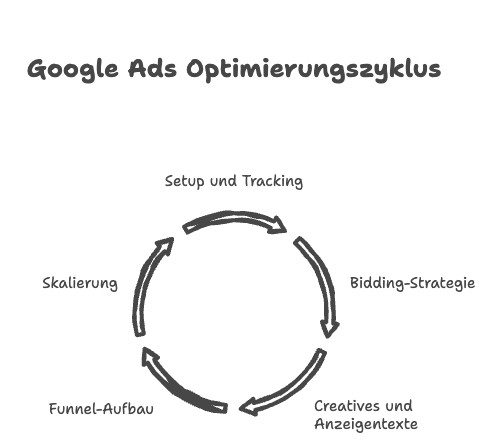
Setup and Tracking: Clean account structure, events, server-side signals
Bidding Strategy: Data-backed, scalable, aligned with business goals
Creatives and Ad Copy: Message match, strong proof points, clear CTAs
Funnel Build: Search network, remarketing, demand capture
Scaling: Test plan, budget shifts, quality control
Task | Responsibility | Tooling | Output |
ICP & Keyword Strategy | AdWords Agency + Sales | Google Ads Editor, Sheets | Funnel mapping, priority keywords |
Tracking & Data Quality | Google Ads Agency | Google Tag Manager, GA4, Tag Assistant | Valid conversions, debug logs |
Creation & Tests | Google Ads Experts | Ads interface, Drafts & Experiments | CTR winners, qualified leads |
Optimization & Scaling | Google Ads Consultant | Looker Studio, bidding reports | Budget efficiency, stable CPL |
Reporting & Sparring | Google Ads Consulting | Looker Studio, executive deck | SQL rate, pipeline transparency |
Budget Control, Bidding, and Audience Targeting in B2B
We pilot your Google Ads budget precisely where it is needed. With clear bidding, diverse targeting options for specific audience outreach, and precise audience targeting, you get more qualified inquiries. This allows you to run your ads profitably and grow.
Choosing Bidding Strategies Right: tCPA, tROAS, Maximize Conversions
Start with tCPA when you have 15–30 conversions in 30 days. For focus on revenue or pipeline, use tROAS. In new accounts, you test Maximize Conversions first—there are various possibilities of bidding strategies in Google Ads that can be tailored individually to your goals.
We couple PPC ads to clear target values. This keeps bidding efficient, even with fluctuating B2B search volumes.
Signals for Smart Bidding: Conversion Volume and Data Hygiene
Smart Bidding needs strong signals. Crucial are deduplicated conversions and correct values. Feed offline conversions back from the CRM so that algorithms understand quality—especially when using Performance Max campaigns for automating bidding strategies.
Keep tracking stable: consistent events in GA4 and clear UTM parameters. This way, Google reads patterns correctly and you avoid expensive noise.
Audience Layering: Remarketing, Similar, Customer Match, CRM Lists
Layer audiences instead of mixing them. Use remarketing lists specifically for website visitors to target them again, and for high-intent segments. Combine similar and lookalike equivalents and feed Customer Match for upsell or exclusions.
Activate observation mode and set bid adjustments per segment. This scales audience targeting precisely without wasting reach.
Budget Allocation by Funnel and Campaign Priority
Prioritize BOFU: Brand keywords and "demo"/"price" search intents receive budget first. MOFU remains funded consistently to nurture demand. TOFU is tested compactly with clear CPL caps.
Avoid artificial daily limits. Bundle the Google Ads budget on campaigns with proven profitability. Scale PPC ads step-by-step as long as the cost per lead remains stable.
Processes, KPIs, and Collaboration with a Google Ads Agency
We make your Google Ads success predictable. Through continuous work on optimizing your Google Ads campaigns, we use clear processes and measurable KPIs. This is how we run your campaigns successfully.
Important B2B KPIs: CPL, SQL Rate, Pipeline Value, ROAS
We set goals for each funnel stage. In early TOFU, reach and CTR count. In middle MOFU, we focus on SQL rate and pipeline value.
In late BOFU, we measure CPL and CVR. For the board view, we use ROAS and a pipeline forecast, where the benefits of data-driven KPI management for B2B companies lie in improved decision-making and more efficient resource allocation.
TOFU: Reach, CTR, qualified visits
MOFU: SQL rate, pipeline value, appointment rate
BOFU: CPL, CVR, close probability
Executive: ROAS, forecast on pipeline and revenue
Planning Reporting Cadence, Tests, and Learning Phases
We work with clear strategies and respect learning phases. Changes need 7–14 days. This prevents hectic decisions.
Weekly tactical reviews with your Google Ads consultant
Bi-weekly test reviews on creatives, audiences, and keywords
Monthly executive reports with KPIs and measures, focusing on regular optimizations for continuous campaign performance growth
Briefing and QA Checklist for Google Ads Consultants and Experts
A clean briefing is important. We clarify ICP, USPs, and no-gos. Regions, languages, and budgets are also included, as are the various services of our agency in the field of Google Ads, which cover our comprehensive service portfolio.
Tracking test, primary/secondary conversions, negative lists
Location and schedule, ad extensions, creative standards
Brand protection, compliance, clear naming conventions
Alignment with campaign management and Google Ads experts
Scaling: From Proof-of-Concept to Predictable Demand
We start focused on 1–2 core SKUs. We check unit economics and attribution. Especially for e-commerce businesses, we scale Google Ads campaigns specifically to support online trade effectively. Then we expand horizontally and vertically.
Stable unit economics, repeatable creatives, reliable KPIs
Gradual budget increases after the learning phase and signal quality validation
Documented Google Ads strategy and clear test hypotheses
Team-up with Google Ads agency, Google Ads experts, and internal sales unit
For sustainable growth, we complement this with operational training. Precise Google Ads courses accelerate your team. They secure clean handovers and increase the hit rate throughout the entire funnel.
Conclusion
Using Google Ads in B2B requires five things: precise keywords, clean tracking, clear campaigns, strong landing pages, and good budget control. A central goal of Google Ads in B2B is raising your company's visibility in search results. This is how you use Google Ads well. Our checklist helps you save money and invest in results.
Start with validating tracking, finding clean keywords, and protecting the brand. Prioritize BOFU and run A/B tests. This will make your advertising better and bring more revenue to your campaign.
We support you as a partner. We help from audit to scaling. With good online marketing and tests, you build a strong demand generation machine.
Want help? Then we analyze your accounts and find quick improvements. This is how Google Ads optimization becomes a continuous process.
Over 80% of B2B budgets in Google Ads are wasted every year. This happens due to incorrect targeting, poor tracking, and a bad account structure. We want your money to flow into your sales, not into the trash. Our Google Ads Agency is based in Vienna and offers you local consulting directly on-site.
We show you five major mistakes in Google Ads that affect B2B companies in Austria. These include unclear goals, incorrect keywords, poor tracking, weak landing pages, and chaotic budget management. Professional support for your Google Ads campaigns is crucial here for maximum performance and sustainable success. We focus on performance—measurable, scalable, and profitable.
You get a checklist with benchmarks and quick wins. In just 10 minutes, you will find the biggest leaks in your campaigns. This way, you can reduce your Google Ads costs and increase your success. This is perfect for SEA teams who want clean advertising. Our team brings many years of experience in the field of Google Ads and knows proven strategies for various industries.
We show you how to make Google Ads better. This includes precise keyword mapping, clean data with GA4, a good consent setup, strong landing pages, and smart budget management. This is how advertising becomes a growth lever, not a cost factor.
Takeaways
The biggest losses in SEA arise from incorrect keyword targeting and missing negatives.
Without reliable conversion tracking, budget and bidding remain blind.
Message match between search, ad, and landing page increases the conversion rate immediately.
Structure beats coincidence: A clear campaign and ad group logic saves budget.
Smart Bidding needs data quality and volume; otherwise, CPCs and CPLs will rise.
A quick 10-minute check reveals expensive leaks in paid search and PPC.
Clean Google Ads optimization leads to predictable demand and a stable pipeline.
Benefits of professional Google Ads support for B2B companies: Experienced experts maximize efficiency, reduce costs, and ensure sustainable results through targeted strategies and continuous optimization.
Why B2B Google Ads is Particularly Susceptible to Expensive Search Engine Advertising
In B2B search engine marketing, high click prices are often associated with low reach. We combine PPC marketing, Google marketing, and a clear Google Ads strategy. Search Engine Advertising (SEA) is a central component of the services we offer. This keeps your search engine marketing efficient.
With a digital marketing strategy, we manage online advertising based on data and offer a wide range of services in the area of Google Ads. We accompany you from the first click to the qualified meeting.
Complex Purchase Decisions and Long Sales Cycles in B2B
Multiple stakeholders, compliance rules, and budget approvals extend decision-making. Target-oriented addressing of relevant people in decision-making processes is crucial here to reach the right target groups effectively. Online marketing in B2B needs full-funnel approaches and clean lead scoring. This way, SEM does not just pay off in leads, but in a real pipeline.
We prioritize intent signals, content offers, and appointment bookings. This reduces friction between initial contact and demo—especially in software, industry, and professional services.
Smaller Target Groups, Higher CPCs: Impact on Google Ads Costs
Niche keywords deliver low volume while CPCs rise. Without precise keyword targeting and smart bidding, budget disappears. For an efficient Google Ads campaign, it is crucial to define the target group precisely and to optimally match the keywords and ads to their needs. With a focused Google Ads strategy, negative keywords, and a clean match type setup, we keep costs within limits.
© iGrow
We use SEM with narrowly defined search terms, test ad texts, and bundle budgets by intent, using various targeting options to address the target group in a targeted manner. This keeps online advertising measurable—even in tough competition.
Alignment of Marketing Strategy, Sales, and Campaign Management
When marketing, sales, and ops play together, the lead-to-pipeline rate rises—especially through coordinated work in task distribution between marketing, sales, and campaign management. We define the ICP, offer logic, and routing into the CRM. Sales feedback on SQL quality flows directly back into the PPC marketing.
Result: coherent online marketing, resilient data, and clear ROAS decisions. This is exactly how search engine marketing becomes predictable—from the ad to the closed deal.
Lever | Concrete Measure | Expected Effect |
Full-Funnel Setup | Combine BOFU demos + MOFU content via SEM and remarketing | More qualified inquiries with a stable CPL |
Keyword Precision | Exact/Phrase, strong negatives, intent clusters | Less wasted spend, higher CTR |
Smart Bidding | tCPA/tROAS with clean conversion signals | Predictable costs per SQL |
Sales Alignment | CRM feedback loop, lead routing, SLA | Better lead quality and conversion rate |
Creative Tests | Value proposition, ad extensions, landing page variants | Higher Quality Score and lower CPCs |
The Checklist: How to Identify Money Wasters in Your Campaigns
We show you how to find leaks in PPC campaigns in just a few minutes. The goal is to have clean data and efficient campaign management. This way, your ad budget is used effectively.
Tip: Work structurally, note discrepancies, and decide which measure has the biggest lever. This makes campaign optimization measurable and fast. Continuous optimizations are crucial here to steadily improve the performance of your campaigns and achieve the maximum ROI.
Quick Check in 10 Minutes: Account Structure, Budgets, Conversion Tracking
Account Structure: Separate Search, Display, and Performance Max. Isolate Brand vs. Non-Brand as well as countries/languages. A well-structured Google Ads account is crucial for campaign performance, as it enables a clear overview and targeted control. This creates clarity in campaign management for your online marketing campaigns.
Budgets: Are funds flowing into the most profitable ad groups? Shift the ad budget to winners and stop wasted spend in weak PPC campaigns. When managing multiple accounts, a central Ads account offers advantages in the overview and control of budgets.
Conversion Tracking: Check whether primary conversions are marked as "primary" in Google Ads, that there is no double-counting with GA4, and that no events are missing. Without clean tracking, Google Ads Analytics is worthless.
The initial setup and optimization of the Google Ads account is crucial for the success of your campaigns. Pay attention to a well-thought-out account structure and the ongoing mentoring of your account to maximize the relevance of the ads and increase the ROI.
Warning Signals in Google Ads Analytics: Impression Share, Search Terms, CTR
Low Impression Share in profitable campaigns indicates a budget limit. Increase selectively or tighten targeting to maintain efficiency in Google Ads management.
Search terms with generic intent like "free," "jobs," or "definition" are money wasters. Pause them and refine match types to protect your keyword errors and online marketing campaigns.
CTR under 3% for non-brand in niches is an indication of a weak message match. Optimize ad copy and landing pages for faster campaign optimization.
High spend without conversions in the search terms or placements report, especially if placements occur on various websites in the Google Display Network, demands an immediate stop and realignment of your PPC campaigns.
Prioritization: Tackle High-Impact Fixes First
Fix conversion tracking: Only valid data leads to smart bids and precise decisions in Google Ads Analytics—there are various possibilities for optimizing campaigns here.
Pause money-wasting search terms: Remove irrelevant intents and focus on clear B2B signals.
Shift budget: Move the ad budget to high-performing ad groups and ensure brand protection so that strong queries don't lose out.
Check Area | Problem Indicator | Quick Measure | Expected Effect |
Account Structure | Mixed networks, no brand split | Separate campaigns, isolate brand | Clear data basis, better control |
Budgets | Winners underfunded, budget limit | Budget to top-ROI ad groups | More reach at the same cost |
Search Terms | Generic intent, high costs | Set negatives, sharpen match types | Reduction of wasted spend |
CTR | < 3% in non-brand | Improve message match, test snippets | Higher relevance and Quality Score |
Tracking | Double counting GA4 + Ads | Define primary events, remove duplicates | Reliable KPIs for campaign optimization |
Mistake: Incorrect Keyword Targeting and Impromiscuous Match Types
Sometimes you lose a lot of money in search ads. This happens when you choose keywords incorrectly. Potential customers actively search Google for specific products or services—Google Ads makes it possible to precisely address these search queries. With good keyword targeting and careful keyword optimization, you get more qualified inquiries in Austria.
Our goal: more pipeline, less wasted spend—measurable and scalable.
Keyword Research for B2B: Intent, Negative Keywords, Keyword Optimization
Start with analyzing interest intent. Distinguish between purchasing intentions like "offer" and informational interest like "guidebook." This way, you can prioritize Google Ads keywords better, especially for specific products in the B2B context, to optimize their visibility and marketing.
Maintain negative lists: "jobs," "salary," "PDF," "free," "private," "definition."
Keyword advertising with clear qualification: e.g., "For companies with 50+ employees".
Ongoing keyword optimization: Expand winners, cut wasted spend.
Broad vs. Phrase vs. Exact: When Which Match Type Makes Sense
Exact is ideal for direct purchasing intentions. You maintain control and a stable CPA.
Phrase is good for expanding with some control. You reach a good balance between reach and relevance.
Broad is only recommended with strong signals. Otherwise, it devours your budget. Compelling ad copy is crucial here to increase the relevance of your text ads and improve the performance of your campaigns.
Search Terms Report: Identify and Exclude Money Wasters
Review the report regularly. Pause irrelevant search queries immediately. Add suitable negatives. Also, analyze the behavior of website visitors to enable targeted remarketing measures. This stabilizes your Google Ads keyword research and ad placement.
Flag expensive non-converters above a defined click and cost threshold.
Cluster search terms by intent before letting them expand.
Elevate ROAS frontrunners into their own ad groups.
Practical Framework: Keyword Mapping by Funnel Phase
© iGrow
TOFU: Informative keywords in separate campaigns with a moderate CPL target. Content offers matching the search intention, with high-quality content being crucial to increase user interaction and improve the conversion rate.
MOFU: Comparison terms and use cases. Lead magnets, clear value advantages, and strong search ads.
BOFU: Brand, "price," "demo," "offer." Aggressive budget, sharp CPA target, precise keyword targeting. Use Google Ads keywords with high buying intent and secure the conversion route.
This keeps the journey consistent, while keyword advertising and Google Ads keyword research deliver data for better decisions.
Mistake: Missing or Faulty Conversion Tracking
Without clean measurement, performance marketing remains blind. We connect strategy and technology so that you make decisions that have an impact—and your advertising budget is optimally deployed through precise tracking. This way, we get more out of budgets and can optimize Google Ads based on real signals and solid Google Ads success measurement.
Primary vs. Secondary Conversions: What You Should Really Measure
Define clear primary conversions like Request Demo, Book Appointment, or Contact Form Sent—especially if you are promoting a service, this is often the most important conversion goal. These events steer budget and bids.
Secondary conversions like e-book downloads, newsletter sign-ups, or video views are valuable, but only for observation. This prevents you from steering conversion tracking toward soft targets and keeps Smart Bidding focused.
Properly Connecting Server-Side Tracking, Consent, and GA4 Events
Set up GA4 cleanly, map events consistently, and link Google Ads and GA4 bi-directionally. Activate enhanced conversions to close gaps.
With consent requirements, server-side tracking is worthwhile, for example via Google Tag Manager Server-Side. By targeted use of tracking tools, you can improve data quality. This reduces data loss and keeps your conversion tracking stable, even with restrictive browsers.
Attribution Model and Data Quality: Basing Decisions on Robust Data
Use an attribution model that fits your volume. To choose the right model, the necessary know-how is crucial. With enough conversions, data-driven is ideal. With low data, position-based or linear works as a transition—the main thing is consistency.
Regularly check event names, parameters, and entities. Only clean data enables real Google Ads performance measurement and targeted Google Ads optimization throughout the funnel.
Diagnostic Check: Test Conversions, Tag Assistant, DebugView
Trigger test conversions and check with Google Tag Assistant and GA4 DebugView whether gclid and client_id arrive. Watch out for double counting, for example when GA4 imports and manual Ads conversions are active simultaneously.
Check signal flow: click to lead event
Validate parameters: source/medium, campaign, gclid
Exclude duplicates: one event, one count
As part of the diagnostic check, you should also review the performance of your Google Ads to identify optimization potentials.
Only when conversion tracking is stable do bidding strategies grasp precisely—the basis for sustainable performance marketing.
Mistake: Inefficient Campaign Structure and Campaign Optimization
Sometimes everything is mixed in one campaign: search network, display network, and video—yet in the Google Ads ecosystem, there is a variety of advertisements such as text ads, banners, Gmail, and video ads, which each offer different application possibilities and benefits. This makes campaign management untidy. We separate everything clearly by goals, signals, and phases. This improves data quality and allows for better ad optimization.
Clean Separation: Search Ads, Display Advertising, Remarketing
Search ads utilize intent. We work with precise search terms. Display advertising on the network brings reach and visual messages. Remarketing runs separately with special messages for each stage.
© iGrow
Various ad formats are available in the Google Ads ecosystem: Display ads reach potential customers across the entire Google Display Network, while text ads appear directly in search results and serve as the first point of contact between company and customer. Shopping ads and each individual shopping ad present products with image, price, and other details directly in the search results, which is particularly effective for e-commerce and promoting products.
Performance Max campaigns make it possible to increase visibility and reach on multiple Google advertising channels simultaneously, maximizing the conversion rate.
Ads campaigns, paid ads, and ads advertisements are central instruments to target clients in e-commerce, promote products, and increase the visibility of products and brands.
Google Ads campaigns and Ads remarketing play an important role in winning back visitors by targeting users again and supporting the promotion of products and services.
Our plan: Search campaigns for demand, display for awareness, remarketing as an extra layer. This keeps budgets clear and management scalable.
Ad Group Granularity, Keyword Clustering, and Ad Delivery
To-broad groups harm relevance. We cluster keywords by intent, without rigid SKAGs. Each cluster receives responsive search ads with 8–12 headlines and 3–4 descriptions. Important elements can be adjusted as needed.
High relevance through precise keyword clusters
Consistent ad delivery for clear messages
Continuous ad optimization with A/B variants
Performance Max in B2B: Opportunities, Risks, and Controls
Performance Max campaigns offer reach and automation across multiple Google advertising channels, so you efficiently reach clients and benefit from cross-channel advantages. But only with strong signals like clean tracking and clear conversions. We organize assets by personas and continuously review search terms.
Controls are important: Brand as a separate search campaign, limit display waste, clearly define remarketing. This keeps efficiency and overview in place.
Use Ad Extensions: Sitelinks, Callouts, Snippets, Forms
Ad extensions increase reach. Google Ads profit particularly from suitable extensions because they target different ad types like search ads, display ads, and banner ads, reaching a wider audience. Sitelinks show use cases, prices, and references. Callouts highlight USPs. Structured snippets and lead forms improve quality and click rate.
Clear added value in the extensions
More screen space, higher CTR, better ad delivery
Seamless campaign management in daily business
Mistake: Unclear Offers and Weak Landing Pages
You win clicks but no leads? This is often due to unclear offers and weak landing pages. A big advantage of clear offers and optimized landing pages is that they specifically generate qualified leads. We improve this by using clear messages that fit exactly. This is how we increase your conversion rate.
Message Match: Keeping Search Intent, Ad, and Landing Page Consistent
Every search query deserves its own story. The headline uses the keyword, the subline explains the offer briefly. This is how we place ads effectively and guide to the landing pages. This increases the Quality Score and reduces wasted spend. You get more leads.
Above-the-fold clear value and CTA like "Book Demo."
Bullet value props instead of empty phrases, matching the search intent.
Consistently identical terminology between Google ads, ad copy, and landing page—especially with Google Ads to ensure a consistent user experience.
Conversion Design: Forms, Trust Elements, Social Proof
Forms are short and precise. You collect more data later. Trust helps stabilize the funnel.
Logos of real clients and industry references from DACH.
Certifications and reviews on platforms like G2 or ProvenExpert.
Case studies with clear KPIs and business impact.
Speed, UX, and Mobile: Technical Adjustment Screws for Better CR
Fast pages convert better, especially on mobile. The goal is a page load time under 2 seconds. This improves your campaigns and reduces costs per click.
Core Web Vitals in the green zone, mobile-first layout—optimize your websites specifically for mobile users and fast loading times.
Compressed media, lazy loading, clean caching strategy.
Clear visual hierarchy and highly visible CTAs.
A/B Testing: Prioritize Headlines, Value Proposition, CTA
Test first what has the biggest lever, and scale winners. Use the opportunity to compare different approaches for optimizing landing pages with various A/B tests. This gets more out of online advertising and online marketing.
Fine-tune headline and value proposition.
Vary CTA text, color, and placement.
Shift position of social proof and trust seals.
Optimize number and sequence of form fields.
Monitor metrics like CVR, bounce rate, scroll depth, and time to interaction. This way, you quickly recognize which landing pages drive conversion rate and which Google ads efficiently deliver leads.
Lever | Measure | Expected Effect | Measurement |
Message Match | Keyword in headline, consistent subline | Higher Quality Score, lower CPCs | CTR, CPC, lead rate |
Form | Reduction to 3 core fields | Fewer drop-offs in online ads | Form abandonment rate, CVR |
Trust | Logos, reviews, case KPIs | More trust in B2B, better lead quality | SQL rate, time to interaction |
Speed/UX | Optimize Core Web Vitals | Faster first click, stable sessions | LCP, FID/INP, bounce rate |
A/B Testing | Test headline and CTA first | Quick win per budget unit | CVR lift, ad campaign ROAS |
Google Ads
Google Ads delivers predictable leads when strategy, data, and processes work together. With our long expertise in planning and implementing Google Ads strategies, we combine clear Google Ads management with clean tracking and strong creatives. This way, you get a measurable pipeline instead of expensive clicks.
© iGrow
Our approach: We jointly define your ICP and map keywords to funnel phases. We build a testing roadmap. As Google Ads consultants, we work closely with your sales unit.
We use Google Ads Editor and Google Tag Manager. Weekly syncs and monthly reports keep everyone on track. You maintain control; we deliver speed and quality.
Setup and Tracking: Clean account structure, events, server-side signals
Bidding Strategy: Data-backed, scalable, aligned with business goals
Creatives and Ad Copy: Message match, strong proof points, clear CTAs
Funnel Build: Search network, remarketing, demand capture
Scaling: Test plan, budget shifts, quality control
Task | Responsibility | Tooling | Output |
ICP & Keyword Strategy | AdWords Agency + Sales | Google Ads Editor, Sheets | Funnel mapping, priority keywords |
Tracking & Data Quality | Google Ads Agency | Google Tag Manager, GA4, Tag Assistant | Valid conversions, debug logs |
Creation & Tests | Google Ads Experts | Ads interface, Drafts & Experiments | CTR winners, qualified leads |
Optimization & Scaling | Google Ads Consultant | Looker Studio, bidding reports | Budget efficiency, stable CPL |
Reporting & Sparring | Google Ads Consulting | Looker Studio, executive deck | SQL rate, pipeline transparency |
Budget Control, Bidding, and Audience Targeting in B2B
We pilot your Google Ads budget precisely where it is needed. With clear bidding, diverse targeting options for specific audience outreach, and precise audience targeting, you get more qualified inquiries. This allows you to run your ads profitably and grow.
Choosing Bidding Strategies Right: tCPA, tROAS, Maximize Conversions
Start with tCPA when you have 15–30 conversions in 30 days. For focus on revenue or pipeline, use tROAS. In new accounts, you test Maximize Conversions first—there are various possibilities of bidding strategies in Google Ads that can be tailored individually to your goals.
We couple PPC ads to clear target values. This keeps bidding efficient, even with fluctuating B2B search volumes.
Signals for Smart Bidding: Conversion Volume and Data Hygiene
Smart Bidding needs strong signals. Crucial are deduplicated conversions and correct values. Feed offline conversions back from the CRM so that algorithms understand quality—especially when using Performance Max campaigns for automating bidding strategies.
Keep tracking stable: consistent events in GA4 and clear UTM parameters. This way, Google reads patterns correctly and you avoid expensive noise.
Audience Layering: Remarketing, Similar, Customer Match, CRM Lists
Layer audiences instead of mixing them. Use remarketing lists specifically for website visitors to target them again, and for high-intent segments. Combine similar and lookalike equivalents and feed Customer Match for upsell or exclusions.
Activate observation mode and set bid adjustments per segment. This scales audience targeting precisely without wasting reach.
Budget Allocation by Funnel and Campaign Priority
Prioritize BOFU: Brand keywords and "demo"/"price" search intents receive budget first. MOFU remains funded consistently to nurture demand. TOFU is tested compactly with clear CPL caps.
Avoid artificial daily limits. Bundle the Google Ads budget on campaigns with proven profitability. Scale PPC ads step-by-step as long as the cost per lead remains stable.
Processes, KPIs, and Collaboration with a Google Ads Agency
We make your Google Ads success predictable. Through continuous work on optimizing your Google Ads campaigns, we use clear processes and measurable KPIs. This is how we run your campaigns successfully.
Important B2B KPIs: CPL, SQL Rate, Pipeline Value, ROAS
We set goals for each funnel stage. In early TOFU, reach and CTR count. In middle MOFU, we focus on SQL rate and pipeline value.
In late BOFU, we measure CPL and CVR. For the board view, we use ROAS and a pipeline forecast, where the benefits of data-driven KPI management for B2B companies lie in improved decision-making and more efficient resource allocation.
TOFU: Reach, CTR, qualified visits
MOFU: SQL rate, pipeline value, appointment rate
BOFU: CPL, CVR, close probability
Executive: ROAS, forecast on pipeline and revenue
Planning Reporting Cadence, Tests, and Learning Phases
We work with clear strategies and respect learning phases. Changes need 7–14 days. This prevents hectic decisions.
Weekly tactical reviews with your Google Ads consultant
Bi-weekly test reviews on creatives, audiences, and keywords
Monthly executive reports with KPIs and measures, focusing on regular optimizations for continuous campaign performance growth
Briefing and QA Checklist for Google Ads Consultants and Experts
A clean briefing is important. We clarify ICP, USPs, and no-gos. Regions, languages, and budgets are also included, as are the various services of our agency in the field of Google Ads, which cover our comprehensive service portfolio.
Tracking test, primary/secondary conversions, negative lists
Location and schedule, ad extensions, creative standards
Brand protection, compliance, clear naming conventions
Alignment with campaign management and Google Ads experts
Scaling: From Proof-of-Concept to Predictable Demand
We start focused on 1–2 core SKUs. We check unit economics and attribution. Especially for e-commerce businesses, we scale Google Ads campaigns specifically to support online trade effectively. Then we expand horizontally and vertically.
Stable unit economics, repeatable creatives, reliable KPIs
Gradual budget increases after the learning phase and signal quality validation
Documented Google Ads strategy and clear test hypotheses
Team-up with Google Ads agency, Google Ads experts, and internal sales unit
For sustainable growth, we complement this with operational training. Precise Google Ads courses accelerate your team. They secure clean handovers and increase the hit rate throughout the entire funnel.
Conclusion
Using Google Ads in B2B requires five things: precise keywords, clean tracking, clear campaigns, strong landing pages, and good budget control. A central goal of Google Ads in B2B is raising your company's visibility in search results. This is how you use Google Ads well. Our checklist helps you save money and invest in results.
Start with validating tracking, finding clean keywords, and protecting the brand. Prioritize BOFU and run A/B tests. This will make your advertising better and bring more revenue to your campaign.
We support you as a partner. We help from audit to scaling. With good online marketing and tests, you build a strong demand generation machine.
Want help? Then we analyze your accounts and find quick improvements. This is how Google Ads optimization becomes a continuous process.
Written by:

Edin
Author & Founder
Share this article
Share on X
Share on f
Share on in
What five Google Ads mistakes cost B2B companies in Austria the most money?
Incorrect keyword targeting and faulty conversion tracking are often the causes. Inefficient campaign structures, weak landing pages, and unclear budget management also play a role. By implementing precise keyword targeting and clean conversion tracking, you can reduce costs and increase qualified leads.
How do I start the 10-minute check of my campaigns?
Start by reviewing the account structure and the target audiences. Then check the budgets and the tracking. Finally, look at impression share, search terms, and CTR in Google Ads Analytics.
Which match types should I use in B2B: Broad, Phrase, or Exact?
Use Exact for purchase-related search queries. Phrase is good for controlled scaling. Broad is only recommended with strong data and many conversions. Add negative lists and evaluate good search terms as Exact.
What exclusion keywords are mandatory in B2B?
Avoid terms like 'jobs', 'salary', and 'free'. Add industry-specific terms based on your keyword report. This reduces scatter loss and improves the quality score.
What counts as a primary vs. secondary conversion?
Primary conversions are direct actions like "requesting a demo". Secondary conversions are less direct actions such as e-book downloads. Only observe secondary conversions to avoid influencing Smart Bidding.
Related Insights for Success

Edin Cerimagic
CEO von igrow
ChatGPT

ChatGPT Visibility: We are a B2B software provider and are noticing that our target group is increasingly using ChatGPT instead of Google for research. We want to be recommended as a provider there, but we have no internal expertise on the subject – How to reach your target group where they are actually searching
Edin Cerimagic
CEO von igrow
Other

Growth Marketing Agency for B2B SaaS Lead Generation: How to Find the Right One
What five Google Ads mistakes cost B2B companies in Austria the most money?
Incorrect keyword targeting and faulty conversion tracking are often the causes. Inefficient campaign structures, weak landing pages, and unclear budget management also play a role. By implementing precise keyword targeting and clean conversion tracking, you can reduce costs and increase qualified leads.
How do I start the 10-minute check of my campaigns?
Start by reviewing the account structure and the target audiences. Then check the budgets and the tracking. Finally, look at impression share, search terms, and CTR in Google Ads Analytics.
Which match types should I use in B2B: Broad, Phrase, or Exact?
Use Exact for purchase-related search queries. Phrase is good for controlled scaling. Broad is only recommended with strong data and many conversions. Add negative lists and evaluate good search terms as Exact.
What exclusion keywords are mandatory in B2B?
Avoid terms like 'jobs', 'salary', and 'free'. Add industry-specific terms based on your keyword report. This reduces scatter loss and improves the quality score.
What counts as a primary vs. secondary conversion?
Primary conversions are direct actions like "requesting a demo". Secondary conversions are less direct actions such as e-book downloads. Only observe secondary conversions to avoid influencing Smart Bidding.
Related Insights for Success
Edin Cerimagic
CEO von igrow
ChatGPT
ChatGPT Visibility: We are a B2B software provider and are noticing that our target group is increasingly using ChatGPT instead of Google for research. We want to be recommended as a provider there, but we have no internal expertise on the subject – How to reach your target group where they are actually searching
Edin Cerimagic
CEO von igrow
Other
Growth Marketing Agency for B2B SaaS Lead Generation: How to Find the Right One
What five Google Ads mistakes cost B2B companies in Austria the most money?
Incorrect keyword targeting and faulty conversion tracking are often the causes. Inefficient campaign structures, weak landing pages, and unclear budget management also play a role. By implementing precise keyword targeting and clean conversion tracking, you can reduce costs and increase qualified leads.
How do I start the 10-minute check of my campaigns?
Start by reviewing the account structure and the target audiences. Then check the budgets and the tracking. Finally, look at impression share, search terms, and CTR in Google Ads Analytics.
Which match types should I use in B2B: Broad, Phrase, or Exact?
Use Exact for purchase-related search queries. Phrase is good for controlled scaling. Broad is only recommended with strong data and many conversions. Add negative lists and evaluate good search terms as Exact.
What exclusion keywords are mandatory in B2B?
Avoid terms like 'jobs', 'salary', and 'free'. Add industry-specific terms based on your keyword report. This reduces scatter loss and improves the quality score.
What counts as a primary vs. secondary conversion?
Primary conversions are direct actions like "requesting a demo". Secondary conversions are less direct actions such as e-book downloads. Only observe secondary conversions to avoid influencing Smart Bidding.
Related Insights for Success
Edin Cerimagic
CEO von igrow
ChatGPT
ChatGPT Visibility: We are a B2B software provider and are noticing that our target group is increasingly using ChatGPT instead of Google for research. We want to be recommended as a provider there, but we have no internal expertise on the subject – How to reach your target group where they are actually searching
Edin Cerimagic
CEO von igrow
Other
Growth Marketing Agency for B2B SaaS Lead Generation: How to Find the Right One